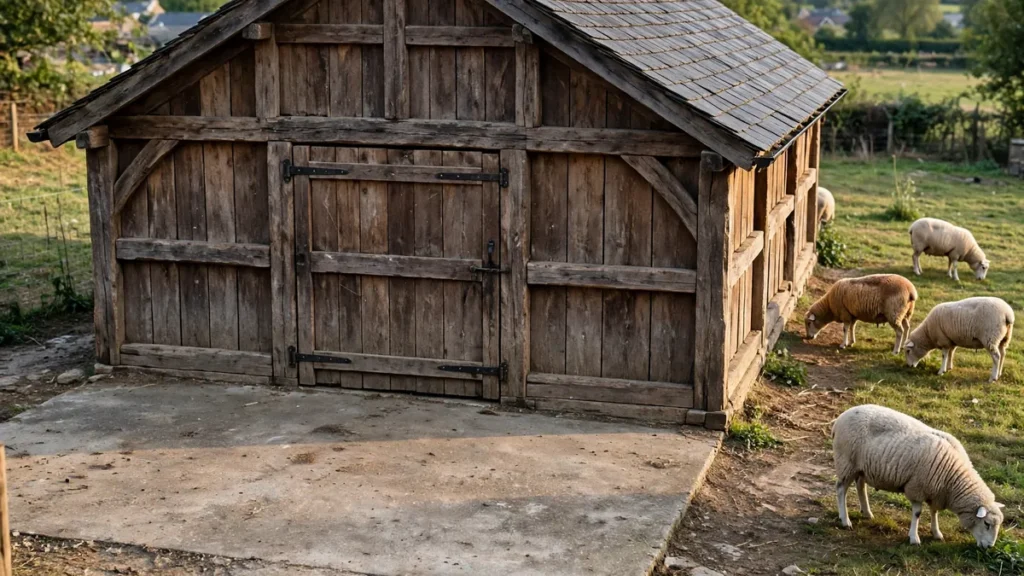
The best AI tools for sheep barn installation startups in 2026 decide whether a new building business becomes the first call every shepherd in the county makes when the flock outgrows its old shed, or just another contractor who once put up a field shelter and hoped the ewes would settle in it. A sheep barn is an enclosed sheep house: solid walls, a steep roof, a dry floor, pens, a feed passage, ventilation and bedding, all under one roof. It is the building where the flock lives, eats, lambs and shelters for much of the year, and every mistake in the design shows up fast. A pen that is too tight for a ewe with twins, a feed passage a tractor cannot turn in, a lambing bay with nowhere warm and dry for a newborn lamb, ventilation that leaves the air damp and the bedding wet, a gate a ewe pushes open on the first night. Owners notice all of it, and they talk to other owners at the feed merchant, at the market and in the shepherding groups online.
A sheep barn that keeps lambs alive through a cold snap earns you the next three jobs in the valley. A sheep barn that leaves ewes coughing in stale air costs you the next three. That is why the software matters as much as the timber and the steel. The tools below help a startup design the enclosed building properly, price it honestly, build it in the right order and hand over a barn the flock actually thrives in. This guide covers the whole job, not just the drawing board. You will find design and modelling tools for the barn itself, flock and lambing software that tells you how big the pens and lambing bays really need to be, penning and handling equipment that keeps the flock where it belongs, ventilation and feeding systems for the enclosed space, and hygiene kit that keeps the bedding dry.
Each tool earns its place by solving a specific sheep barn problem, and together they form a stack a one-person startup can run from a laptop and a phone. The nine tools were chosen for the enclosed barn build: solid walls, a steep roof, a dry floor, pens, a feed passage, ventilation and bedding. Nothing here is a field-shelter tool dressed up as a barn tool, and nothing is borrowed from the open-sided shelter playbook. If you build sheep barns, this is the kit that fits the building you actually sell.
Key Takeaways
- A sheep barn is an enclosed sheep house built around solid walls, a steep roof, a dry floor, pens, a feed passage, ventilation and bedding — design the inside first and the walls second.
- Size lambing bays and pen space from the flock’s real lambing calendar, not from a guess, or the barn will be full before the busiest week of the year.
- Ventilation and drainage decide whether lambs stay healthy; a dry, fresh-air barn beats a warm, damp one every time.
- Steel penning, a proper handling race and frost-proof waterers are what make an enclosed barn work day after day, so specify them early rather than as an afterthought.
- Quote the barn from a measured takeoff, not from a round number, and track every variation so the job stays profitable.

Best AI Tools for Sheep Barn Installation Startups Compared
| Tool | Best for | Sheep-barn job | Starting point |
|---|---|---|---|
| Autodesk Revit | Enclosed barn design | Modelling walls, roof, pens and ventilation | Subscription, trial available |
| Shearwell Data | Flock records | EID tags and lambing records | Hardware plus software |
| Datamars Livestock | Weighing and EID | Growth records and drafting decisions | Hardware plus software |
| Big Dutchman | Ventilation and feeding | Airflow and feed systems for the barn | Quote-based |
| IAE | Steel penning | Pens, gates and feed barriers | Quote per job |
| Te Pari | Handling races | Races and yards for calm handling | Quote per job |
| Miraco | Frost-proof waterers | Drinking water that never freezes | Per unit |
| JFC Agri | Lambing-pen equipment | Feeders, pens and lambing kit | Per unit |
| MS Schippers | Barn hygiene | Bedding, cleaning and handover kit | Per order |
What Makes a Sheep Barn Installation Startup Different
A sheep barn installation startup is not a general shed business with a different sign on the van. The building has to work for animals that lamb in it, and lambing is the hardest week of the shepherd’s year. Ewes need individual pens for the first day or two after lambing, then group pens as the lambs strengthen. The feed passage has to let a tractor or a barrow through without disturbing the pens. The bedding has to stay dry enough that lambs do not chill. None of that is true of a storage shed, and only some of it is true of other livestock buildings. The design tools have to model sheep behaviour, not just draw rectangles.
The line that matters most is the line between a barn and a shelter. A sheep barn is enclosed: four solid walls, a steep roof that sheds rain and snow, doors that close, a dry floor and a controlled inside climate. A field shelter is open-sided, and the animal walks in and out as it pleases. The two buildings are planned differently, priced differently and judged differently. The barn costs more, takes longer to build and carries a longer materials list, because the client judges the result on lamb survival inside a closed building, not on how the roof looks from the fence line. That is why the software stack below is built around the inside of the enclosed building first: walls, roof, pens, feed, air and bedding, in that order.
The closest cousin to this trade is the sheep shelter installation startup, where pen layout and lambing bays matter in a similar way — but the shelter build is open-sided, while the barn build is enclosed, so the ventilation, drainage and door details are not interchangeable. A pen that works in an open shelter may still fail in a closed barn, because the barn holds moisture, ammonia and heat that an open building lets escape. Sheep flock, follow and pile into corners when they are frightened, so the barn needs wider gates for a ewe with twins, lower-stress handling, and a lambing bay layout that lets the shepherd reach every ewe quickly at two in the morning. Compared with the cattle barn installation startup, the scale is smaller but the detail is finer: cattle barns are sized for half-tonne animals and slurry systems, while a sheep barn is sized for ewes, twins and lambs, with bedding budgets and pen divisions to match. And against the goat shelter installation startup, the difference is behaviour: goats climb, push and test every fence and gate, while sheep need calm, wide, draught-free pens and a handling race that moves the flock without panic.
Finally, the work does not end at handover. Owners come back for pen extensions, extra lambing bays, better ventilation, new waterers and repairs after a hard winter. A startup that keeps the flock’s records, the lambing plan and the barn’s drawings on file can sell the next job before the owner has finished describing it. The tools in this guide are chosen with that repeat work in mind, not just the first build.
Designing the Enclosed Barn: Layout, Structure and Client Sign-Off
The enclosed barn is won or lost at the design stage. The client is usually a shepherd who has lambed in a draughty old shed for years and knows exactly what went wrong with it, and they will test your drawings against that experience. The design tool has to show solid walls, a steep roof, a dry floor, pen divisions, a feed passage and ventilation in one model, so the client can see the finished barn before a single post goes in. A flat floor plan is not enough: the roof pitch, the ridge outlet and the door positions all change how the inside air behaves.
1. Autodesk Revit: The Best Tool for Enclosed Barn Design
Autodesk Revit is the strongest choice for modelling a fully enclosed sheep barn, because it treats the building as one connected model rather than a set of separate drawings. Walls, roof, doors, pens and ventilation openings all live in the same model, so changing the roof pitch updates the ridge height, and moving a pen wall updates the floor area the shepherd can actually use. That matters for a barn, where the roof, the walls and the inside air are one system: a steep roof that sheds snow also sets the height of the ridge outlet, and the ridge outlet sets how fast damp air leaves the lambing bays.
For a startup, the practical advantage is the conversation the model forces with the client. You can walk a shepherd through the feed passage on screen, show them the width a tractor needs to turn, and prove the lambing bays sit close enough to the door for a two-in-the-morning check. When the client asks for one more pen, the model shows immediately whether the feed passage still works or whether the whole layout needs to shift. That kind of answer, given on the spot, is what turns a first visit into a signed contract.
Revit also keeps the job honest on quantities. The model produces a measured schedule of wall panels, roof sheets, pen divisions and door sets, so the quote is built from real numbers rather than a round figure. When the client changes the barn’s length halfway through the job, the variation is priced from the same model instead of guessed. The learning curve is real, and the subscription is not the cheapest on this list, but for an enclosed barn the model pays for itself the first time it catches a pen layout that would have failed in the build.
Flock Records and Lambing Data
A sheep barn is sized from the flock, not from the field. The number of ewes, the lambing dates, the twinning rate and the growth of the lambs decide how many pens the barn needs, how wide the feed passage must be and how much bedding the store must hold. A startup that designs from the flock’s real records builds a barn that fits in the busiest week of the year, and a startup that designs from a guess builds a barn that is full before lambing peaks. The two tools below keep those records where the whole crew can find them, and they turn lambing data into pen numbers the design can use.
2. Shearwell Data: The Best Tool for Flock Records and Lambing
Shearwell Data is built around electronic identification for sheep, and it is the natural record-keeping choice for a barn startup that wants to hand over more than keys. EID tags, readers and the accompanying software log each ewe, her lambs, her lambing date and her treatment history in one place, so the shepherd can see at a glance which ewes are due, which pens they need and which lambs need extra attention. That record is what sizes the lambing bays: a flock with a tight lambing window needs more individual pens at once than a flock that lambs over two months.
For the installer, the advantage is practical. When you return to extend the barn or add lambing bays, the flock record tells you whether the flock has grown, whether twinning has risen and whether the pen count still fits. You can quote the extension from the flock’s own numbers instead of asking the owner to guess. The hardware is rugged enough for barn work, the readers work in the pen and in the race, and the data stays with the flock rather than in a notebook that gets lost in the feed store. A startup that supplies and sets up the EID system as part of the handover turns a one-off build into a relationship that brings the next job.
3. Datamars Livestock: The Best Tool for Weighing and Drafting Decisions
Datamars Livestock, known on many farms through its Tru-Test weighing systems, covers the other half of the flock record: weight, growth and drafting. A weigh crate and EID reader in the barn’s handling area lets the shepherd weigh lambs, draft them by weight and see which ewes are producing the best lambs, all without a separate trip to the yards. For a barn installer, that matters because the handling area is part of the building: the race, the weigh crate and the drafting gates have to fit the barn’s floor plan, and the design has to leave room for them.
The tool earns its place by making the barn pay after handover. A shepherd who can weigh and draft inside the barn uses the building every week, not just at lambing, and they notice when the race flows well and when it does not. A startup that plans the handling area around a real weighing system, with a dry floor under the crate and a gate layout that moves sheep calmly, delivers a barn the owner recommends to neighbours.
Air, Feed and Water Inside the Barn
An enclosed barn lives or dies on its inside climate. Four solid walls keep the weather out, but they also keep moisture, ammonia and heat in, so the ventilation, feeding and watering systems have to be designed for a closed building rather than copied from an open shelter. A barn with still, damp air grows coughs and chilled lambs. A barn with a draught at ewe level grows huddled, hungry sheep that eat more and gain less. The two tools below handle the two systems that decide the inside climate: the air and the feed, and the water that must never freeze.
4. Big Dutchman: The Best Tool for Ventilation and Feeding Systems
Big Dutchman is a livestock housing specialist, and its ventilation and feeding systems are the right scale for an enclosed sheep barn. The ventilation side models airflow through the whole building: inlets along the side walls, a ridge outlet at the top of the steep roof, and fans where natural airflow alone will not clear the lambing bays. That whole-building approach is what a closed barn needs, because guessing at fan sizes leaves either damp corners or draughts at animal level, and both cost lambs.
The feeding side is just as important. Feed passages, feed barriers and automated feeding lines have to match the pen layout, so the tractor or barrow reaches every pen without disturbing the ewes. Big Dutchman’s systems are designed to fit the building rather than the other way round, which means the installer can plan the feed passage width, the barrier height and the store position from one supplier’s layout instead of stitching three catalogues together. The systems are priced per job, so get a written quote before promising the client a number.
5. Miraco: The Best Tool for Frost-Proof Waterers
Miraco makes insulated, energy-efficient livestock waterers, and a frost-proof waterer is one of the most underrated parts of a sheep barn. Ewes drink more than most new owners expect, especially in late pregnancy and early lactation, and a frozen trough in January means a shepherd carrying buckets through snow at dawn. Inside an enclosed barn the waterer sits in the pen line, where it must be reachable, cleanable and impossible for a ewe to foul, and it must keep working when the temperature outside drops well below freezing.
Miraco’s waterers use insulated bodies and optional heating elements, so the water stays liquid without a constant power draw, and the lids and valves are built for animals that push and nudge everything in the pen. For the installer, the advantage is that the waterer is a known quantity: a fixed size, a fixed plumbing connection and a fixed place in the pen layout, so it can be drawn into the plan early rather than squeezed in at the end. A startup that specifies frost-proof waterers in the first quote, rather than offering them as an upgrade after the first frozen week, looks like a builder who has actually lambed in a barn.

Pens, Handling and Lambing Equipment
The steel inside the barn is what the shepherd touches every day. Pens, gates, races and feeders take more wear in a sheep barn than almost any other part of the building, because sheep push, crowd and pile into corners, and the shepherd moves them twice a day. Cheap penning bends, rattles and eventually fails, and a failed gate at lambing time is a welfare problem, not an inconvenience. The three suppliers below cover the three steel jobs in the barn: the pens themselves, the handling race and the lambing-pen equipment.
6. IAE: The Best Tool for Steel Penning and Gates
IAE is a long-established maker of agricultural steel penning, and its sheep hurdles, gates and feed barriers are the standard many shepherds measure everything else against. The penning is galvanised steel, built to take the daily push of a flock, and the hurdles pin together quickly, so a group pen can be split into lambing pens in an afternoon and put back together when lambing ends. That flexibility is exactly what a sheep barn needs: the pen layout changes through the year, and the steel has to change with it.
For a startup, IAE penning is easy to specify and easy to install. The hurdles come in standard lengths, the gates hang on standard fittings, and the feed barriers bolt to the pen line at a height that suits ewes rather than cattle. You can draw the pen layout from the catalogue, price it from the catalogue, and install it without a fabricator on site. The result is a barn where the shepherd can reconfigure the pens without calling the builder back. That is a handover that earns recommendations.
7. Te Pari: The Best Tool for Handling Races and Yards
Te Pari builds sheep handling equipment in New Zealand, where the flocks are large and the handling has to be fast, calm and safe. Its races, yards and drafting modules are designed around the way sheep actually move: they follow, they bunch, and they panic when they are rushed or cornered. A well-designed race uses that behaviour, curving the flock gently towards the drafting gates instead of forcing it down a straight, noisy corridor. Inside a sheep barn, the race is usually the last part of the building the client sees and the first part they judge, because they use it every time they weigh, treat or draft the flock.
For the installer, Te Pari’s modular yards are a practical fit. The panels and races arrive as a kit, the layout can be drawn into the barn’s floor plan, and the same modules can be extended when the flock grows. A startup that plans the race into the barn from the start, with a dry floor, good light and a clear run from the pens, delivers a building that works on a wet Tuesday in November, not just on handover day.
8. JFC Agri: The Best Tool for Lambing-Pen Equipment
JFC Agri supplies the smaller equipment that makes lambing pens work: feeders, hay racks, lambing pens, creep feeders and the plastic and steel kit that fills the gaps between the big pen divisions. These are the items the shepherd reaches for at two in the morning, and they have to be within arm’s reach, easy to clean and impossible for a ewe to knock over. A lambing pen with a feeder at the wrong height wastes feed every day, and a hay rack that drops hay onto wet bedding wastes bedding too.
For a startup, JFC Agri’s catalogue is useful because it is complete. One supplier covers the feeders, the racks, the pen accessories and the lamb adoption kit, so the installer can fit out every pen from one order instead of chasing five suppliers for the finishing touches. The equipment is sized for sheep rather than adapted from cattle kit, which means the feeder heights, the rack gaps and the pen dimensions match the animals that will use them.
Hygiene, Bedding and the Handover Kit
The last job in a sheep barn is the one the shepherd does every day: mucking out, bedding down and keeping the pens clean. Bedding is the barn’s biggest running cost after feed, and the design decides how much of it the barn uses. A barn with a dry floor, a falls-to-drain slope and a bedding store beside the pens uses less straw and keeps it drier than a barn where the bedding has to be carried across a wet yard. The hygiene kit below closes the loop between the build and the daily routine, and it is what the startup hands over with the keys.
9. MS Schippers: The Best Tool for Barn Hygiene and Bedding
MS Schippers is a livestock equipment and hygiene supplier, and its range covers the daily work of a sheep barn: bedding products, cleaning equipment, disinfectants, foot care and the consumables that keep pens dry and healthy. The bedding side matters most at design stage, because the store has to hold enough straw or woodchip for the lambing peak, and the pens have to be easy to fork out and re-bed without disturbing the ewes. A barn designed with the bedding routine in mind saves the shepherd hours every week.
For a startup, MS Schippers earns its place at handover. A handover kit — bedding, disinfectant, foot-trimming tools and a written cleaning routine for the pens — turns the keys into a working system the owner can follow from the first night. It also keeps the relationship alive: consumables run out, bedding needs topping up, and the supplier who fitted the barn is the first call when the owner wants more pens or a better store.
Your Sheep Barn Startup Checklist
- Survey the site for drainage, wind direction and access, and confirm the barn’s doors and feed passage work for a tractor in all weather.
- Model the enclosed barn in 3D with solid walls, a steep roof, a dry floor, pens and ventilation before quoting, and get the client to approve the model.
- Size the lambing bays and group pens from the flock’s real lambing calendar and twinning rate, not from a guess.
- Specify steel penning, a handling race, frost-proof waterers and lambing-pen feeders in the first quote, not as later upgrades.
- Price the barn from a measured takeoff of walls, roof, pens, doors and equipment, and track every variation in writing.
- Hand over flock records, pen plans, ventilation settings, a bedding routine and a hygiene kit, so the owner can run the barn from day one.
Frequently Asked Questions
What is a sheep barn installation startup?
A sheep barn installation startup is a small business that designs, builds and fits out enclosed sheep barns: solid walls, a steep roof, a dry floor, pens, a feed passage, ventilation and bedding, all under one roof. The work covers the survey, the design, the build, the penning and handling equipment, and the handover, and the client judges the result on lamb survival and daily ease of use inside the barn.
How is a sheep barn different from a sheep shelter?
A sheep barn is enclosed, with four solid walls, doors that close and a controlled inside climate. A sheep shelter is open-sided, and the animal walks in and out as it pleases. The barn costs more, takes longer to build and needs proper ventilation and drainage design, because the closed building holds moisture and heat that an open shelter lets escape. The two buildings are planned, priced and judged differently.
How much does it cost to start a sheep barn installation business?
The startup costs depend on the size of the first jobs, but a one-person business can start with design software, a measuring kit, a reliable vehicle and supplier accounts for penning and equipment. Most of the early spending goes on the first barn’s materials, so price the first jobs from a measured takeoff and keep the software stack lean until the order book justifies more.
How many pens does a sheep barn need?
The pen count comes from the flock’s lambing calendar. Allow one individual lambing pen per ewe expected to lamb on the busiest days, plus group pens for ewes with older lambs, and keep the feed passage clear of pen divisions. A flock with a tight lambing window needs more individual pens at once than a flock that lambs over two months, so design from the flock’s real records.
What ventilation does an enclosed sheep barn need?
An enclosed sheep barn needs inlets along the side walls and a ridge outlet at the top of the steep roof, so fresh air enters low and damp air leaves high without blowing across the ewes at animal level. Fans help where natural airflow alone will not clear the lambing bays. The goal is dry, fresh air: a dry, fresh-air barn beats a warm, damp one every time.
Do I need planning permission for a sheep barn?
Rules vary by location, so check with the local planning authority before promising a client a start date. Agricultural buildings often have different rules from houses, but size, position, access and drainage can all affect whether permission or prior approval is needed. Confirm the position in writing and build it into the project schedule.
The Bottom Line
A sheep barn is an enclosed working building, and the startup that builds it well wins on the inside of the barn, not on the outside. Solid walls, a steep roof and a dry floor set the building apart from any open shelter, and pens, a feed passage, ventilation and bedding decide whether the flock thrives in it. The nine tools in this guide cover the whole enclosed build: Revit models the barn, Shearwell Data and Datamars Livestock keep the flock records, Big Dutchman and Miraco handle air, feed and water, IAE, Te Pari and JFC Agri supply the steel and the lambing kit, and MS Schippers closes the loop with hygiene and bedding. Start with the design and the flock records, specify the steel and the waterers early, and hand over a barn the shepherd can run from day one.

Keep what speaks to you.
Leave room for your own perspective.


