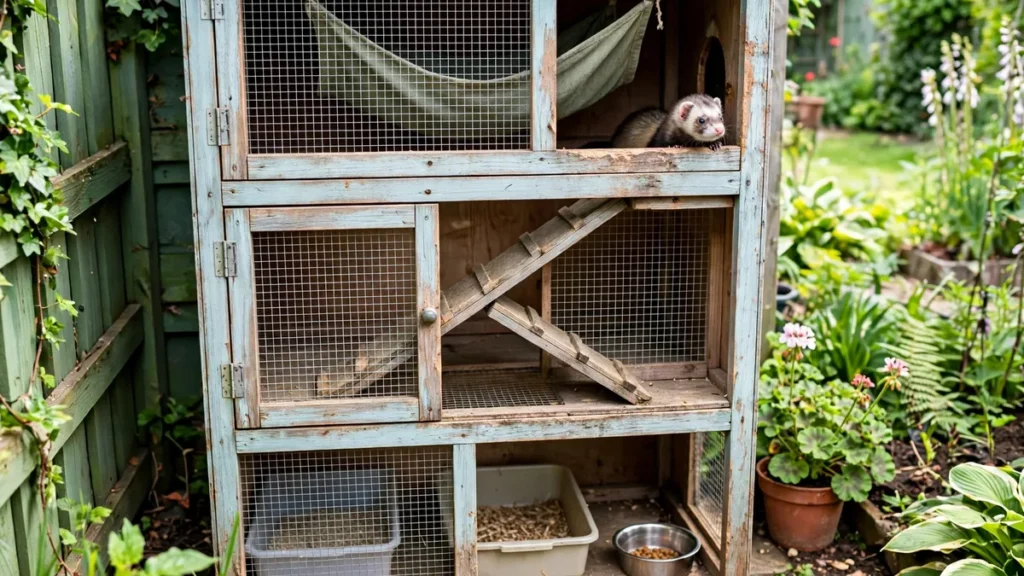
A ferret hutch installation startup builds a house for an animal that climbs, squeezes, digs, chews and sleeps for most of the day. That combination is the whole trade, and it is worth stating plainly at the start, because the word hutch gets used for several different builds. A ferret hutch is a tall, multi-level ferret house: a stack of connected levels joined by ramps, with hammocks slung from the top, tunnels to run through, a litter corner that stays clean, and mesh fine enough that a ferret cannot push its head through. The ferret sleeps up high in the hammock, eats and drinks in the middle, and uses the litter tray at the bottom, and the hutch has to let it do all three without a fall, a draught or an escape.
Most ferret hutch jobs go wrong in the same few places, and almost all of them are decided before a single board is cut. A ramp set too steep turns into a slide, and a ferret that slides will stop using the upper levels altogether. Mesh with gaps wider than an inch lets a young ferret through, and a ferret that gets out once will try the same gap every day. A hammock hung across a draught leaves the ferret cold, and a litter tray placed on the sleeping level turns the warmest spot in the hutch into the smelliest one. The tools in this guide turn a garden corner, a set of measurements and a count of ferrets into a hutch layout that fits, ramps a ferret will actually climb, and a price that covers the whole job.
The nine tools below cover the ferret hutch build from the first site visit to the final invoice. Three handle planning: laying out the levels, setting the ramps, and placing the hammocks where ferrets sleep best. Three handle the build itself: routing the tunnels, making the hutch escape-proof, and getting the air moving so the hutch stays fresh. The last three handle hygiene, pricing and the books, which decide whether the startup survives its first year. None of them is a rabbit tool, and none of them is a cage-cleaning product. A rabbit hutch installation is a different build from this one: a rabbit lives mostly on one level with a run, while a ferret lives up and down a stack of levels, and the tools that plan a rabbit hutch will not tell you whether a ferret will climb a ramp or sleep in a hammock. What follows is a builder’s toolkit, chosen for the ferret hutch itself.
Key takeaways
- A ferret hutch is a multi-level house: stacked levels, ramps, hammocks, tunnels, a litter corner and fine mesh, built as one working unit.
- Design for the ferret’s habits first: it climbs, squeezes through small gaps, sleeps high up, and needs a clean litter corner away from where it sleeps.
- Ramps, bar spacing and hammock placement decide whether the hutch works; a steep ramp or a wide gap is a failed build, however tidy the woodwork looks.
- Ventilation and a daily cleaning routine decide whether the hutch stays fresh; a stuffy hutch smells within days, whatever it cost to build.
- Price the levels, the ramps, the hammocks, the mesh and the litter setup as well as the timber, or the quote will run short halfway through the job.

The nine tools at a glance
| Tool | Best for | What it does for a ferret hutch build |
|---|---|---|
| FerretLevel AI | Multi-level hutch layouts | Stacks the levels, sizes each one to the ferrets, and places doors and feeding points |
| FerretRamp AI | Ramp angles and grip | Sets ramp angles a ferret will climb, adds grip strips, and checks every landing |
| HammockFit AI | Hammock placement and sleep spots | Places hammocks high and out of draughts, and sizes them for the ferrets that sleep in them |
| TunnelRoute AI | Tunnels and enrichment routes | Routes tubes and tunnels between levels so ferrets can run, hide and play safely |
| EscapeProof AI | Escape-proofing and latches | Checks mesh spacing, door gaps and latches so no ferret can squeeze or nose its way out |
| FerretVent AI | Ventilation and fresh air | Plans airflow through the hutch so it stays fresh without draughts on the sleeping levels |
| LitterHutch AI | Litter trays and hygiene | Places litter trays away from sleep and food, and sets a cleaning routine that keeps smells down |
| FerretQuote AI | Estimating and quoting | Prices the whole build, levels and hammocks included, and turns it into a clear written quote |
| FerretLedger AI | Jobs and bookkeeping | Tracks each hutch job, its costs and its payments, and keeps the startup’s books in order |
Planning the hutch: levels, ramps and sleep
Every good ferret hutch starts on paper, or on a screen, long before anyone picks up a saw. The planning stage is where the expensive mistakes are cheapest to fix: a level a few inches too short, a ramp that lands in front of a door, a hammock hung where the wind blows straight through the mesh, a litter tray with nowhere sensible to go. Each of these is a small drawing decision that becomes a big rebuilding job once the timber is cut and the mesh is stapled on. The three tools in this section lay out the levels, set the ramps and place the hammocks, so the crew works from a settled plan that a ferret will actually use.
FerretLevel AI: the best tool for multi-level hutch layouts
FerretLevel AI is the drawing board for the hutch stack. You start with the ferrets the hutch has to hold, because the ferret decides the size of everything else. A hutch for a pair of small jills needs different levels from a hutch for a business of four big hobs. FerretLevel AI takes the number and size of the ferrets, and works out level dimensions that give them room to stretch, turn and play without wasting height, how many levels the stack needs, and where each level sits so the ferret can move between them without a long drop. It lays those levels out in a stack, with a service door on each level so cleaning and feeding happen without taking the hutch apart.
What makes it a ferret tool, rather than a generic hutch planner, is that it thinks in height. Ferrets sleep high and use the litter tray low, so the tool puts the hammocks and sleep boxes at the top, the food and water in the middle, and the litter at the bottom, with the ramps connecting them in a route the ferret will follow. The plan shows where the water reaches, where the food bowls sit, and where the litter trays go, so the daily routine is drawn in rather than added as an afterthought. It also flags which way the sleeping level should face, so driving rain does not blow straight into the hammocks, and where the sun falls in the morning, so the hutch dries after a wet night. A customer who can see that level of thought on a drawing is a customer who trusts the build.
FerretRamp AI: the best tool for ramp angles and grip
FerretRamp AI answers the question that decides whether the upper levels get used at all, which is whether the ferret will climb the ramp. A ferret is a good climber, but it is not a mountain goat: a ramp set too steep becomes a slide, and a ramp with a smooth surface becomes a skating rink for little paws. The tool takes the height between two levels and the space the hutch allows, and works out the gentlest angle that fits, then adds grip strips or cleats spaced for ferret paws, and checks the landing at each end so the ferret steps off onto a flat level rather than onto a gap. A ramp that a ferret will not climb is not a ramp, it is a decoration, and a hutch full of decorations is a hutch the ferret only uses half of.
The tool is careful about the details that ferrets test every day. It sets the ramp width so two ferrets can pass without one being pushed off the edge, and it adds low side rails on the steeper runs, because a ferret that slips wants something to catch itself on. It places the ramps so they do not block the doors, the food bowls or the litter trays, and it checks that the ramp does not land directly above a litter tray, because nobody wants to be dripped on from above. It also works out the fixings: the hinges and brackets that hold the ramp to the level, because a ramp that wobbles is a ramp a ferret will avoid, and a ramp that comes loose is a fall waiting to happen.
HammockFit AI: the best tool for hammock placement and sleep spots
HammockFit AI places the hammocks, and the hammock is where the ferret spends most of its life. Ferrets sleep for around eighteen hours a day, and they sleep curled together in a warm, high, sheltered spot. A hammock hung low, in a draught, or where the rain blows in will sit empty, and an empty hammock is the clearest sign a hutch has been planned for the customer rather than for the ferret. HammockFit AI takes the hutch layout and the number of ferrets, and works out how many hammocks the hutch needs, how big each one should be so two or three ferrets can curl in together, and where each one hangs: high up, out of the draught, and away from the litter corner.
The tool also thinks about the fabric and the fixings. A hammock needs to be washable, because it will be slept in, dragged about and occasionally used as a toilet by a young ferret, so the tool specifies fabrics that survive a hot wash and clips that come off without tools. It checks that the hammock hangs with a gentle sag rather than stretched flat, because a ferret wants a pocket to curl into, not a trampoline. And it leaves room for a second sleep spot, such as a sleep sack or a wooden sleep box, because ferrets like a choice, and a hutch with one sleep spot and four ferrets is a hutch with an argument every evening.

Building it ferret-proof: tunnels, escapes and air
Once the plan is settled, the build comes down to three things: the tunnels, the escapes and the air. The tunnels are what the ferret enjoys most, but they are only one third of the job. A hutch that is secure but stuffy will smell within a week and leave its ferrets miserable. The tunnels have to be safe to run through, the mesh and latches have to hold against an animal that spends its spare time testing them, and the air has to move without blowing across the hammocks. The three tools in this section each own one of those three things, and together they decide whether the hutch works in February, when the ferrets spend the longest hours inside.
TunnelRoute AI: the best tool for tunnels and enrichment routes
TunnelRoute AI routes the tubes and tunnels that turn a stack of levels into a ferret playground. Ferrets are tunnel animals by nature: they run through tubes, pop out of one end and dive straight into another, and a hutch without tunnels is a hutch without fun. The tool takes the level layout and works out where tunnels can run: between levels, along the back of the hutch, and out into a safe play area where the customer wants one. It sizes each tube so a big hob can pass without getting stuck, and it checks every bend and join, because a tunnel with a sharp bend is a tunnel a ferret will refuse, and a tunnel with a loose join is a tunnel that comes apart mid-game.
The tool also plans the tunnels as part of the cleaning routine, not as an afterthought. Tubes need to come off for washing, so it specifies quick-release joins and smooth interiors that rinse clean, and it keeps the tunnel route away from the litter corner so play and toileting stay separate. It adds a second route where the hutch allows it, because ferrets love a choice of ways through, and a single tunnel with a ferret asleep in the middle is a traffic jam. And it checks the tunnel exits: every tunnel needs a clear landing on a level, not a drop onto a food bowl, because a ferret that lands in its dinner will not use that tunnel twice.
EscapeProof AI: the best tool for escape-proofing and latches
EscapeProof AI checks the hutch against the ferret’s greatest talent, which is getting out. A ferret can squeeze through a gap that looks far too small, dig under a floor that looks solid, and nose open a latch that would hold a much bigger animal. The tool takes the hutch drawings and checks every gap: the mesh spacing, which must be tight enough that a young ferret cannot push its head through; the gaps around the doors, which must be smaller than a ferret’s skull; the floor, which must be solid or lined so a digging ferret cannot tunnel out; and the roof, which must be fixed down rather than resting loose. A hutch that a ferret can escape from is not a hutch, it is a temporary suggestion, and a customer whose ferret escapes on the first night will not be a customer for long.
The latches get the same treatment. EscapeProof AI specifies latches a ferret cannot work with its nose and paws, placed where the keeper can reach them easily but the ferret cannot, and it checks that every door has two points of fastening where the door is wide, because a door held by one latch will bow in the middle and leave a gap. It also thinks about the daily routine: a latch that is hard for the keeper to open will be left unfastened, and an unfastened latch is an open door. The tool’s rule is simple, and it is the rule the whole build is judged by: if a gap is big enough for a ferret’s head, it is big enough for the ferret. There is a clear line here that matters for this guide. A larger animal’s housing forgives gaps a ferret will exploit, and a dog kennel installation builds for a much bigger animal with different mesh, different latches and different doors. EscapeProof AI designs for the ferret’s size, not the dog’s, and a startup that understands that difference will not sell a customer a dog’s latch on a ferret’s door.
FerretVent AI: the best tool for ventilation and fresh air
FerretVent AI plans the airflow, and it is the tool that decides whether the hutch smells fresh or stale. Ferrets have a strong natural smell, and a hutch with no air movement holds that smell, along with damp from bedding, litter and breath, until the whole stack feels close and heavy. The tool takes the hutch size, the number of ferrets and the local weather, and works out where the air should come in and where it should go out: low vents that bring fresh air in, high vents that let warm, damp air out, and a route between them that passes through the litter level rather than across the hammocks. A hutch that is ventilated properly smells like fresh air, not like ferrets, and a customer who opens the hutch door without flinching is a customer who keeps the hutch clean.
The tool also guards against the opposite problem, which is too much air in the wrong place. A draught across the hammocks leaves ferrets cold and snuffly, so FerretVent AI checks the sleeping level separately, and it keeps the vents small, screened and baffled so rain cannot blow in and a ferret cannot chew through them. It checks the summer problem too: a hutch that holds its warmth in January can overheat in July, so the tool checks shade, roof ventilation and the position of the hutch against the sun. Indoor animal housing faces the same air problem, and a cattery installation has to solve ventilation and litter smells inside a building, where the air has nowhere to go. A ferret hutch has the advantage of sitting outdoors, but the principle is the same: move the air through the dirty end, keep it off the sleeping end, and never let the hutch sit still and damp.
Hygiene, quoting and the books
A hutch that is built well but priced badly will not keep its builder in business, and a hutch that is cleaned badly will not keep its ferrets healthy. The last three tools cover hygiene, pricing and the books. Hygiene is a building decision, because the litter trays, the washable surfaces and the cleaning access have to be built into the hutch, not added afterwards. Pricing is a building decision too, because a quote that forgets the hammocks and the mesh loses money. And the books are what turn a run of good builds into a startup that can afford the next van and the next quiet month.
LitterHutch AI: the best tool for litter trays and hygiene
LitterHutch AI plans where the ferrets go to the toilet, and where the keeper cleans up afterwards. Ferrets are tidy animals in their own way: given a choice, they use the same corner every time, and they prefer a corner that is low, quiet and away from where they sleep and eat. The tool takes the level layout and places the litter trays in those corners, sized for the ferrets that use them, with a low entry so a young ferret can climb in and high sides so litter stays inside. It keeps the trays on the bottom level, far from the hammocks, because a litter tray on the sleeping level turns the warmest spot in the hutch into the one the ferrets avoid.
The hygiene plan matters for the keeper’s routine as well as for the ferrets’ health. LitterHutch AI specifies surfaces that wipe clean, a floor that lifts out or hoses down, and doors wide enough to reach every corner with a brush, because a hutch that cannot be cleaned properly will not be cleaned properly. It sets a cleaning routine to go with the build: litter changed daily, bedding washed weekly, and a deep clean monthly, with a checklist the customer can follow.
FerretQuote AI: the best tool for estimating and quoting
FerretQuote AI prices the job, and it prices all of it. The tool takes the layout, the ramp sizes, the hammock count, the mesh, the tunnels and the litter plan, and turns them into a line-by-line estimate: timber and mesh, ramps and fixings, hammocks and sleep boxes, tunnels and tubes, litter trays and bedding, labour and travel. It prices the parts customers forget to ask about, which are usually the parts that cost the most: the fine mesh, which costs more than standard mesh and takes longer to fit; the hammocks, which are small in number and large in price when they are made properly; and the ramps, which are small in timber and large in labour. A quote that lists those parts separately is a quote the customer can understand, and a quote the customer understands is a quote they are more likely to accept.
The tool also keeps the pricing honest in the other direction. It is easy to overprice a ferret hutch by guessing, and a startup that overprices will lose jobs to installers who price properly. FerretQuote AI prices from the measurements, so two hutches of the same size cost the same to quote. It also tracks what the job actually cost against what was quoted, so the startup learns where its estimates go wrong: whether the mesh always runs over, or whether the travel to rural plots is eating the margin.
FerretLedger AI: the best tool for jobs and bookkeeping
FerretLedger AI keeps the books, and it keeps them job by job. A ferret hutch startup’s money comes in lumps: a deposit, a payment on delivery of materials, a final payment when the hutch is finished. Its money goes out in lumps too: timber, mesh, hammocks, fuel, and the occasional broken tool. FerretLedger AI tracks each job from the first deposit to the final payment, so the installer always knows which jobs have been paid, which are waiting on a payment, and which are owed money. It matches the costs to the job they belong to, so the profit on each hutch is visible, not just the money in the bank.
The tool also keeps the records that a ferret hutch business needs beyond the money. Every job gets a file: the site notes, the layout, the quote, the materials used, the photos of the finished hutch, and the customer’s details. That file is worth real money, because the next customer will ask what the last hutch looked like and what it cost, and an installer who can answer from a file will win work that an installer who has to guess will lose. It is also the record that settles arguments: when a customer says a ramp was supposed to be on the other side, the file shows what was agreed.
A ferret hutch installation checklist
- Walk the garden and check the spot before drawing anything, and mark where the rain runs and where the sun falls.
- Size every level to the ferrets that will live in it, and check that the hammocks sit high, warm and out of draughts.
- Set every ramp to an angle a ferret will climb, with grip strips and a flat landing at each end.
- Check every gap, mesh panel and latch against a ferret’s head, and fit latches a ferret cannot nose open.
- Place the litter trays low and away from sleep and food, and make sure every corner can be reached for cleaning.
- Photograph the finished hutch, file the layout and the quote together, and keep them for the next customer who asks.
Frequently asked questions
What does a ferret hutch installation startup actually build?
It builds the ferret hutch itself: a tall, multi-level house with stacked levels, ramps, hammocks, tunnels and a litter corner, plus the fine mesh, latches and ventilation that make the hutch work. The ferrets sleep high in the hammocks, eat and drink in the middle, and use the litter tray at the bottom, and the hutch is built so they can do all three safely. The startup builds the house; looking after the ferrets inside it is a different trade.
How is a ferret hutch different from a rabbit hutch?
A rabbit hutch is mostly a single-level house with an attached run, built for an animal that lives on the ground. A ferret hutch is a tall stack of levels, because ferrets climb, sleep high up in hammocks, run through tunnels, and squeeze through gaps a rabbit could never fit through. The ferret hutch needs finer mesh, steeper attention to latches, and ramps between every level. The two trades share woodwork skills, but they build different houses for different animals.
How steep can a ferret hutch ramp be?
Gentle enough that a ferret walks up it without sliding back down. As a rule, the ramp should rise no more than it runs, and a shallower ramp is better wherever the hutch has room for it. The ramp also needs grip strips or cleats for little paws, low side rails on the steeper runs, and a flat landing at each end. A ramp that is too steep or too smooth will sit unused, and the ferret will simply stop visiting the levels above it.
What mesh spacing does a ferret hutch need?
Mesh with gaps no wider than an inch, and tighter is safer for young ferrets. A ferret can squeeze through a gap that looks far too small, so the rule is that if a ferret’s head fits through, the whole ferret fits through. The mesh should be welded wire rather than soft netting, fixed firmly to the frame, with no loose edges a ferret can chew. Every gap around a door needs the same check, because a door gap is just a hole with a hinge.
Where should the litter tray go in a ferret hutch?
On the bottom level, in a quiet corner away from the hammocks and the food bowls. Ferrets naturally pick a low corner for toileting, and they will keep using it if it stays clean and stays in the same place. The tray needs a low entry, high sides, and a spot the keeper can reach easily for a daily change. A tray on the sleeping level, or next to the food, will be ignored, and the ferret will choose its own corner instead.
What should a ferret hutch installation quote include?
The whole build, line by line: timber and fine mesh, levels and ramps, hammocks and sleep boxes, tunnels and tubes, litter trays and bedding, latches and fixings, labour and travel. A quote that lists only the timber is not a quote for a ferret hutch, it is a quote for a box. A clear, itemised quote lets the customer compare like with like, and it protects the installer when the customer asks for changes, because each change can be priced from the same list.
Bottom line
A ferret hutch is a house for a climber, a squeezer and a sleeper, and a ferret hutch installation startup is a builder of tall, multi-level houses for ferrets. The job is the levels, the ramps, the hammocks, the tunnels, the escape-proofing, the air and the litter, built as one working unit that stays warm at the top, fresh throughout and cleanable every day. The nine tools in this guide cover that job from the layout to the books. Start with the ferret, draw the hutch before cutting anything, price every line, and keep a record of every build. A hutch built that way will keep its ferrets safe, its keeper happy and its builder in work.

Keep what speaks to you.
Leave room for your own perspective.