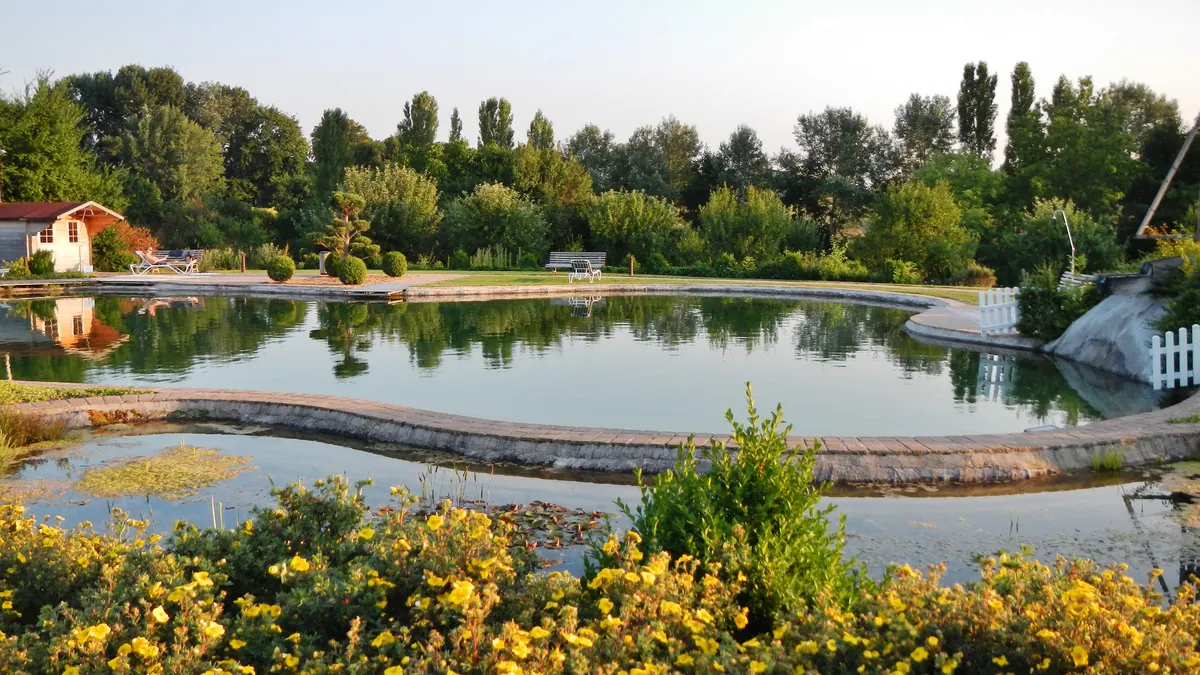
The best AI tools for natural pool installation startups in 2026 turn a garden into a living swimming pool, one that is filtered by plants and biology instead of chemicals. A natural pool is a chemical-free swimming pool with two zones that work together: a clear swimming zone where people actually swim, and a shallow regeneration zone planted with reeds, irises and water lilies, where gravel beds and plant roots clean the water as it circulates slowly between the two. There is no dosing unit, no chemical store and no smell of treated water. The plants do the filtering, the gravel does the trapping, and the slow movement of water does the rest.
That two-zone build is what makes a natural pool a different job from every other pool a startup could build. A lap pool is a long exercise lane, a diving pool is a deep hole with a board, an indoor pool is a heated hall, a swim spa is a small current machine and a spool is a heated plunge tub. None of them has a living filter that has to be planted, fed and kept in balance. In a natural pool, the planting is not decoration around the edge. It is the filtration system, and if the regeneration zone is too small, planted with the wrong species or starved of flow, the swimming water turns green within a fortnight and the client’s first summer is ruined.
The nine tools in this guide cover the whole build in the order a startup actually uses them. Three design the two zones and the planting, three handle the water balance, testing and monitoring that keep the living filter working, and three keep the plants, the circulation and the business itself alive. None of them adds a single chemical to the water. Every one of them makes the pool cheaper to build, easier to explain to a client, or simpler to hand over on a day when the water is clear and the plants are doing their job.
Key takeaways
- A natural pool is a chemical-free swimming pool filtered by plants and biology, with a swimming zone and a planted regeneration zone that must be designed as one system.
- The regeneration zone is the filter, not the decoration: its size, planting and flow rate decide whether the swimming water stays clear.
- Water balance comes first and stays first — nutrients, oxygen and circulation matter more in a natural pool than in any other pool build.
- Plant choice is local work: the species that filter well in one climate and one soil will struggle in another, so identification and sun mapping pay for themselves.
- Nine tools cover the build in three groups — zone design, water, and plants with circulation — and every one of them works without chemicals.
How a natural pool installation startup actually works
The build starts with the two zones. The swimming zone is the formal part: a lined or concrete basin, deep enough to swim in, with steps, an edge and a floor that can be cleaned. The regeneration zone sits beside it, shallower, filled with graded gravel and planted with marginal and aquatic species, and separated from the swimming water by a low wall that lets water flow over it. A pump moves water slowly from the swimming zone through the gravel beds and back again, and the whole pool turns over at a gentle rate that gives the plants time to take up nutrients. Get the ratio wrong and the filter is undersized for the water it has to clean.
A natural pool is also not the same thing as a pond that happens to be swimmable. A natural swimming pond is earth-formed and pond-like, shaped by its banks and its planting, while a natural pool is a built pool with a defined swimming basin, a formal edge and an engineered regeneration zone that is sized and planted to a specification. The two share the same biology, but the pool is the more formal, more measured build, and its clients expect pool-level clarity from a system that contains no chemicals at all. That expectation is the whole business: you are selling clear water that is kept clear by plants.
The nine tools at a glance
| Tool | Best for | Where it fits |
|---|---|---|
| Vip3D | Modelling the swimming zone and the regeneration zone in 3D | Design |
| Realtime Landscaping Architect | Planting plans for the regeneration zone | Design |
| SunCalc | Mapping sun and shade across the planting | Design |
| SWMM | Water balance, rainfall, overflow and top-up | Water |
| YSI EXO2 | Continuous monitoring of oxygen, pH and clarity | Water |
| LaMotte WaterLink Spin Touch | Fast nutrient and phosphate testing on site | Water |
| iNaturalist | Identifying native aquatic and marginal plants | Plants and circulation |
| OASE AquaMax Eco Premium | Low-energy circulation through the gravel beds | Plants and circulation |
| Aquascape BioFalls Filter | Biological filtration at the head of the regeneration zone | Plants and circulation |
Design the two zones: swimming water and planted filtration
Design is where a natural pool is won or lost, because the two zones have to be sized against each other before anything is dug. The swimming zone sets the volume of water to be cleaned, and the regeneration zone sets the area of planted gravel available to clean it. A common working rule is that the planted zone should be at least as large as the swimming zone, and on a pool with heavy use or full sun it should be larger still. That ratio is not a guess to be made on site with a spade. It is a number that comes out of the design, and the client should see it before the digger arrives.
1. Vip3D: the best tool for modelling the swimming zone and the regeneration zone in 3D
Vip3D is a 3D pool design tool that lets a startup draw the swimming basin and the planted zone as one model instead of two separate drawings that never quite meet. The swimming zone gets its depth, steps and edge, the regeneration zone gets its shallow profile and its planting shelves, and the low wall between them is drawn at the height that sets the water level on both sides. The client sees the pool from the terrace, from the water and from above, and can understand where the swimming stops and the planting starts before any ground is broken.
For a natural pool, the most useful part of the model is the way it shows the water moving. The pump intake, the flow over the dividing wall and the return through the gravel beds can all be placed in the drawing, so the circulation path is visible instead of imagined. That matters because the most common natural pool failure is dead water: a corner of the swimming zone, or a stretch of the regeneration zone, where the water barely moves and algae takes hold. A model that shows the flow path lets the startup move an intake or reshape a shelf before the liner goes in, when a change costs an afternoon of drawing rather than a week of rebuilding.
2. Realtime Landscaping Architect: the best tool for planting plans for the regeneration zone
Realtime Landscaping Architect is a landscape design tool that a natural pool startup uses to plan the regeneration zone as a planting system rather than a list of pretty plants. The zone is drawn to scale with its gravel beds, its planting shelves at different depths, and its marginal strips, and each species is placed where its roots will sit in the right depth of water. Reeds go where the water is shallow and the flow is steady, water lilies go where the water is deeper and calmer, and oxygenating plants go where the circulation passes over them. The plan shows the planting as a filter with zones, not as a border that happens to be wet.
The tool earns its place because the planting has to do two jobs at once: clean the water and look like a garden. A regeneration zone planted only for filtration can look like a reed bed that swallowed the garden, and a zone planted only for looks can leave the water cloudy by August. The design lets the startup balance the two, putting the heavy-feeding reeds where the nutrient load is highest and the flowering marginals where the client actually looks from the terrace. It also lets the startup show the planting in summer, when the reeds are tall and the lilies are out, instead of in the thin, bare state the client sees on handover day.
3. SunCalc: the best tool for mapping sun and shade across the planting
SunCalc is a free sun-path tool that shows where the sun falls on a garden at any date and time, and for a natural pool startup it answers a question that decides the planting: which parts of the regeneration zone get sun, for how long, and in which season. The reeds and marginals that do the filtering need sun to grow, and the swimming water needs enough sun to stay warm but not so much that algae outruns the plants. A zone that sits in shade until mid-afternoon will filter slowly in spring, and a swimming zone in full sun all day will need a larger planted area to keep up.
The tool is used on the first site visit, standing in the garden with the client. The sun path is laid over the garden, the house, the trees and the fences are checked against it, and the two zones are sketched where the light actually falls rather than where the plan says it should. A regeneration zone tucked behind the house will struggle no matter how well it is planted, and a swimming zone under a large tree will fill with leaves every autumn. Moving the pool by a few metres at this stage costs nothing, and it is the cheapest decision the whole build contains.
Water: balance, testing and living filtration
4. SWMM: the best tool for water balance, rainfall, overflow and top-up
SWMM, the storm water management model published by the United States Environmental Protection Agency, is a free modelling tool that a natural pool startup uses to work out the water balance of a pool before it is built. Rain adds water, evaporation takes it away, swimmers splash it out, and the overflow has to go somewhere that does not flood the garden. The model takes the rainfall and evaporation of the local climate, the surface area of the two zones, and the expected use, and produces the numbers that size the top-up supply and the overflow. It is the tool that stops a pool from losing its level in a dry summer or overflowing its edge in a wet one.
The model matters most on sites where the water has to be managed rather than simply supplied. A pool fed from a rainwater tank behaves differently from one fed from the mains, and a pool on heavy clay behaves differently from one on free-draining ground. The top-up rate, the overflow route and the level at which the pump starts to draw air all come out of the same balance, and a startup that has run the numbers can tell a client how much water the pool will need in July and where the overflow will go in November. That is the kind of answer that turns a nervous client into a confident one, because it shows the pool has been thought through as a water system rather than a hole with a liner.
5. YSI EXO2: the best tool for continuous monitoring of oxygen, pH and clarity
The YSI EXO2 is a water-quality sonde, a probe that sits in the water and measures dissolved oxygen, pH, turbidity and temperature continuously, and for a natural pool startup it is the difference between guessing and knowing. The oxygen level shows whether the plants and the circulation are keeping the water alive, the pH shows whether the balance is drifting, and the turbidity shows whether the water is starting to cloud long before the client can see it from the terrace. The readings are logged, so the startup can look back over a hot week and see exactly when the oxygen dipped and what the weather was doing at the time.
Monitoring also makes regular pool maintenance a planned job instead of a reactive one. The logged readings show when the oxygen starts to fall in late summer, when the pH starts to drift after heavy rain, and when the turbidity starts to rise because the gravel beds need attention. The startup can schedule its visits around the readings rather than around the client’s phone calls, and it can show the client a record of the water quality over the whole season. That record is the best marketing a natural pool startup has, because it proves the pool works without chemicals, week after week, in numbers rather than in promises.
6. LaMotte WaterLink Spin Touch: the best tool for fast nutrient and phosphate testing on site
The LaMotte WaterLink Spin Touch is a portable photometer that tests pool water on site in under a minute, and in a natural pool the tests that matter are the nutrients: phosphate and nitrate, the two things that feed algae. A natural pool has no chemical to suppress algae, so the only defence is keeping nutrients low enough that the plants take them up before the algae can. A spin test on the terrace tells the startup whether the nutrient load is rising, whether the planting is keeping up, and whether the leaves that fell in last week have started to release their load into the water.
The speed of the test is what makes it useful. A startup that has to send a sample to a laboratory waits days for a result, and by the time it arrives the pool has already gone green or cleared on its own. A test done on site, while the client watches, gives an answer before the visit ends, and the advice follows straight from it: thin the reeds, clear the leaves, check the top-up water, or leave the pool alone because the nutrients are already falling. The client sees a professional test rather than a guess, and the startup leaves with a record of the reading rather than a memory of what the water looked like.
Plants and circulation: keep the living filter alive
7. iNaturalist: the best tool for identifying native aquatic and marginal plants
iNaturalist is a free species-identification app and community, and for a natural pool startup it answers the question that decides whether the regeneration zone will thrive: which plants already grow well in this place. The startup photographs the marginal and aquatic plants growing in local ponds, ditches and streams, and the app identifies them, with the community confirming the trickier ones. Those are the species that will filter well in the client’s garden, because they are already growing in the same water, the same soil and the same climate a few miles away.
Native planting matters in a natural pool for a practical reason, not just a romantic one. A species brought in from a nursery in another climate may look right on the day it is planted and then fail in its first winter, leaving a gap in the filter exactly when the pool needs it most. A native reed, iris or water lily is already adapted to the local frost, the local sun and the local water, and it will spread to fill the space it is given. The startup that plants native species hands over a filter that gets stronger every year instead of weaker, and that is the filter a client will still be swimming beside in five years’ time.
8. OASE AquaMax Eco Premium: the best tool for low-energy circulation through the gravel beds
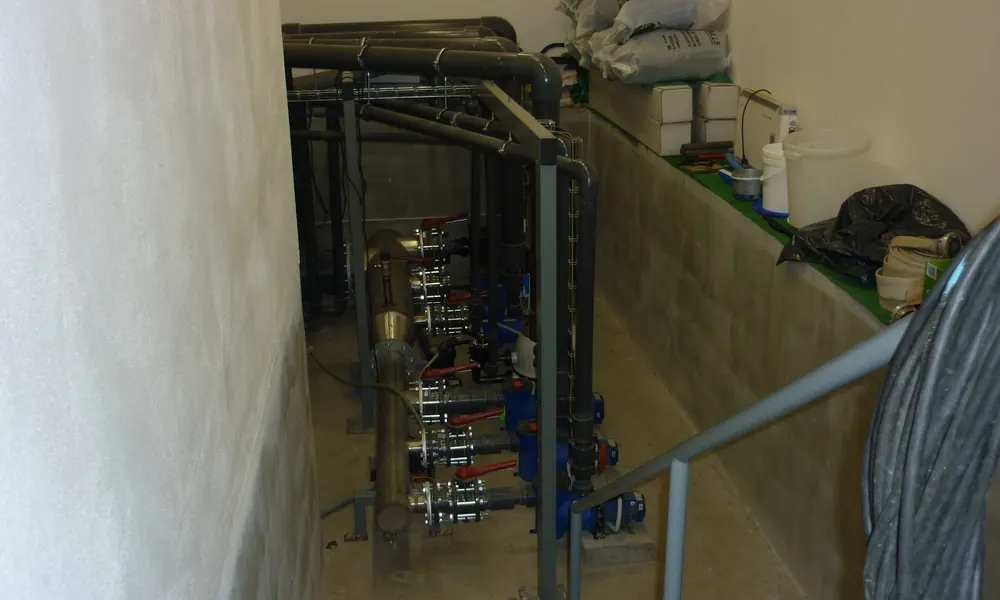
The OASE AquaMax Eco Premium is a low-energy pond pump built to move large volumes of water at low pressure, and in a natural pool it is the pump that keeps the living filter fed. The water has to move slowly and steadily through the gravel beds, day and night, at a rate the plants and the bacteria can use, and it has to do it without the electricity bill that would make the client regret the whole pool. The pump’s variable flow lets the startup set the circulation to the rate the design calls for, and turn it down in winter when the plants are dormant and the water needs less movement.
Low energy matters because the pump never stops. A natural pool circulates around the clock through the swimming season, and a pump that draws a few hundred watts more than it needs will cost the client hundreds over a summer. The AquaMax Eco Premium is built for that continuous duty, with a motor and impeller designed for dirty water carrying the fine particles that a natural pool always has, and a strainer that can be cleaned without dismantling the whole plant room. A pump that is easy to clean is a pump that gets cleaned, and a pump that gets cleaned is a pump that keeps its flow rate through the season instead of fading as the strainer clogs.
9. Aquascape BioFalls Filter: the best tool for biological filtration at the head of the regeneration zone
The Aquascape BioFalls Filter is a biological filter unit that sits at the head of the regeneration zone, where the water arrives from the pump before it spreads across the gravel beds. Inside it, water passes over filter mats and media that give bacteria a surface to colonise, and those bacteria break down the organic matter that the plants cannot take up directly. It is the first stage of the living filter, catching the fine material and starting the breakdown before the water reaches the roots, and it is the stage that can be opened, cleaned and inspected without digging up a single plant.
The filter earns its place because it makes the regeneration zone maintainable. A gravel bed that has to be dug up to be cleaned will never be cleaned, and a filter that cannot be reached will be left until the pool goes green. The BioFalls unit sits at the edge of the zone with a lid that lifts off, so the mats can be rinsed, the media can be checked and the flow can be seen with the naked eye. The startup can show the client the water entering the unit cloudy and leaving it clearer, which is a demonstration that no brochure can match, and it gives the client a simple job to do between visits: lift the lid, look at the flow, and call if it has changed.
What a natural pool installation costs in 2026
A natural pool costs more to build than a conventional pool of the same size, and the startup that pretends otherwise will lose money on its first job. The extra cost is not the liner or the pump. It is the second zone: the excavation, the gravel, the planting and the wall between the two, which roughly doubles the area of water to be built. A small natural pool for a family garden, with a swimming zone of about thirty square metres and a regeneration zone of the same size, will usually come in well above a standard pool installation of the same swimming area, and the quote has to show the client why: they are buying two pools, one to swim in and one to clean the water.
Running costs are where a natural pool wins the argument. There is no chemical bill, no dosing unit to service and no chemical store to keep safe, and the pump is the only thing drawing power. The costs that remain are the ones the client should be told about honestly: electricity for the pump, water for the top-up, plants to replace and thin, and a visit or two a year from the startup that built it. A pool that is sold on low running costs and then handed over without a maintenance plan will disappoint its owner in its second year, when the plants need thinning and nobody has booked the visit. The startup that sells the plan with the pool keeps the client, and keeps the pool clear.
Your launch checklist
- Walk the garden with SunCalc and mark where the sun falls on the swimming zone and the regeneration zone through the seasons.
- Model both zones in Vip3D with the dividing wall, the flow path and the pump position, and agree the size ratio with the client before digging.
- Run the water balance in SWMM for rainfall, evaporation, top-up and overflow, and confirm where the overflow will go in a wet month.
- Choose the planting with iNaturalist from native species that already grow in local water, and draw the planting plan in Realtime Landscaping Architect.
- Set the circulation with the OASE AquaMax Eco Premium and the Aquascape BioFalls Filter, and tune the flow rate in the first weeks after handover.
- Test the water on site with the LaMotte WaterLink Spin Touch, log the oxygen and clarity with the YSI EXO2, and book the first thinning and testing visit before you leave.
Frequently asked questions
How much does it cost to start a natural pool installation business?
The tools in this guide cost a few thousand in total, with the monitoring sonde and the testing kit the largest items, and the design software available on subscription. The larger cost is the knowledge: the planting, the water balance and the circulation design that make a natural pool work. A startup should budget for its first two pools to be learning jobs, priced to cover the build and the follow-up visits, and should not expect to make its margin until the third or fourth, when the design process is routine and the plant suppliers are known.
Can AI size a regeneration zone accurately enough to build from?
The tools in this guide size the zone from the swimming volume, the expected use and the local climate, and that sizing is accurate enough to dig from, provided the inputs are honest. The number that matters is the nutrient load, and that depends on how many people swim, how much sun the pool gets and how many leaves fall into it. A startup that measures those inputs on site will get a zone size it can trust. A startup that guesses them will get a pool that goes green in August, and no tool can fix a guess made on the first visit.
How is a natural pool different from a natural swimming pond?
A natural pool is a built pool with a defined swimming basin, a formal edge and an engineered regeneration zone that is sized and planted to a specification, while a natural swimming pond is earth-formed and pond-like, shaped by its banks and its planting. The two share the same biology, but the pool is the more formal build, and its clients expect pool-level clarity from a system that contains no chemicals. The pool is the right choice for a client who wants to swim lengths in clear water; the pond is the right choice for a client who wants a water garden they can also swim in.
Do I need all nine tools to start?
No. A startup can begin with the design tools, the testing kit and the pump, and add the monitoring sonde and the biological filter as the order book grows. The tools to buy first are the ones that prevent the expensive mistakes: the 3D model that stops a badly sized zone, the sun map that stops a shaded planting, and the nutrient test that stops a green pool. The monitoring and the filter can follow, but the design tools should be in place before the first digger arrives on the first job.
How long does a natural pool installation take?
A small garden natural pool usually takes six to ten weeks from the first dig to handover, with the planting going in last and the pool then needing several weeks for the plants to establish and the bacteria to colonise the gravel. The swimming water may cloud during that settling period and then clear again, which is normal and should be explained to the client before it happens. The startup should plan its handover for the point when the water is clear and the plants are growing, not for the day the last stone is laid, because the pool is not finished until the living filter is working.
Which tool should I buy first?
Buy Vip3D first, because the 3D model is what sells the pool and what sizes the two zones against each other. A client who can see the swimming water and the planted zone in one model will sign the quote, and a startup that has modelled the flow path will not dig a pool with dead water in it. The testing kit should follow immediately, because a natural pool startup that cannot test its own water is working blind, and the first green pool will cost more in remedial work and reputation than the test kit ever would.
The bottom line
A natural pool installation startup sells clear water that is kept clear by plants, and the nine tools in this guide are the way to deliver that promise without guesswork. Design the two zones as one system, keep the water in balance with testing and monitoring, and plant the regeneration zone with species that belong in the garden it sits in. Get those three things right and the pool will stay clear through its first summer and every summer after it, with no chemicals, no dosing unit and no smell of treated water. That is a pool worth building, and a business worth starting.

Keep what speaks to you.
Leave room for your own perspective.