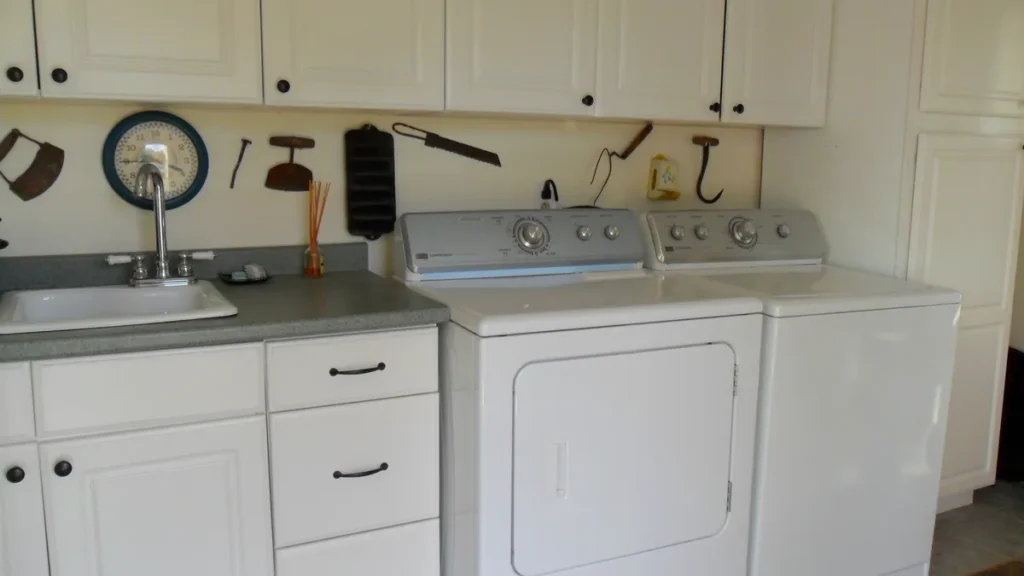
A new laundry room can quietly become one of the most expensive small projects in a home. The machines get all the attention, but the real money goes into moving pipes, adding outlets, building storage, and fixing ventilation. Plan the room first and the costs stay under control.
This guide walks through the build in the order that saves the most: layout, plumbing, machines, storage, and ventilation.
Start With the Layout, Not the Shopping List
The cheapest laundry room is the one that fits the space you already have. Before you look at a single machine, measure the room twice and draw the layout on paper. Note where the water, drain, and power already are.
Keep the washer and dryer on the wall that already has the water supply and drain. Every metre you move them adds pipe, labour, and risk. Stacking the machines is the cheapest way to free floor space in a narrow room.
Keep the Plumbing Short and Simple
Plumbing is where laundry room budgets usually break. A washer needs a hot and cold supply, a drain, and a shut-off valve you can reach. Moving any of them across a room turns a small job into a big one.
Put the machines against the wall that already carries the water lines. If the room has no water at all, the cheapest option is usually the wall closest to the kitchen or bathroom, because the pipes have the shortest run. Long runs cost more in materials and labour, and they are more likely to leak or freeze.
Add a utility sink only if the drain is close by. A basic laundry tub is genuinely useful for soaking stains and costs far less than a fancy fitted one. If the budget is tight, skip it for now.
Fit shut-off valves you can reach without moving a machine. A small leak caught early costs almost nothing, while the same leak hidden behind a washer for a month can ruin flooring and walls. Efficient habits help as well: wash full loads and fix drips promptly. Our guide on how to save money on your water bill covers the simple changes that add up fastest.
Choose Machines That Fit the Room and the Budget
Machines are the biggest single purchase, so careful shopping pays off most here. Buy the size your household actually needs, not the largest model in the store. An oversized washer wastes water and power on half-empty loads, while one that is too small means running it twice as often.
Front-loaders usually cost more up front but use less water and spin clothes drier, which shortens drying time. Top-loaders are cheaper to buy and easier to load without bending. Pick the one that fits your budget, your space, and your household.
Look for last year’s model, floor stock, and open-box machines from reputable sellers. A washer that is one model old does the same job for noticeably less money, and the warranty is usually the same. Measure the delivery path as well as the room: a machine that cannot fit through the door is a costly mistake. For a closer look at timing and discounts, see our guide on how to save money on a new washer and dryer.
Do not buy a dryer with features you will never use. Steam cycles and Wi-Fi controls are pleasant, but they add cost and can add repair bills later. A reliable mid-range machine will serve for a decade.
Storage That Costs Little and Saves a Lot
A laundry room without storage becomes a dumping ground within a week. Detergent, stain remover, pegs, and clean laundry all need a home, and the cheapest storage is planned early rather than bought in a panic later.
Open shelves above the machines cost far less than fitted wall cabinets and hold just as much. Two sturdy shelves will carry detergent and supplies for years. Keep the things you use every day at arm height.
A folding counter is the single most useful surface in the room, and it does not need to be expensive. A length of worktop over the machines or a wall-mounted drop-down shelf both work. What matters is a flat, clear surface at a comfortable height where clothes can be folded straight out of the dryer.
Ventilation and Light: The Cheap Fixes That Prevent Expensive Damage
A laundry room makes heat and moisture every time it runs. Without ventilation, that moisture settles into walls, paint, and stored clothes, and the damage costs far more than a vent ever will. This is the part of the build people skip most often, and the one they regret skipping most.
A dryer must vent outside, through the shortest straight run you can manage. Every bend slows the air and traps lint, so use rigid metal ducting rather than flexible plastic, which sags and collects lint. Clean the vent at least once a year. A blocked vent costs more to run and is a genuine fire risk.
If the room has a window, open it while the machines run and let the steam out. If there is no window, a small extractor fan wired to run with the light is a cheap and effective fix. Good light helps too: a bright ceiling light over the folding area makes stains easier to spot.
Where to Spend and Where to Save
Not every part of a laundry room deserves the same budget. Spend on the things that are hard or expensive to change later, and save on the things you can upgrade any time.
Spend on plumbing, wiring, ventilation, and the machines themselves. These are the bones of the room. A cheap valve, a badly placed outlet, or a dryer vent that is too long will cost far more later than doing them properly now. If you hire a professional for anything, hire one for the plumbing and electrical work.
Save on cabinets, worktops, paint, and decoration. A simple shelf does the job of an expensive fitted cabinet, and a basic worktop folds clothes just as well as a stone one.
The same thinking applies to running costs. Once the room is built, the monthly spend comes down to how you use it: full loads, cold washes where they work, and a dryer that is cleaned and vented properly. Our guide on how to save money on laundry explains the everyday habits that keep those ongoing costs low.
A Realistic Budget for a New Laundry Room
Costs vary by location and by how much work you do yourself. A basic refresh of an existing space, with machines, paint, shelves, and a folding counter, can be done for a modest sum if the plumbing and wiring already exist. A mid-range build with a utility sink, better storage, and new flooring costs more but still stays sensible. A full build in a room with no water or power is the most expensive, because the trades work dominates the bill.
Before you start, get two or three quotes for any plumbing and electrical work, and ask each tradesperson to break the price down by task. A detailed quote shows exactly where the money goes. Keep a buffer of about ten percent for surprises, because opening up walls in an older home almost always reveals something unexpected.
The Bottom Line
Saving money on a new laundry room is not about buying the cheapest of everything. It is about spending in the right order: layout first, plumbing second, machines third, and decoration last. Keep the pipes short, the vent straight, the storage simple, and the machines matched to your household. A good laundry room is the one planned properly before a single thing was bought.

Keep what speaks to you.
Leave room for your own perspective.