The best AI tools for rain barrel installation startups in 2026 turn a simple water-saving idea into a real business: a one-van outfit that measures a roof from the office, prices a barrel, diverter and stand as one tidy package, books the job before a rival has even returned the call, and leaves the homeowner with a system that fills itself every time it rains. A rain barrel startup is not a gardening hobby with a van. It sells a fitted product that has to work through storms, freezes and dry summers, and the homeowner judges the company on the fit, the finish and the overflow long after the installer has driven away.
Starting a rain barrel business is cheap to enter and easy to get wrong. A van, a stock of barrels, a box of diverters and a handful of neighbours can win the first few jobs, but the business side arrives all at once. Ten enquiries land while the founder is under a downspout, three quotes need writing in the evening, a supplier calls to say the 55-gallon barrels are delayed, and the invoices from last month are still unpaid. There is no office team to catch a missed call and no estimator to price a job while the founder is on a ladder, so every hour spent on paperwork is an hour not spent earning, and every missed call is a homeowner ringing the next company on the list.
This guide compares the AI tools that fit a rain barrel installation startup, not a large landscaping firm and not a general home services company. Every tool below is judged on what a new founder actually needs: a low starting cost, no long contract, useful from the first week, workable from a phone beside a house, and able to grow from one van to two or three crews without forcing a painful switch. You will find a comparison table, a startup checklist, and answers to the questions new rain barrel founders ask most often, all focused on the work this trade really involves: measuring roof runoff, choosing the right diverter, sizing the barrel, fitting a level stand, routing the overflow safely away from the house, and winterising the system before the first freeze.
Key takeaways
- Start with three tools only: AI roof measurement and quoting, AI booking and answering, and a simple job record that keeps one file per home. Everything else can wait until the diary is full.
- Speed wins barrel jobs. A clear quote sent within the hour beats a perfect quote sent the next day, because the homeowner with a soggy garden hires the first company that responds well.
- Measure the roof before you quote. Barrel size, diverter choice and overflow routing all depend on roof area and downspout position, and guessing any of them eats the margin.
- Overflow is the sale and the risk. A barrel that floods a foundation in a storm costs far more than the job was worth, so the tool that plans the overflow route wins the job.
- Keep the stack small and the customer record single. One record per home, with every quote, measurement, photo and winterising reminder on it, will serve a startup far better than six overlapping apps.
Best AI tools for rain barrel installation startups at a glance
The table below gives a quick view of where each tool helps most in a new rain barrel business. The sections that follow explain how to use each one on a real job, what to look for before you pay, and where small teams usually go wrong.
| Tool | Main job for a barrel startup | Standout AI feature | Starting price |
|---|---|---|---|
| DroneDeploy | Aerial roof and downspout measurement | AI roof area and gutter mapping from drone photos | Free trial; paid plans per user |
| Estimate Rocket | Quoting barrel, diverter and stand packages | AI quote builder with photos and good, better, best options | From $49 per month |
| CompanyCam | Photo records of every install | AI photo organisation and before-and-after reports | From $29 per user per month |
| FieldPulse | Job management and dispatch | AI scheduling, estimates and customer records in one place | From $69 per month |
| Joist | Fast quotes and invoices | AI estimate templates and one-tap invoice follow-ups | Free plan; paid plans from $9.99 per month |
| Tomorrow.io | Rain forecasting for install timing | Hyperlocal rain forecasts and fill-rate estimates | Free tier; paid plans per user |
| Calendly | Booking site visits and surveys | AI scheduling that fills gaps and sends reminders | Free plan; paid plans from $10 per user per month |
| Thryv | CRM, reviews and repeat work | AI review requests and automated seasonal reminders | From $99 per month |
| Thumbtack | Finding the first customers | AI lead matching for local home services | Pay per lead |
What makes a rain barrel installation startup different
A rain barrel installation startup is not a smaller version of a big home services company. It is a different kind of business altogether. The founder is the salesperson, the estimator, the scheduler, the bookkeeper, and often the person fitting the diverter, all in the same day. There is no office team to catch a missed call, no estimator to price a job while the founder is cutting a downspout, and no marketing department to keep new leads coming in. Every hour spent on paperwork is an hour not spent earning, and in a trade where most jobs take half a day, that trade-off decides whether the month makes money.
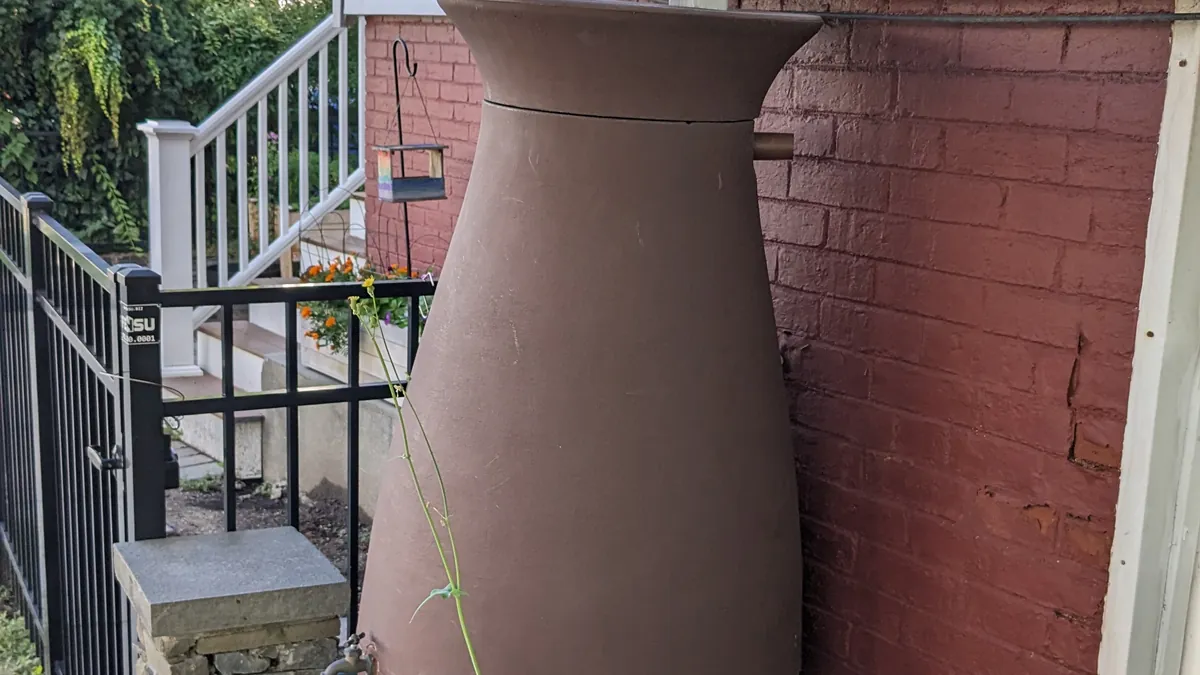
The work itself shapes the software too. A barrel job is a product sale as much as a fitting job. The homeowner is choosing between a plain 55-gallon drum that does the job quietly, a decorative urn that suits the front of the house, a slimline tank that fits a narrow side passage, and a linked pair of barrels for a large garden. Each option has a different price, a different look from the street, and a different stand and overflow arrangement, and the founder has to explain those differences clearly, in the garden, without sounding like a salesperson reading a script. A tool that turns a roof measurement into a clear, visual quote with good, better and best options is worth far more than a tool with a long feature list nobody opens.
The closest trade to rain barrels is the gutter trade, because both live on the same downspout. A barrel hangs off a gutter system, and a badly fitted guard or a blocked gutter starves the barrel or floods it. Founders who understand that connection can sell the two jobs together, and our guide to the best AI tools for gutter guard installation startups shows how neighbouring installers use the same kind of measurement and quoting tools to win higher-value work. The difference is the ending: a gutter guard job ends when the guard is fitted, while a barrel job ends when the water is stored, used and safely overflowed, which is a longer story to manage.
Irrigation is the other neighbour founders confuse with rain barrels, and the confusion costs jobs. An irrigation system pushes water out under pressure through sprinklers and drip lines, while a rain barrel catches water coming in and stores it for gravity-fed use. The two trades share customers and gardens, but they solve opposite problems, and our guide to the best AI tools for irrigation startups covers the pressurised side of garden water in detail. A rain barrel startup that can explain that difference in one sentence, and show a customer how a barrel feeds a watering can rather than a sprinkler zone, will win the jobs that irrigation firms turn away.
The 9 best AI tools for rain barrel installation startups
The nine tools below were judged on what a new rain barrel installer actually needs: accurate roof and downspout measurements, honest package quotes, photo proof of a tidy install, simple job running, and a price a startup can afford. Each one earns its place by saving time on a job that repeats every week, not by having the longest feature list.
1. DroneDeploy: the best aerial measurement for roof runoff
DroneDeploy turns a drone flight over a house into a measured map of the roof, the gutters and the downspouts, and that map is the foundation of every accurate barrel quote. A founder who knows the roof area can work out how much water a storm will deliver, and a founder who knows the downspout positions can say exactly where each barrel should sit. The AI stitches the drone photos into a single overhead view, measures roof faces and edges, and marks the gutter runs so the quote is built on numbers rather than a guess from the pavement.
For a rain barrel startup, the real value is the runoff calculation. A 1,000-square-foot roof sheds roughly 600 gallons in a one-inch rainstorm, which means a single 55-gallon barrel fills in minutes during a heavy downpour and the overflow route matters from the first minute. DroneDeploy lets the founder show the homeowner that maths on a map, explain why one barrel is not enough for a large roof, and sell a linked pair with a proper overflow instead of a single barrel that floods the flower bed. That conversation turns a commodity sale into an expert one.
The tool also saves the ladder work. Measuring a roof by eye means climbing up, walking the gutters and hoping the numbers are right, while a drone flight takes minutes and keeps the founder on the ground. For a one-person business, that is a safety gain as well as a time gain. The paid plans are not the cheapest on this list, so most founders start with the free trial on a few real quotes and only pay once the measurement habit is part of every job. Roofing contractors use the same measurement-first idea, and the best AI tools for roofing contractor startups show how aerial measurement tools pay for themselves on the very first accurate quote.
2. Estimate Rocket: the best quoting for barrel packages
Estimate Rocket is built for exterior trades that quote packages rather than hours, which is exactly how a rain barrel job should be sold. A barrel job is never just a barrel: it is the barrel, the diverter kit, the stand, the overflow hose, the spigot and the labour, and a quote that lists those parts separately confuses the homeowner. Estimate Rocket lets the founder build a package once, with good, better and best options, and then send it with photos of each barrel style in a few taps from the van.
The AI quote builder is the part founders use most. It drafts the quote from a few answers about roof size, barrel style and downspout count, adds the standard parts automatically, and flags anything missing, such as an overflow hose on a job with no drain nearby. The homeowner receives a clean proposal they can accept on their phone, and the founder receives a signed job instead of a week of chasing. That speed matters more than polish in the first year, because the company that sends the price first usually wins the job.
3. CompanyCam: the best photo record of every install
CompanyCam is a photo app with a filing system, and for a rain barrel startup that filing system is worth more than the camera. Every install needs proof: the diverter before and after, the level stand, the overflow hose running away from the foundation, and the spigot working. CompanyCam tags each photo to the job address, the date and the crew member automatically, so a year later the founder can pull up exactly what was fitted at a house without digging through a phone gallery.
The AI organisation is what makes it work at scale. Photos are grouped by project, faces and addresses are recognised, and the before-and-after report is generated in one tap. That report is a selling tool as much as a record: a homeowner who sees their own downspout before the diverter and after it understands what they paid for, and a neighbour who sees the same report on social media rings up for a quote. For a trade that lives on referrals, that is free marketing on every job.

4. FieldPulse: the best all-round job system for a growing barrel firm
FieldPulse is the tool founders buy when the notebook stops working, usually around the thirtieth customer. It holds the estimate, the schedule, the customer record, the invoice and the follow-up in one place, so a job moves from first call to final payment without anything being retyped. The AI scheduling suggests the best order for the day, groups jobs by street to cut drive time, and flags clashes before the founder drives to the wrong house.
For a rain barrel startup, the customer record is the most valuable part. Each home gets one file with the roof size, the barrel style, the diverter type, the stand height, the overflow route and the winterising date. When the same customer rings in autumn to ask about draining the barrel for winter, the founder can answer from the record instead of guessing. That memory is what turns a one-off install into a customer who comes back every year for a check, a clean and a second barrel.
5. Joist: the best fast quotes and invoices for a solo installer
Joist is the simplest tool on this list, and for a solo founder that simplicity is the point. It builds a professional estimate in minutes from a saved template, sends it to the homeowner, and turns the accepted estimate into an invoice with one tap. There is no long setup, no training course and no monthly maze of settings to learn before the first job.
The AI estimate templates do the quiet work. A founder saves a template for a single 55-gallon install, another for a linked pair, and another for a decorative urn with a custom stand, and the tool fills in the customer details, the prices and the terms each time. The invoice follow-up is equally simple: a reminder goes out automatically if the invoice is unpaid after a few days, with a polite message and a payment link. For a founder who hates chasing money, that feature alone is worth the price.
6. Tomorrow.io: the best rain forecasting for install timing
Tomorrow.io is the only tool on this list that thinks about the weather the way a rain barrel installer should, and that makes it the most rain-barrel-specific purchase a founder can make. It gives hyperlocal rain forecasts street by street, hour by hour, so the founder can plan the week around the rain instead of being surprised by it. Dry days are booked for installs, wet days are kept for quotes, paperwork and supplier runs.
The fill-rate estimate is the feature that sells barrels. Tomorrow.io can show a homeowner how much rain is forecast for their street in the coming week and how quickly their new barrel will fill, which turns an abstract promise about saving water into a concrete number for the next seven days. A founder who arrives at a quote with the forecast in hand can say, with a straight face, that the barrel will be full by Thursday, and the homeowner can watch it happen. That is a demonstration no brochure can match.
7. Calendly: the best booking for site visits and surveys
Calendly removes the back-and-forth that eats a founder’s evening. A homeowner who wants a site survey clicks a link, picks a time that is actually free, and receives a confirmation and a reminder automatically. The founder does not answer a single message about availability, and the diary fills itself around the jobs already booked.
The AI scheduling is smarter than a simple calendar link. It fills the gaps between jobs with short surveys, groups visits by area so the van is not crossing town four times a day, and sends reminders that cut no-shows. A missed survey is a wasted drive and a lost morning, so every no-show prevented is money saved. The tool also asks the homeowner a few questions at booking time, such as how many downspouts the house has and whether the garden is on a slope, so the founder arrives knowing what to look for.
8. Thryv: the best CRM and reviews for repeat barrel work
Thryv is a customer system built for small home services firms, and it earns its place here because rain barrel work is repeat work in disguise. Every barrel needs a spring check, a summer clean, an autumn drain-down and, sooner or later, a second barrel or a replacement diverter. Thryv remembers all of that and reminds the customer at the right moment, so the founder does not have to.
The AI review request is the part that grows the business. After each install, Thryv asks the homeowner for a review at the moment they are happiest, usually the day after the first rain fills the barrel, and posts it to the places new customers look. A barrel startup with forty five-star reviews looks like a company that has been trading for years, and those reviews do more for the next quote than any advertisement. The tool also sends seasonal reminders automatically, so the winterising round books itself instead of depending on the founder remembering to ring round.
9. Thumbtack: the best way to find the first customers
Thumbtack is a marketplace where homeowners look for local trades, and for a brand-new rain barrel startup it solves the hardest problem of all: the first twenty customers. The founder creates a profile, lists rain barrel installation as a service, and receives leads from homeowners in the area who are already looking. The AI matching sends the jobs that fit the profile and filters out the ones that do not, so the founder is quoting real buyers rather than cold-calling strangers.
The pricing model suits a startup because it is pay per lead rather than a monthly fee. A quiet month costs nothing, and a busy month pays for itself from the jobs it brings in. That matters when cash is tight and every fixed monthly cost is a worry. The founder can also set the service area tightly, so every lead is within a short drive, and can turn the tap off entirely when the diary is full, which is a control that advertising never gives.
How to choose AI tools when money is tight
The first rule for a startup is to buy for the job you have today, not the company you hope to be in five years. A platform built for a fifty-person firm will feel heavy, expensive and slow when there is one van and one founder, and the money spent on it is money not spent on barrels, diverters and fuel. Start with the three tools that touch money directly: measurement and quoting, booking and answering, and the customer record. Everything else can wait until the diary is full.
The second rule is to count the monthly total before buying anything new. A stack of six tools at $50 a month each is $300 a month before a single barrel is sold, and a quiet winter month will punish that bill. A sensible first-year budget is $100 to $200 a month, which covers a quoting tool, a booking tool and a photo record with room to spare. Add a tool only when it clearly saves an hour a week or wins a job a month, and cancel anything that has not been opened in three weeks.
Building your starter stack for a rain barrel startup
A sensible starter stack has three layers and costs under $150 a month. The first layer is measurement and quoting: DroneDeploy on trial for the roof numbers and Estimate Rocket for the package quotes, so every price is built on a real measurement and sent within the hour. The second layer is booking: Calendly for site surveys, so the diary fills itself and the founder stops spending evenings texting about times. The third layer is the record: CompanyCam for the photo proof of every install, so each home has a file that makes the next visit easy.
Common mistakes rain barrel startups make with AI tools
The most common mistake is buying six tools in the first week. A founder who is still learning to fit diverters does not need a review engine, a drone fleet and a marketing platform, and the time spent learning them is time not spent installing. Three tools, used well, will beat six tools used badly every time, and the stack can grow when the business grows.
The third mistake is forgetting the overflow. A barrel is a container with a limit, and every storm after it fills has to go somewhere safe. Founders who sell the barrel and forget the overflow route will get the call they dread after the first heavy rain, when the water has run back towards the house. Plan the overflow on every quote, photograph it on every install, and make it part of the price rather than an afterthought.
Rain barrel installation startup checklist
Use this checklist before the first paid job, and again before the first busy season.
- Measure the roof and map every downspout with an aerial tool, so each quote is built on real runoff numbers.
- Build three package quotes, single barrel, linked pair and decorative urn, with the diverter, stand and overflow included in each price.
- Set up a booking link for site surveys, with automatic reminders that cut no-shows.
- Photograph every install, diverter, stand and overflow route, and file the photos against the home address.
- Plan the overflow route on every job, and never sell a barrel without a safe place for the excess water to go.
- Book the winterising round before the first freeze, and remind every customer to drain the barrel in good time.
Frequently asked questions
How much should a rain barrel installation startup spend on AI tools?
A sensible first-year budget is $100 to $200 a month. That covers a quoting tool, a booking tool and a photo record, which are the three tools that touch money directly. Add a job system such as FieldPulse once the diary is full for a month running, and add a review tool such as Thryv once there are enough past customers to make it pay. Avoid fixed monthly bills for tools that have not been opened in three weeks.
What is the best first AI tool to buy?
Buy the quoting tool first. A rain barrel startup lives or dies on how fast it can send a clear, accurate price, and a tool such as Estimate Rocket turns a roof measurement into a package quote in minutes. The second purchase should be a booking tool such as Calendly, and the third should be a photo record such as CompanyCam. Those three cover winning the job, booking the visit and proving the install.
Can AI really measure a roof accurately enough to quote from?
Yes, for barrel work it can. A drone or satellite measurement gives the roof area and the downspout positions accurately enough to size the barrel and plan the overflow, which is what a barrel quote needs. The measurement does not replace a site visit: the founder still needs to check the ground level, the stand position and the drain route in person. But it replaces the ladder, the tape measure and the guess, and the quote it produces is far more accurate than one built from the pavement.
Which rain barrel size should a startup sell first?
Start with the 55-gallon barrel. It suits most homes, it is light enough to move and install without special equipment, and it fills quickly enough for the homeowner to see it working after the first rain. Offer a linked pair for large roofs and big gardens, and a decorative urn for front-of-house jobs where looks matter. The 55-gallon size keeps the stock simple, the stand simple and the price simple, which is what a new business needs.
Do I need a drone to run a rain barrel startup?
No, but a drone or a satellite measurement tool makes quoting faster and safer. A founder can measure a roof from satellite imagery without any hardware at all, and many start that way. A drone adds accuracy on cut-up roofs and large properties, and it produces the overhead map that impresses homeowners. Buy the measurement software first and add the drone only when the volume of quotes justifies it.
Will AI replace rain barrel installers?
No. AI can measure a roof, draft a quote, book a visit and remind a customer about winterising, but it cannot cut a downspout, level a stand, fit a diverter or route an overflow hose. The physical work, the judgement about where the water should go, and the relationship with the homeowner all stay human. The founders who win are the ones who let AI handle the paperwork and spend their own time on the fitting.
The bottom line
The best AI tools for rain barrel installation startups in 2026 are the ones that turn a one-van outfit into a business that measures honestly, quotes quickly, installs tidily and remembers every customer. Start with measurement and quoting, add booking and a photo record, and let the job system and the review engine follow when the diary earns them. Keep the overflow planned, the stand level and the barrel drained before winter, and the rain will do the rest of the selling.

Keep what speaks to you.
Leave room for your own perspective.