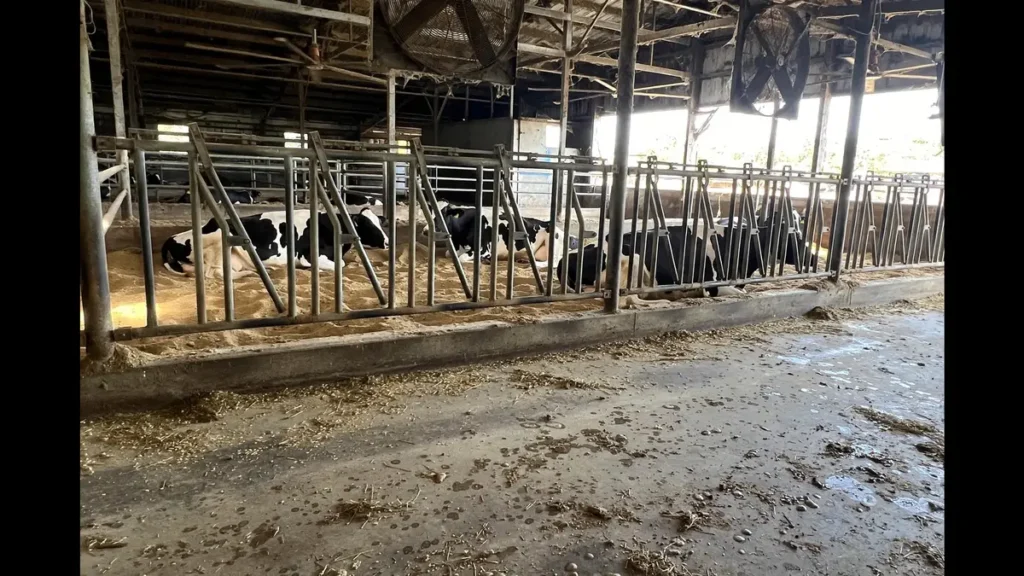
A dairy barn is the building where dairy cows live, eat and rest. It is not a general farm shed, and it is not the building where cows are milked. The herd spends most of its day inside it: lying in stalls, walking to the feed passage, drinking, and moving through air that has to stay fresh in every season. Every decision in the build, from the width of a freestall to the slope of the floor, is about cow comfort first, because a comfortable cow lies down longer, eats more calmly and gives more milk.
That focus makes a dairy barn a different build from the farm structures it is often confused with. A pole barn is a post-frame shell. A Dutch barn is a steel or timber frame with a gambrel roof. A Quonset hut is a curved steel arch. A bank barn is built into a hillside. None of those shapes tells you how wide a stall should be, how much air a hundred cows need, or how a mixer wagon turns in the feed passage. A dairy barn is defined by what happens inside it: stalls, feed, water, bedding, manure and ventilation, all working together for the herd.
For a new installation startup, that specialisation is good news. Dairy farmers know exactly what a bad barn costs them: lame cows, dirty udders, heat stress and milk that never reaches its potential. A startup that can design stalls properly, size the ventilation and hand over a barn that stays dry and clean will get repeat work, because every dairy farm in the district talks to every other one. The nine AI tools below cover the whole job, from the first stall measurement to the aftercare visit a year later, and each one is built for the dairy barn itself rather than borrowed from general barn work.
Key takeaways
- A dairy barn is where dairy cows live, eat and rest — stalls, feed passages and ventilation are the build, and the milking happens in a separate specialist building.
- The build lives or dies on four things: stall size and bedding, the feed passage, airflow, and floors that drain and stay grippy.
- Start with stall design and ventilation tools, then add feeding and cow-monitoring tools once the first jobs are booked.
- Budget roughly $300 to $700 a month for the full nine-tool stack in your first year, and far less if you start with the three core tools.
- Aftercare is where dairy barn startups earn repeat work — bedding, fans, stall dividers and manure equipment all need a yearly check.

Best AI tools for dairy barn installation startups at a glance
| Tool | Best for | Typical starting cost | Dairy-barn job |
|---|---|---|---|
| CowSignals | Stall design and cow comfort | From around $100 per course | Measuring stalls, bedding and lying time |
| Big Dutchman | Freestall and barn equipment | Quoted per project | Stalls, feeding and ventilation hardware |
| Trioliet | Feeding systems | Quoted per project | Mixer wagons and automatic feeding |
| FeedWatch | Feed management software | From around $100 a month | Rations, mixer loads and feed costs |
| Fancom Lumina | Barn climate control | Quoted per project | Fans, inlets and ventilation control |
| smaXtec | Cow health monitoring | From around $5 per cow a month | Early health alerts from inside the barn |
| DairyComp 305 | Herd records | From around $150 a month | Milk, breeding and health records |
| Patz | Manure handling | Quoted per project | Barn cleaners and manure equipment |
| simPRO | Quoting and job management | From around $150 a month | Quotes, scheduling and invoicing |
What makes a dairy barn different
A dairy barn has to work for the cow before it works for the farmer. A cow lies down for twelve to fourteen hours a day, and she will only do that if the stall fits her body, the bedding is dry and the neck rail does not press on her shoulders. A stall that is too short leaves her perched half out of it. A stall that is too wide lets her turn around and soil the bedding. A neck rail set too low stops her standing up properly. None of this shows up on a general barn plan, because a general barn plan does not know how a cow lies down.
The feed passage is the second thing that sets a dairy barn apart. Cows eat at a long feed bunk, and the passage in front of it has to fit the machine that delivers the feed, usually a mixer wagon, plus a person pushing feed up with a fork or a small loader. If the passage is too narrow, the wagon scrapes the headlocks. If the feed bunk is too high, smaller cows cannot reach the ration. If the floor has no slope, feed and water pool where cows walk. A dairy barn startup that gets the feed passage wrong will hear about it at every feeding time, twice a day, for the life of the building.
Ventilation is the third difference, and it is the one most often underestimated. A hundred cows produce a surprising amount of heat and moisture, and a barn that traps it becomes warm, damp and smelly within hours. Fresh air has to move across the stalls without creating cold draughts on lying cows, and the fans, inlets and ridge opening have to be sized for the hottest week of the year, not the average one. Heat stress cuts milk yield quickly, so ventilation is not a comfort extra. It is part of the production system, and it is one of the first things a farmer will check on a handover walk.
The fourth difference is what happens underneath the cows. Manure, bedding and wash water have to leave the barn every day without the farmer fighting the building to do it. Floors need a fall toward the drains or the scraper channel, and they need enough grip that a heavy cow does not slip when she stands. Alleys need to be wide enough for a scraper or a skid-steer. The milking itself happens elsewhere: a milking parlour is the specialist building where cows are milked, and the barn is where they live between milkings. Keeping that line clear matters, because the two buildings need different tools, different drainage and different routines. The guide to milking parlour installation startups covers the parlour side of the farm in full.
Stall design and cow comfort
1. CowSignals: The Best Tool for Stall Design and Cow Comfort
CowSignals is a cow-comfort training and assessment system that teaches installers to read a barn the way a cow experiences it. The method scores the things that decide whether cows lie down: stall length and width against the size of the herd, neck rail height, brisket board position, bedding depth and dryness, and how long cows actually spend lying down. An installer who has learned the method walks into a barn and sees problems a tape measure alone would miss, like cows standing half in stalls because the divider is set for a smaller breed, or bedding that looks deep but is wet underneath.
For a startup, the value is that it turns comfort into a sales argument. Instead of telling a farmer the stalls will be fine, you can show the measurements, the lying-time target and the changes you made to reach it. The CowSignals app and checklists give a repeatable way to survey an old barn before a refit and to prove a new barn works after handover. It also keeps the startup honest: if the cows are not lying down twelve hours a day, the barn is not finished, however straight the steelwork looks.
CowSignals works best as the first tool a dairy barn startup buys, because every other decision follows from stall size. The feed passage, alley width, fan positions and manure system all depend on how many stalls there are and how big they are. Learning to measure a cow before buying hardware saves the most expensive mistake in this trade: a beautiful barn the cows refuse to use properly.
2. Big Dutchman: The Best Tool for Freestall and Barn Equipment
Big Dutchman is one of the largest makers of dairy barn equipment in the world, and its catalogue reads like a checklist for the inside of a dairy barn: freestall dividers, headlocks, feed fences, cubicles, ventilation systems, feeding equipment and manure handling. For an installation startup, that breadth matters, because the equipment has to fit together. A freestall divider that does not match the headlock spacing will leave gaps a cow can wedge herself into, and a feed fence that does not suit the mixer wagon will slow every feeding.
The practical advantage of working with a single equipment maker is that the parts are designed as a system. Stall widths, alley widths, waterer positions and fan mounts all come from the same set of drawings, so the installer is not guessing how one supplier’s divider lines up with another supplier’s feed rail. Big Dutchman also supplies the ventilation and feeding hardware that the rest of this list controls, which means the startup can offer a complete barn fit-out rather than a steel shell the farmer then has to equip.
Big Dutchman equipment is quoted per project, and a startup should expect it to be a large share of the job value. That is normal for dairy barns: the shell is the cheap part, and the stalls, feeding and ventilation are where the money goes. The installer who can explain why a divider suits a Holstein herd will win work over one who only talks about steel and concrete.
Feeding the herd
3. Trioliet: The Best Tool for Feeding Systems
Trioliet is a Dutch maker of feeding equipment, best known for its mixer wagons and its Triotrac self-propelled feed mixer. The mixer wagon is the machine that defines the feed passage: it mixes silage, hay, concentrates and minerals into one ration, then delivers it along the feed bunk. If the barn is built for the wagon, feeding takes one pass a day. If it is not, feeding becomes a daily struggle with a machine that cannot turn, cannot reach the bunk or cannot get through the door.
For a startup, Trioliet matters at the design stage, before a single wall goes up. The turning circle, the height, the width and the discharge side of the mixer all decide the width of the feed passage, the height of the feed bunk and the size of the doors. Trioliet also makes automatic feeding systems that deliver small amounts of feed many times a day, which changes the barn again: the feed kitchen needs space, the rails need a clear run, and the power supply has to be planned in. An installer who asks which feeding system the farmer will use, and designs around the answer, avoids the most common dairy barn complaint of all, which is a feed passage that fights the machine every day.
Trioliet feeding systems are quoted per project, and they are a serious investment for the farmer. A new startup does not need to sell the wagon itself. It needs to know the wagon’s dimensions and turning circle and build a barn that makes the machine easy to use. Farmers notice that, and they remember the installer who asked about feeding before the concrete was poured.
4. FeedWatch: The Best Tool for Feed Management Software
FeedWatch, from Valley Agricultural Software, is feed management software that tracks what the herd eats, what it costs and whether the ration on the bunk matches the ration the nutritionist wrote. It records every mixer load, weighs the ingredients, flags when a load is over or under, and shows the feed cost per cow per day. For a dairy barn startup, it is the tool that turns the feed passage from a concrete detail into a business case the farmer can see in numbers.
FeedWatch belongs in an installation article because the barn decides how well it works. A feed bunk that is easy to reach, a passage wide enough for the mixer, and a load-out area where the wagon can be filled without reversing across the yard all make the numbers better, because the ration is delivered accurately and on time. An installer who understands FeedWatch can also offer a handover service: load the first rations, check the mixer scales, and show the farmer the feed cost per litre.
FeedWatch starts from around $100 a month, which puts it within reach of a startup that wants to offer feed management as part of a handover package. It is not a design tool, and it will not draw a barn, but it is the tool that proves the feeding side of the barn is working. A farmer who can see the feed cost per cow falling after moving into a new barn is a farmer who will recommend the installer who built it.

Ventilation and barn climate
5. Fancom Lumina: The Best Tool for Barn Climate Control
Fancom Lumina is a climate computer that controls the fans, air inlets, heating and cooling inside a livestock building. It reads temperature, humidity and air speed, then opens inlets, speeds up fans or switches on cooling to keep the barn inside the range where cows are comfortable. A dairy barn with a Lumina system does not depend on someone remembering to open a curtain or switch on a fan. The building manages its own air, day and night, in every season.
For an installation startup, the Lumina makes ventilation a design decision rather than a guess. Fan positions, inlet sizes, the ridge opening and the sensor placement all have to be planned with the control system in mind. A fan in the wrong place blows cold air onto lying cows, and a sensor in a draught tells the computer the barn is cooler than it is. Plan the climate system with the farmer, the fan supplier and the electrician together.
Fancom Lumina systems are quoted per project, because the cost depends on the size of the barn and the number of fans and sensors. A startup should treat ventilation as a line item the farmer can understand, not a mystery. Showing the farmer the temperature and humidity readings from the first hot week after handover is one of the strongest proofs a dairy barn installer can offer, because it turns an invisible part of the build into a number on a screen.
Cow health and records inside the barn
6. smaXtec: The Best Tool for Cow Health Monitoring
smaXtec is a cow health monitoring system built around a bolus that sits in the cow’s reticulum and measures temperature and activity. It picks up the early signs of illness, often a day or two before the cow looks sick, and it also detects heat, so the farmer knows when to breed. The alerts go to a phone or a computer, which means the farmer can check the herd from the house instead of walking the barn looking for a cow that is off her feed.
For a dairy barn startup, smaXtec matters because the barn decides how useful the monitoring is. A comfortable, well-fed and well-ventilated cow has a steady temperature and a normal activity pattern, so a change in the readings means something. A cow stressed by a bad stall or hot air shows noisy readings that are hard to read. An installer who understands that can offer monitoring as part of the handover: fit the boluses, set up the readers, and show the farmer how the alerts work.
smaXtec starts from around $5 per cow a month, which makes it a modest cost for a herd that is already worth a great deal. It is not a design tool, and it will not draw a stall, but it is the tool that tells the farmer, every day, whether the barn is doing its job. A startup that offers it as an optional extra gives the farmer a reason to call back, and a reason to recommend the installer to the next farm down the road.
7. DairyComp 305: The Best Tool for Herd Records
DairyComp 305, also from Valley Agricultural Software, is herd management software that holds the records of the whole dairy: milk yields, breeding dates, health events, treatments and culling decisions. It is the system most large dairy farms run their herd on, and it is where the numbers from the barn end up. A cow that is not eating, a group that is not milking, a pen that is always treating sick animals, all of it shows up in DairyComp if the records are kept.
For an installation startup, DairyComp is useful because it gives the farmer a way to judge the new barn. Before the move, the herd’s milk, health and breeding numbers are in the system. After the move, the same numbers can be compared. If lying time goes up and treatments go down, the barn has worked. An installer who asks to see those numbers understands the farm far better than one who only looks at the building.
DairyComp 305 starts from around $150 a month, and it is aimed at working dairy farms rather than at startups themselves. A new installation business does not need to buy it. It needs to know it exists, to ask the farmer what the herd’s numbers look like, and to design a barn that will improve them. That conversation is what separates a dairy barn specialist from a general builder, and it is the conversation that wins the next job.
Manure, cleaning and the business side
8. Patz: The Best Tool for Manure Handling
Patz is an American maker of barn cleaners and manure handling equipment, and its kit is the part of a dairy barn that nobody photographs and everybody depends on. Barn cleaners run along the alleys, scraping manure into a cross gutter or a pit. Manure spreaders, pumps and handling systems move it out of the building and onto the fields. If the cleaner breaks, the barn fills up. If the alleys are too narrow for it, the cleaner cannot run at all.
For a startup, Patz matters at the design stage, because the manure system decides the floors. Alleys need the right fall toward the cleaner channel, the channel needs the right depth, and the crossings need to be wide enough for the equipment to pass. A barn designed around its manure system stays clean with one pass a day. One that is not will need a person with a scraper in every alley, every day, for the life of the building.
Patz equipment is quoted per project, and a startup should price the manure system as part of the barn, not as an afterthought the farmer sorts out later. Farmers know the cost of a barn that does not clean itself, because they pay it in labour every single day. An installer who designs the floors, the alleys and the cleaner together will hand over a barn that stays clean, and a clean barn is the best advertisement a dairy barn startup can have.
9. simPRO: The Best Tool for Quoting and Job Management
simPRO is job management software for trade and installation businesses, and it covers the part of a dairy barn startup that has nothing to do with cows: quoting, scheduling, invoicing and keeping track of the job. It builds a quote from the materials and the labour, turns the quote into a job, schedules the crew, tracks the costs as the build goes on, and produces the invoice at the end. For a startup doing its first dairy barns, that structure is the difference between a business and a series of favours.
simPRO fits a dairy barn startup because these jobs are long, expensive and full of parts: steel, concrete, stalls, feeding equipment, fans, sensors and a manure system, each from a different supplier on a different lead time. simPRO keeps the quote, the orders and the schedule in one place, so the installer knows what has arrived, what is late and what the job has actually cost. That matters when a farmer asks why the price has moved, because the answer is in the system instead of in someone’s memory.
simPRO starts from around $150 a month, which is a real cost for a new business, but it is cheaper than one bad quote. A dairy barn that is underpriced by ten percent can wipe out the profit on the whole job, and a job that runs two weeks late because the stalls were ordered after the concrete was poured will cost the farmer a season. A startup that quotes properly, schedules properly and invoices properly will still be in business when the next dairy barn comes up for tender.
Dairy barns and the buildings around them
A dairy barn sits in a yard full of other farm buildings, and a startup that understands the neighbours wins more work. The closest neighbour is the horse stable, because both buildings are about stalls, bedding and air. The difference is the animal: a horse stands in a box and is led out to work, while a dairy cow walks herself to feed and water many times a day and lies down for most of the rest of it. That changes the stall design, the alley widths and the way the building is cleaned, and the guide to horse stable installation startups shows how differently the same problems are solved for horses.
The other neighbour that matters is the calf housing. Young calves are kept apart from the milking herd, in hutches or a calf barn of their own, because they need warmth, dry bedding and protection from disease. A startup that can also advise on calf housing will be asked back, because the farmer would rather deal with one installer who understands the whole dairy. The guide to calf hutch installation startups covers the youngstock side of the farm.
Dairy barn installation checklist
- Measure the herd before drawing anything: stall length, width and neck rail height must fit the largest cows, not the average ones.
- Size the feed passage for the mixer wagon, including its turning circle, its discharge side and the height of the feed bunk.
- Plan ventilation for the hottest week of the year, with fans, inlets and a ridge opening sized together, not added one at a time.
- Fall every floor toward a drain or scraper channel, and choose a finish with enough grip that a heavy cow cannot slip.
- Put water where cows drink: at least one waterer per pen, close to the feed bunk and easy to clean.
- Hand over a pack with the stall measurements, the fan settings, the feed ration and the service dates for the cleaner, fans and sensors.
Frequently asked questions
What is the best AI tool for a dairy barn installation startup to buy first?
CowSignals is the best first buy, because stall design decides everything else in the building. Once the stall size is right, the feed passage, the alley widths, the fan positions and the manure system all follow. A startup that can measure a cow and design a stall around her will avoid the most expensive mistake in this trade, which is a barn the cows will not lie down in.
How much should a dairy barn installation startup spend on AI tools each month?
Budget roughly $300 to $700 a month for the full nine-tool stack in the first year, once the project-quoted equipment is set aside. Starting with the three core tools, CowSignals, FeedWatch and simPRO, costs far less, around $250 to $400 a month. Add the monitoring and records tools once the first jobs are booked and the monthly cost is covered by work rather than by savings.
What is the difference between a dairy barn and a milking parlour?
A dairy barn is where cows live, eat and rest. A milking parlour is the specialist building where cows are milked. The barn needs stalls, a feed passage, bedding and ventilation for the whole day. The parlour needs milking units, a pit for the milker, wash water and milk cooling for two short sessions a day. The two buildings sit side by side on most farms, but they are different builds with different tools, and a startup should never sell parlour equipment as if it were barn equipment.
Can AI really design a dairy barn without a site visit?
No, and any tool that claims it can should not be trusted. AI can size stalls from herd data, model airflow, check a ration and flag a sick cow, but it cannot measure the slope of a yard, feel how wet the bedding is or see where the wind comes from. Every dairy barn needs a site visit, a tape measure and a conversation with the farmer about how the herd is fed, milked and bedded.
Do dairy barn installers need different AI tools from pole barn installers?
Yes. A pole barn installer needs tools for post-frame plans, truss design, roofing measurement and general job tracking. A dairy barn installer needs tools for stall design, feeding, ventilation, cow health and manure handling. The shell of the building is the easy part. The inside of a dairy barn is a working system for animals, and it needs tools that understand cows, not just steel.
How long does a dairy barn installation take?
A straightforward freestall barn for a small herd takes around eight to twelve weeks from groundworks to handover, and a larger barn with feeding and ventilation systems takes longer. The shell goes up quickly. The slow parts are the concrete curing, the stall and feed equipment arriving on time, and the ventilation being tested in real weather. A startup should never promise a date that depends on every supplier arriving on the same day.
Bottom line
A dairy barn is a building for cows before it is a building for people, and the startups that succeed are the ones that design it that way. Get the stalls right, size the feed passage for the machine that feeds the herd, move enough air without draughts, and build floors that drain and grip. The nine tools in this guide cover that whole job: CowSignals and Big Dutchman for the stalls, Trioliet and FeedWatch for feeding, Fancom Lumina for the air, smaXtec and DairyComp 305 for the herd, Patz for the manure, and simPRO for the business. Start with stall design and ventilation, add feeding and monitoring as the work grows, and hand over a barn the cows lie down in on the first night. That is the result a farmer remembers, and it brings the next job.

Keep what speaks to you.
Leave room for your own perspective.


