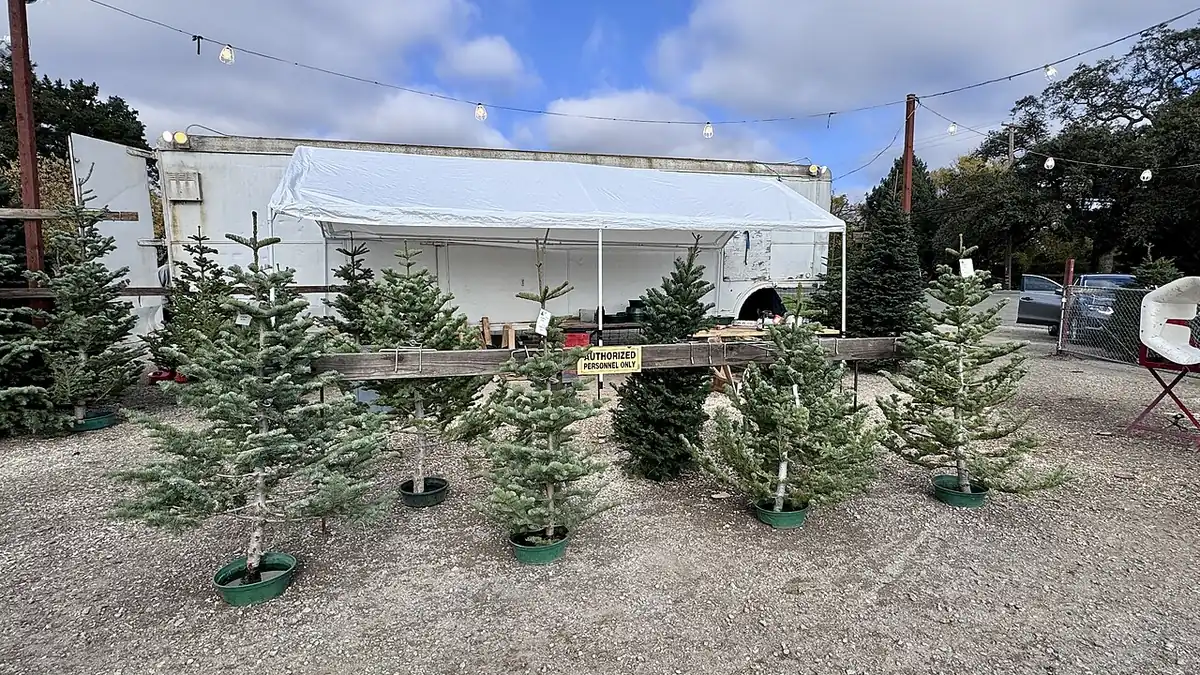
A Christmas tree farm is a conifer farm, and that single fact shapes every decision a startup makes. The crop is a living evergreen — a Fraser fir, a Nordmann fir, a Norway spruce or a Douglas fir — grown in straight rows for seven to ten years, sheared every summer into a dense cone, and then cut, baled and sold in a rush of three or four weeks before Christmas. Nothing about that rhythm matches a fruit crop. There is no blossom to protect, no fruit to grade by colour, no trellis to train and no crush or press at the end of the season. The work is spacing, soil, shearing and timing, repeated year after year on the same blocks until the trees are tall enough to leave the field on a truck.
That long, slow rhythm is exactly why a Christmas tree farm installation startup needs tools built for conifers rather than borrowed from another crop. An orchard installation plans around fruiting wood and harvest windows measured in days for each variety, while a Christmas tree farm plans around a single harvest date shared by the whole block and a shape standard every buyer can see at a glance. The rows must be wide enough for a shearing crew and a baler to pass, the soil must suit acid-loving conifers rather than fruit trees, and the inventory must be counted by height class, not by weight or by crate. Get any of those wrong in year one and the mistake stands in the field, visible and unsaleable, for a decade.
This guide compares the nine best AI tools for Christmas tree farm installation startups in 2026, chosen because each one solves a real conifer problem: laying out rows that stay workable when the trees are two metres tall, reading soil the way a fir reads it, timing the shear so the leader stays straight, spotting needle trouble before it spreads down a row, counting trees by height, calling the cut at the right week, and running the short, intense selling season without losing track of a single tagged tree. Together they cover the whole build, from the first soil sample to the last baled tree on the truck.
Key takeaways
- A Christmas tree farm grows conifers for harvest over seven to ten years, so row spacing, soil and shearing matter far more than any single season’s weather.
- Start with layout and soil: ConiferRow AI for the row plan and FirSoil AI for the ground beneath it, before a single seedling is ordered.
- Shearing is the skill that makes the sale, and ShearSense AI turns it from guesswork into a dated, block-by-block schedule.
- Count trees by height class with TreeCount AI and call the cut with CutReady AI, so the harvest crew cuts saleable trees and leaves the rest to grow.
- The selling season is only three or four weeks long, so LotBook AI and BaleTrack AI have to be ready before the first customer arrives.
How the nine tools compare
The table below gives the short version. Every tool was picked for a conifer job, not a generic farm job, and the sections that follow explain how each one earns its place on a Christmas tree farm.
| Tool | Best for | Conifer job it solves | Buy it |
|---|---|---|---|
| ConiferRow AI | Row layout and block planning | Spacing, access lanes and variety blocks | Before planting |
| FirSoil AI | Soil mapping for conifers | pH, drainage and amendment plans | Before planting |
| ShearSense AI | Shearing schedules | Leader shaping and shear timing | Year two onwards |
| NeedleScan AI | Needle health and pests | Early warnings for needle cast and adelgids | Year two onwards |
| TreeCount AI | Inventory by height class | Drone counts of saleable trees | Year three onwards |
| CutReady AI | Harvest timing | Grading trees and calling the cut | Harvest season |
| BaleTrack AI | Baling and haulage | Tagging, baling and truck loads | Harvest season |
| LotBook AI | Choose-and-cut sales | Bookings, pricing and the sales lot | Harvest season |
| ConiferLedger AI | Money across ten years | Costs, invoices and slow-season cash flow | From day one |
Plan the blocks, rows and soil
A Christmas tree farm is planted once and lived with for a decade, so the planning stage carries more weight here than on almost any other farm. The rows cannot be moved once the seedlings are in, the variety blocks cannot be swapped when a variety falls out of favour, and a wet corner that was ignored in year one will still be drowning seedlings in year five. The first two tools in this guide exist to stop those mistakes before they are planted, and the third makes sure the plan on paper matches the trees in the ground.
1. ConiferRow AI: the best tool for laying out conifer rows
ConiferRow AI draws the farm before a spade touches the ground. It takes the field boundary, the slope, the wet corners and the access points, then lays out rows at the spacing the chosen species needs — wider for a spreading Norway spruce, tighter for a slim Nordmann fir — with turning headlands at the end of every block and access lanes wide enough for a tractor, a shearing crew and, years later, a baler. The plan marks each block by species and planting year, so a crew never has to guess whether the row in front of them is a three-year-old Fraser fir or a five-year-old Douglas fir.
The value shows up in the years when the trees are tall. Rows planned for seedlings are easy; rows that still work when the trees are two metres high and the shearing crew is walking them with long shears are not. ConiferRow AI tests the plan against the mature height of each species, flagging rows that will close over and lanes that will pinch shut, and it keeps a clear route for the harvest truck to every block. A startup that plants from this plan spends its first harvest moving trees, not fighting the layout it planted seven years earlier.
2. FirSoil AI: the best tool for reading conifer soil
FirSoil AI reads the ground the way a fir tree does. Conifers want free-draining, slightly acid soil, and they punish a startup that plants them into heavy, wet or alkaline ground with yellow needles, stunted leaders and whole rows that never catch up. The tool takes soil samples by block, maps pH, organic matter and drainage across the field, and turns the results into an amendment plan that says, in plain terms, which blocks are ready to plant, which need lime kept away and drainage opened up, and which should never have been a conifer block at all.
The map matters because a Christmas tree farm is not uniform ground. One corner may drain well and grow a straight leader every year, while the hollow twenty metres away holds water after rain and rots young roots. FirSoil AI draws that difference instead of averaging it away, so the startup plants the demanding species on the best ground and keeps the tolerant species for the awkward corners. That single choice can decide whether a block is saleable in year seven or still patchy in year ten.
3. TreeCount AI: the best tool for counting trees by height class
TreeCount AI counts the farm from the air and sorts what it finds by height. A drone flight over a block returns a count of every living tree, grouped into height classes — under a metre, one to one-and-a-half metres, one-and-a-half to two metres, and saleable — with the gaps marked where seedlings failed and the doubles marked where two trees are competing in one spot. For a farm that will not sell a tree for seven years, that count is the first honest answer to the only question that matters: how many saleable trees are actually growing.
The height classes are what make the tool a conifer tool rather than a generic counter. A Christmas tree is sold by height, so a count that only says how many trees exist is not enough; the startup needs to know how many will be ready this Christmas, how many next Christmas, and how many the year after. TreeCount AI gives that forward view, block by block, and it repeats the flight each year so the forecast sharpens as the trees grow. A block that was meant to cut two hundred trees this year but only holds one hundred and forty saleable ones is a problem found in spring, when it can be managed, not in December, when customers are already arriving.
It also settles the replanting question with numbers instead of optimism. Gaps are mapped to the row and the metre, so a spring replanting crew walks straight to the empty spots with the right number of seedlings, and the replacement trees are logged against the block they joined. Over a decade, that discipline is what keeps a farm’s blocks full and its harvests predictable.
Grow, shear and keep the trees healthy
The middle years of a Christmas tree farm are quiet work: mowing between the rows, shearing in summer, watching the needles, and waiting. Nothing is sold, so nothing forgives a wasted season. The trees that are sheared well in year four are the trees that sell in year eight, and the pest outbreak that is caught in June is a footnote while the one found in September is a lost block. The two tools in this section exist for those middle years, and they share one job: to make sure the slow work is done at the right time and in the right order. General outdoor tree planting work ends once the tree is in the ground and watered in; a Christmas tree farm is only getting started at that point, because the shape and the health of the tree are the product.
4. ShearSense AI: the best tool for shearing schedules and leader shaping
ShearSense AI turns shearing from a summer rush into a dated plan. It watches the growth of each block, the weather and the calendar, then sets the shearing window for every variety — early for the fast-growing spruce that throws a long leader, later for the slower fir that needs its new growth to firm up first — and it lists the blocks in the order they should be cut. The crew starts each morning knowing which block, which rows and which shape standard they are working to, and the tool records what was sheared, when, and by whom.
The leader is where the tool earns its keep. A Christmas tree lives or dies by its leader: one straight central shoot, neither forked nor bent, carrying the star at the top. ShearSense AI flags trees whose leaders have forked or doubled, marks them for corrective pruning, and tracks whether the correction took. A forked leader found in year three is a five-minute fix; the same fork found in year seven is a tree that will never sell as a premium grade. The tool also photographs the shape standard for each grade, so a new crew member can see what a saleable cone looks like instead of being told about it.
Shearing is also the most labour-heavy job on the farm, and the schedule is what keeps it affordable. Blocks sheared in the right week need one pass; blocks left too late need corrective work on top of the shear. ShearSense AI keeps the farm inside that window, year after year, and the shape of the trees at harvest is the proof.
5. NeedleScan AI: the best tool for spotting needle trouble early
NeedleScan AI looks at needles the way a grower would if they could walk every row every day. It reads drone and phone photographs of the canopy, compares the colour and density of the needles against healthy conifers of the same species and age, and raises an alert when a patch of trees starts to yellow, thin or show the speckling that comes before needle cast takes hold. The alert names the block and the rows, so the grower walks straight to the trouble instead of discovering it while shearing a month later.
Early matters because conifer pests and diseases move down a row. An adelgid colony on one tree in June can be a row of sticky, stunted trees by September, and needle cast spreads on wet wind from the lowest branches upwards. NeedleScan AI is built for that pattern: it watches the lower canopy first, where trouble starts, and it separates a feeding problem from a disease problem, so the response is the right one — a targeted treatment, a drainage fix, or a cull of the worst trees before they infect their neighbours.

Harvest, sell and run the season
Everything on a Christmas tree farm leads to three or four weeks in late November and December. The trees are cut, baled, loaded and sold in a rush, and the farm that is organised for that rush sells its best trees at its best price, while the farm that improvises sells whatever is left at whatever price the day allows. The four tools in this section are the season tools: one calls the cut, one moves the trees, one runs the sales lot, and one makes sure the money from those few weeks carries the farm through the other forty-eight.
6. CutReady AI: the best tool for calling the harvest
CutReady AI decides which trees are cut and when. It reads the height counts from TreeCount AI, the shape grades from the shearing record and the needle health from NeedleScan AI, then grades every block into cut now, cut next year, and leave to grow, with a week-by-week cutting order for the season. The crew cuts the trees that will sell at the top grade first, while the ground is still firm and the trucks can reach the block, and the borderline trees get a final decision in the field rather than a hopeful guess.
The cutting order is the quiet skill of the harvest. Cut a block too early and the trees drop needles before Christmas; cut it too late and the best trees are gone while the crew is still working the far block. CutReady AI staggers the cut so the freshest trees reach the customer last, keeps a reserve of uncut trees for late buyers, and logs every cut tree against its tag, so the farm knows at the end of each day exactly how many saleable trees remain standing.
7. BaleTrack AI: the best tool for baling, tagging and haulage
BaleTrack AI runs the yard where cut trees become loads. Each tree is tagged as it is cut, baled in netting, and scanned onto a pile by grade and height, so the farm always knows how many baled trees are ready, how many are on the truck, and how many are still standing in the block. The tool plans the loads — how many trees of each height fit on the truck, in what order they should be loaded, and which customer or market each load is going to — and it prints the paperwork for every load as it leaves.
Baling looks simple until it is done at volume. A poorly baled tree sheds needles, snags on its neighbours and arrives looking tired, while a well-baled tree travels tight, stacks neatly and opens up fresh at the other end. BaleTrack AI records the baling crew, the netting used and the time each load spent waiting, so a problem with needle drop can be traced to a day, a crew or a batch of netting instead of blamed on the season. It also tracks the stumps and the offcuts, so the block is left clean for spring replanting rather than scattered with waste.
For a startup selling to garden centres and wholesalers as well as to its own lot, the load plan is also the promise. A buyer who ordered eighty trees at one-eighty to two metres gets eighty trees at one-eighty to two metres, counted and tagged, and the tool holds the proof if the count is ever questioned.
8. LotBook AI: the best tool for choose-and-cut sales
LotBook AI runs the choose-and-cut lot, where customers walk the rows, pick a living tree, and watch it cut and baled in front of them. It takes bookings by the hour so the lot never holds more cars than the field can take, prices trees by height class before the customer arrives, and keeps a live count of which blocks are open for choosing and which are closed because the best trees are gone. The customer gets a clear price and a booked slot; the farm gets a steady flow instead of a Saturday crush.
The booking matters because a choose-and-cut lot is a working farm for three weeks of the year, not a shop. Cars need somewhere to park that is not a seedling block, saws need a safe cutting area away from children, and the crew needs to know how many trees will be cut each hour so the baler keeps up. LotBook AI lays out the day in slots, staggers the arrivals, and flags the moment a block should close so the farm is not picked bare in the first weekend.
It also sells the extras that make the season pay: netting, stands, delivery and the smaller trees for flats and porches. Each sale is logged against the tree it came with, so the farm can see which height class earned the most per tree and which block sold out first. A lavender farm installation runs on a cutting season too, but its crop is cut for oil and dried bundles, not chosen live by a family standing in the field — and the lot tool has to be built for that difference, with bookings, live trees and a saw in the grower’s hand.
9. ConiferLedger AI: the best tool for money across ten years
ConiferLedger AI keeps the books for a business that spends for seven years before it sells. It records every cost against the block it belongs to — seedlings, soil amendments, mowing, shearing, pest control, baling netting and the truck — and it spreads those costs across the years until the block is cut, so the startup knows the true cost of each saleable tree instead of a hopeful guess. Income is logged the same way, by block, by height class and by sales channel, so the farm can see which variety earned its keep and which one only looked good in the catalogue.
The cash-flow view is the part that saves startups. A Christmas tree farm earns almost everything in December and spends all year, so the tool forecasts the slow months, flags the weeks when the account will run low, and holds back a reserve for the spring replanting before the season’s takings are spent. It raises quotes and invoices for wholesale buyers, tracks who has paid and who has not, and keeps the tax record clean across a decade of planting and cutting.
Christmas tree farm installation checklist
Use this checklist before the first seedling is ordered. Each step is a decision that is cheap to make now and expensive to fix once the trees are in the ground.
- Walk the whole field in wet weather and mark the ground that holds water; keep conifers off it or drain it first.
- Sample the soil by block, check the pH and drainage with FirSoil AI, and match each species to the ground it will actually grow in.
- Draw the row plan with ConiferRow AI, including headlands, access lanes and a truck route to every block.
- Order seedlings by species and planting year, and log every delivery against the block it was planted in.
- Set the shearing calendar with ShearSense AI before the second growing season, and train the crew on the shape standard for each grade.
- Plan the harvest before the trees are ready: cutting order, baling, loads, lot bookings and the cash reserve for spring replanting.
Frequently asked questions
How much do AI tools for Christmas tree farm installation startups cost in the first year?
Most startups spend a modest amount in the first year because the farm itself is small and the tools are bought in stages. The planning tools come first — the row plan and the soil map — and they cost far less than replanting a block that was laid out wrong. The growing tools join in year two, when there is something to shear and something to scan, and the harvest tools are only needed when the first trees are close to saleable. A one-person startup can run the planning stage on two tools and add the rest as the trees grow, which keeps the first-year bill low and the spending tied to real work.
Which AI tool should a Christmas tree farm installation startup buy first?
Buy the row plan first, then the soil map. ConiferRow AI decides where every tree will stand for the next decade, and FirSoil AI decides whether the ground beneath it will grow a straight leader or a stunted one. Everything else — shearing, scanning, counting and selling — depends on those two decisions being right. A startup that buys a harvest tool before it has planted a straight row is spending money on a problem it does not have yet, while the problem it does have is quietly growing in the wrong place.
Can AI really lay out conifer rows accurately enough to plant from?
Yes, provided the plan is checked on the ground before planting. The tool works from the field boundary, the slope and the species spacing, and it produces a plan a planting crew can follow with a measuring line and marker posts. The startup should still walk the first rows with the plan in hand, check the headlands turn a tractor, and confirm the wet corners are marked, because a map cannot feel soft ground under a boot. Once the first block is planted and checked, the same plan carries the farm for the life of the trees.
How long before a newly planted Christmas tree farm pays for itself?
Most blocks take seven to ten years from planting to the first sale, and the farm as a whole usually pays for itself a few years after the first blocks are cut, once the replanting cycle is running and the later blocks are coming into saleable height. That long wait is why the planning tools matter so much: a block planted well in year one sells in year eight, while a block planted badly in year one is still a cost in year eight. Staggering the planting across several years, so a new block comes into harvest each Christmas, is how a farm turns a single payday into a steady income.
Do Christmas tree farms need irrigation?
Most established Christmas tree farms do not irrigate, because conifers are grown outdoors in a climate that suits them and the trees are expected to grow on rainfall once they are settled. Newly planted seedlings are the exception: a dry first summer can kill a whole row, so a startup should have a plan for watering the first-year trees, whether that is a bowser, a simple drip line or planting early enough for the roots to settle before the dry weather. The soil map matters here too, because a free-draining block dries out faster than a heavy one, and the seedlings on it need water first.
Should a Christmas tree farm installation startup also offer harvest services?
Yes, if the farm is set up for it, because the harvest is where the skill and the money meet. Cutting, baling and loading are skilled jobs, and a startup that can do them well can sell that service to neighbouring growers as well as to its own customers. The work needs the right tools — a cutting order, a baling plan and a load schedule — and it needs a crew that can be trusted with a saw near a customer’s chosen tree. A startup that offers harvest services should build them on the same tools that run its own harvest, so the quality is the same on every farm it works on.
Bottom line
A Christmas tree farm is a ten-year promise made in the first spring, and the tools in this guide exist to keep that promise. Lay the rows out with ConiferRow AI, read the soil with FirSoil AI, shear on schedule with ShearSense AI, watch the needles with NeedleScan AI, count by height with TreeCount AI, call the cut with CutReady AI, move the trees with BaleTrack AI, sell them through LotBook AI, and keep the money honest with ConiferLedger AI. No single tool makes the farm, but together they turn a field of seedlings into a business that sells straight, healthy trees every Christmas.
Start with the plan and the soil, add the growing tools as the trees grow, and have the harvest tools ready before the first customer arrives. The trees will do the slow work themselves; the startup’s job is to make sure every slow year points in the same direction, towards a block of saleable conifers, cut at the right week, and sold at the right price.

Keep what speaks to you.
Leave room for your own perspective.