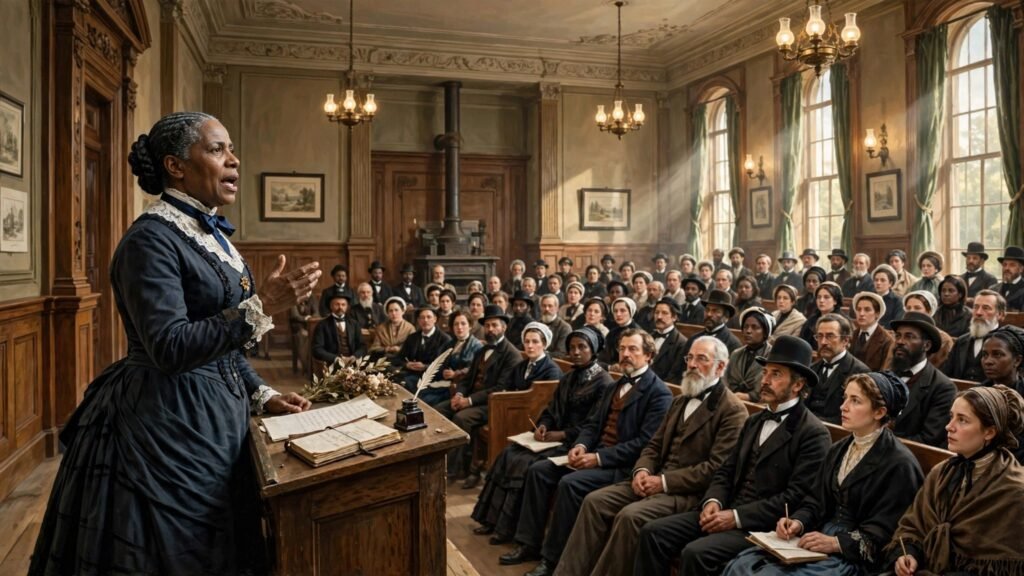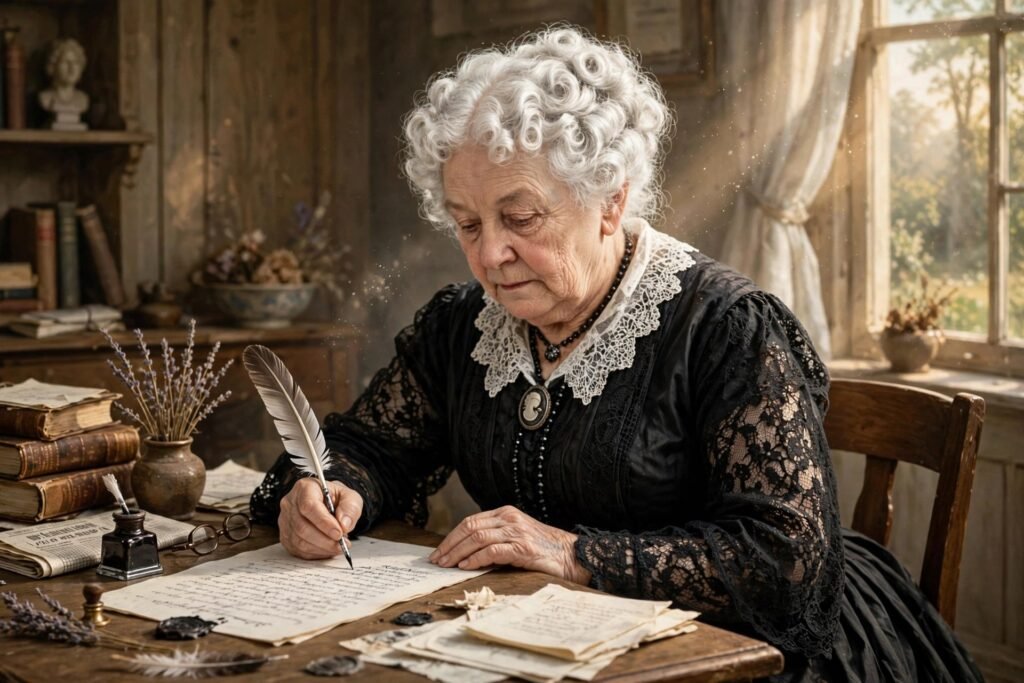
In the summer of 1848, in a small chapel in Seneca Falls, New York, a thirty-two-year-old mother of three stood before a crowd of neighbours and read aloud a document that would change the course of American history. Elizabeth Cady Stanton had taken the Declaration of Independence, the most famous text in the young republic, and rewritten it with a single, electrifying change: where Jefferson wrote “all men are created equal,” she wrote “all men and women are created equal.” The women in the room wept. The men in the room argued. And the women’s suffrage movement, which would take another seventy-two years to win the vote, was born.
Stanton was not a soldier, a politician, or a wealthy heiress. She was a sharp-minded, stubborn, funny woman who had grown up listening to her father, a prominent judge, lament the fact that she had not been born a boy. She turned that wound into a weapon. Over the next half century she would write, speak, organise, and argue her way through the abolitionist movement, the Civil War, and the long suffrage campaign, producing some of the most powerful words ever written about equality in America.
This is the story of Elizabeth Cady Stanton: how a girl from Johnstown, New York, became the mind of a movement, how she and Susan B. Anthony built the most enduring partnership in American reform, and what her life still teaches anyone who wants to change the world. Her lessons are not only about women’s rights. They are about courage, patience, friendship, and the art of saying the true thing when everyone else is afraid to say it.
Key takeaways
- Elizabeth Cady Stanton wrote the Declaration of Sentiments in 1848, launching the organised women’s rights movement in America.
- Her fifty-year partnership with Susan B. Anthony combined Stanton’s ideas and writing with Anthony’s organising and stamina.
- She refused to wait for permission: she spoke, wrote, and published even when newspapers mocked her and churches condemned her.
- Her greatest victories — the vote, married women’s property rights, higher education for women — came long after her work began.
- Stanton’s life teaches that lasting change needs bold ideas, deep friendships, and the patience to keep going for decades.
Elizabeth Cady Stanton at a Glance
| Fact | Detail |
|---|---|
| Born | 12 November 1815, Johnstown, New York |
| Died | 26 October 1902, New York City, aged 86 |
| Best known for | Writing the Declaration of Sentiments, 1848 |
| Main partner | Susan B. Anthony, fifty-year collaboration |
| Major works | Declaration of Sentiments, The Woman’s Bible, Eighty Years and More |
| Key organisations | National Woman Suffrage Association, National American Woman Suffrage Association |
| Family | Married Henry Brewster Stanton; mother of seven children |
| Education | Emma Willard’s Troy Female Seminary, graduated 1832 |
| Final victory | The Nineteenth Amendment, 1920 — eighteen years after her death |
| Legacy | Called the “philosopher” and the mind of the women’s suffrage movement |
A Childhood That Asked Uncomfortable Questions
Elizabeth Cady was born on 12 November 1815 in Johnstown, New York, the daughter of Daniel Cady, a successful lawyer who later became a judge, and Margaret Livingston Cady, from one of New York’s great landowning families. The Cady house was comfortable and well-connected, but it was also a house where a daughter’s limits were made plain. When Elizabeth was eleven, her only surviving brother, Eleazar, died at twenty. She remembered her father weeping over the boy’s body and saying, “Oh, my daughter, I wish you were a boy!” It was a sentence she never forgot. It taught her, young, that the world valued her less for being a girl — and that the unfairness was not in her, but in the world.
She spent hours in her father’s law office, reading his law books and listening to his clients. She noticed something that shocked her: the law treated women as if they were children. A married woman could not own property, keep her own wages, sign a contract, or keep her children if her husband left her. Widows and single women had more rights, but married women had almost none. Young Elizabeth asked her father why the laws were so unjust. He told her the laws were the laws, and when she grew up she could change them — but first, he said, the laws had to be obeyed. She never accepted that answer.
At school she was a fierce student. She attended the Johnstown Academy, where she was the only girl in the senior class in Greek, and then the Troy Female Seminary, one of the first schools in America to offer girls a serious education. She learned Latin, Greek, mathematics, and philosophy, and she learned something else: that she was just as clever as any boy. The gap between what she could do and what the world would let her do became the engine of her life.
Marriage, Motherhood, and a Growing Restlessness
In 1840 Elizabeth married Henry Brewster Stanton, a handsome abolitionist orator she had met through the anti-slavery movement. Their honeymoon was a voyage to London for the World’s Anti-Slavery Convention — and it was there that she received one of the great shocks of her life. The convention refused to seat the women delegates, including the famous Lucretia Mott. The women were forced to sit behind a curtain, silent, while the men debated slavery. Stanton and Mott walked the streets of London together, furious, and promised each other that one day they would hold a convention of their own — a convention about women’s rights.
Back in America, Stanton settled into the life expected of a respectable wife: she kept house, raised children — seven in all — and supported her husband’s career. But the restlessness never left her. She read widely, wrote letters to reformers, and thought constantly about the position of women. She later wrote that she felt “like a caged bird” in those years, and that the loneliness of a thinking woman in a small town was one of the hardest things she ever endured.
Yet those years were not wasted. Raising seven children taught her about the sheer physical and emotional labour of women’s lives, and it made her arguments concrete. When she later wrote about the need for women to control their own bodies, their own wages, and their own education, she was writing from experience, not from theory. Motherhood did not silence her. It gave her something to say.
Seneca Falls: The Convention That Started Everything
In July 1848, Stanton was visiting Lucretia Mott in Waterloo, New York, when the two women and a small group of friends decided, almost on the spur of the moment, to call a women’s rights convention. They placed a notice in the local newspaper giving just five days’ warning. They expected a handful of people. On 19 July, three hundred men and women crowded into the Wesleyan Chapel in Seneca Falls, spilling out of the doors and into the street.
Stanton had spent the days before the convention writing the document that would define it: the Declaration of Sentiments. Modelled line by line on the Declaration of Independence, it listed eighteen grievances against men — the denial of the vote, the denial of property rights, the denial of education, the denial of divorce, the denial of a woman’s right to her own wages. Then came the resolutions, eleven of them, including the most controversial: that it was the duty of women to secure the right to vote. Even Lucretia Mott worried the demand was too bold. Stanton insisted. The resolution passed — by a narrow margin, after Frederick Douglass, the great abolitionist, rose to support it.
The newspapers mocked the convention mercilessly. Preachers denounced it from their pulpits. But the idea could not be put back in the bottle. The Seneca Falls Convention is now remembered as the birth of the organised women’s rights movement in the United States, and the Declaration of Sentiments as its founding text. Stanton was thirty-two years old, and she had just written herself into history.
The Partnership with Susan B. Anthony
In 1851, Stanton met a young Quaker schoolteacher named Susan B. Anthony, and the two women formed what became the most famous partnership in American reform. They were opposites in almost every way. Stanton was married, the mother of a growing family, witty, warm, and endlessly creative with words. Anthony was single, childless, tireless, and organised to the last detail. Stanton called Anthony her “other self.” Anthony called Stanton the brains of the operation. Together they were unstoppable.
The division of labour was simple and brilliant. Stanton, tied to her home by her children, wrote the speeches, the articles, and the petitions. Anthony travelled, organised, collected signatures, and delivered the speeches Stanton wrote — often hundreds of miles from home, in freezing halls, to hostile crowds. “I forged the thunderbolts and she fired them,” Stanton later said. It was a partnership built on total trust: each woman knew exactly what the other could do, and neither tried to do the other’s job.
The partnership lasted more than fifty years, through the Civil War, through the split in the suffrage movement, through decades of defeat. When Stanton died in 1902, Anthony said she had lost her other half. Their friendship is one of the great lessons of Stanton’s life: that lasting change is rarely the work of one person alone. It is the work of people who choose each other, share the burden, and refuse to quit.
The Civil War and the Fight Over the Vote
When the Civil War began in 1861, Stanton and Anthony put the suffrage campaign on hold and threw themselves into the abolitionist cause. They believed, like most reformers, that the war would end slavery and that women’s rights would follow. They organised the Women’s Loyal National League, collecting hundreds of thousands of signatures demanding emancipation. It was the largest petition campaign in American history to that point.
But the end of the war brought a bitter disappointment. The Fourteenth Amendment, passed in 1868, gave citizenship and voting rights to formerly enslaved men — and for the first time, it wrote the word “male” into the United States Constitution. The Fifteenth Amendment, in 1870, forbade denying the vote on account of race, but said nothing about sex. Stanton and Anthony felt betrayed. They had worked for emancipation, and they believed women had been left behind.
The disagreement split the women’s movement in two. One group, led by Lucy Stone, supported the amendments and believed women’s turn would come. Stanton and Anthony formed their own organisation, the National Woman Suffrage Association, and demanded a constitutional amendment for women. The split lasted twenty years. It was a painful chapter, and historians still argue about who was right. What is clear is that Stanton never stopped fighting for the principle she had stated at Seneca Falls: that the vote belonged to all citizens, not just to men.
A Writer Who Would Not Be Silenced
Stanton’s greatest weapon was her pen. Over her long life she wrote thousands of pages: speeches, newspaper articles, pamphlets, books, and letters. Her writing was clear, funny, and fearless. She attacked the church, the law, and the customs of her day with a wit that made her enemies furious and her friends laugh. She believed that ideas were the real engine of change, and that a well-written sentence could do more than a thousand meetings.
Her most controversial work came late in life. In 1895, at the age of eighty, she published The Woman’s Bible, a commentary on the passages of scripture used to keep women subordinate. It caused a scandal. Even her allies in the suffrage movement distanced themselves, passing a formal resolution condemning the book. Stanton was hurt but unbowed. She believed that no movement could be free while it left unquestioned the religious ideas that justified inequality.
In 1898 she published her autobiography, Eighty Years and More, one of the great memoirs of nineteenth-century America. It is funny, candid, and full of the energy that carried her through eight decades. She wrote about her childhood, her marriage, her children, her friendships, and her fights — and she wrote as if she were talking to a friend across a table. It remains one of the best ways to meet her.
The Long Wait and the Final Years
Stanton spent the last decades of her life watching the movement she had founded grow beyond her. Younger women took over the leadership. State by state, the vote was won — first in Wyoming, then in Colorado, then in a slow trickle across the West. Stanton testified before Congress, wrote articles, and gave speeches well into her eighties. She never saw the final victory, but she never doubted it would come.
She died in New York City on 26 October 1902, at the age of eighty-six. She had outlived most of her contemporaries, and she died knowing that the cause was in younger hands. Eighteen years later, in 1920, the Nineteenth Amendment was ratified, giving American women the right to vote. It was the victory she had demanded at Seneca Falls in 1848, seventy-two years earlier.
Stanton’s life is a lesson in patience. She began with a demand that seemed impossible, and she worked for it for more than half a century without seeing it fulfilled. She did not live to see the vote, but the vote came because of her. That is the paradox of her life: she won by refusing to stop, even when winning was far away.
Why Elizabeth Cady Stanton Still Matters
Stanton matters today because the questions she asked have not gone away. Who gets to vote? Who owns their own wages? Who decides what a woman can do with her life? These are still live questions in every country on earth, and Stanton was one of the first people to ask them in public, in writing, and to demand answers. She did not invent the idea of equality, but she gave it a voice that could not be ignored.
She also matters because of how she worked. She did not wait for permission, or for the right moment, or for someone else to lead. She wrote the document, called the convention, and took the criticism that followed. She built a partnership that lasted fifty years. She kept going when the movement split, when the newspapers mocked her, and when even her allies turned away. That is a model of leadership that has nothing to do with titles and everything to do with character.
Finally, Stanton matters because she was funny. She believed that laughter was a weapon, and she used it constantly. She mocked the men who said women were too delicate to vote, pointed out that the same men expected women to scrub floors and carry water, and asked why delicacy stopped at the ballot box. Humour made her arguments memorable, and it made her enemies look foolish. It is a lesson for every reformer: take the cause seriously, but never take yourself so seriously that you lose your sense of humour.
Lessons from the Life of Elizabeth Cady Stanton
The first lesson of Stanton’s life is to say the true thing, even when it is unpopular. At Seneca Falls she insisted on demanding the vote when even her friends thought it was too bold. She was right, and they were wrong — but she could only be proved right by saying it first. Change begins with someone willing to be laughed at.
The second lesson is to find your partner. Stanton’s fifty-year collaboration with Susan B. Anthony was the engine of the suffrage movement. One woman wrote the words; the other carried them across the country. Neither could have done it alone. The lesson is not to find someone just like you, but someone whose strengths complete yours.
The third lesson is to work for the long term. Stanton fought for the vote for more than fifty years and died before it was won. She did not measure success by what she saw in her own lifetime. She measured it by whether the work would outlast her. Anyone who wants to change the world needs that kind of patience.
Checklist: What We Can Learn from Elizabeth Cady Stanton
- Say the bold thing first — even your friends may think it is too much, and they may be wrong.
- Find a partner whose strengths complete yours, and build a friendship that can carry decades of work.
- Write it down: clear, honest writing outlasts speeches and survives every setback.
- Do not wait for permission — call the meeting, publish the article, make the demand.
- Keep your sense of humour; laughter makes hard truths easier to hear.
- Measure success in decades, not in days — the work you start may be finished by others.
Frequently Asked Questions
Who was Elizabeth Cady Stanton?
Elizabeth Cady Stanton (1815–1902) was an American writer and activist who organised the Seneca Falls Convention in 1848 and wrote the Declaration of Sentiments, the founding document of the women’s rights movement in the United States. She spent more than fifty years campaigning for women’s suffrage, property rights, and education.
What did Elizabeth Cady Stanton write at Seneca Falls?
She wrote the Declaration of Sentiments, modelled on the Declaration of Independence, which listed eighteen grievances against men and demanded equal rights for women — including the right to vote. It was the first public document in America to demand the vote for women.
How did Stanton and Susan B. Anthony work together?
Stanton wrote the speeches, articles, and petitions, while Anthony travelled the country delivering them and organising the movement. Stanton said, “I forged the thunderbolts and she fired them.” Their partnership lasted more than fifty years.
Did Elizabeth Cady Stanton live to see women win the vote?
No. She died in 1902, eighteen years before the Nineteenth Amendment was ratified in 1920. But the amendment was the direct result of the movement she founded at Seneca Falls in 1848.
Why was The Woman’s Bible controversial?
Published in 1895, The Woman’s Bible challenged the passages of scripture used to justify women’s subordination. Even her allies in the suffrage movement condemned it, but Stanton believed no movement could be free while it left those ideas unquestioned.
What is Elizabeth Cady Stanton’s legacy today?
She is remembered as the philosopher and the mind of the women’s suffrage movement. Her writings, her partnership with Anthony, and her insistence on demanding the vote shaped the fight for women’s rights in America and inspired movements around the world.
Bottom line
Elizabeth Cady Stanton was a woman who asked an uncomfortable question — why should women have fewer rights than men? — and then spent fifty years refusing to accept the answers she was given. She wrote the founding document of the women’s rights movement, built one of the great partnerships in American history, and kept going through mockery, defeat, and division until the cause was in younger hands. She did not live to see women win the vote, but the vote was won because she began. Her life is proof that one clear voice, joined to a true friendship and sustained by patience, can change a nation.
Note: This article is a general historical account of Elizabeth Cady Stanton’s life and work, written for readers of Face Zem. Her story, like that of her fellow campaigner Sojourner Truth and the fearless conductor of the Underground Railroad, Harriet Tubman, is a reminder that the rights we take for granted were won by people who refused to wait for them.

Keep what speaks to you.
Leave room for your own perspective.