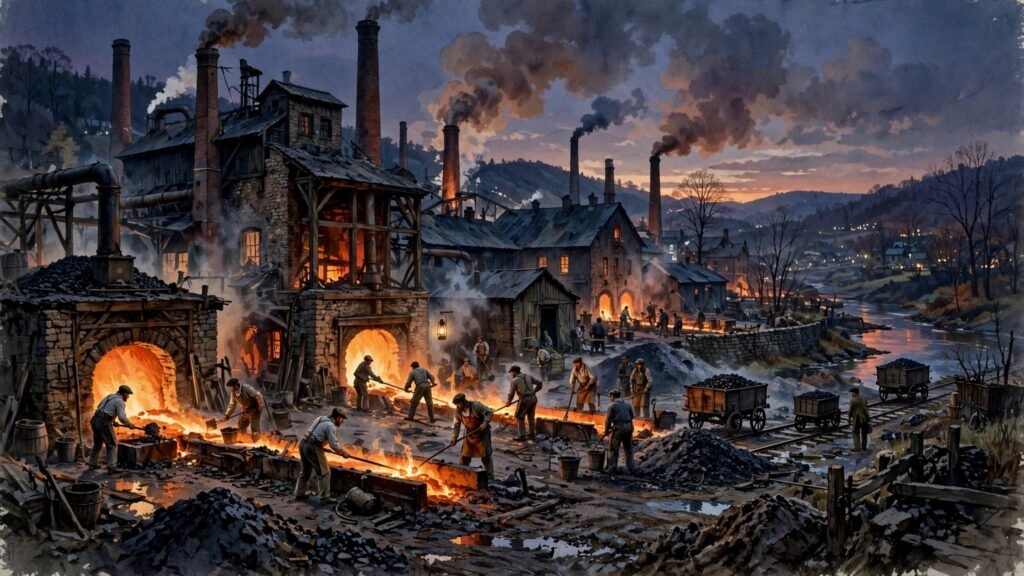
In 1861, a shy young woman from Wheeling, Virginia, mailed a story to the most famous magazine in America. She had never met an editor, never lived in a literary city, and never published a word. The Atlantic Monthly read her manuscript, printed it in its April issue, and paid her one hundred dollars — a small fortune for a writer who had spent her life teaching school in a river town. The story was called “Life in the Iron-Mills,” and it changed American literature.
Rebecca Harding Davis was not a celebrity writer. She never became rich or famous in the way later authors did, and for decades after her death she was nearly forgotten. Yet the story she wrote in her early thirties did something no American fiction had done before: it took readers inside a factory, into the smoke and noise and exhaustion of the men who worked there, and asked them to see those men as fully human. Before the muckrakers, before the social novel, before realism became a fashion, Davis wrote the truth as she saw it.
Her success story is not a story of sudden fame. It is a story of patience, courage, and a stubborn refusal to write pretty stories when ugly truths needed telling. She wrote through marriage, motherhood, financial worry, and long years of being overlooked. And in the end, her work outlived her obscurity. This is how a woman who wrote about iron and smoke became one of the most important American writers of the nineteenth century.
Key takeaways
- Rebecca Harding Davis published “Life in the Iron-Mills” in the Atlantic Monthly in 1861, and it made her famous overnight.
- She was one of the first American writers to make industrial workers the heroes of serious fiction.
- Her realism — writing about poverty, pollution, and hard labour — was decades ahead of its time.
- She kept writing for nearly fifty years, publishing novels, stories, and journalism while raising a family.
- Her greatest lesson is that telling the truth plainly, even when it is unfashionable, is a form of courage that lasts.

Rebecca Harding Davis at a Glance
| Born | 24 June 1831, Washington, Pennsylvania |
| Died | 29 September 1910, Mount Kisco, New York |
| Breakthrough work | “Life in the Iron-Mills” (Atlantic Monthly, April 1861) |
| Best-known novels | Margret Howth (1862), Waiting for the Verdict (1868), John Andross (1874) |
| Writing career | 1861–1910, nearly fifty years |
| Family | Married journalist L. Clarke Davis in 1863; three children, including writer Richard Harding Davis |
| Style | Realism, social reform fiction, industrial literature |
| Honours | Rediscovered by feminist scholars in the 1970s; now a classic of American literature |
| Famous line | “What shall we do to be saved?” — the question at the heart of “Life in the Iron-Mills” |
| Legacy | A pioneer of American realism and the social novel |
A Childhood on the Edge of Industry
Rebecca Blaine Harding was born on 24 June 1831 in Washington, Pennsylvania, the eldest of five children. Her father, Richard W. Harding, was an English-born businessman; her mother, Rebecca Wilson Harding, came from a wealthy Virginia family. When Rebecca was five, the family moved to Wheeling, Virginia — a booming industrial town on the Ohio River, full of iron mills, glass factories, and coal smoke.
Wheeling was not a pretty place. The mills ran day and night. The air was thick with soot, and the river ran black with waste. But it was also a place of energy and ambition, and young Rebecca watched it all. She saw the mill workers trudge home at dawn, their faces blackened, their bodies bent. She saw the owners’ fine houses on the hill and the workers’ shanties below. The contrast stayed with her for the rest of her life.
She was educated at home and then at Washington Female Seminary, where she graduated in 1848 as the valedictorian of her class. She was a serious, bookish girl who read widely and thought deeply. After school, she returned to Wheeling and worked as a teacher, but teaching was only a way to earn a living. Her real education was the town itself — the mills, the workers, and the questions their lives raised in her mind.
The Story That Changed Everything
In 1860, Rebecca wrote a long short story called “Life in the Iron-Mills.” It told the story of Hugh Wolfe, a Welsh immigrant who worked as a puddler in an iron mill — one of the hottest, hardest, most dangerous jobs in the factory. Hugh was not a hero in the usual sense. He was poor, uneducated, and slowly being destroyed by his work. But he had a gift: he could carve beautiful figures from korl, the waste metal of the mill. His art was his soul crying out for something better than the life he had been given.
The story’s narrator speaks directly to the reader, refusing to let anyone look away. “I want you to come down and look at this Wolfe,” the narrator says, dragging the comfortable reader into the mill’s smoke and heat. When Hugh steals money to escape his life and is caught, the story asks the question that haunted Davis for the rest of her career: “What shall we do to be saved?” It was a question aimed at every reader who had ever enjoyed the comforts that other people’s labour made possible.
She sent the story to the Atlantic Monthly, the most respected literary magazine in America. The editor, James T. Fields, read it and wrote back immediately. He published it in the April 1861 issue, and it caused a sensation. Readers wrote letters. Critics praised it. The great novelist Nathaniel Hawthorne read it and wrote to Fields, asking who the author was. Davis had arrived.
Overnight Fame in Boston
The success of “Life in the Iron-Mills” changed Rebecca’s life in a matter of weeks. She was invited to Boston, the centre of American literary life, where she met the writers she had only read about: Ralph Waldo Emerson, Henry Wadsworth Longfellow, and the Atlantic’s circle of editors and authors. They welcomed her warmly. Emerson praised her work. Hawthorne, who had been one of her heroes, became a friend and correspondent.
For a young woman from Wheeling, Boston was dazzling. But Davis was not dazzled into changing who she was. She did not want to write elegant stories about elegant people. She wanted to write about the world she knew — the mills, the workers, the poor, and the overlooked. Her second novel, Margret Howth, was published in 1862, and though the publisher softened its ending against her wishes, it confirmed that she was a serious novelist, not a one-story wonder.
In Boston she also met L. Clarke Davis, a young journalist and lawyer who worked for the New York Tribune. They fell in love and married in 1863. It was a partnership of equals: two writers who respected each other’s work and shared a commitment to honest journalism and honest fiction.
Marriage, Motherhood, and the Pen
After her marriage, Davis moved to Philadelphia, where her husband worked as an editor. Over the next decade, she gave birth to three children — Richard, Charles, and Nora — and somehow kept writing. She wrote novels, short stories, essays, and journalism, often at night after the children were asleep. Her son Richard Harding Davis would grow up to become one of the most famous war correspondents and novelists of his generation, and he always credited his mother’s example.
The years after the Civil War were productive. She published Waiting for the Verdict in 1868, a novel about the aftermath of slavery and the struggle for justice. She wrote John Andross in 1874, a novel about politics and corruption. She contributed regularly to magazines like Harper’s, Scribner’s, and the Atlantic. Her work was steady, serious, and respected — even if it never again caused the sensation of her first story.
But writing was not easy. The family was never wealthy, and Davis often wrote for money as much as for art. She wrote quickly, sometimes too quickly, and her later work does not always match the power of her early stories. Yet she never stopped. She believed that a writer’s job was to keep looking, keep telling the truth, and keep working — even when the world stopped paying attention.
A Realist Before Realism
Today, Rebecca Harding Davis is recognised as one of the founders of American realism. When she wrote “Life in the Iron-Mills” in 1861, most American fiction was romantic and sentimental. Novels were about noble heroes, beautiful heroines, and happy endings. Davis wrote about a mill worker who steals, goes to prison, and dies. There was no happy ending, no easy moral, and no escape from the smoke.
Her realism was not just a style. It was a moral choice. She believed that literature should show the world as it really was, especially the parts of the world that comfortable people preferred to ignore. She wrote about factories, slums, prisons, and the lives of working women. She wrote about the cost of industrial progress — not in statistics, but in human lives. Like Charlotte Perkins Gilman, whose own writing challenged how society treated women, Davis used fiction to question the world she lived in.
Decades later, writers like Stephen Crane, Theodore Dreiser, and Upton Sinclair would do the same thing and be celebrated for it. Davis did it first, and she did it as a woman in a literary world that expected women to write about love and home. Her courage was not only in what she wrote, but in the fact that she wrote it at all.
The Novels of the Middle Years
Davis published more than a dozen novels and hundreds of stories and essays. Her best-known novels after Margret Howth include Dallas Galbraith (1868), Waiting for the Verdict (1868), John Andross (1874), A Law Unto Herself (1878), and Natasqua (1886). Each of them took up a social question: the treatment of workers, the corruption of politics, the position of women, the legacy of slavery.
She also wrote for children and for newspapers, and she was a regular contributor to the New York Tribune, where her husband worked. Her journalism covered everything from factory conditions to the lives of women in the city. She was, in the modern sense, a working writer — someone who wrote what editors would buy, but who smuggled her convictions into everything she wrote.
Not all of her work has survived the test of time. Some of her novels are melodramatic, and some of her plots are clumsy. But at her best — in “Life in the Iron-Mills,” in her short stories, and in her finest essays — she wrote with a power and honesty that few of her contemporaries could match. She belongs in the company of other nineteenth-century women writers who shaped American literature, among them Emily Dickinson and Jane Austen, whose work also outlasted the fashions of their day.
The Long Quiet Years
As the nineteenth century drew to a close, Davis’s fame faded. New writers arrived with new styles, and the literary world moved on. She kept writing, but her books sold less and less. She and her husband lived modestly in Philadelphia, and later in Mount Kisco, New York, where they moved to be near their son Richard.
She did not complain. In her memoirs, published as Bits of Gossip in 1904, she wrote about her life with warmth and humour, remembering the Boston of Emerson and Hawthorne, the excitement of her first publication, and the long years of steady work. She was proud of what she had done, even if the world had moved on.
She died on 29 September 1910, at the age of seventy-nine. Her obituaries were respectful but brief. For the next sixty years, she was largely forgotten — a footnote in literary histories, a name that students rarely encountered.
The Rediscovery
In 1972, the feminist scholar Tillie Olsen republished “Life in the Iron-Mills” with a long biographical essay, and suddenly Davis was back. Olsen argued that Davis had been one of the most important American writers of the nineteenth century, and that her neglect was a result of both her sex and her subject matter: she wrote about workers, and the literary establishment preferred writers who wrote about gentler things.
Olsen’s edition changed everything. Scholars began to study Davis seriously. Her novels were reprinted. University courses included her work. “Life in the Iron-Mills” became a standard text in American literature classes, and Davis was recognised as a pioneer of realism, a founder of the social novel, and one of the first American writers to take the working class seriously.
Today, she is read not as a curiosity but as a classic. Her story of Hugh Wolfe is taught alongside the work of Melville, Hawthorne, and Twain. Her life is studied as an example of what it meant to be a woman writer in the nineteenth century — and of what it cost to tell the truth.
What Made Her Great
Rebecca Harding Davis was great because she looked where others refused to look. She saw the iron mills of Wheeling not as a backdrop but as a subject worthy of serious literature. She saw the workers not as scenery but as people with souls, dreams, and moral claims on the reader. That vision — simple, direct, and unflinching — was revolutionary.
She was also great because she kept going. She wrote through marriage, motherhood, poverty, and obscurity. She wrote when she was famous and when she was forgotten. She wrote because she believed that writing mattered, that stories could change how people saw the world, and that a writer’s duty was to bear witness.
Finally, she was great because she was honest. She did not flatter her readers. She did not offer easy answers. She asked hard questions and left them hanging in the air. “What shall we do to be saved?” is still a question worth asking — and Davis was one of the first American writers brave enough to ask it.
Lessons from Her Life
Davis’s life offers lessons for anyone who wants to do meaningful work. The first is to trust what you see. She did not need to travel to Paris or London to find a subject. Her subject was outside her window, in the smoke of Wheeling. The world you know best is often the world most worth writing about.
The second lesson is to be brave about the truth. Davis knew that “Life in the Iron-Mills” would shock readers, and she published it anyway. She knew that writing about workers and poverty would cost her the easy path to literary fame, and she chose it anyway. Courage is not the absence of fear. It is doing the honest thing even when it is hard.
The third lesson is to keep working. Davis wrote for nearly fifty years, through good times and bad. She did not wait for perfect conditions or perfect recognition. She wrote because the work mattered to her, and that steady persistence is what allowed her to produce a body of work that outlived her.
The fourth lesson is that obscurity is not failure. Davis was forgotten for sixty years, and then she was rediscovered. Good work has a way of surviving, even when the world is slow to recognise it. The job is to do the work well and let time do the rest.
Checklist: Writing with Courage Like Rebecca Harding Davis
- Look closely at the world around you — your best material is often close at hand.
- Write about people who are usually ignored, and take their lives seriously.
- Ask hard questions in your work, even when there are no easy answers.
- Keep writing through busy seasons, setbacks, and years when nobody seems to notice.
- Choose honesty over comfort, even when the honest version is harder to sell.
- Remember that good work can outlive obscurity — write for the long term, not the moment.
Frequently Asked Questions
What is Rebecca Harding Davis best known for?
She is best known for her short story “Life in the Iron-Mills,” published in the Atlantic Monthly in April 1861. It was one of the first American works of realism and the first major American story to centre on industrial workers.
Was “Life in the Iron-Mills” really that important?
Yes. It appeared decades before realism became the dominant style in American fiction, and it influenced later writers who wrote about factories, poverty, and social reform. It also impressed Nathaniel Hawthorne, who praised it and became Davis’s friend.
Did Rebecca Harding Davis write anything besides “Life in the Iron-Mills”?
She wrote for nearly fifty years, publishing more than a dozen novels — including Margret Howth, Waiting for the Verdict, and John Andross — along with hundreds of stories, essays, and newspaper articles.
Why was she forgotten for so long?
She wrote about working-class life at a time when literary critics favoured romantic and genteel subjects, and as a woman writer she received less attention than her male contemporaries. Feminist scholars in the 1970s, led by Tillie Olsen, rediscovered her work.
Was her son Richard Harding Davis also a writer?
Yes. Richard Harding Davis became one of the most famous journalists and novelists of his generation, known for his war reporting and adventure stories. He often credited his mother’s example and encouragement.
Where can I read “Life in the Iron-Mills” today?
The story is widely available in anthologies of American literature and in standalone editions, and it is taught in university courses on American realism and nineteenth-century literature.
Bottom line
Rebecca Harding Davis wrote one of the most important stories in American literature from a small industrial town, with no connections and no literary pedigree — only a clear eye, a brave heart, and a refusal to look away. She proved that the lives of ordinary workers were worthy of great art, and she paid for that honesty with decades of obscurity. Her rediscovery reminds us that real achievement is not always recognised in its own time, and that the work itself is the reward. Face Zem celebrates her as a writer who changed what American literature could be, and whose question — “What shall we do to be saved?” — still deserves an answer.
Note: This article is a general historical account of Rebecca Harding Davis’s life and work, written for readers of Face Zem. Dates, titles, and events are drawn from the public historical record.

Keep what speaks to you.
Leave room for your own perspective.


