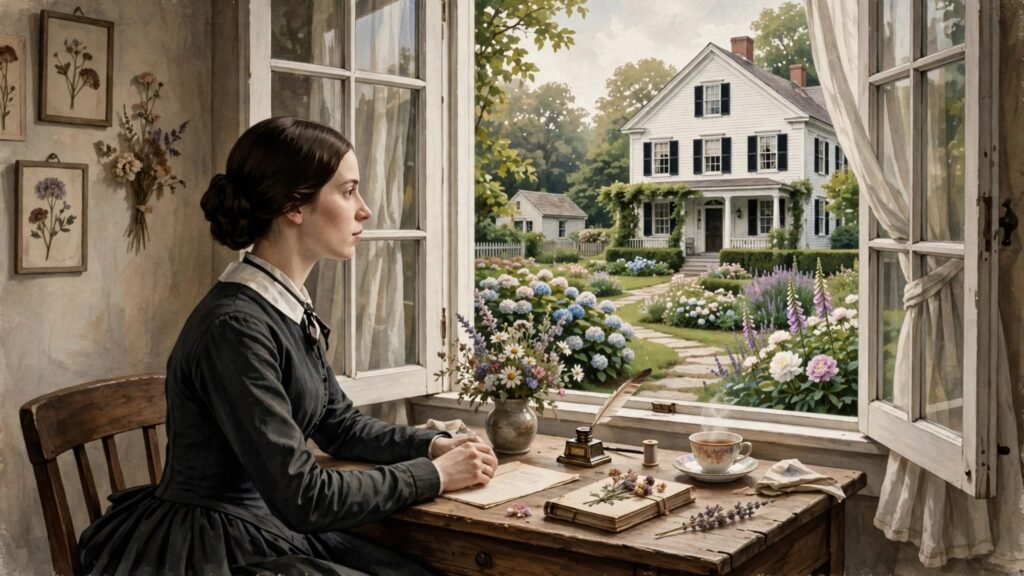
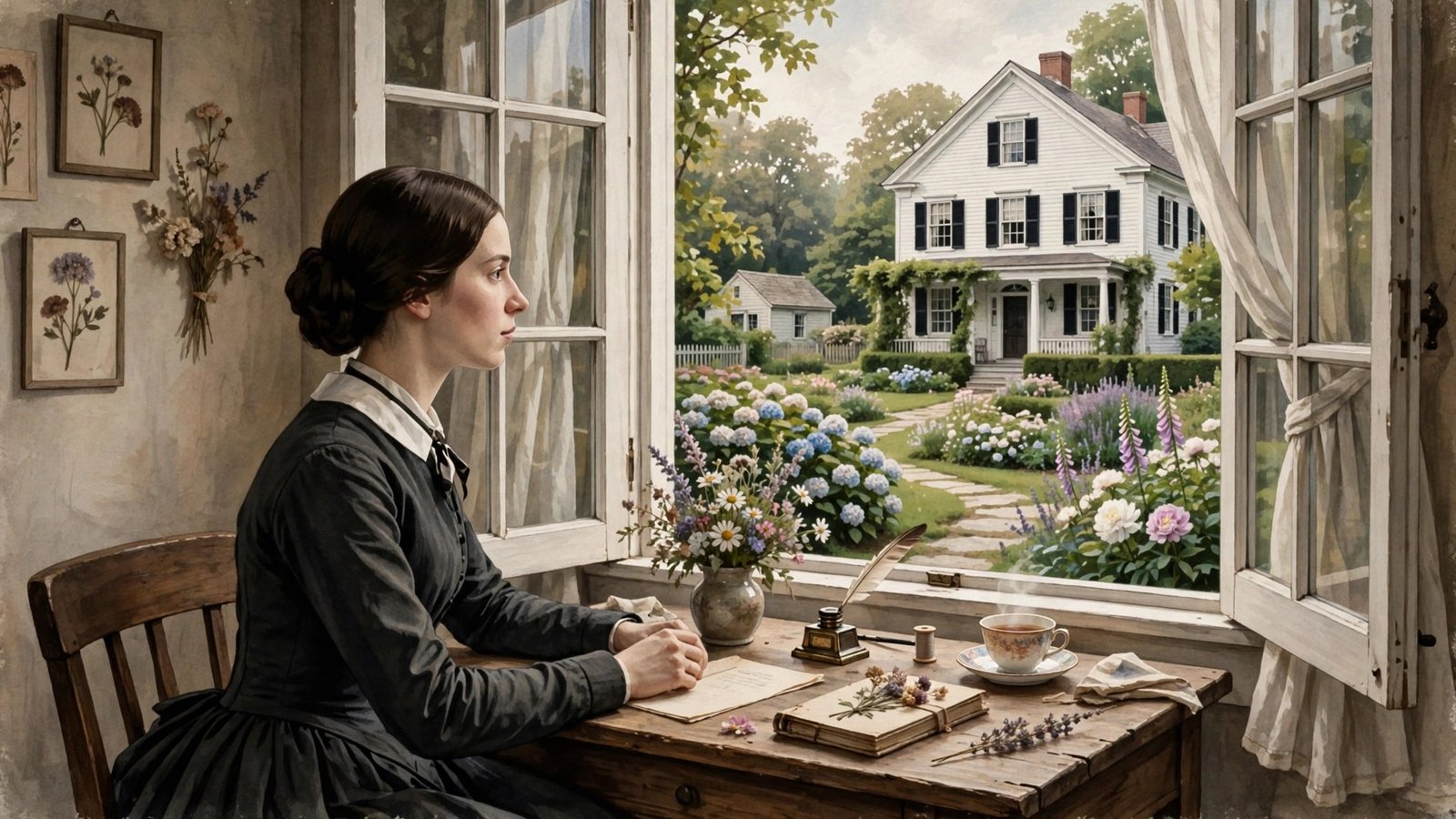
Emily Dickinson spent most of her life in a single house in Amherst, Massachusetts, writing poems almost nobody read. She dressed in white, received few visitors, and sent her verses in letters to a small circle of friends. When she died in 1886 at the age of 55, her family found nearly 1,800 poems in her bedroom — bound in little hand-sewn booklets, hidden in drawers, and tucked into envelopes. Almost none of them had ever been published.
Today, Emily Dickinson is counted among the greatest poets America has ever produced. Her poems are read in classrooms around the world, set to music, quoted in films, and studied by scholars who still argue over what she meant. She never gave a public reading, never sought fame, and never earned a living from her writing — yet her words outlived every bestseller of her own century. Her story is proof that success does not always arrive on schedule, and that a quiet life can hold an enormous legacy.
What makes Dickinson’s success story so powerful is that she refused to measure herself by the world’s standards. Editors told her to smooth out her strange dashes and broken rhythms, to make her poems sound like everyone else’s. She said no. She kept writing in her own voice, in her own room, on her own terms — and the world eventually came to her. On Face Zem, her life is a reminder that the work itself is the reward, and that patience can be a form of courage.
Key takeaways
- Emily Dickinson wrote nearly 1,800 poems, most of them unpublished during her lifetime.
- She wrote in a radical, original style — short lines, dashes, slant rhymes — that editors of her day did not understand.
- Her sister Lavinia discovered the poems after her death and fought to publish them.
- Her fame grew slowly, over decades, until she became one of America’s most celebrated poets.
- Her lesson: protect your voice, keep working quietly, and let the work speak for itself.
Emily Dickinson at a Glance
| Detail | Fact |
|---|---|
| Born | 10 December 1830, Amherst, Massachusetts |
| Died | 15 May 1886, Amherst, Massachusetts |
| Poems written | Nearly 1,800 |
| Poems published in her lifetime | About 10, mostly anonymously |
| Best-known poems | “Because I could not stop for Death”, “Hope is the thing with feathers”, “I dwell in Possibility” |
| First collection | Poems (1890), edited by Thomas Wentworth Higginson and Mabel Loomis Todd |
| Writing style | Short lines, dashes, slant rhyme, capitalised nouns |
| Occupation | Poet, homemaker, gardener |
| Legacy | One of the most important poets in American literature |
| Lesson | Success can arrive long after the work is done |
A Childhood in Amherst
Emily Elizabeth Dickinson was born on 10 December 1830 into one of Amherst’s most respected families. Her father, Edward Dickinson, was a lawyer and later a congressman; her mother, Emily Norcross Dickinson, kept a busy household. The Dickinson home — the Homestead on Main Street — was large, comfortable, and full of books. Emily grew up with her older brother Austin and her younger sister Lavinia, and the three siblings remained close all their lives.
As a girl, Emily was bright, witty, and musical. She played the piano well, loved the garden, and devoured books. She attended Amherst Academy and then spent a year at Mount Holyoke Female Seminary, one of the best schools for young women in America. She left after a single year, homesick and unsettled by the school’s intense religious atmosphere. It was the first of many times she would choose her own path over the expected one.
Back home, she settled into the rhythm of a nineteenth-century New England household: baking, gardening, visiting neighbours, and writing letters. But beneath that ordinary surface, something extraordinary was happening. She was reading widely — Shakespeare, the Brontës, Emerson, the Bible — and beginning to write poems of her own, in a voice unlike anything anyone had heard.
The Poet in the White Dress
By her early thirties, Dickinson had begun to withdraw from the social world. She stopped attending church, received visitors less and less, and eventually rarely left the Homestead at all. She wore white dresses, a habit that fascinated visitors and later generations alike. Some called her eccentric; some called her the “Myth of Amherst.” But her seclusion was not emptiness — it was focus. Inside her room, she was writing at a furious pace.
Between 1861 and 1865, the years of the American Civil War, Dickinson wrote more than 800 poems — the most productive period of her life. She copied many of them into hand-sewn booklets called fascicles, carefully arranging them as if she were preparing a book no publisher would ever see. She also sent hundreds of poems in letters to friends, family, and a few literary correspondents, often tucking a verse into a note about the weather or a gift of flowers.
Her poems were short, strange, and startling. She used dashes where other poets used commas, capitalised ordinary nouns like “Circumference” and “Eternity,” and rhymed words that only almost rhymed — “soul” with “all,” “port” with “chart.” To the editors of her day, this looked like mistakes. To readers today, it looks like genius: a poet who bent language until it could hold what she wanted to say.
Writing to Thomas Wentworth Higginson
In 1862, Dickinson did something bold: she wrote to Thomas Wentworth Higginson, a well-known writer and editor, and asked him a simple question — “Are you too deeply occupied to say if my Verse is alive?” She sent him four poems and asked whether they were any good. It was one of the few times she reached beyond her small circle for a professional opinion.
Higginson was puzzled. He recognised that the poems were original and powerful, but he thought they were too rough, too strange, to publish as they were. He advised her to delay publication and to smooth out her style. He also, gently, told her that her poems “spasmodic” and “uncontrolled.” Dickinson thanked him, kept writing to him for the rest of her life, and kept writing exactly as she pleased. She never took his advice to change.
Their friendship lasted more than twenty years. Higginson became one of her most important correspondents, and — after her death — one of the editors who brought her poems to the world. He never quite understood her, but he never stopped believing she mattered. Sometimes the people who doubt us most still help us reach the audience we need.
Love, Loss, and the Garden
Dickinson’s private life was rich with feeling, even if it was lived mostly indoors. She had deep, intense friendships — with her sister-in-law Susan Gilbert Dickinson, who lived next door and received hundreds of her poems; with her friend Kate Scott Turner; and with several others whose letters reveal a woman of enormous emotional range. Scholars still debate whether she was in love with Susan, or with a mysterious “Master” addressed in three passionate letters. What is certain is that she loved deeply, and that love and loss run through her poetry like a river.
Loss came often. Friends died, family members grew ill, and the Civil War cast its shadow over everything. Dickinson’s poems return again and again to death — not with fear, but with curiosity. “Because I could not stop for Death — / He kindly stopped for me,” she wrote, turning death into a gentleman caller who takes the speaker for a carriage ride. It is one of the most famous poems in English, and it was written by a woman who rarely left her house.
Her garden was her other world. She grew flowers — roses, lilies, jasmine — and knew their Latin names. She pressed them into letters and poems, and her conservatory was famous in Amherst. The garden gave her images, metaphors, and peace. For a poet who lived so much of her life inside, she paid extraordinary attention to the living world outside her window.
Why Editors Rejected Her
During her lifetime, only about ten of Dickinson’s poems were published, and almost all of them appeared anonymously in newspapers, often edited without her permission to make them sound more conventional. She saw a few of them in print and was not pleased. Editors removed her dashes, fixed her rhymes, and capitalised her words in the usual way — stripping out exactly what made the poems hers.
It is easy to see why publishers hesitated. Her poems did not look like the poetry of the 1860s. They were short when fashion demanded long, plain when fashion demanded ornate, and full of gaps and silences that readers were not used to. She wrote about death, eternity, and the soul in the voice of a neighbour talking over a fence. It was a new kind of poetry, and the world was not ready for it.
But Dickinson did not stop. She kept writing, kept copying her poems into fascicles, kept sending them to friends. She did not need a publisher’s approval to know her work was real. That stubbornness — that refusal to reshape her art to fit the market — is one of the great lessons of her life.
The Sister Who Saved the Poems
When Emily Dickinson died on 15 May 1886, after a long illness, her sister Lavinia began the sad work of sorting her belongings. Emily had asked Lavinia to burn her letters and papers after her death. Lavinia burned the letters — but when she opened a locked drawer and found hundreds of poems, neatly copied and tied in bundles, she could not bring herself to destroy them.
Lavinia spent years trying to get the poems published. She showed them to Higginson, who helped edit the first collection, Poems, published in 1890. It sold out quickly. Two more volumes followed. The poems were heavily edited — dashes removed, rhymes “fixed,” titles added — but readers loved them anyway. A poet who had never sought fame was suddenly famous, four years after her death.
Without Lavinia, the poems might have been lost forever. Her decision to disobey her sister’s instructions — and to fight for the poems through years of legal disputes and family quarrels — is one of the great acts of literary rescue in history. Success sometimes depends on someone else believing in your work when you cannot be there to defend it yourself.
The Long Road to Recognition
Dickinson’s reputation grew slowly, in waves. The early editions made her popular, but critics dismissed her as a charming amateur. It took the twentieth century — and the publication of her poems in something close to their original form — for readers to see how radical she really was. In 1955, the scholar Thomas H. Johnson published a complete edition of her poems, restoring her dashes, her capitalisation, and her line breaks. Suddenly, the “amateur” looked like a modernist, decades ahead of her time.
Today, Dickinson is taught in schools around the world, and her poems have been translated into dozens of languages. “Hope is the thing with feathers / That perches in the soul,” she wrote — a poem so simple a child can understand it, and so deep that scholars still write books about it. She is one of the few poets whose work is both universally loved and endlessly studied.
Her story is a reminder that recognition has its own timetable. She wrote for herself, for her friends, and for the future — and the future arrived. The work she did in silence, in a small room in Amherst, now belongs to the whole world.
What Made Her Poetry Different
Dickinson’s poems are short — most are under twenty lines — but they hold enormous ideas. She wrote about death and eternity, about nature and God, about love and loneliness, in language that feels both plain and mysterious. A bee, a fly, a train, a house: ordinary things become doors into the biggest questions a person can ask.
Her technique was part of the message. The dash — her signature mark — creates pauses, hesitations, and sudden turns, as if thought itself were being interrupted. The slant rhymes keep the ear slightly off balance, so the reader never settles into a comfortable rhythm. The capitalised nouns — “Circumference,” “Eternity,” “Immortality” — give abstract ideas the weight of physical things. Together, these choices make her poems feel alive, as if they were written in the moment and never finished.
She also wrote without titles, without chapters, without the scaffolding other poets used. Each poem stands alone, numbered rather than named, like a small room of its own. Readers enter, look around, and leave changed. It is a style that has influenced generations of poets, from modernists to contemporary writers who still borrow her dashes and her daring.
The Lessons of Emily Dickinson
What can we learn from a poet who never published, never performed, and never left home? First, that the work matters more than the audience. Dickinson wrote nearly 1,800 poems with almost no expectation that anyone would read them. She wrote because she had to, because the poems were how she thought and felt. That kind of devotion is rare — and it is the foundation of everything she achieved.
Second, that originality is worth protecting. Editors told her to change her style, to make her poems sound normal. She refused, politely and completely. She understood that what made her work strange was what made it valuable. If you have a voice that is truly your own, do not trade it for approval.
Third, that success does not always look like success. Dickinson died unknown to the wider world, with no book to her name and no literary reputation. By every conventional measure, she had failed. And yet she is now one of the most celebrated poets in the English language. Her life asks us to be patient with our own timelines — and to keep going, even when no one is watching.
Emily Dickinson in 2026
More than a century after her death, Dickinson’s influence is everywhere. Her poems appear in films, songs, and television; her life has inspired plays, novels, and a hit television series. Her house in Amherst is a museum, visited by thousands of people each year who come to stand in the small bedroom where she wrote. The poems she hid in drawers are now read by millions.
Modern readers find in her a voice that feels strikingly current: a woman who chose solitude over society, who questioned religion, who wrote about her inner life with total honesty. In an age of constant self-promotion, her refusal to perform feels almost radical. She reminds us that a quiet life can be a full life — and that the deepest work is often done away from the noise.
For writers, artists, and anyone building something that the world has not yet recognised, Dickinson is a patron saint. She did the work, trusted the work, and let the future decide. In 2026, her poems are still being discovered by new readers every day — proof that true originality does not expire.
Checklist: Lessons from Emily Dickinson
- Write for the work itself, not for applause — the audience may arrive later.
- Protect your voice: do not smooth out what makes you original.
- Keep a daily habit, even a small one — Dickinson wrote in the gaps of an ordinary life.
- Share your work with a few trusted people, even if you are not ready for the world.
- Be patient with recognition: some legacies take decades to arrive.
- Let your private life be rich — gardens, letters, friendships — because that is where the material comes from.
FAQ: Emily Dickinson
How many poems did Emily Dickinson write?
Nearly 1,800 poems, written mostly between 1850 and 1886. Only about ten were published during her lifetime, most anonymously.
Why did Emily Dickinson stay at home?
She gradually withdrew from social life in her thirties, rarely leaving the Homestead in Amherst. The reasons are debated — illness, anxiety, a preference for solitude — but her seclusion gave her the time and focus to write.
What is Emily Dickinson’s most famous poem?
“Because I could not stop for Death” is probably her best-known poem, followed closely by “Hope is the thing with feathers” and “I dwell in Possibility.”
Who discovered her poems?
Her younger sister Lavinia found hundreds of poems in a locked drawer after Emily’s death in 1886 and fought to have them published. The first collection appeared in 1890.
Why does Emily Dickinson use so many dashes?
The dash was her signature punctuation — it creates pauses, hesitations, and sudden shifts in thought. Early editors removed them, but modern editions restore them because they are essential to her style.
What can writers learn from Emily Dickinson?
That the work matters more than the audience, that originality is worth protecting, and that success can arrive long after the work is done — if you keep writing and trust your own voice.
Bottom line
Emily Dickinson wrote nearly 1,800 poems in a small bedroom in Amherst, published almost none of them, and died unknown to the literary world. Today she is one of the greatest poets America has ever produced. Her success story is not about fame or fortune — it is about devotion to the work, courage to stay original, and the patience to let the future catch up. She reminds us that a quiet life can hold an enormous legacy, and that the best thing you can do with your gift is to use it, whether or not anyone is watching.
Note: This article is a general historical account of Emily Dickinson’s life and work, based on widely reported biographical records. Dates and figures may vary slightly between sources. For more inspiring lives, read the Jane Austen success story, the Helen Keller success story, and the Maya Angelou success story on Face Zem.

Keep what speaks to you.
Leave room for your own perspective.


