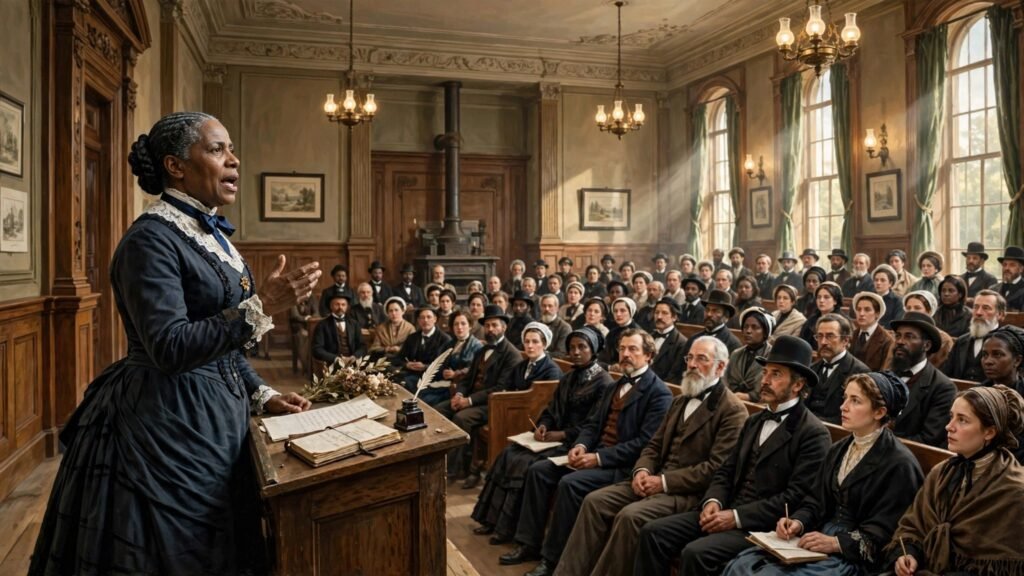
In 1854, a young Black woman from Baltimore published a slim book of poems that sold thousands of copies and made her one of the most famous writers in America. Frances E.W. Harper had no university degree, no fortune and no powerful patrons. What she had was a voice — clear, fearless and impossible to ignore — and she used it for nearly sixty years to speak for freedom, for women and for people the world preferred to forget.
Harper was born free in a slave state, orphaned as a child, and barred by law from returning to her own home. Every door that closed in front of her became a reason to open one for someone else. She lectured across the country when few women spoke in public at all, wrote poems that were read aloud in parlours and pulpits, and published a novel that is still read today. She did all of it while raising children, burying a husband, and living on the modest earnings of her pen.
This is the success story of Frances E.W. Harper — the poet, novelist and abolitionist who spoke for freedom — and the lessons from her life are as urgent now as they were in 1854. Face Zem tells her story here: how she turned loss into purpose, words into wages, and a single voice into a movement.
Key takeaways
- Frances E.W. Harper was born free in Baltimore in 1825, orphaned young, and educated at her uncle’s school for Black children.
- A Maryland law that barred her from her own home turned her into a full-time abolitionist lecturer in 1854.
- Her first poetry collection, Poems on Miscellaneous Subjects, was a bestseller and was reprinted again and again.
- She published Iola Leroy in 1892, one of the first novels by an African American woman.
- Her 1866 speech “We Are All Bound Up Together” remains one of the great speeches of the women’s rights movement.

Frances E.W. Harper at a Glance
| Fact | Detail |
|---|---|
| Full name | Frances Ellen Watkins Harper |
| Born | 24 September 1825, Baltimore, Maryland |
| Died | 22 February 1911, Philadelphia, Pennsylvania |
| Known for | Poetry, novels, abolitionist lectures, women’s rights |
| First book | Poems on Miscellaneous Subjects (1854) |
| Best-known novel | Iola Leroy, or Shadows Uplifted (1892) |
| Famous speech | “We Are All Bound Up Together” (1866) |
| Organisations | National Association of Colored Women, WCTU, AME Church |
| Marriage | Fenton Harper (1860–1864) |
| Legacy | A founder of African American literature and Black women’s activism |
A Free Black Childhood in Baltimore
Frances Ellen Watkins was born free in Baltimore on 24 September 1825. That single fact — free — shaped everything that followed. Maryland was a slave state, and freedom for a Black child there was never secure. It could be questioned, stolen or legislated away. Harper grew up knowing that her freedom was a gift she would have to defend, and a gift she owed to others who did not have it.
Her parents died when she was young, and she was raised by her aunt and uncle, Henrietta and William Watkins. William Watkins was an abolitionist, a teacher and a minister who ran the Watkins Academy for Negro Youth, one of the few schools open to Black children in Baltimore. Frances was educated there, and the education was serious: reading, writing, history, religion and the classics. Her uncle also taught her something no textbook could — that Black children deserved the same learning as anyone else, and that knowledge was a tool for liberation.
As a teenager, Harper went to work as a domestic servant in the home of a Quaker family that owned a bookshop. The family treated her kindly and, crucially, let her read. She read widely — poetry, history, the Bible, the abolitionist newspapers of the day. She began writing poems of her own, and the bookshop household became her first audience. By the time she left domestic service, she had already decided that her pen would be her profession.
The Loss That Turned Her Into an Activist
In 1850, Harper left Baltimore to teach at Union Seminary in Ohio, a school for Black students run by the African Methodist Episcopal Church. Teaching was respectable work for an educated young woman, and she was good at it. But events at home soon pulled her onto a different path entirely.
In 1853, Maryland passed a law that forbade free Black people from entering the state. Harper was living in Pennsylvania by then, and the law meant she could not go home to Baltimore without risking arrest and enslavement. She was, in effect, exiled from the city of her birth by the stroke of a pen. The cruelty of it — a free woman locked out of her own home — struck her as intolerable, and she said so, in print and in public, for the rest of her life.
The law did more than anger her. It clarified her. She wrote to a friend that she could not be silent while her people suffered, and she gave up teaching to devote herself to the abolitionist cause. She became a lecturer for the Maine Anti-Slavery Society and then for the Pennsylvania Anti-Slavery Society, travelling from town to town to speak against slavery. She was twenty-eight years old, a Black woman speaking in public in an age when women — Black or white — were told that public speaking was unladylike. She spoke anyway.
Finding Her Voice in Print
Harper’s first book, Poems on Miscellaneous Subjects, appeared in 1854, the same year she began lecturing. It was an immediate success. The collection included poems about slavery, temperance, faith and freedom, and it went through edition after edition — more than twenty printings in her lifetime, an extraordinary achievement for any poet of the era, let alone a Black woman writing without institutional backing.
Her most famous poem, “Bury Me in a Free Land”, was written in 1858 and became an anthem of the abolitionist movement. In it, she asked not for wealth or fame but for the simple dignity of a grave in free soil. The poem was reprinted in newspapers across the country and read aloud at meetings. Other poems, like “The Slave Mother” and “Eliza Harris”, put the suffering of enslaved women at the centre of the story — a choice that was deliberate. Harper believed that if readers could feel the pain of a mother torn from her child, they could not remain neutral about slavery.
Writing was also how Harper earned her living. She was paid for her poems, her lectures and later her books, and she supported herself and her family by her pen for decades. In an age when very few women of any race earned an independent income from writing, Harper built a career out of words — and she used the money to fund the cause, travelling to speak, donating to schools and helping freed people after the Civil War.
The Lecture Circuit: Speaking for Freedom
Between 1854 and 1860, Harper travelled thousands of miles as an anti-slavery lecturer, speaking in New England, the Mid-Atlantic and the Midwest, sometimes sharing platforms with fellow abolitionist speakers such as Frederick Douglass. Her audiences were usually white, often hostile at first, and almost always won over by the end. She spoke without notes, in a clear, measured voice, and she combined moral argument with vivid stories of the people slavery had harmed. She was, by every contemporary account, a remarkable speaker.
The work was hard and sometimes dangerous. Lecturers against slavery were pelted with eggs, threatened and occasionally attacked. Harper travelled alone, stayed in strangers’ homes, and spoke in halls where she was the only Black person present. She wrote home that she was sometimes tired and lonely, but she never stopped. She believed that every speech was a blow against slavery, and that silence was a luxury she could not afford.
Her lectures did more than argue against slavery. They argued for the full humanity of Black people at a time when the law denied it, and they argued for women’s right to speak in public at a time when custom denied that too. Harper was doing two radical things at once — speaking as a Black person and speaking as a woman — and she made both seem natural, which was itself a kind of revolution.
Marriage, Loss and a New Beginning
In 1860, Harper married Fenton Harper, a widower with children, and for four years she stepped back from the lecture circuit to raise a family. The marriage was happy, and she became a devoted stepmother as well as a mother. Then, in 1864, Fenton Harper died suddenly, leaving her a widow with children to support and debts to pay.
Many women in her position would have retreated into private life. Harper did the opposite. She returned to public work with even greater energy, because now she had a family to feed and a cause that still needed her. After the Civil War ended in 1865, she travelled through the South on behalf of the Freedmen’s Bureau, speaking to newly freed people, encouraging them to seek education, and helping them rebuild their lives. She saw the devastation of the war at first hand, and she wrote about it in poems and letters that remain among the most vivid accounts of the period.
The Southern tour changed her writing. Her later work is less about persuading white audiences and more about speaking to Black readers — about education, self-respect, temperance and the hard work of building free communities. She had always written for freedom; now she was writing for what freedom should become.
Iola Leroy and the First Black Novel
Harper’s greatest literary achievement came late in life. In 1892, at the age of sixty-seven, she published Iola Leroy, or Shadows Uplifted, one of the first novels written by an African American woman. The novel tells the story of Iola, a young woman raised in privilege who discovers that she is Black and enslaved, and who rebuilds her life as a teacher and activist after emancipation.
Iola Leroy was a bestseller in its day, and it is now recognised as a landmark of American literature. It was one of the first novels to place a Black woman at the centre of the story as a heroine rather than a victim, and one of the first to argue — through fiction — that education, temperance and racial uplift were the path forward for Black Americans. Harper had been making these arguments in speeches for forty years; the novel let her make them to readers who would never attend a lecture.
She had also published a serial novel, Sketches of Southern Life, in 1872, and a collection of poems, Poems, in 1871. Her writing career spanned nearly six decades, from her first published poem in the 1840s to her last years in Philadelphia. Few writers of her century were productive for so long, and fewer still wrote with such consistency of purpose.
Poetry That Moved a Nation
Harper’s poetry deserves to be read on its own terms, not only as a weapon of the abolitionist cause. She wrote in the plain, musical style of the popular poetry of her day, but her subjects were her own: the slave auction, the mother who loses her child, the fugitive who reaches free soil, the woman who refuses to be broken. Her poems are direct where other poets were ornate, and that directness is their power.
“The Slave Auction” describes a mother and child sold to different buyers, and it does so in language so plain that it cannot be dismissed as exaggeration. “Bury Me in a Free Land” asks for nothing more than a grave where no slave can be buried — a poem that turns the simplest human wish into an indictment of an entire system. These poems were read in churches, printed in newspapers, and recited by schoolchildren. They carried the abolitionist message into homes that no lecturer could reach.
Harper understood something about poetry that many writers miss: a poem that can be remembered can be repeated, and a poem that can be repeated can change minds. Her best poems are short, rhythmic and unforgettable, and they are still anthologised today — more than a century after her death, her words are still doing their work.
The Suffrage Split and Her Stand
After the Civil War, Harper threw herself into the women’s suffrage movement, but she did so on her own terms. Like Sojourner Truth, whose famous speeches had made the same point a generation earlier, Harper insisted that the fight for women’s rights could not be separated from the fight for Black rights.
In 1866, she addressed the National Woman’s Rights Convention in New York and delivered one of the great speeches of the movement. “We are all bound up together in one great bundle of humanity,” she said, “and society cannot trample on the weakest and feeblest of its members without receiving the curse in its own soul.” The speech was a warning and a plea: do not build a movement for women that leaves Black women behind. It was also a rebuke to those in the suffrage movement who were willing to sacrifice Black rights for white women’s votes.
When the suffrage movement split in 1869 over the Fifteenth Amendment, which gave Black men the vote but not women, Harper sided with those who supported the amendment. She believed that the vote for Black men was a step forward, not a betrayal, and she said so publicly — even though it cost her friendships. She never wavered from the principle that justice could not be divided: the rights of Black women, Black men and white women rose and fell together.
A Life of Organising: Temperance, Church and Community
Harper’s activism was never limited to the lecture platform. She was a tireless organiser, and she believed that change happened in communities, not only in Congress. She was active in the African Methodist Episcopal Church, in the temperance movement, and in the women’s club movement that grew up in the 1890s.
In 1896, she helped found the National Association of Colored Women, an organisation of Black women’s clubs that worked for education, childcare, temperance and civil rights. She served as its vice president, and she used the platform to argue — as she had for forty years — that Black women were the moral centre of the race’s progress. A generation later, Ida B. Wells would carry the same tradition of fearless Black women’s journalism and activism into the twentieth century. “We need women who are so strong they can be gentle,” she said, “so large-hearted they can be helpful.” The NACW became one of the most important Black organisations in America, and Harper was one of its founders.
She was also a leading figure in the Woman’s Christian Temperance Union, where she worked to combat alcohol abuse in Black communities. She saw temperance not as a moral luxury but as a practical necessity: families destroyed by drink could not build the schools, churches and businesses that freedom required. Her organising work was unglamorous and often unrecorded, but it was the foundation on which her public fame rested.
What Made Her Great
Harper’s greatness did not come from a single achievement. It came from the combination of gifts that she brought to every task: a poet’s ear, a preacher’s moral clarity, an organiser’s patience and a survivor’s resilience. She was orphaned, exiled, widowed and impoverished at various points in her life, and each time she turned the setback into fuel for the next chapter.
She was also great because she refused to choose between her causes. She was an abolitionist and a feminist, a poet and an organiser, a writer for white audiences and a teacher of Black children. In an age that demanded that women — and especially Black women — pick one role and stay in it, Harper insisted on being all of them at once. That refusal is the heart of her example.
Finally, she was great because she lasted. Her public career ran from 1854 to 1911 — fifty-seven years of writing, speaking and organising. She outlived slavery, outlived the Civil War, and lived to see the twentieth century. She did not live to see the vote for women or the end of segregation, but she helped build the movements that would achieve them. Longevity, in her case, was not an accident. It was a discipline.
The Lessons from Her Life
Harper’s life offers lessons that are practical, not sentimental. The first is to use what you have. She had no money and no connections; she had a voice and a pen, and she used them until they made her famous. The second is to turn exile into purpose. When Maryland barred her from home, she did not waste years in bitterness; she made the law itself the subject of her life’s work.
The third lesson is to refuse false choices. Harper was told, again and again, to choose between the rights of Black people and the rights of women, between art and activism, between earning a living and serving a cause. She refused every time, and her refusal made her more effective, not less. The fourth lesson is to build institutions, not only reputations. Her poems are remembered, but the organisations she helped found — the NACW above all — outlived her and carried her work forward.
The last lesson is the simplest and the hardest: keep going. Harper wrote and spoke for nearly sixty years, through grief, poverty and disappointment, because the work was not finished. It still is not finished. That is why her story still matters, and why Face Zem is telling it now.
Checklist: Lessons You Can Use Today
- Use the tools you already have — your voice, your pen, your skills — instead of waiting for perfect conditions.
- Turn a setback into a cause: ask what the obstacle is teaching you and who else it affects.
- Refuse false choices between the things that matter to you; find a way to serve them together.
- Build something that outlasts you — a group, a habit, a body of work — not only a reputation.
- Speak plainly and memorably, so that others can repeat what you said when you are not in the room.
- Keep going for the long haul: a lifetime of steady work beats a single brilliant year.
Frequently Asked Questions
Who was Frances E.W. Harper?
Frances Ellen Watkins Harper (1825–1911) was an African American poet, novelist, abolitionist lecturer and women’s rights activist. She was one of the most popular writers in nineteenth-century America and a founder of the National Association of Colored Women.
What is Frances E.W. Harper best known for?
She is best known for her bestselling poetry collection Poems on Miscellaneous Subjects (1854), her poem “Bury Me in a Free Land”, her novel Iola Leroy (1892), and her speech “We Are All Bound Up Together” (1866).
Was Frances E.W. Harper born enslaved?
No. She was born free in Baltimore, Maryland, in 1825. However, in 1853 Maryland passed a law barring free Black people from entering the state, which exiled her from her home and pushed her into full-time abolitionist work.
What was Iola Leroy about?
Iola Leroy, or Shadows Uplifted (1892) tells the story of a young woman raised in privilege who discovers she is Black and enslaved, and who rebuilds her life as a teacher and activist after emancipation. It was one of the first novels published by an African American woman.
What did Harper mean by “we are all bound up together”?
In her 1866 speech, Harper argued that the rights of Black people and the rights of women could not be separated — that society cannot trample on its weakest members without harming itself, and that a women’s movement that ignored Black women would fail.
When did Frances E.W. Harper die?
She died in Philadelphia on 22 February 1911, at the age of eighty-five, after a public career of nearly sixty years as a writer, lecturer and organiser.
Bottom line
Frances E.W. Harper was born free in a slave state, orphaned young, exiled from her home by law, widowed with children to support — and she answered every one of those blows by writing, speaking and organising harder. Her poems sold by the thousand, her novel helped found African American literature, and her speeches still define what it means to fight for justice without leaving anyone behind. Her success was not luck and it was not ease. It was a lifetime of turning words into wages, setbacks into causes, and a single voice into a movement that outlived her.
Note: This article is a general historical account of Frances E.W. Harper’s life and work, written for readers of Face Zem. Dates and facts are drawn from the public historical record.

Keep what speaks to you.
Leave room for your own perspective.


