Sojourner Truth was born into slavery in New York, and she died a free woman whose voice had shaken a nation. She never learned to read or write, yet her words are still quoted more than a century and a half after she spoke them. Her life is one of the most powerful stories of courage in American history, and it begins in bondage and ends in triumph.
Truth was born around 1797, in Ulster County, New York, and was given the name Isabella Baumfree. She was sold away from her parents as a child, beaten by her owners, and forced to work from dawn until dark. When slavery was finally abolished in New York in 1827, she walked away from her owner’s house with her youngest daughter in her arms, carrying nothing but her faith and her determination. She later said that God told her to take a new name, and she became Sojourner Truth, a traveller who would speak the truth wherever she went.
What makes her story extraordinary is not only what she escaped, but what she became. Truth sued a white man in court and won, fought for the rights of Black people and women, spoke at conventions across the country, and met President Abraham Lincoln in the White House. She did all of this as a Black woman in the 1800s, in a world that told her she was worth nothing. Her life proves that a voice, once found, cannot be silenced, and her example still inspires people who are fighting for justice today.
Key takeaways
- Sojourner Truth was born enslaved in New York around 1797 and won her freedom when the state abolished slavery in 1827.
- She became one of the first Black women in America to win a court case against a white man, fighting for her son’s freedom.
- Her famous “Ain’t I a Woman?” speech at Akron in 1851 made her a leading voice for both abolition and women’s rights.
- She travelled the country speaking against slavery, met President Lincoln, and worked to help freed people after the Civil War.
- Her legacy teaches that courage, faith, and persistence can turn the hardest life into a force that changes history.
Sojourner Truth at a Glance
| Fact | Detail |
|---|---|
| Born | Around 1797, Ulster County, New York |
| Birth name | Isabella Baumfree |
| Freed | 1827, when New York abolished slavery |
| New name | Sojourner Truth, taken in 1843 |
| Famous speech | “Ain’t I a Woman?” at Akron, Ohio, 1851 |
| Landmark case | Won her son Peter’s freedom in court, 1828 |
| Met President Lincoln | 1864, at the White House |
| Main causes | Abolition of slavery and women’s rights |
| Died | 26 November 1883, Battle Creek, Michigan |
| Legacy | Icon of courage, faith, and human rights |
1. Born Into Slavery in New York
Isabella Baumfree was born around 1797 on the estate of Colonel Johannes Hardenbergh in Ulster County, New York. Her parents, James and Elizabeth, were enslaved, and Isabella was one of their many children. Her first language was Dutch, because the Hardenbergh family spoke Dutch at home, and she would speak English with a Dutch accent for the rest of her life.
When Isabella was about nine years old, her owner died, and she was sold at auction for one hundred dollars, along with a flock of sheep. She was separated from her parents, and she never saw her mother again. The experience of being sold like an animal, of watching her family torn apart, stayed with her forever, and it shaped the woman she became.
Over the next years, Isabella was sold several times. She was owned by John Neely, who beat her cruelly, and then by Martinus Schryver, and finally by John Dumont, a farmer in New Paltz. Dumont’s wife was especially harsh, and Isabella later remembered that she was forced to work from before sunrise until long after dark, milking cows, spinning wool, and doing heavy farm labour. She was given little food and no kindness, and she was punished for the smallest mistakes.
2. A Mother Torn From Her Children
Isabella married an enslaved man named Thomas, and they had five children together. But under slavery, a mother had no rights over her own children. Her children could be sold away at any moment, and she could do nothing to stop it. This was the deepest pain of her early life, and it taught her that slavery was not only cruel to the body, but cruel to the heart.
When she learned that one of her sons, Peter, had been sold illegally to a slave owner in Alabama, she was devastated. New York law had made it illegal to sell enslaved people out of the state, and Isabella decided to fight back. She did something almost unheard of for a Black woman in 1828: she took a white man to court, and she won. Her son Peter was returned to her, making her one of the first Black women in American history to win a legal case against a white man.
This victory showed the world what Isabella was made of. She had no education, no money, and no powerful friends, yet she refused to accept injustice. The same courage that won her son’s freedom would carry her through the rest of her life, and it is one of the reasons her story is still told today.
3. Walking to Freedom
New York had passed a law to end slavery gradually, and freedom finally came on 4 July 1827. But John Dumont had promised Isabella her freedom a year earlier, and then he broke his promise, claiming she had not worked hard enough. Isabella refused to wait. Late one night in 1826, she took her youngest daughter Sophia and walked away from the Dumont farm, carrying the baby in her arms.
She found shelter with Isaac and Maria Van Wagenen, a Quaker family who took her in and bought her freedom from Dumont for twenty dollars. The Van Wagenens treated her with kindness, and for the first time in her life, Isabella experienced what it felt like to be welcomed as a human being. She later said that she had prayed for God to help her escape, and that God had answered her prayer.
After she was free, Isabella worked as a domestic servant in New York City, and she became deeply religious. She joined the Methodist church, and she began to feel that God was calling her to a greater purpose. She did not know it yet, but she was about to become one of the most famous speakers in America.
4. A New Name and a New Mission
In 1843, Isabella had a powerful religious experience. She believed that God spoke to her and told her to leave New York and travel the country, preaching the truth and fighting for justice. She took a new name to match her new mission: Sojourner, because she would travel as a sojourner, and Truth, because she would speak the truth. From that day on, she was Sojourner Truth.
She began travelling across the eastern United States, speaking at churches, meetings, and conventions. She was a tall, striking woman with a deep, powerful voice, and audiences were mesmerised by her. She could not read or write, so she spoke from her heart and from her own experience, and her words were more powerful than any book. She told crowds about the cruelty of slavery, about the dignity of Black people, and about the rights of women.
Truth was not afraid of anyone. She spoke to hostile crowds, to people who shouted at her and tried to silence her, and she never backed down. She once said, “I will not allow my life to be run by any man or woman.” Her courage made her famous, and it also made her a target, but she kept travelling, kept speaking, and kept fighting.
5. “Ain’t I a Woman?” at Akron
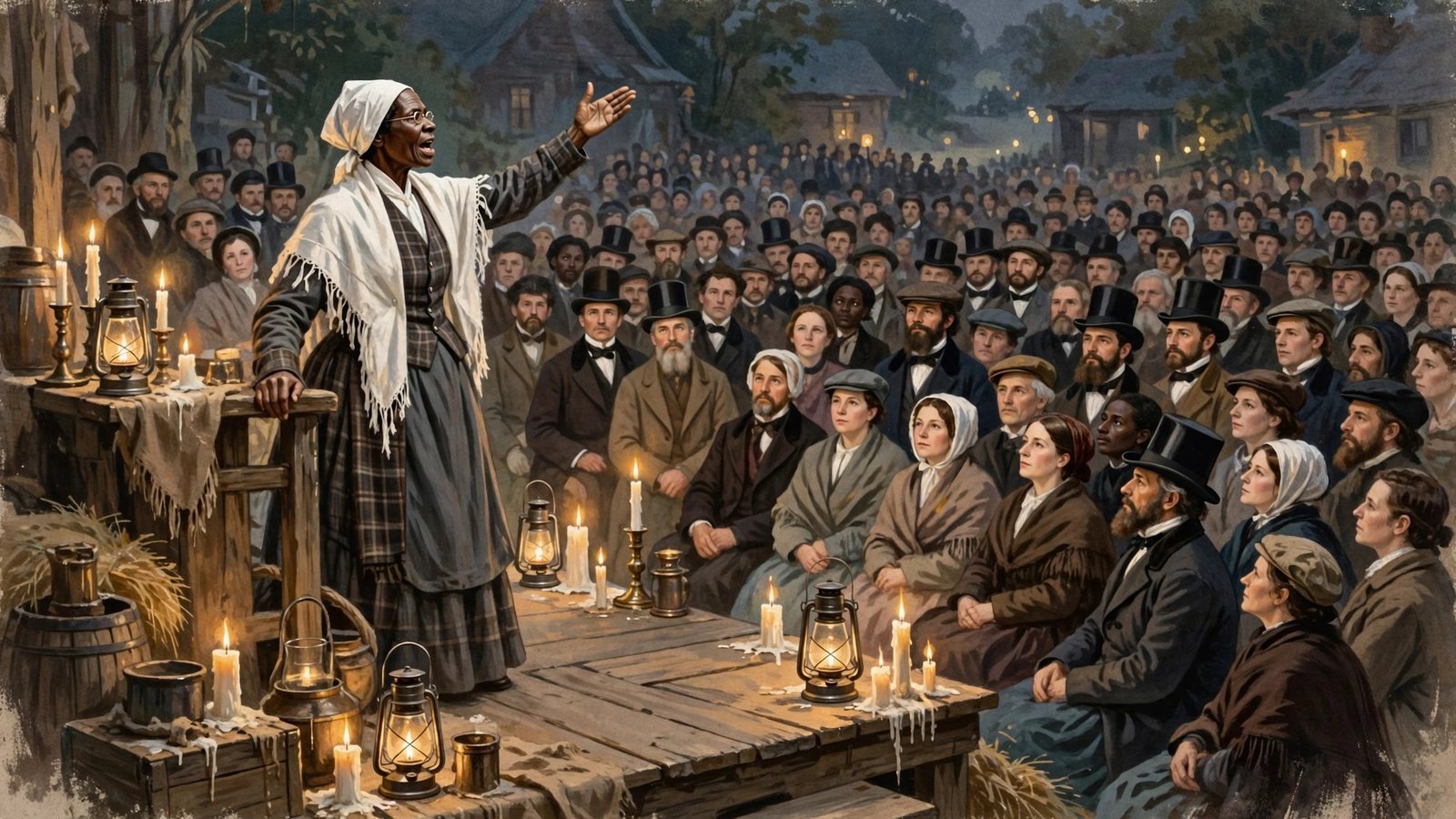
Sojourner Truth’s most famous moment came in May 1851, at the Women’s Rights Convention in Akron, Ohio. The meeting was tense, and some men in the audience argued that women were too weak and delicate to deserve equal rights. Truth stood up and asked to speak, and what followed became one of the most famous speeches in American history.
She spoke about her own life: the hard labour she had done, the children she had borne and seen sold into slavery, and the strength she had shown. “I have ploughed and planted, and gathered into barns, and no man could head me,” she said. “And ain’t I a woman?” She pointed out that she had suffered as much as any man, and that she deserved the same rights as any woman. The speech electrified the audience, and it became a rallying cry for both the women’s rights movement and the abolitionist cause.
Historians note that the exact words of the speech were written down years later, and the famous phrase “Ain’t I a woman?” may have been added by the writer who recorded it. But the power of the moment is not in doubt. Truth’s speech at Akron showed the world that the fight for women’s rights and the fight against slavery were the same fight, and that Black women belonged at the centre of both.
6. Fighting Slavery Alongside the Great Abolitionists
After Akron, Sojourner Truth became a leading figure in the abolitionist movement. She worked alongside Frederick Douglass, William Lloyd Garrison, and other great campaigners, and she spoke at anti-slavery meetings across the North. She sold copies of her life story, “The Narrative of Sojourner Truth,” which was published in 1850, to support herself and to spread her message.
Truth and Douglass were friends and allies, but they did not always agree. Douglass believed in working through politics and persuasion, while Truth believed in speaking the plain truth, even when it made people uncomfortable. Their debates were famous, and they showed that the abolitionist movement was not one voice, but many voices, all working for the same freedom.
During the Civil War, Truth worked tirelessly for the Union cause. She collected supplies for Black soldiers, spoke to crowds to encourage enlistment, and helped freed people who had escaped from the South. She believed that the war was God’s judgement on slavery, and that it would end with freedom for all. She was right, and when the war ended, she was there to help build the new world that followed.
7. Meeting President Lincoln
In October 1864, Sojourner Truth travelled to Washington, D.C., and met President Abraham Lincoln in the White House. It was an extraordinary moment: a woman who had been born enslaved, who could not read or write, was welcomed by the President of the United States. Lincoln told her that he had heard of her, and he thanked her for her work. Truth later said that she was deeply moved by the meeting, and that Lincoln treated her with great respect.
After the meeting, Truth worked in Washington helping freed people who had come to the capital looking for work and shelter. She helped them find jobs, and she fought against the segregation of the city’s streetcars, even being assaulted by a conductor when she refused to accept being treated as a second-class citizen. She was in her late sixties, but she had lost none of her fire.
The meeting with Lincoln was a symbol of how far Truth had come, and how far America had come. A woman who had once been sold at auction for one hundred dollars was now shaking hands with the President. Her life was proof that no one is born to be a slave, and that freedom, once won, cannot be taken away.
8. The Fight for Women’s Rights
Sojourner Truth was not only an abolitionist; she was also a passionate advocate for women’s rights. She believed that women deserved the vote, the right to own property, and the right to be treated as equals. She spoke at women’s rights conventions for decades, and she was one of the few Black women whose voice was heard in a movement that was often dominated by white women.
In 1867, she spoke at the first annual meeting of the American Equal Rights Association, and she warned the audience that if Black men got the vote but Black women did not, the work would not be finished. “There is a great stir about coloured men getting their rights,” she said, “but not a word about the coloured women.” Her words were prophetic, and they are still quoted today by people who fight for equality.
Truth’s feminism was rooted in her own experience. She had worked as hard as any man, suffered as much as any man, and survived what no man should have to survive. She knew that strength had nothing to do with gender, and that justice had to include everyone. Her insistence that Black women mattered changed the women’s movement, and it is one of her most important legacies.
9. Later Years and the Battle Creek Years
In her later years, Sojourner Truth settled in Battle Creek, Michigan, where she lived with her daughter Elizabeth. She continued to speak and travel when she could, but her health was failing, and she spent more time at home. She was a beloved figure in Battle Creek, and people came from far away to meet the famous woman who had spoken to Lincoln and shaken a nation.
Truth spent her final years working for a cause close to her heart: she wanted the government to give land to freed people in the West, so that they could build their own lives. She petitioned Congress, collected signatures, and travelled to Washington to make her case. The government never granted her request, but her campaign showed that she never stopped fighting for others, even when she was old and ill.
Sojourner Truth died on 26 November 1883, at the age of about eighty-six. Her funeral in Battle Creek was attended by more than a thousand people, and she was buried with honour. The woman who had been born a slave was mourned as a hero, and her name was already being remembered across the country.
10. Why Her Story Still Matters in 2026
Sojourner Truth’s story still matters because the things she fought for are still being fought for today. She fought for the dignity of Black people, for the rights of women, and for the simple idea that every human being deserves to be treated as a person. Her life is a reminder that change does not come from the powerful, but from ordinary people who refuse to accept injustice.
Her story also matters because she did it all without the advantages that most people take for granted. She had no education, no money, and no legal rights, yet she changed the course of American history. She proves that a voice is the most powerful weapon anyone can have, and that courage is not the absence of fear, but the decision to act in spite of it.
In 2026, Sojourner Truth’s name is honoured in schools, in statues, and in history books. Her portrait hangs in the United States Capitol, and her words are taught to children around the world. She is remembered not as a victim of slavery, but as a victor over it, and her life is an inspiration to anyone who has ever been told that they are not enough.
11. Lessons From Sojourner Truth’s Life
Truth’s life is full of lessons for anyone who wants to make a difference. The first is to speak up, even when your voice shakes. Truth spoke to hostile crowds, to presidents, and to people who wanted to silence her, and she never let fear stop her. The second is to stand on your own experience. Truth could not quote books, but she could tell her own story, and her story was more powerful than any argument.
The third lesson is to fight for everyone, not just yourself. Truth fought for Black men and Black women, for enslaved people and for free people, for the rights of all. She understood that justice is not complete until it includes everyone, and she never accepted a partial victory. The fourth lesson is to never give up. Truth was eighty years old and still petitioning Congress, still travelling, still speaking, and still believing that the world could change.
The final lesson is to let your faith carry you. Truth believed that God had called her to her mission, and that belief gave her the strength to keep going when the world was against her. Whether or not you share her faith, her example shows that a deep sense of purpose can sustain a person through the hardest times, and that purpose is what turns a life into a legacy.
12. Checklist: How to Live Like Sojourner Truth
- Speak the truth, even when it is uncomfortable and even when people do not want to hear it.
- Stand up for others, not only for yourself, and fight for justice that includes everyone.
- Use your own story and your own experience as your greatest strength.
- Refuse to accept limits that others place on you because of who you are.
- Keep going, even when you are tired, old, or facing setbacks that seem impossible.
- Let your purpose be bigger than your fear, and let it carry you forward every day.
Frequently Asked Questions
Who was Sojourner Truth?
Sojourner Truth was an American abolitionist and women’s rights activist, born enslaved in New York around 1797 as Isabella Baumfree. After winning her freedom in 1827, she became one of the most famous speakers in America, fighting for the end of slavery and for women’s rights.
What is Sojourner Truth most famous for?
She is most famous for her “Ain’t I a Woman?” speech, delivered at the Women’s Rights Convention in Akron, Ohio, in 1851. The speech argued that Black women deserved the same rights as white women and as men, and it became a landmark moment in both the women’s rights and abolitionist movements.
Did Sojourner Truth really win a court case against a white man?
Yes. In 1828, she sued a white slave owner who had illegally sold her son Peter to Alabama, and she won the case. She was one of the first Black women in American history to win a legal case against a white man, and the victory showed her extraordinary courage.
Did Sojourner Truth meet Abraham Lincoln?
Yes. In October 1864, she met President Abraham Lincoln at the White House. Lincoln told her he had heard of her work, and she later said she was deeply moved by the meeting. She also worked in Washington helping freed people after the war.
Could Sojourner Truth read or write?
No. Sojourner Truth never learned to read or write, and she dictated her life story, “The Narrative of Sojourner Truth,” to a friend, Olive Gilbert, who wrote it down for her. Her speeches were delivered from memory and from her own experience, which made them even more powerful.
When did Sojourner Truth die?
Sojourner Truth died on 26 November 1883 in Battle Creek, Michigan, at the age of about eighty-six. Her funeral was attended by more than a thousand people, and she is remembered today as one of the great heroes of American history.
Bottom line
Sojourner Truth’s life is a story of transformation: from an enslaved child sold at auction to a free woman who spoke to presidents and changed a nation. She had no education, no money, and no rights, yet she became one of the most powerful voices of the nineteenth century. Her courage, her faith, and her refusal to accept injustice made her a hero, and her words still ring true today.
Her story teaches us that no one is born to be small, and that the hardest life can become the greatest legacy. Sojourner Truth walked out of slavery with nothing but her faith and her determination, and she used them to change the world. That is why her name is still spoken, her speech is still quoted, and her example still inspires people who are fighting for freedom and justice in 2026.
To learn more about the lives of other brave people who changed history, read the success stories of Harriet Tubman, Frederick Douglass, and Booker T. Washington on Face Zem.
Note: This article is a general historical account of Sojourner Truth’s life and legacy, based on widely known historical facts, and is intended for general readers.

Keep what speaks to you.
Leave room for your own perspective.