
Rosalind Franklin was one of the greatest scientists of the twentieth century, yet for decades her name was missing from the story of the most famous discovery in biology. In 1952, working at King’s College London, she produced an X-ray photograph of DNA known as Photo 51 — an image so clear that it revealed the molecule’s double helix structure. It was the key piece of evidence that unlocked the secret of life itself. But Franklin did not win the Nobel Prize for it. She died in 1958, at just thirty-seven, four years before the prize was awarded to the men who built on her work.
Franklin was not a woman who sought the spotlight. She was a meticulous, fiercely independent scientist who believed that careful data, honestly gathered, was the only route to the truth. She had already made her name in the study of coal during the Second World War and in the structure of viruses later in her career. Her work on DNA was one brilliant chapter in a life spent doing science the hard way — through patience, precision and an unwillingness to cut corners.
Today, Rosalind Franklin is finally recognised as one of the central figures of modern science. Her story is not only about a discovery; it is about what happens when talent meets prejudice, and about a woman who refused to let either stop her. This is her success story, told on Face Zem — the story of the scientist who photographed the secret of life.
Key takeaways
- Rosalind Franklin produced Photo 51, the X-ray image that revealed DNA’s double helix structure.
- She was a brilliant physical chemist who had already done vital wartime research on coal.
- Her data was shown to Watson and Crick without her full knowledge, and they used it to build their model.
- She went on to do pioneering work on the structure of viruses, including the tobacco mosaic virus.
- Franklin died of ovarian cancer in 1958, aged thirty-seven, before the 1962 Nobel Prize for DNA.
Rosalind Franklin at a Glance
| Fact | Detail |
|---|---|
| Born | 25 July 1920, Notting Hill, London |
| Died | 16 April 1958, London, aged thirty-seven |
| Education | Newnham College, Cambridge — physical chemistry |
| PhD | Cambridge, 1945 — the structure of coal |
| Most famous work | Photo 51, the X-ray image of DNA (1952) |
| Key employer | King’s College London, then Birkbeck College |
| Later research | Structure of viruses, including tobacco mosaic virus |
| Recognition | Posthumous: asteroid, buildings, awards and a Google Doodle |
| Colleagues | Maurice Wilkins, Raymond Gosling, Aaron Klug |
| Legacy | One of the founders of modern molecular biology |
1. A Childhood Built on Questions
Rosalind Elsie Franklin was born in 1920 into a wealthy, educated Jewish family in London. Her father was a banker and her mother a charity worker, and the Franklin home was full of books, debate and high expectations. From an early age, Rosalind was known for being clever, stubborn and exact. She wanted to know how things worked, and she wanted proof, not opinions.
At school, she excelled at science and mathematics, subjects that few girls of her generation were encouraged to pursue. Her father at first opposed her plan to study science at university — he thought it an unsuitable career for a woman — but Rosalind would not be moved. She won a place at Newnham College, Cambridge, to read physical chemistry, and she threw herself into her studies with the intensity that would define her whole career.
Cambridge in the late 1930s was still a place where women were second-class citizens: they could take the exams but were not awarded full degrees until 1948. Franklin did not let that stop her. She graduated with first-class honours and stayed on to work on a PhD, studying the structure of coal — a subject that seemed unglamorous but would soon become vital to the war effort.
2. The War Years and the Science of Coal
During the Second World War, Franklin’s research on coal had immediate practical importance. Britain depended on coal for fuel, gas masks and industry, and understanding its structure meant using it better. Her PhD work classified coals by how they burned and how they absorbed gases, and her findings were used by the British Coal Utilisation Research Association.
It was not the kind of science that made headlines, but it was science that mattered, and Franklin did it brilliantly. She published five papers on coal before she was twenty-six. Her work was precise, thorough and honest — the qualities that would later make her X-ray photographs of DNA so trustworthy.
Yet the war years also taught her something else: that a woman scientist had to work twice as hard to be taken half as seriously. She would carry that lesson with her for the rest of her life, and it would shape the way she defended her work and her independence.
3. Paris and the Art of X-Ray Crystallography
After the war, Franklin moved to Paris to work at the Laboratoire Central des Services Chimiques de l’État, where she learned X-ray crystallography — the technique of firing X-rays at a crystal and reading the pattern they scatter to work out the arrangement of atoms inside. It was a demanding, painstaking craft, and Franklin became one of its finest practitioners.
In Paris she was happy. The laboratory was collegial, the work was respected, and for the first time she felt fully accepted as a scientist. She also discovered a love of French food, fashion and the outdoors, and she made close friends. When she later returned to England, she would miss Paris for the rest of her life.
But the pull of home and of a bigger scientific challenge brought her back. In 1951, she accepted a fellowship at King’s College London to work on the structure of DNA — a molecule that scientists knew carried the instructions of life, but whose shape nobody had yet worked out.
4. The Race to Find the Shape of DNA
By the early 1950s, DNA was the great unsolved puzzle of biology. Scientists knew it was made of four chemical bases — adenine, thymine, guanine and cytosine — and that it carried genetic information. But nobody knew how those parts were arranged in three dimensions, and without the shape, nobody could explain how DNA copied itself.
Several teams were racing to solve it. At Cambridge, James Watson and Francis Crick were building models. At King’s, Maurice Wilkins was working on DNA with X-rays. And at Caltech in America, Linus Pauling — the most famous chemist alive — was working on it too. Franklin arrived in the middle of this race, and she brought something the others lacked: the skill to take the clearest X-ray photographs of DNA anyone had ever produced.
She set to work with her PhD student Raymond Gosling, preparing DNA fibres, keeping them at exactly the right humidity, and exposing them to X-rays for up to a hundred hours at a time. The work was slow and exacting. Franklin insisted on gathering more data before drawing conclusions, a caution that her rivals mistook for slowness.
5. Photo 51: The Image That Changed Everything
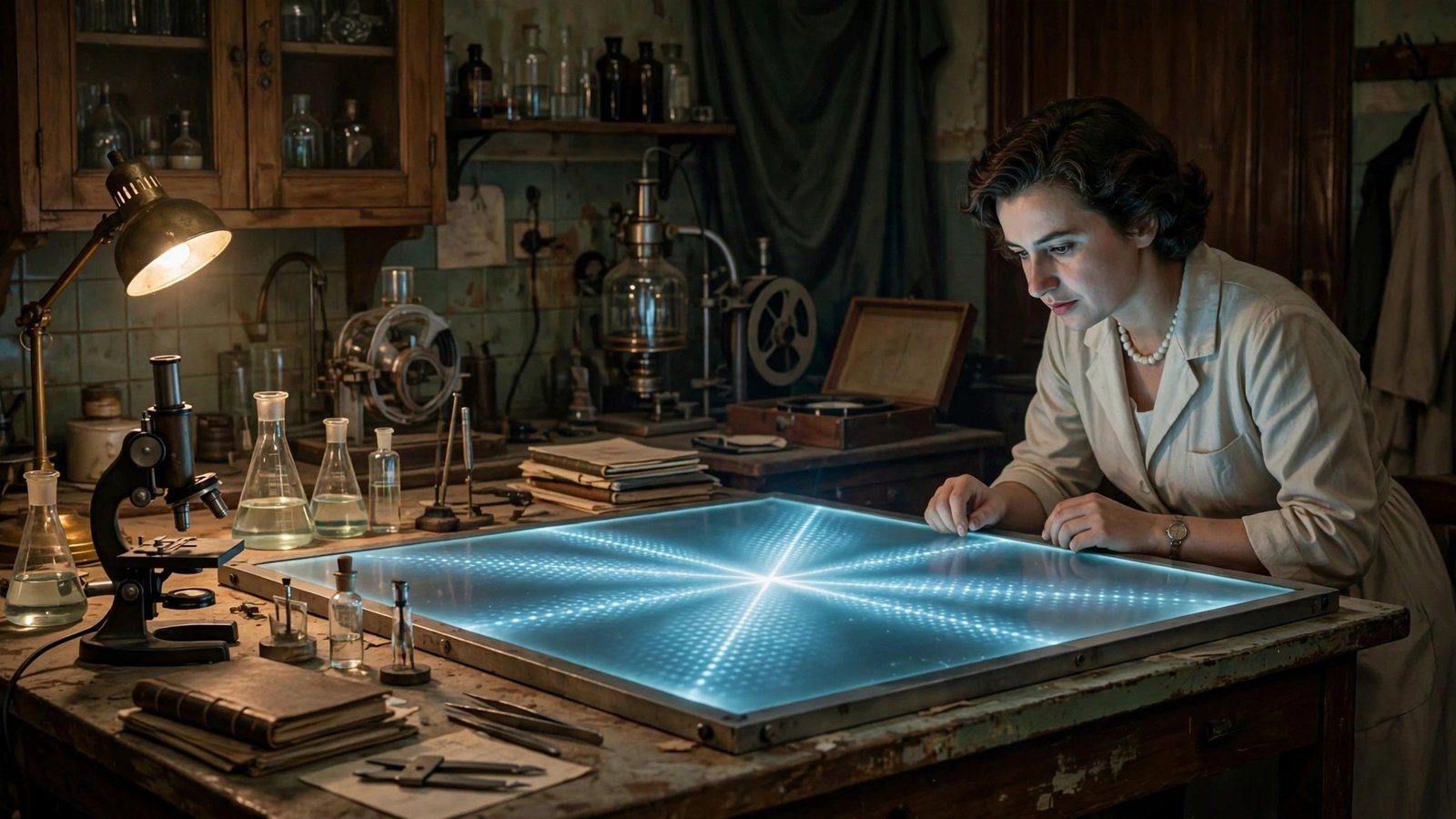
In May 1952, Franklin and Gosling produced the photograph that would change biology forever. Known as Photo 51, it was an X-ray diffraction image of the B form of DNA, and its pattern was unmistakable: a dark X shape in the centre, the unmistakable signature of a helix — a spiral.
To an expert eye, Photo 51 said almost everything. It showed that DNA was a helix, that it had two strands, that the sugar-phosphate backbone was on the outside, and that the bases were on the inside. Combined with Franklin’s careful measurements, it pointed directly to the double helix.
Franklin herself was close to the answer. Her notebooks show that by early 1953 she had worked out that DNA was a two-chain helix with the bases inside, and she was preparing a paper on it. But she believed in publishing only when the evidence was complete, and she was still refining her results when events overtook her.
6. The Photograph She Did Not Know Was Shared
In January 1953, Maurice Wilkins — Franklin’s colleague at King’s, with whom she had a difficult and frosty relationship — showed Photo 51 to James Watson during a visit to London. Watson saw the image and understood at once what it meant. Within weeks, he and Crick had built their model of the double helix.
Franklin was not told that her photograph had been shown to her rivals. She learned of the Watson-Crick model only when it was nearly complete, and she was asked to see a draft of their paper. With characteristic generosity, she raised no public objection; she simply asked that her own papers, reporting her data, be published alongside theirs in the same issue of the journal Nature in April 1953.
That is what happened. The Watson-Crick paper appeared first, followed by Franklin and Gosling’s paper presenting the X-ray evidence. But history remembered only the first paper. For decades, Franklin’s contribution was reduced to a footnote, and many accounts of the discovery did not mention her at all.
7. Leaving King’s and the Turn to Viruses
Franklin’s time at King’s had been unhappy. She clashed with Wilkins, she disliked the atmosphere, and she felt her work was not respected. In 1953 she moved to Birkbeck College in London, where she turned to a new problem: the structure of viruses.
It was a bold move, and it paid off. Working with a young team that included Aaron Klug, Franklin used X-ray crystallography to work out the structure of the tobacco mosaic virus, showing that it too was a helix, with its protein coat arranged in a spiral around its genetic material. Her work laid the foundations of the whole field of structural virology — the study of how viruses are built.
At Birkbeck she was happy and respected. Her team admired her, her students loved her, and her work was recognised internationally. She travelled widely, lectured in America and Europe, and was at the height of her powers when illness struck.
8. The Final Years and a Life Cut Short
In 1956, Franklin was diagnosed with ovarian cancer. She continued working through surgery and treatment, travelling to America to lecture even while ill, and publishing papers on the polio virus in the last months of her life. Her colleagues remembered her determination: she refused to let the illness define her or slow her down.
She died on 16 April 1958, at the age of thirty-seven, in London. Her death was a loss not only to her friends and family but to science itself — she was, by every account, one of the most gifted experimentalists of her generation, and her best work may still have been ahead of her.
Four years later, in 1962, the Nobel Prize in Physiology or Medicine was awarded to Watson, Crick and Wilkins for the discovery of the structure of DNA. Nobel Prizes are not awarded posthumously, so Franklin could not have received one even if she had lived — but the omission has become a symbol of how women’s contributions to science were overlooked.
9. The Long Road to Recognition
For many years after her death, Franklin’s role in the DNA story was barely acknowledged. Watson’s bestselling 1968 book, The Double Helix, portrayed her unflatteringly and minimised her contribution. It was only in the 1970s, when her friend and colleague Anne Sayre wrote a biography defending her, that the record began to be corrected.
Since then, the evidence has been examined again and again — her notebooks, her letters, her papers — and the conclusion is clear: Franklin’s data was essential to the discovery of the double helix, and she was close to solving the structure herself. The scientific community has gradually given her the recognition she deserved in life.
Today her name is everywhere: the Rosalind Franklin University of Medicine and Science in Chicago, the Rosalind Franklin rover on its way to Mars, the Franklin Medal, and a Google Doodle on what would have been her ninety-third birthday. She has become an icon for women in science — and, more importantly, a scientist whose work is studied on its own merits.
10. What Made Franklin Great
What set Rosalind Franklin apart was not luck or showmanship but method. She believed that a theory was only as good as the data behind it, and she refused to publish until she was sure. In a field full of brilliant guessers, she was the person who checked.
She was also fiercely independent. She did not join teams to be liked; she joined them to do the work. She argued with colleagues when she thought they were wrong, and she was usually right. Her independence made her unpopular in some quarters, but it also made her science trustworthy.
And she was versatile in a way few scientists are: coal, DNA, viruses — three different fields, each transformed by her work. That range is the mark of a scientist who understood not just one technique but the way the natural world is put together.
11. Lessons from Rosalind Franklin’s Life
Franklin’s life offers lessons that reach far beyond the laboratory. The first is about patience: she spent months perfecting a single photograph, and that photograph changed the world. Careful work, done properly, beats hurried work every time.
The second is about integrity. Franklin never overstated what she knew, and she never took credit for what she had not done. That honesty is why her data could be trusted — and why, when the record was finally examined, the truth came out in her favour.
The third is about resilience. Franklin worked in a world that did not want women in science, in laboratories where she was treated as an outsider, and she kept going. She did not wait for permission to be a scientist. She simply did the science, and let the results speak.
12. Why Her Story Still Matters in 2026
Rosalind Franklin’s story matters today because the problems she faced have not disappeared. Women are still underrepresented in science, and their contributions are still too often overlooked. Her story is a reminder to look at the evidence — and to credit the people who produced it.
It matters, too, because it shows how science really works. The double helix was not the flash of inspiration of one person; it was the product of many minds, many experiments and many years of careful work. Franklin’s photograph was the hinge on which the whole discovery turned.
Above all, her story matters because it is a story of a life well lived, however short. In thirty-seven years, Rosalind Franklin changed the course of biology twice — once with DNA, once with viruses. That is a legacy few scientists, of any era, can match.
Checklist: Lessons from Rosalind Franklin
- Trust the data, not the guess — gather the evidence before you draw conclusions.
- Be patient with hard problems — months of careful work can produce a single decisive result.
- Stand by your standards, even when others are moving faster.
- Do not wait for permission to do important work — start, and let the results speak.
- Stay honest about what you know and what you do not yet know.
- Keep learning new fields — versatility is a strength, not a distraction.
Frequently Asked Questions
What was Photo 51?
Photo 51 was an X-ray diffraction photograph of DNA taken by Rosalind Franklin and Raymond Gosling in May 1952. Its distinctive X-shaped pattern revealed that DNA was a helix, and it provided the key evidence for the double helix model.
Did Rosalind Franklin discover the double helix?
Franklin’s data was essential to the discovery, and her notebooks show she had worked out that DNA was a two-chain helix with the bases inside. Watson and Crick built the final model, but they did so using her photograph and measurements.
Why didn’t Franklin win the Nobel Prize?
Franklin died in 1958, four years before the 1962 Nobel Prize for DNA was awarded. Nobel Prizes are not given posthumously, so she could not have received one even if she had lived.
What did Franklin do after DNA?
She moved to Birkbeck College and pioneered the study of virus structure, working out the shape of the tobacco mosaic virus and laying the foundations of structural virology.
How old was Rosalind Franklin when she died?
She was thirty-seven. She died of ovarian cancer in London on 16 April 1958, at the height of her scientific career.
How is Franklin remembered today?
She is recognised as one of the founders of molecular biology. Universities, awards, a Mars rover and a Google Doodle bear her name, and she has become an icon for women in science.
Bottom line
Rosalind Franklin photographed the secret of life, and the world took decades to thank her for it. Her story is a reminder that great science is not always done by the loudest voices in the room — sometimes it is done by the person quietly taking the clearest photograph, checking the measurements twice, and refusing to publish until the evidence is right. Franklin’s legacy is not a grievance; it is a body of work that changed biology forever. That is the truest kind of success.
Note: This article is a general historical account of Rosalind Franklin’s life and work, written for Face Zem. Net worth and career figures cited are estimates based on public records.
Read more on Face Zem: Marie Curie Success Story, Ada Lovelace Success Story, and Katherine Johnson Success Story.

Keep what speaks to you.
Leave room for your own perspective.


