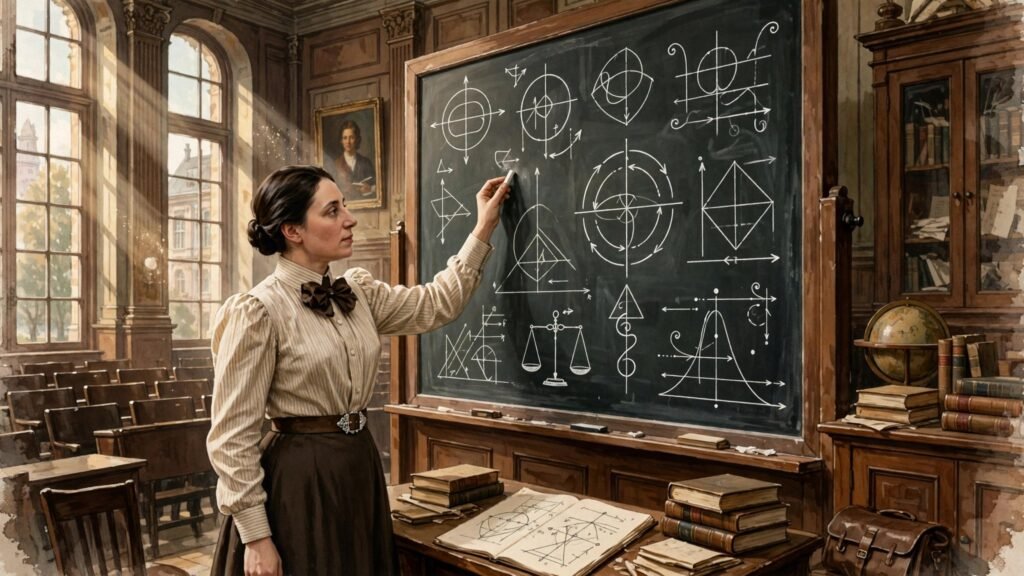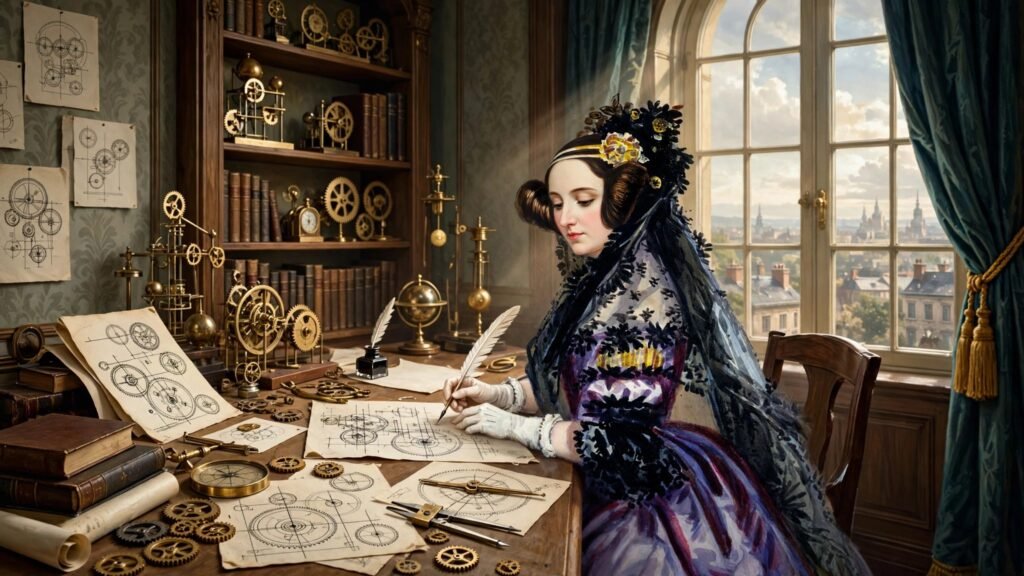
In 1843, a 27-year-old woman published a set of notes that described, in careful detail, how a machine could be made to calculate numbers it had never seen before. The machine did not exist yet. No such computer had ever been built, and none would be built for another century. Yet Ada Lovelace, the only legitimate daughter of the poet Lord Byron, saw further than anyone else alive — she understood that machines could do more than crunch numbers. She imagined them making music, composing art, and thinking in entirely new ways. It was the first computer program in history, written for a computer that had not been invented.
Ada Lovelace lived in a world that did not believe women could do mathematics, let alone invent computing. She was told to be quiet, to be proper, to marry well and stay out of serious intellectual life. Instead, she taught herself mathematics, befriended the greatest inventors of her age, and wrote notes that were three times longer than the paper she was translating — notes that would become the founding document of computer science. Her life is one of the most remarkable stories of imagination triumphing over the limits of an era.
This is the success story of Ada Lovelace, the mathematician who wrote the first computer program a century before computers existed. From a lonely childhood in a famous and scandalous family to a partnership with Charles Babbage that changed the world, her journey shows what happens when curiosity refuses to be fenced in. On Face Zem, we explore the lessons her life still holds for anyone who dreams ahead of their time.
Key takeaways
- Ada Lovelace wrote the first computer program in 1843, for a machine that had not yet been built.
- She was the first person to see that computers could create music and art, not just calculate numbers.
- Her mathematical gift was nurtured by her mother, who pushed her toward science to counter her father’s poetic influence.
- Her partnership with Charles Babbage produced the notes that founded computer science.
- Her legacy was forgotten for a century — then rediscovered and honoured around the world.

Ada Lovelace at a Glance
| Fact | Detail |
|---|---|
| Full name | Augusta Ada King, Countess of Lovelace |
| Born | 10 December 1815, London, England |
| Died | 27 November 1852, aged 36 |
| Parents | Lord Byron and Annabella Milbanke |
| Known for | The first computer program and the first vision of computing |
| Key work | Notes on the Analytical Engine (1843) |
| Main collaborator | Charles Babbage, inventor of the Analytical Engine |
| Married | William King, later Earl of Lovelace, in 1835 |
| Children | Three: Byron, Annabella and Ralph |
| Legacy | Ada Lovelace Day, the Ada programming language, and a place as the first computer programmer |
The Daughter of a Famous Poet
Ada Lovelace was born Augusta Ada Byron on 10 December 1815, the only legitimate child of the poet Lord Byron and his wife Annabella Milbanke. Her father was the most famous poet in Europe, a romantic celebrity whose scandalous life filled the newspapers. Her mother was a brilliant, disciplined woman who loved mathematics. The marriage lasted barely a year. When Ada was only a few weeks old, her parents separated, and her father left England forever. He never saw his daughter again, and he died in Greece when Ada was eight years old.
Ada grew up in the shadow of a father she never knew, and her mother was determined that the girl would not follow in his footsteps. Annabella feared that Ada had inherited her father’s wild imagination and emotional nature, so she pushed her daughter hard toward mathematics and science — subjects considered cold, logical and safe. It was a remarkable decision for the time. Girls of Ada’s class were taught music, drawing and French, not algebra and geometry. But Annabella hired the best tutors she could find and made mathematics the centre of her daughter’s education.
The plan worked in a way Annabella never expected. Ada did not lose her imagination; she combined it with mathematics. She would later call her approach “poetical science” — the idea that imagination and logic together could see further than either one alone. That blend of poetry and numbers would become the secret of her genius.
A Childhood of Curiosity and Illness
Ada’s childhood was marked by frequent illness, including a long bout of measles that left her bedridden for months and, for a time, unable to walk. But confinement only sharpened her curiosity. While other children played outdoors, Ada read, drew, and designed. At the age of twelve, she became fascinated by flight and spent months studying birds, examining their wings and bones, and designing a flying machine powered by steam. She even wrote a book about it, complete with illustrations and calculations.
Her mother worried constantly about Ada’s health and her temperament. Tutors came and went, and Ada was often kept under strict discipline. But she had a stubborn, questioning mind that no amount of rules could tame. She asked why things worked, how they might work differently, and what might be possible if the rules were changed. It was exactly the kind of thinking that would one day let her imagine a computer before computers existed.
By her late teens, Ada was studying advanced mathematics with Mary Somerville, one of the most respected scientists of the age and one of the few women in Britain who had made a name in science. Somerville became a mentor and a friend, and it was through her that Ada would meet the man who would change her life.
Meeting Charles Babbage
In 1833, when Ada was seventeen, Mary Somerville introduced her to Charles Babbage, a brilliant and eccentric mathematician who had spent years designing a machine he called the Difference Engine — a mechanical calculator that could work out complex tables of numbers automatically. Babbage was delighted by Ada’s quick mind and her understanding of his work. Most visitors nodded politely at his machines; Ada asked sharp, probing questions that showed she truly understood what he was trying to do.
Babbage soon began work on a far grander machine, the Analytical Engine. Unlike the Difference Engine, which could only do one kind of calculation, the Analytical Engine was designed to be programmable — it could be given different instructions and carry out different tasks. It was, in every important way, the first general-purpose computer, designed a hundred years before the first electronic computers were built. But it was enormously complex, and Babbage could never get the funding to build it.
Ada and Babbage became close friends and collaborators. She visited his workshop, studied his designs, and discussed his ideas at length. Babbage called her “the Enchantress of Numbers” — a playful nickname that captured both her mathematical skill and her gift for seeing the poetry in machines. Their friendship would produce one of the most important documents in the history of computing.
Marriage, Family and Mathematics
In 1835, Ada married William King, a quiet and supportive man who later became the Earl of Lovelace. Ada became the Countess of Lovelace. The couple had three children, and Ada threw herself into family life — but she never gave up mathematics. Her husband encouraged her studies, and she continued to work with tutors, including the great mathematician Augustus De Morgan, who taught her advanced calculus and was astonished by her ability.
De Morgan wrote that Ada had a gift few mathematicians possessed: she could see the “big picture” of a problem, grasping how different ideas connected, while most students could only follow one step at a time. It was this ability to see connections that would let her understand the Analytical Engine more deeply than anyone else, including Babbage himself.
Balancing motherhood, marriage and mathematics was not easy in Victorian England, where a woman of Ada’s position was expected to spend her days on social calls and household management. Ada’s letters show a woman constantly torn between her duties and her passion for learning, but she never stopped. She studied late into the night, filled notebooks with calculations, and kept up a lively correspondence with the leading scientists of her day.
The Paper That Changed Computing
In 1840, Babbage travelled to Turin in Italy to lecture on his Analytical Engine. An Italian engineer named Luigi Menabrea took notes on the lectures and published them in French. Three years later, Ada was asked to translate Menabrea’s paper into English. She agreed — and then she did something extraordinary. She added her own notes to the translation, and those notes ended up three times longer than the original paper.
In her notes, Ada did two things that no one had ever done before. First, she wrote a detailed method for calculating a sequence of numbers — the Bernoulli numbers — on the Analytical Engine. It was a step-by-step algorithm, complete with a table showing how the machine would work through it. That algorithm is now recognised as the first computer program ever written.
Second, and even more remarkably, Ada looked beyond calculation. She wrote that the Analytical Engine “might act upon other things besides number” and could compose “elaborate and scientific pieces of music of any degree of complexity or extent”. She imagined machines creating art, a full century before anyone built a machine that could do such a thing. Babbage had designed a calculator; Ada saw a computer.
The Visionary Behind the Machine
What made Ada’s work so extraordinary was not just the algorithm — it was the vision. Babbage understood his machine as a brilliant calculating device. Ada understood it as something far bigger: a machine that could manipulate symbols according to rules, and therefore do anything that could be expressed as symbols. Numbers, music, images, words — all of it could be processed by a machine, if only the right instructions were given.
She was also clear-eyed about the limits of machines. In a famous passage, she wrote that the Analytical Engine “has no pretensions whatever to originate anything. It can do whatever we know how to order it to perform.” Machines, she said, could follow instructions but could not truly think or create on their own. That distinction — between following instructions and genuine understanding — is still at the heart of debates about artificial intelligence today, more than 180 years later.
Ada’s notes were published in 1843 in a scientific journal, under her initials “A.A.L.” — she did not put her full name on the work, as was common for women of the time. The paper was admired by specialists but largely forgotten by the wider world. The Analytical Engine was never built in her lifetime, and her vision would have to wait a century to be understood.
Struggle, Debt and a Short Life
Ada’s later years were difficult. She became fascinated by gambling and mathematical models for predicting horse races, and she fell into serious debt — a secret she kept from her husband. She also suffered from poor health, and the illnesses that had troubled her since childhood returned with greater force. Her friendship with Babbage became strained, as the two strong-willed collaborators quarrelled over credit and over Babbage’s endless, unfunded projects.
In 1851, Ada became seriously ill. The following year, at the age of thirty-six, she died of uterine cancer — the same disease that had killed her father, at the same age. She was buried, at her own request, beside Lord Byron in the family vault at Hucknall in Nottinghamshire, next to the father she had never known.
Her death was quiet, and her work was soon forgotten. Victorian science moved on, and the Analytical Engine became a footnote in the history of failed inventions. For a hundred years, Ada Lovelace was remembered, if at all, as Lord Byron’s daughter — not as a mathematician in her own right.
The Rediscovery of Ada Lovelace
Ada’s reputation was rescued in the 1950s, when the pioneers of electronic computing began to look back at the history of their field. They found her 1843 notes and realised, with astonishment, that a woman in the Victorian age had already described the principles of programming. The computer scientist Alan Turing cited her work in his famous 1950 paper on computing machinery and intelligence, engaging directly with her argument that machines could not truly think.
In 1980, the United States Department of Defense named a new programming language “Ada” in her honour — a rare tribute, and one that brought her name to millions of programmers around the world. Since then, her fame has only grown. Her portrait appears on banknotes, stamps and murals. Schools, awards and conferences carry her name.
In 2009, the second Tuesday of every October was established as Ada Lovelace Day, an international celebration of women in science, technology, engineering and mathematics. Every year, events around the world honour her memory and the women who followed her. The daughter of a poet, forgotten for a century, is now one of the most celebrated figures in the history of computing.
What Ada Lovelace Teaches Us
Ada Lovelace’s life holds lessons that reach far beyond computing. The first is that imagination is a form of intelligence. Ada did not just learn mathematics; she imagined what mathematics could become. She combined the poet’s eye for possibility with the mathematician’s discipline, and that combination let her see a future nobody else could see. The most important breakthroughs often come from people who refuse to stay inside one discipline.
The second lesson is about persistence in the face of doubt. Ada lived in a society that told her, in a hundred small ways, that serious thinking was not for women. She was not allowed to attend university, she could not publish under her own name, and her work was dismissed or ignored. She kept going anyway, studying late at night, writing letters to the greatest minds of her age, and trusting her own judgement.
The third lesson is about seeing further than the present. Ada’s contemporaries looked at Babbage’s machine and saw a calculator. She looked at the same machine and saw the future of human creativity. Success is not always about building something new — sometimes it is about understanding, before anyone else, what something new could mean.
Checklist: Lessons from Ada Lovelace
- Combine imagination with discipline — her “poetical science” joined poetry and mathematics.
- Ask what a tool could become, not only what it already does.
- Study deeply, even when the world doubts you — Ada kept learning through illness and family life.
- Write your ideas down clearly, so they can outlive you — her 1843 notes waited a century to be understood.
- Seek mentors and collaborators who challenge you, as Somerville and Babbage challenged her.
- Trust your own judgement when you see further than everyone around you.
Frequently Asked Questions
Was Ada Lovelace really the first computer programmer?
Yes, by the standard definition. In 1843 she published a step-by-step algorithm for calculating Bernoulli numbers on Babbage’s Analytical Engine, complete with a table of operations. It was the first algorithm ever written for a machine, a century before electronic computers existed.
Did Ada Lovelace build a computer?
No. Babbage’s Analytical Engine was never built in their lifetime, because it was too complex and expensive for the technology of the 1840s. Ada’s achievement was to write a program for it and to understand what such a machine could do.
What did Ada Lovelace mean by “poetical science”?
It was her own phrase for combining imagination with rigorous logic. She believed that the best science needed both — the poet’s ability to imagine new possibilities and the mathematician’s ability to prove them.
Why was Ada Lovelace forgotten for so long?
Her work was published under her initials in a specialist journal, the machine it described was never built, and Victorian society had little interest in celebrating a woman mathematician. Her notes were rediscovered only in the 1950s, when electronic computing made her ideas relevant again.
What is Ada Lovelace Day?
Ada Lovelace Day is celebrated on the second Tuesday of every October. It is an international day that honours her memory and celebrates the achievements of women in science, technology, engineering and mathematics.
What is the Ada programming language?
Ada is a programming language developed for the United States Department of Defense and named after Ada Lovelace in 1980. It is used in systems where reliability and safety are critical, such as aircraft and spacecraft.
Bottom line
Ada Lovelace wrote the first computer program for a machine that did not exist, and she imagined computers making music and art a century before anyone else dreamed of such a thing. She did it as a woman in Victorian England, with no university education, no laboratory, and no recognition in her lifetime. Her story is a reminder that the future belongs to those who can imagine it — and that imagination, joined to discipline, is one of the most powerful forces in the world.
Note: This article is a general historical account of Ada Lovelace’s life and work, based on widely published biographical sources. Net worth and financial details are not applicable to this historical figure. For more inspiring stories of remarkable people, explore the other success stories on Face Zem.
Read more on Face Zem: Marie Curie Success Story, Helen Keller Success Story, and Isaac Newton Success Story.

Keep what speaks to you.
Leave room for your own perspective.