
Emmy Noether changed the world with an idea so deep that physicists still use it every single day, yet for most of her life she worked without pay, without a title, and without the recognition she deserved. Born in Germany in 1882, she became one of the greatest mathematicians of the twentieth century at a time when universities barely allowed women through the door. Her theorem, connecting symmetry to conservation laws, became the foundation of modern physics.
Her story is one of brilliance meeting barriers again and again. She was told women could not study at university, then told they could not teach there. She lectured under a male colleague’s name for years, worked unpaid for a decade, and was forced to flee her country when the Nazis came to power. Through it all, she never stopped working, never stopped teaching, and never stopped helping others.
Face Zem tells the story of Emmy Noether not just as a triumph of mathematics, but as a triumph of persistence. Her life shows what happens when talent refuses to wait for permission, and why the most important ideas often come from the people the system tries hardest to ignore.
Key takeaways
- Emmy Noether proved that every symmetry in nature corresponds to a conservation law — the foundation of modern physics.
- She worked for years without pay or an official position because German universities would not hire a woman to teach.
- Albert Einstein called her “the most significant creative mathematical genius thus far produced since the higher education of women began.”
- Her work shaped abstract algebra as well as physics, and her students, known as the “Noether boys,” carried her ideas around the world.
- Noether fled Nazi Germany in 1933 and rebuilt her career at Bryn Mawr College in the United States, where she died in 1935.
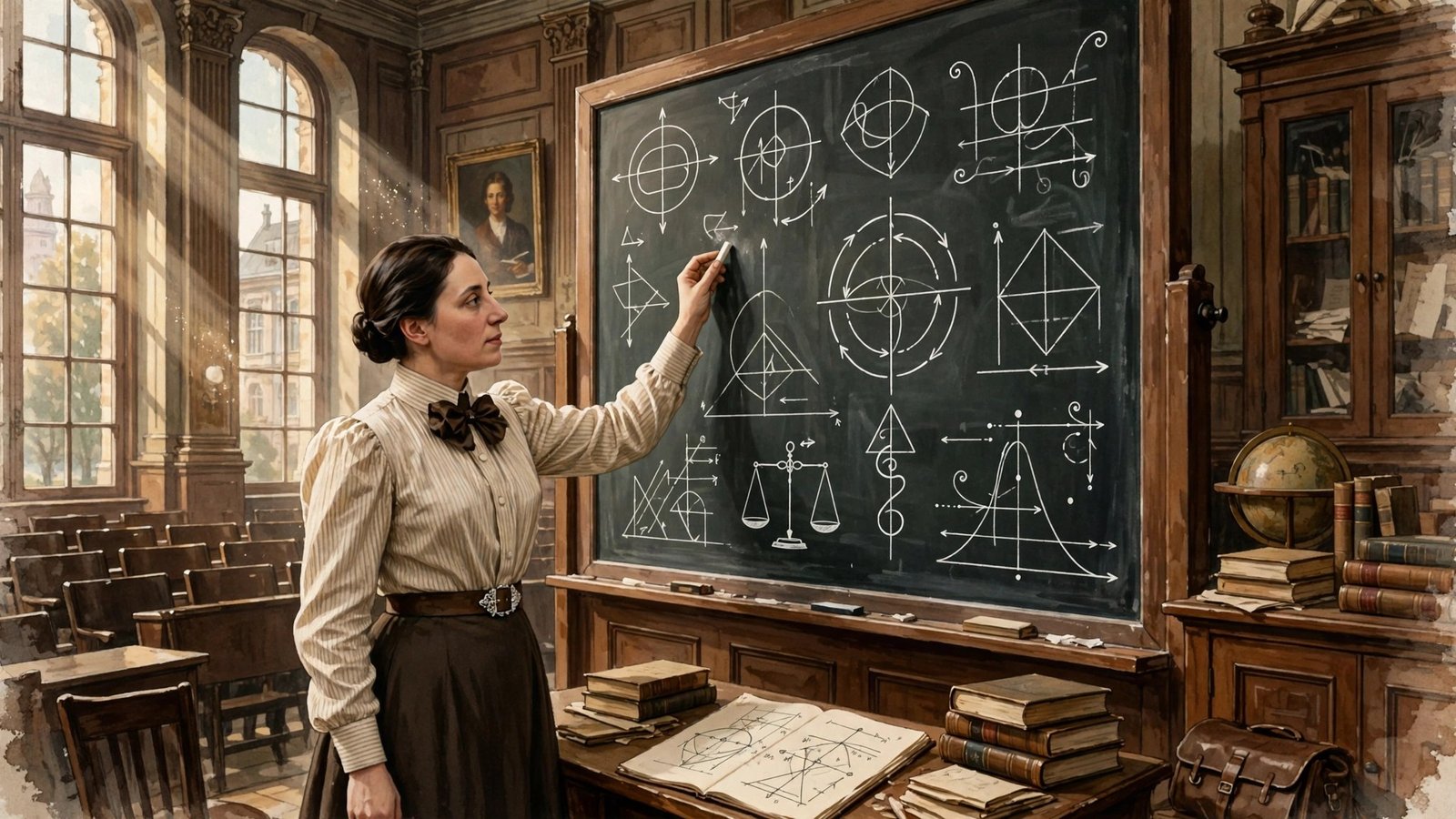
Emmy Noether at a Glance
| Fact | Detail |
|---|---|
| Full name | Amalie Emmy Noether |
| Born | 23 March 1882, Erlangen, Germany |
| Died | 14 April 1935, Bryn Mawr, Pennsylvania, United States |
| Field | Abstract algebra and theoretical physics |
| Greatest achievement | Noether’s theorem, linking symmetry and conservation laws |
| Key work | Invariant theory, ring theory, ideal theory |
| Main institutions | University of Erlangen, University of Göttingen, Bryn Mawr College |
| Famous students | The “Noether boys,” including Ernst Witt and Bartel van der Waerden |
| Honours | Ackermann–Teubner Memorial Award (1932), named craters and asteroids |
| Legacy | Her theorem underpins particle physics, relativity, and quantum field theory |
1. A Childhood Among Mathematicians
Emmy Noether was born on 23 March 1882 in Erlangen, a small university town in Bavaria. Her father, Max Noether, was a professor of mathematics, and her home was filled with books, equations, and visiting scholars. She grew up hearing mathematics discussed at the dinner table, and she absorbed the language of the subject the way other children absorb music.
Yet nobody expected her to become a mathematician. In nineteenth-century Germany, girls were educated to become wives and mothers, and Emmy was no exception. She attended a girls’ school, learned piano and dancing, and trained to teach English and French in a girls’ school. Her future seemed settled and ordinary.
But the mathematics around her had other plans. Emmy was drawn to the abstract world of numbers and structures, and she was far too curious to stay in the narrow lane laid out for her. She studied mathematics privately, sat in on lectures she was not officially allowed to attend, and proved that she belonged in the subject long before anyone gave her permission to enter it.
2. Fighting Her Way Into University
When Emmy was eighteen, German universities did not admit women as regular students. Women could, with a professor’s permission, audit lectures, but they could not register, sit exams, or earn a degree. It was a system designed to keep them out, and Emmy decided to walk through it anyway.
In 1900, she passed the state examination to teach English and French, but instead of taking a teaching job, she began attending mathematics lectures at the University of Erlangen as an auditor. Two years later, the rules changed just enough: women were allowed to matriculate at German universities. Emmy enrolled immediately.
She studied under the great mathematicians of Erlangen, including her father and the invariant theorist Paul Gordan, and in 1907 she completed her doctorate with a thesis on invariant theory. It was a formidable piece of work, filling 235 pages with dense calculations. She was one of the first German women to earn a doctorate in mathematics, and she had done it against rules written to stop her.
3. The Unpaid Years
A doctorate did not open doors for a woman in Germany. For the next eight years, Emmy worked at the Mathematical Institute in Erlangen without a salary and without an official position. She researched, she supervised students, she substituted for her father when he was ill — and she was paid nothing.
It is hard to overstate how unjust this was. Her male colleagues with lesser qualifications held paid posts, while she, already one of the strongest mathematicians in Germany, worked for free. But she kept going, because the mathematics mattered more to her than the recognition.
During these years she published papers on invariant theory and began moving toward the abstract algebra that would become her greatest contribution. She was building, quietly and without reward, a new way of thinking about mathematics itself.
4. Göttingen and the Fight to Teach
In 1915, the great mathematicians David Hilbert and Felix Klein invited Emmy to Göttingen, then the centre of the mathematical world. They wanted her there because she was brilliant. But the university’s philosophy faculty refused to let her teach. One professor is said to have objected: “What will our soldiers think when they return to the university and find that they are required to learn at the feet of a woman?” Hilbert reportedly answered: “Gentlemen, I do not see that the sex of the candidate is an argument against her admission. After all, we are a university, not a bathhouse.”
For four years, Emmy lectured under Hilbert’s name. The announcements listed his name; she did the teaching. It was humiliating, but it gave her a classroom and students, and she used it.
In 1919, after the First World War, the rules finally changed, and Emmy was allowed to habilitate — the qualification to teach at a German university. She became a Privatdozent, a lecturer paid only by student fees. It was still far less than she deserved, but it was official at last.
5. Noether’s Theorem: The Idea That Changed Physics
In 1915, the year she arrived in Göttingen, Emmy Noether solved a problem that had been troubling the greatest physicists of the age. Einstein had just published his general theory of relativity, and Hilbert and Klein were puzzling over why energy seemed not to be conserved in the new theory. Noether’s answer was a theorem of breathtaking elegance.
Noether’s theorem states that every continuous symmetry of a physical system corresponds to a conservation law. If the laws of physics are the same at all times, energy is conserved. If they are the same in all places, momentum is conserved. If they are unchanged by rotation, angular momentum is conserved. Symmetry and conservation are two faces of the same coin.
The theorem did more than solve a puzzle about relativity. It gave physicists a new way to think: look for the symmetries, and the conservation laws follow. A century later, Noether’s theorem is the backbone of particle physics, quantum field theory, and the search for new particles. Physicists still say that when you understand Noether’s theorem, you understand something fundamental about how the universe works.
6. Reinventing Algebra
While her theorem was transforming physics, Emmy Noether was quietly transforming mathematics itself. In the 1920s, she moved from the concrete calculations of invariant theory to a new, abstract way of thinking. She studied rings, ideals, and modules — structures that describe how mathematical objects behave — and she proved general theorems about them instead of solving individual problems.
This shift from calculation to structure was revolutionary. Mathematicians had spent centuries solving particular equations; Noether taught them to study the patterns behind all equations at once. Her 1921 paper on ideal theory is one of the most important works in the history of algebra, and her ideas became the foundation of modern abstract algebra.
Her lectures were famously difficult. She thought out loud, followed ideas where they led, and expected her students to keep up. But the students who did — the group that came to be called the “Noether boys” — became some of the most important mathematicians of the century, and they carried her abstract methods to universities around the world.
7. The Noether Boys
Emmy Noether’s students were devoted to her, and she was devoted to them. Her lectures at Göttingen attracted young mathematicians from across Europe and beyond, and the group became known as the “Noether boys” — a name that stuck even though several of her students were women.
She taught in a small room, often with her students gathered around a table, and the sessions were as much conversations as lectures. She would start with a problem, think through it aloud, and invite her students to challenge her. It was mathematics as a living, collaborative activity, and it was unlike anything else in Göttingen.
Her students included Ernst Witt, Bartel van der Waerden, Max Deuring, and others who went on to shape twentieth-century mathematics. Van der Waerden’s famous textbook on modern algebra was built on Noether’s lectures, and it spread her ideas to a generation of mathematicians who had never met her.
8. The Recognition That Came Too Slowly
By the early 1930s, Emmy Noether’s reputation was enormous. In 1932, she gave a plenary address at the International Congress of Mathematicians in Zürich, one of the highest honours in the field. In the same year she won the Ackermann–Teubner Memorial Award. Her colleagues knew she was one of the greatest mathematicians alive.
But her position at Göttingen remained modest. She was an associate professor without tenure, paid far less than her male colleagues, and she had no security. The recognition came in honours and invitations, not in a proper salary or a permanent chair.
Einstein, who had praised her work from the beginning, wrote in 1935 that she was “the most significant creative mathematical genius thus far produced since the higher education of women began.” It was generous praise, but it came too late for her to enjoy it fully.
9. Exile from Nazi Germany
In 1933, the Nazis came to power in Germany, and Emmy Noether’s life was turned upside down. She was Jewish, and she was also known for her left-wing politics. In April 1933, she was dismissed from her position at Göttingen, along with many other Jewish academics.
It was a brutal end to eighteen years of work. She had built her career in Germany against every obstacle, and now the government was throwing her out. But she did not waste time on bitterness. She helped her students find positions abroad, and she looked for a way out herself.
Help came from the United States. Bryn Mawr College, a women’s college in Pennsylvania, offered her a visiting professorship, and she sailed for America in the autumn of 1933. She was fifty-one, starting over in a new country, in a new language, with almost nothing. And she got straight to work.
10. A New Home at Bryn Mawr
At Bryn Mawr, Emmy Noether found something she had never had in Germany: a community that valued her. The college welcomed her warmly, and she threw herself into teaching and research with her usual energy. She gave weekly lectures at the Institute for Advanced Study in Princeton, where she met Einstein again, and she built a new circle of students.
She was happy in America, by all accounts, happier than she had been in years. She wrote to friends that Bryn Mawr was a wonderful place, and she began to plan a long future there. She had finally found a home where her brilliance was matched by respect.
But her time in America was tragically short. In April 1935, after surgery to remove a pelvic tumour, she died suddenly from complications. She was fifty-three. The mathematical world was stunned. Einstein’s obituary in the New York Times called her a genius, and mathematicians around the world mourned a mind that had only just begun to be understood.
11. What Made Emmy Noether Great
Emmy Noether’s greatness was not just her talent, though her talent was extraordinary. It was the way she thought. Where other mathematicians saw individual problems, she saw the structure beneath them. Where others calculated, she understood. Her abstract approach looked strange at first, and some of her contemporaries complained that it was too general, too far from the concrete. But it was the future of mathematics, and she saw it before anyone else.
She was also great because of her character. She was generous with her ideas, giving them freely to students and colleagues. She was kind, funny, and famously absent-minded, forgetting appointments and losing papers, but never losing track of a mathematical idea. She cared more about the work than about credit, and she was happy when her students succeeded.
And she was great because she refused to stop. She worked without pay, taught under another man’s name, and was driven from her country — and she kept doing mathematics through it all. Her persistence was as remarkable as her brilliance.
12. The Legacy of Emmy Noether
Emmy Noether’s legacy is everywhere in modern science. Her theorem is the foundation of particle physics, and every time physicists search for a new particle, they are looking for a symmetry that Noether’s theorem predicts. Her algebra underpins computer science, cryptography, and engineering. Her ideas are so deeply woven into science that it is hard to imagine the modern world without them.
Her name is honoured in ways she never lived to see: craters on the Moon and an asteroid bear her name, the Noether Lecture is one of the highest honours in mathematics, and universities and institutes around the world celebrate her work. In 2015, on the centenary of her theorem, physicists and mathematicians around the world marked the occasion.
But perhaps her greatest legacy is the example she set. She showed that brilliance does not depend on gender, that talent can thrive even when the system tries to crush it, and that the most important work is often done by the people who are given the least. Her life is a reminder that the world loses when it wastes talent — and gains immeasurably when it lets talent work.
Checklist: Lessons from Emmy Noether’s Life
- Do not wait for permission to do your best work — Noether worked for years without a title or a salary, and the work itself was the reward.
- Look for the structure beneath the problem — her abstract thinking found the patterns that connected everything.
- Share your ideas generously — her students carried her work further than she ever could alone.
- Refuse to be defined by other people’s limits — she was told women could not teach, and she taught anyway.
- Keep going after setbacks — exile, dismissal, and injustice never stopped her from doing mathematics.
- Judge people by their work, not their title — her greatest ideas came while she had no official position at all.
Frequently Asked Questions
What is Noether’s theorem?
Noether’s theorem states that every continuous symmetry of a physical system corresponds to a conservation law. For example, the fact that the laws of physics do not change over time means energy is conserved, and the fact that they do not change with position means momentum is conserved. It is one of the most important ideas in physics, and it underpins modern particle physics and quantum field theory.
Why was Emmy Noether not given a proper job in Germany?
Because she was a woman. German universities in the early twentieth century would not hire women to teach, and even after she became one of the most respected mathematicians in the country, she held only a modest, insecure position. She lectured under David Hilbert’s name for four years because the university would not let her teach under her own.
What did Albert Einstein think of Emmy Noether?
Einstein admired her deeply. When she died in 1935, he wrote an obituary in the New York Times calling her “the most significant creative mathematical genius thus far produced since the higher education of women began.” He had praised her work on relativity from the beginning, and he considered her theorem one of the great achievements of modern physics.
What is abstract algebra?
Abstract algebra is the study of mathematical structures — rings, groups, fields, and ideals — and the patterns that govern them. Instead of solving individual equations, abstract algebra studies the general rules that apply to whole families of equations. Emmy Noether was one of the founders of the subject, and her 1921 paper on ideal theory is a landmark in its history.
Who were the “Noether boys”?
The “Noether boys” were Emmy Noether’s students and followers at Göttingen, a group of young mathematicians who attended her lectures and carried her ideas around the world. They included Ernst Witt, Bartel van der Waerden, and Max Deuring. Van der Waerden’s textbook on modern algebra, based on Noether’s lectures, spread her methods to a generation of mathematicians.
Why did Emmy Noether leave Germany?
She was dismissed from her position at Göttingen in 1933 after the Nazis came to power, because she was Jewish and known for her left-wing views. She moved to the United States, where Bryn Mawr College offered her a visiting professorship. She died in Pennsylvania in 1935, only eighteen months after arriving in America.
Bottom line
Emmy Noether was one of the greatest mathematicians who ever lived, and she did her greatest work while the world did its best to ignore her. Her theorem connecting symmetry and conservation laws changed physics forever, and her abstract algebra changed mathematics forever. She worked without pay, taught under another man’s name, and was driven from her country — and she never stopped.
Her story is a reminder that genius is not always recognised in its own time, and that the barriers people face are not a measure of their talent. Emmy Noether’s life shows what happens when brilliance refuses to wait for permission, and why the world is richer when it lets talent work, whoever it belongs to.
Read more inspiring stories on Face Zem: the success story of Ada Lovelace, who wrote the first computer program; the success story of Katherine Johnson, the NASA mathematician who sent men to the Moon; and the success story of Albert Einstein, who called Noether a genius.
Note: This article is a general historical account of Emmy Noether’s life and work, based on widely known facts about her career. It is intended as an inspiring success story, not an academic biography.

Keep what speaks to you.
Leave room for your own perspective.


