
Florence Sabin was born in 1871 in Central City, Colorado, a rough mining town where the nearest doctor was often a day’s ride away. She would go on to become one of the most important medical scientists America has ever produced. Her journey took her from a one-room schoolhouse to the highest levels of Johns Hopkins University, where she became the first woman to hold a full professorship, and then to the Rockefeller Institute, where she led a team studying the body’s defences. Along the way she changed what medicine knew about the lymphatic system, the blood, and tuberculosis.
What makes her story so powerful is not just the list of firsts. It is the way she used each success as a platform for the next. She did not stop at a brilliant research career. In her late sixties she returned to Colorado and built a public health system from almost nothing, cutting the state’s death rate from tuberculosis and bringing clean water, vaccination and child health services to people who had never had them. She proved that a great scientist could also be a great public servant.
This is the Florence Sabin success story, told by Face Zem: a tale of curiosity, persistence and service that still has lessons for anyone chasing a big goal in 2026.
Key takeaways
- Florence Sabin became the first woman to hold a full professorship at Johns Hopkins School of Medicine in 1917.
- Her research revealed how the lymphatic system develops and how blood cells are made, reshaping modern medicine.
- She led a major research department at the Rockefeller Institute for Medical Research in New York.
- At 66 she retired to Colorado and built a public health system that cut tuberculosis deaths across the state.
- Her life shows that talent, patience and service can turn a single career into a legacy that saves lives.
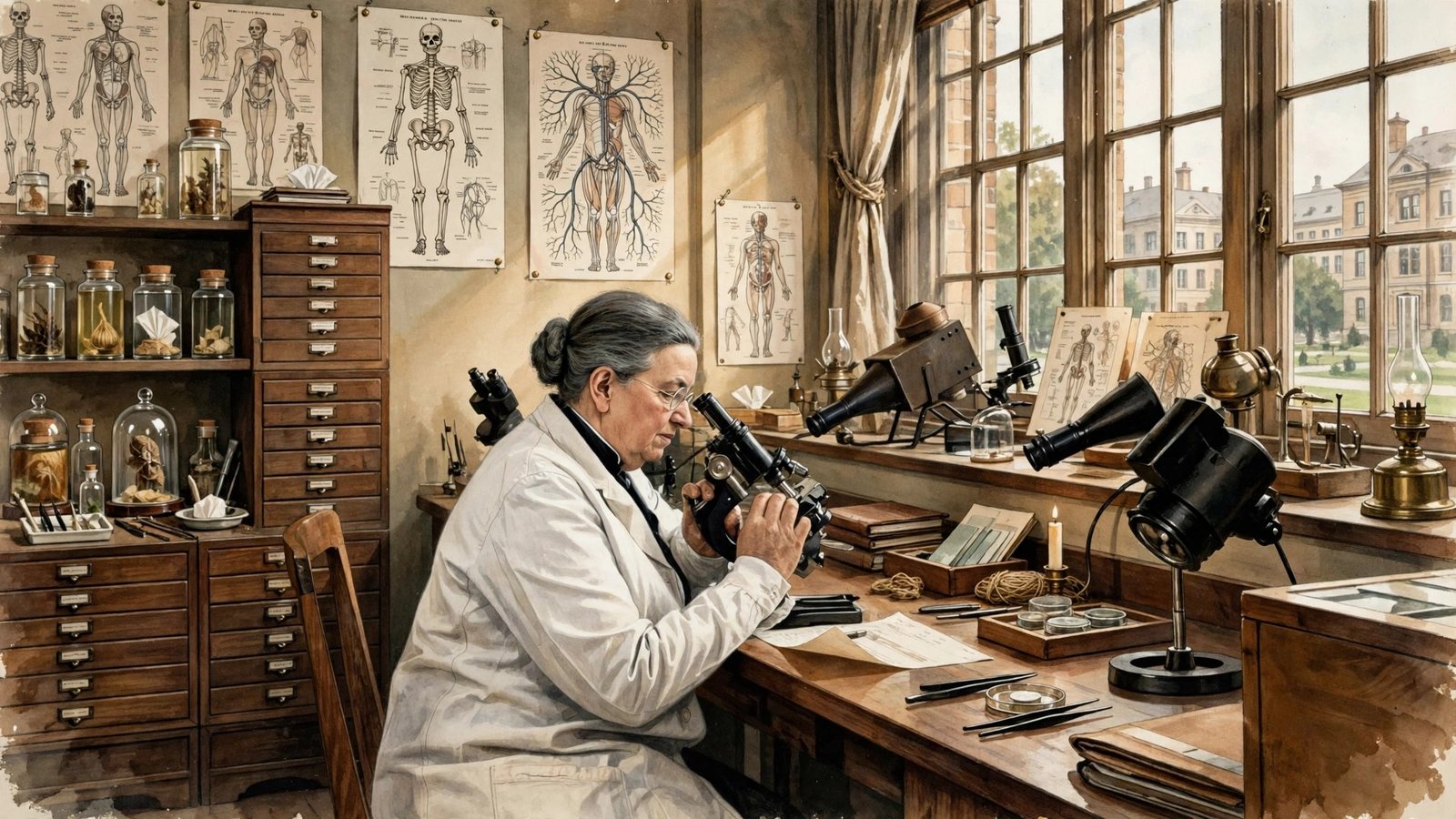
Florence Sabin at a Glance
| Fact | Detail |
|---|---|
| Full name | Florence Rena Sabin |
| Born | 9 November 1871, Central City, Colorado |
| Died | 3 October 1953, Denver, Colorado |
| Education | Smith College; Johns Hopkins School of Medicine |
| Key fields | Anatomy, embryology, immunology, public health |
| Major firsts | First woman full professor at Johns Hopkins; first woman elected to the National Academy of Sciences |
| Best-known work | Development of the lymphatic system; origin of blood cells; tuberculosis research |
| Later career | Chair of public health reform in Colorado from 1944 |
| Honours | Lasker Award; National Women’s Hall of Fame; a statue in the United States Capitol |
| Legacy | Modern understanding of lymph and blood; Colorado’s public health system |
1. A Childhood on the Mining Frontier
Florence Sabin grew up in Central City, a gold-mining town high in the Colorado Rockies. Life there was rough, practical and often dangerous. Her father, George Sabin, was a mining engineer, and her mother, Serena, a schoolteacher who died when Florence was only seven. After her mother’s death, Florence and her sister Mary were raised by their father and by relatives, moving between Colorado and Chicago.
Even as a child, Florence showed the two qualities that would define her life: curiosity and discipline. She loved to watch how things worked, and she loved to study. The frontier gave her something else too, a sense that problems were there to be solved with your own hands. There was no waiting for someone else to fix things in a mining town. That attitude stayed with her for the rest of her life.
Her early schooling was uneven, as frontier schooling often was, but she was a strong student. When she was old enough, she was sent to Smith College in Massachusetts, one of the few places where a young woman of her generation could get a serious education. It was there that her path toward medicine began to take shape.
2. Smith College and the Spark of Science
At Smith College, Florence Sabin studied zoology, and the subject lit a fire in her. She was fascinated by how living things were built, how a tiny embryo could grow into a complex creature. Her professors noticed her talent at once. One of them encouraged her to think about medicine, a field that was then almost entirely closed to women.
She graduated from Smith in 1893 and spent a year teaching school, first in Denver and then in New York. Teaching paid the bills, but it was not her calling. She wanted to understand the human body at the deepest level. So she applied to the Johns Hopkins School of Medicine in Baltimore, one of the finest medical schools in the world and one of the few that admitted women on equal terms.
Getting in was a triumph in itself. Johns Hopkins had only begun admitting women in 1893, and the women in each class were a tiny minority. Sabin arrived determined to prove that she belonged there, and she did it by outworking almost everyone around her.
3. Medical School at Johns Hopkins
At Johns Hopkins, Florence Sabin found her true mentor in Franklin P. Mall, the professor of anatomy. Mall was a demanding teacher who believed that real understanding came from looking carefully and thinking clearly. He saw Sabin’s gift for observation and gave her a research problem that would become her life’s first great work: the development of the lymphatic system.
The lymphatic system is the network of vessels and nodes that drains fluid from the tissues and helps the body fight infection. In the early 1900s, nobody really knew how it formed in the embryo. Sabin spent years tracing its development in pig embryos, making careful models and drawings. Her work was so precise and so beautiful that it became a classic of medical science.
She graduated from medical school in 1900, one of the top students in her class. Mall immediately offered her a position in his anatomy department. It was the start of a research career that would last for decades, and it made her one of the most respected young anatomists in America.
4. The Lymphatic System Breakthrough
Sabin’s research on the lymphatic system answered a question that had puzzled doctors for generations. By studying embryos at different stages of development, she showed that the lymphatic system grows out from the veins, budding off like new branches from a tree. Her evidence was so clear that it settled a long-running scientific argument.
What made the work remarkable was not just the answer but the method. Sabin was famous for her patience. She would examine hundreds of specimens, draw each one by hand, and build three-dimensional wax models to show exactly how the tiny vessels were arranged. Her models were works of art as well as science, and they are still admired today.
This early success gave her a reputation for rigour that never left her. Colleagues learned that when Florence Sabin said something was so, it was so, because she had looked more carefully than anyone else. That reputation would open doors that were closed to almost every other woman of her time.
5. Blood, Bone Marrow and the Body’s Defences
After the lymphatic system, Sabin turned to an even bigger question: where do blood cells come from? In the early twentieth century, doctors knew that blood cells were made in the bone marrow, but the details were murky. Sabin and her students traced the origin of red and white blood cells, showing how they developed from common ancestors in the embryo.
She also studied the cells that line the blood vessels and the cells that fight infection. Her work on the monocyte, a type of white blood cell, helped doctors understand how the body defends itself against tuberculosis, one of the great killers of the age. This research would later become the foundation of her work at the Rockefeller Institute.
Her laboratory at Johns Hopkins became a magnet for talented young scientists. She was a demanding but generous mentor, and many of her students went on to distinguished careers of their own. She believed that science advanced when good people worked together, and she built a team that proved it.
6. The First Woman Professor at Johns Hopkins
In 1917, Florence Sabin was appointed professor of histology at Johns Hopkins School of Medicine. It was a historic moment: she was the first woman to hold a full professorship at the school, and one of the first in the country. The appointment was not a favour. It was recognition of research that had already changed her field.
She held the post for eight years, teaching anatomy and histology to generations of medical students. Her lectures were famous for their clarity. She could take a complex subject and make it simple without ever making it shallow. Students remembered her as a teacher who expected the best and helped them reach it.
But Johns Hopkins, for all its progress, still had limits. Sabin was paid less than her male colleagues, and she knew that her chances of leading a department there were small. When a new opportunity came from New York, she took it, and the move would make her one of the most powerful figures in American medical research.
7. Leading Research at the Rockefeller Institute
In 1925, Florence Sabin joined the Rockefeller Institute for Medical Research in New York, one of the world’s great centres of science. She was made a member of the institute and head of its department of cellular studies, the first woman to hold such a position. At 53, she was starting the most productive phase of her career.
At Rockefeller, she turned her attention to tuberculosis. The disease killed millions of people every year, and Sabin wanted to understand exactly how the body’s cells fought it. Her team studied the immune response in extraordinary detail, showing how white blood cells surrounded and contained the tuberculosis germ.
Her work at Rockefeller was not just about the laboratory. She was also a leader in the wider scientific community, serving as president of the American Association of Anatomists and helping to shape national science policy. In 1925 she was elected to the National Academy of Sciences, the first woman ever to receive that honour.
8. The National Academy and a National Reputation
Election to the National Academy of Sciences in 1925 was a landmark, not just for Sabin but for American science. The academy was the most prestigious scientific body in the country, and no woman had ever been a member. Her election announced that the highest levels of science were open to women, at least in principle.
Sabin never made a fuss about being a pioneer, but she understood what her success meant. She encouraged young women to enter science and medicine, and she used her position to argue for better opportunities for them. She believed that talent was wasted whenever it was held back by prejudice, and she said so plainly.
By the time she retired from the Rockefeller Institute in 1938, she was one of the most honoured scientists in America. She had published more than a hundred papers, trained a generation of researchers, and changed what doctors knew about the body’s defences. Most people would have been content to rest. Florence Sabin was not most people.
9. Retirement to Colorado and a New Mission
In 1938, at the age of 66, Florence Sabin retired to Denver, Colorado. She expected a quiet life of reading, gardening and visits with her sister. Instead, she found a state in a public health crisis. Colorado had one of the highest tuberculosis death rates in the country, and its health services were among the weakest.
Sabin could not look away. She had spent her career studying tuberculosis in the laboratory. Now she saw it killing her neighbours. She decided to do something about it, and she brought to the task the same energy and rigour she had brought to her research.
She began by learning the facts. She travelled across Colorado, visiting towns, talking to doctors, and studying the state’s health records. What she found shocked her: many counties had no health department at all, and the state government spent almost nothing on public health. She set out to change that, and she would spend the next decade doing it.
10. Building Colorado’s Public Health System
In 1944, Colorado’s governor appointed Sabin to chair a committee on public health. It was a remarkable choice: a 73-year-old scientist with no political experience, asked to rebuild the state’s health system. She accepted at once, and she went to work with the same method she had used in the laboratory: gather the evidence, then act on it.
Her committee proposed a series of reforms, including county health departments, clean water supplies, vaccination programmes, and free chest X-rays to detect tuberculosis early. Sabin then campaigned for the reforms across the state, speaking to any group that would listen, from farmers’ clubs to women’s societies. She was a persuasive speaker, and her scientific authority carried enormous weight.
The reforms passed, and the results were dramatic. Within a few years, tuberculosis deaths in Colorado fell sharply, and the state’s public health system became a model for the rest of the country. Sabin’s laws, known as the Sabin Health Laws, are still remembered as one of the great achievements of American public health.
11. What Made Her Great
What made Florence Sabin great was a rare combination of gifts. She had a scientist’s eye for detail and a teacher’s gift for making things clear. She had the patience to spend years on a single problem and the courage to take on new challenges in her seventies. She had the confidence to speak her mind and the humility to keep learning.
She was also, by all accounts, a warm and generous person. Her students remembered her kindness as much as her brilliance. She believed that science was a human enterprise, and that the point of understanding the body was to help people live better lives. That belief ran through everything she did, from the laboratory to the legislature.
Perhaps most of all, she never let age or convention set her limits. She became a professor when women were still rare in medicine. She led a research institute when women were still excluded from most laboratories. She rebuilt a state’s health system when most people her age had long since retired. At every stage, she simply did the work that needed doing.
12. Lessons From Her Life
Florence Sabin’s life offers lessons that still matter in 2026. The first is to follow your curiosity wherever it leads. She started with the lymphatic system, moved to blood cells, then to tuberculosis, then to public health, and each step followed naturally from the one before. Curiosity, pursued with discipline, can carry you a very long way.
The second lesson is that excellence opens doors. Sabin did not spend her energy fighting prejudice directly. She spent it doing work so good that it could not be ignored. That is not a complete answer to unfairness, but it is a powerful strategy, and it worked for her.
The third lesson is that a career is not finished when you retire. Sabin’s greatest public achievement came after the age of 66, when most people would have stopped. She shows that experience, combined with energy, can be more powerful than youth alone. Her life is a reminder that it is never too late to start something that matters.
For more stories of women who changed medicine and science, Face Zem readers can explore the journeys of Elizabeth Blackwell, Florence Nightingale and Marie Curie.
Checklist: Lessons From Florence Sabin
- Follow your curiosity, even when it leads you into unfamiliar territory.
- Do your work so well that it cannot be ignored.
- Find a mentor who believes in you, and become one for others.
- Keep learning at every age, and never let a number define you.
- Use your knowledge to help people, not just to advance yourself.
- Remember that the best careers are built one careful step at a time.
Frequently Asked Questions
Who was Florence Sabin?
Florence Sabin (1871-1953) was an American medical scientist who became the first woman to hold a full professorship at Johns Hopkins School of Medicine and the first woman elected to the National Academy of Sciences. She made major discoveries about the lymphatic system and blood cells, and later rebuilt Colorado’s public health system.
What did Florence Sabin discover?
Her most famous discovery was how the lymphatic system develops in the embryo, showing that it grows out from the veins. She also traced the origins of blood cells and studied how the body’s cells fight tuberculosis, work that shaped modern immunology.
Was Florence Sabin the first woman professor at Johns Hopkins?
Yes. In 1917 she was appointed professor of histology at Johns Hopkins School of Medicine, the first woman to hold a full professorship there. She taught anatomy and histology for eight years before moving to the Rockefeller Institute.
What did Florence Sabin do in Colorado?
After retiring to Denver in 1938, she chaired a committee that reformed Colorado’s public health system. Her Sabin Health Laws created county health departments, clean water supplies and tuberculosis screening, cutting the state’s death rate from the disease dramatically.
What honours did Florence Sabin receive?
She was the first woman elected to the National Academy of Sciences in 1925, and she received the Lasker Award for her public health work. She was inducted into the National Women’s Hall of Fame, and a statue of her stands in the United States Capitol, representing Colorado.
Why is Florence Sabin important today?
Her research underpins modern understanding of the lymphatic system, blood cells and the immune response. Her public health reforms in Colorado remain a model of how science and good government can work together to save lives.
Bottom line
Florence Sabin proved that one life can hold several great careers. She was a brilliant anatomist, a pioneering professor, a leader at the Rockefeller Institute, and, in her seventies, the architect of a public health system that saved thousands of lives. She did it all with patience, rigour and a deep sense of service. Her story is a reminder that the best measure of a life is not the honours it collects but the good it leaves behind.
Note: This article is a general historical account of Florence Sabin’s life and work, based on widely known biographical facts. It is intended for readers of Face Zem who want an inspiring introduction to her story.

Keep what speaks to you.
Leave room for your own perspective.


