
Williamina Fleming arrived in America as a young Scottish immigrant with a small child, no husband, and no money. Within a few years she was working in the home of Edward Pickering, the director of the Harvard College Observatory, as a maid. It was not the life she had planned, but it put her in the one place where her sharp mind could be noticed. When Pickering grew frustrated with his male assistants, he reportedly said his maid could do the job better. He gave her the chance to prove it.
Fleming did far more than prove it. Over the next three decades she became one of the most important astronomers of her time. She built a classification system for the stars that is still the foundation of stellar astronomy today. She discovered ten novae, more than three hundred variable stars, and dozens of nebulae — including the famous Horsehead Nebula. She did all of this at a time when women were not even allowed to use Harvard’s telescopes.
Her story is one of the most remarkable success stories in the history of science. She went from scrubbing floors to leading a team of women whose work changed how humanity understands the universe. Here is how Williamina Fleming did it, and what her life can teach anyone starting from nothing.
Key takeaways
- Williamina Fleming went from working as a maid in the Harvard Observatory director’s home to leading its team of women astronomers.
- She created the first systematic classification of stellar spectra, the foundation of the system astronomers still use today.
- Fleming discovered ten novae, more than 300 variable stars, and dozens of nebulae, including the Horsehead Nebula.
- She catalogued more than 10,000 stars and published the first major catalogue of variable stars.
- Her success came from patience, precision, and hard work — she turned a job nobody else wanted into a scientific legacy.
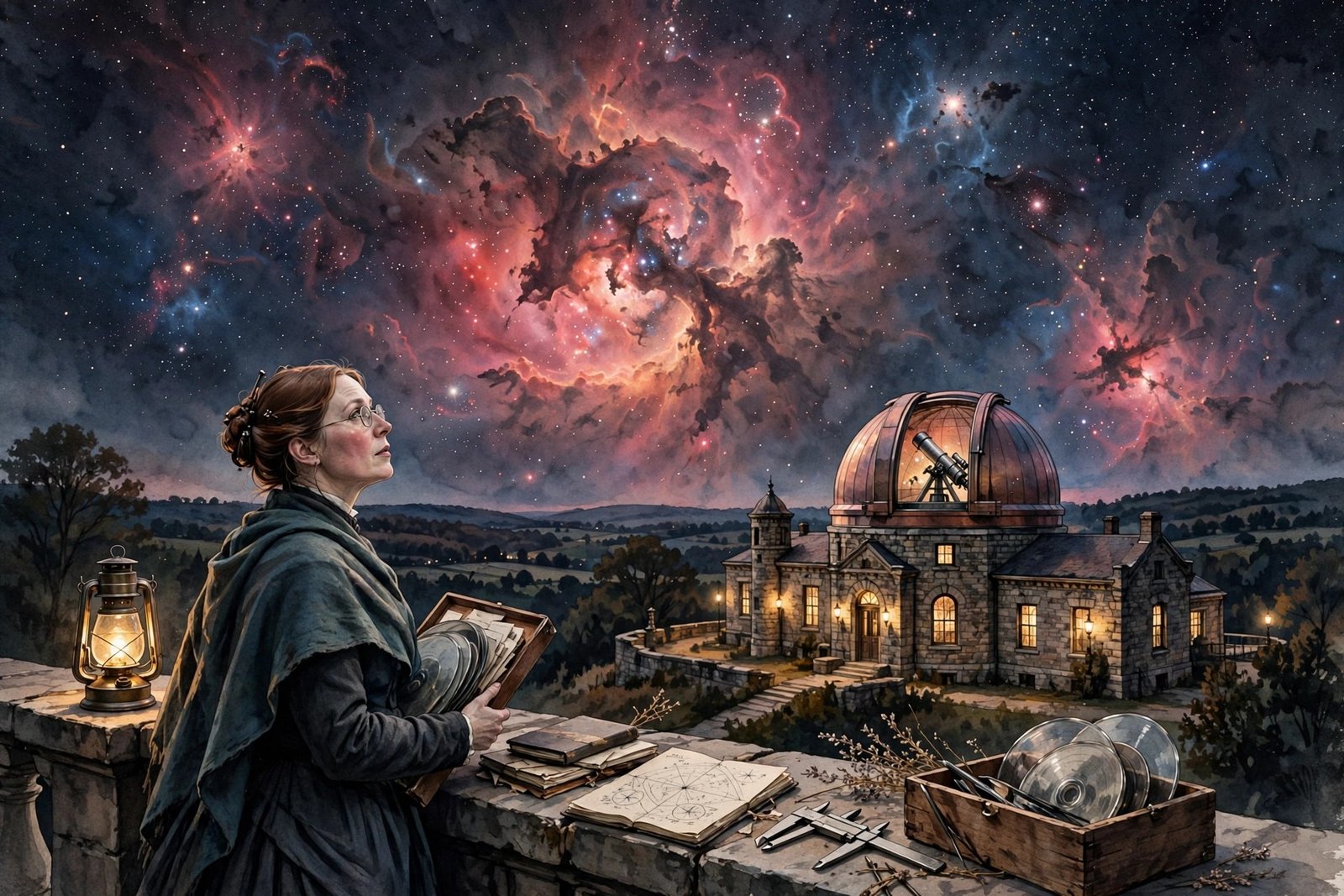
Williamina Fleming at a Glance
| Fact | Detail |
|---|---|
| Full name | Williamina Paton Stevens Fleming |
| Born | 15 May 1857, Dundee, Scotland |
| Died | 21 May 1911, Boston, Massachusetts |
| Known for | Stellar classification system, discovery of the Horsehead Nebula |
| Discoveries | 10 novae, 300+ variable stars, 59 nebulae |
| Stars catalogued | More than 10,000 |
| Role | Curator of Astronomical Photographs, Harvard College Observatory |
| Honours | First woman elected to the Royal Astronomical Society (honorary), Guadalupe Almendaro Medal |
| Key work | The Draper Catalogue of Stellar Spectra (1890) |
| Team | Led the “Harvard Computers,” a team of women astronomers |
1. A Childhood in Dundee
Williamina Paton Stevens was born on 15 May 1857 in Dundee, Scotland, the daughter of Robert Stevens, a skilled craftsman who made and repaired looms, and Mary Walker Stevens. She grew up in a working-class home where education was valued but money was tight. From an early age she showed a quick, curious mind and a gift for numbers.
She attended public schools in Dundee and trained as a teacher. By her early twenties she was teaching schoolchildren, a respectable job for a young woman of her background. But Scotland in the 1870s offered a clever, ambitious woman very few paths forward. Teaching was one of the only professions open to her, and it paid little.
In 1877, at the age of twenty, she married James Orr Fleming, an accountant. A year later the young couple emigrated to Boston, Massachusetts, looking for a better life in America. It was a brave move, and for a while it seemed to work. Then, in 1879, her husband abandoned her while she was pregnant with their son. She was alone in a foreign country, with a baby on the way and no income.
2. The Maid in the Observatory Director’s Home
Williamina needed work, and she found it in the most ordinary way available to a woman in her position: domestic service. She was hired as a maid in the household of Edward Charles Pickering, the director of the Harvard College Observatory. She cleaned, cooked, and looked after the home of one of America’s leading astronomers.
It was a hard, humbling fall from her life as a teacher. But it placed her in a house full of books, scientific conversation, and visitors from the world of astronomy. Pickering, a demanding and impatient man, noticed that his new maid was intelligent, organised, and good with numbers. According to the famous story, when he grew frustrated with one of his male assistants, he declared that his Scottish maid could do the work better — and he set her to work to prove it.
The story may be partly legend, but the fact is clear: in 1879 Pickering hired Williamina as a temporary assistant at the observatory. She was given the tedious, painstaking work of examining photographic plates of the stars — work the men considered beneath them. She took it, and she made it her own.
3. The Harvard Computers
The work Williamina was given involved studying glass photographic plates covered with the spectra of stars — the rainbow patterns of light that reveal what a star is made of and how hot it is. It was slow, eye-straining, detail-obsessed work. Hundreds of plates arrived every year, and each one had to be measured and recorded by hand.
Pickering soon realised that women were better at this work than men — more patient, more careful, and willing to work for lower pay. He began hiring more women, and the group became known as the “Harvard Computers.” Williamina, the first of them, became their leader. She trained, supervised, and organised a team that grew to include some of the most talented women in the history of astronomy.
The team worked in a room at the observatory, examining plates day after day. Their work was called “women’s work” and paid accordingly, but it was the engine of Harvard astronomy. Without them, the great catalogues of the stars could never have been made. Williamina ran the team with a firm hand and a sharp eye, and her colleagues respected her enormously.
4. Building a System to Classify the Stars
Fleming’s first great achievement was creating order out of chaos. When she began, astronomers had no agreed system for sorting stars by their spectra. Thousands of photographic plates were piling up, and nobody could compare one star’s spectrum with another’s in any systematic way.
She devised a classification scheme based on the amount of hydrogen visible in a star’s spectrum, labelling the groups with letters from A to Q. It was the first workable system for classifying stars, and it was published in the Draper Catalogue of Stellar Spectra in 1890, a work that catalogued more than 10,000 stars. Her system became the basis for all later stellar classification.
The scheme was later refined by her colleague Annie Jump Cannon, who rearranged Fleming’s letters into the O, B, A, F, G, K, M sequence that astronomers still use today. Every schoolchild who learns that the Sun is a G-type star is using a system that began with Williamina Fleming’s work. She did the hard first job of making the stars sortable.
5. The Discovery of the Horsehead Nebula
Fleming’s most famous discovery came in 1888, when she was examining a photographic plate of the constellation Orion. On it she noticed a dark, horse-head-shaped cloud silhouetted against a glowing background of gas. It was a dark nebula — a cloud of dust and gas so thick that it blocks the light behind it.
The object became known as the Horsehead Nebula, one of the most photographed and recognisable objects in the night sky. It is now an icon of astronomy, appearing on posters, book covers, and telescope images around the world. Few people who admire its beauty know that it was found by a former maid working at a desk in Cambridge, Massachusetts.
The discovery was typical of Fleming’s gift. She was not looking for fame; she was doing careful, systematic work, plate after plate, and her trained eye caught what others had missed. She went on to discover 59 nebulae in total, along with 91 variable stars in the Orion region alone. Her discoveries were the reward of patience.
6. Ten Novae and Hundreds of Variable Stars
Fleming’s discoveries went far beyond one nebula. Over her career she discovered ten novae — stars that suddenly flare up to many times their normal brightness. At the time, novae were mysterious events, and each discovery added to humanity’s understanding of how stars live and die. She found the first white dwarf ever identified, a discovery that opened a whole new chapter of stellar science.
She also discovered more than 300 variable stars, stars whose brightness changes over time. Variable stars are the yardsticks of the universe: by measuring how their brightness changes, astronomers can work out how far away they are. The period-luminosity law discovered by her colleague Henrietta Swan Leavitt depended on exactly the kind of careful variable-star work that Fleming pioneered.
In 1907 she published her most important catalogue, “A Photographic Study of Variable Stars,” listing 222 variable stars she had discovered herself. It was the first major catalogue of its kind, and it became a standard reference for astronomers around the world. Her work was precise, thorough, and trusted — the hallmark of everything she did.
7. The Catalogue That Mapped the Sky
Cataloguing was Fleming’s great talent, and she understood its value better than anyone. Science does not advance on brilliant ideas alone; it advances on careful records that other people can use. She spent years building catalogues that other astronomers could rely on, work that was unglamorous but essential.
The Draper Catalogue of Stellar Spectra, published in 1890, listed the spectra of 10,351 stars. It was a monumental achievement of organisation and endurance, and it made Harvard the centre of stellar astronomy. The catalogue gave astronomers everywhere a common language for talking about stars.
She also became the curator of the observatory’s collection of astronomical photographs, a vast archive of glass plates that recorded the sky night after night. She knew that collection better than anyone alive, and she protected and organised it as the treasure it was. Her catalogues and her archive remain part of her lasting legacy.
8. The Fight for Recognition
Despite her achievements, Fleming’s position was always precarious. She was a woman, an immigrant, and a former domestic servant in a world run by wealthy, educated men. She was paid far less than her male colleagues, and her title — “curator of astronomical photographs” — understated the work she actually did, which was that of a senior scientist.
She fought for her team as well as for herself. She argued for better pay and better conditions for the women of the observatory, and she kept careful records of their contributions so that their work could not be forgotten or credited to others. She was known for her bluntness: in her diary she wrote that she was “tired of being told that women are not capable of scientific work” and that the women at Harvard were doing the best astronomy in the world.
Recognition did come, slowly. In 1898 she was appointed curator of astronomical photographs at Harvard, the first woman to hold such a position. In 1906 she became the first American woman elected as an honorary member of the Royal Astronomical Society in London. She received the Guadalupe Almendaro Medal from the Astronomical Society of Mexico and an honorary fellowship from Wellesley College. But she was never allowed to use the telescopes herself, and she was never made a professor. The honours came late and were fewer than she deserved.
9. A Leader Who Lifted Others
What made Fleming remarkable was not only her own work but the way she built up the women around her. She trained the Harvard Computers in the skills of spectral analysis, and she gave them credit for their discoveries. Many of them went on to become famous astronomers in their own right.
She was a mentor to Annie Jump Cannon, who refined her classification system and became one of the most celebrated astronomers of the twentieth century. She worked alongside Henrietta Swan Leavitt, whose discovery of the period-luminosity law changed cosmology forever. She created an environment in which talented women could do serious science at a time when almost no other institution would let them.
Her leadership style was practical and direct. She kept the work moving, she kept standards high, and she defended her team. The Harvard Computers became famous precisely because Fleming made them a professional, disciplined scientific team rather than a group of helpers. She proved that women could run a research programme as well as any man — better, in fact.
10. The Later Years
Fleming worked at the Harvard College Observatory for more than thirty years, from 1879 until her death in 1911. She became an American citizen and a respected figure in Boston’s scientific community. Her son, Edward, grew up and became a mining engineer. She was, by any measure, a success.
But her health declined in her final years. She suffered from pneumonia, and the long hours of close work on photographic plates had taken their toll on her eyesight. She kept working as long as she could, publishing papers and catalogues to the end. She died of pneumonia on 21 May 1911, six days after her fifty-fourth birthday.
Her obituaries praised her work, but it took decades for the full scale of her contribution to be recognised. Today, astronomers know her as one of the founders of modern astrophysics. A crater on the Moon is named after her, and the Fleming crater on the Moon honours a woman who began her scientific life as a maid.
11. Why Her Story Still Matters in 2026
Williamina Fleming’s story matters because it is a story about what talent looks like when nobody is looking for it. She had no degree, no family money, and no connections. She had a sharp mind, a willingness to work hard, and the luck of being in the right house at the right time. When her chance came, she was ready for it.
Her story also matters because it shows how much science owes to people who were never celebrated. The catalogues she built, the stars she classified, and the discoveries she made are woven into the fabric of modern astronomy. Every time an astronomer classifies a star, they are standing on her work.
Finally, her story matters for anyone who feels stuck in a job that does not match their ability. Fleming did not wait for permission to be a scientist. She did the work in front of her so well that the work itself became the proof. Her life is a reminder that the job you have is not always the job you are — and that careful, patient, excellent work is eventually impossible to ignore.
12. Lessons From Williamina Fleming’s Life
Fleming’s life offers lessons that reach far beyond astronomy. The first is to master the unglamorous work. Nobody else wanted to examine photographic plates all day, but she turned that tedious job into the foundation of a scientific career. The work nobody wants is often the work that matters most.
The second lesson is that systems beat brilliance. Fleming’s greatest contribution was not a single flash of genius but a classification system — a way of organising knowledge so that everyone could build on it. The people who build the systems are the people who change the field.
The third lesson is to lift others as you climb. Fleming could have guarded her position jealously. Instead, she trained and promoted the women around her, and in doing so she created a team whose work was greater than any one person’s. Her legacy is not only her own discoveries but the careers she made possible.
Checklist: Lessons From Williamina Fleming
- Do the unglamorous work well — it is often the work that matters most.
- Build systems, not just one-off successes, so others can build on your work.
- Stay patient and precise; careful work compounds over years.
- Seize the chance when it comes, even if it arrives in an unexpected form.
- Lift the people around you — a strong team multiplies your impact.
- Keep records of your work so your contribution cannot be forgotten.
Frequently Asked Questions
Who was Williamina Fleming?
Williamina Fleming (1857–1911) was a Scottish-born American astronomer who worked at the Harvard College Observatory. She created the first system for classifying stars by their spectra, discovered the Horsehead Nebula, ten novae, and more than 300 variable stars, and led the team of women astronomers known as the Harvard Computers.
How did a maid become an astronomer?
After her husband abandoned her in Boston, Fleming worked as a maid in the home of Edward Pickering, director of the Harvard College Observatory. Pickering noticed her intelligence and hired her as an assistant to examine photographic plates of the stars. She proved so capable that she was put in charge of the observatory’s team of women astronomers.
What did Williamina Fleming discover?
She discovered the Horsehead Nebula, ten novae, more than 300 variable stars, 59 nebulae, and the first white dwarf ever identified. She also catalogued more than 10,000 stars in the Draper Catalogue of Stellar Spectra, published in 1890.
What is the Harvard Computers team?
The Harvard Computers were a team of women hired by Edward Pickering to examine and classify photographic plates of the stars. Led by Fleming, the team included Annie Jump Cannon and Henrietta Swan Leavitt, and their work made Harvard the centre of stellar astronomy in the late nineteenth and early twentieth centuries.
Why is her classification system important?
Fleming’s system was the first workable way to sort stars by their spectra, giving astronomers a common language for comparing stars. Annie Jump Cannon later refined it into the O, B, A, F, G, K, M sequence that astronomers still use today, so every star classification in modern astronomy traces back to Fleming’s work.
What honours did Williamina Fleming receive?
She was appointed curator of astronomical photographs at Harvard in 1898, became the first American woman elected as an honorary member of the Royal Astronomical Society in 1906, received the Guadalupe Almendaro Medal, and was made an honorary fellow of Wellesley College. A crater on the Moon is named in her honour.
Bottom line
Williamina Fleming went from scrubbing floors to mapping the stars. She had no degree and no money, but she had patience, precision, and a mind that would not be wasted. Her classification system still underpins astronomy today, her discoveries include one of the most famous objects in the sky, and the team she built changed science forever. Her life proves that the most important qualification is not where you start — it is how well you do the work in front of you. Read the success stories of her colleagues Maria Mitchell, the first professional woman astronomer in America, and Henrietta Swan Leavitt, whose law let us measure the universe, to see how one generation of women astronomers opened the sky for the next.
Note: This article is a general historical account of Williamina Fleming’s life and work, based on the widely documented record of her career at the Harvard College Observatory. Dates and discovery counts are drawn from the standard historical sources on Fleming and the Harvard Computers.

Keep what speaks to you.
Leave room for your own perspective.


