
Margaret Sanger was a nurse who looked at the suffering of poor women and refused to accept it as fate. Born in 1879 into a large, poor Irish Catholic family in Corning, New York, she watched her mother die at fifty after eighteen pregnancies. That loss stayed with her for the rest of her life, and it became the seed of a cause that would change the world. She believed that women should be able to decide when and whether to have children, and she spent the next fifty years fighting for that right.
At the time, talking about birth control was not just frowned upon — it was illegal. The Comstock laws made it a federal crime to send information about contraception through the mail, and doctors could be jailed for helping women. Sanger did not care. She opened the first birth control clinic in the United States in Brooklyn in 1916, was arrested, and went to jail rather than pay a fine. She founded the magazine The Woman Rebel, she founded Planned Parenthood, and she never stopped arguing that a woman’s body belonged to the woman herself.
Today, Margaret Sanger is one of the most important figures in the history of women’s rights. Her work led to legal birth control, to the birth control pill, and to a world in which millions of women could plan their families, finish their education, and build their own lives. This is her success story — the story of a nurse who turned grief into a movement, and a movement into a lasting change in the law and in everyday life.
Key takeaways
- Margaret Sanger was a nurse who saw women dying from too many pregnancies and decided to change the law.
- She coined the term “birth control” and opened America’s first birth control clinic in Brooklyn in 1916.
- She was arrested and jailed for her work, but she refused to stop or to pay fines she believed were unjust.
- She founded the organisation that became Planned Parenthood and helped bring the birth control pill into being.
- Her legacy is the idea that women should be free to decide when and whether to have children.
Margaret Sanger at a Glance
| Fact | Detail |
|---|---|
| Full name | Margaret Higgins Sanger |
| Born | 14 September 1879, Corning, New York |
| Died | 6 September 1966, Tucson, Arizona |
| Known for | Birth control movement, Planned Parenthood |
| First clinic | Brownsville, Brooklyn, 1916 |
| Key phrase | “No woman can call herself free who does not own and control her own body.” |
| Major book | Woman and the New Race (1920) |
| Organisation founded | American Birth Control League (1921), later Planned Parenthood |
| Honours | Helped fund the research that produced the birth control pill |
| Legacy | Legal birth control and family planning worldwide |
1. A Childhood Shaped by Loss
Margaret Higgins was the sixth of eleven children born to Michael and Anne Higgins. Her father was a stonemason and a freethinker who argued about politics and religion at the dinner table. Her mother was a devout Catholic who became pregnant eighteen times and gave birth eleven times. Anne Higgins died of tuberculosis at the age of fifty, worn out, in Margaret’s eyes, by a lifetime of childbearing. Margaret later wrote that her mother’s death was the beginning of her crusade. She believed that a woman who could not control her own fertility could not control her own life.
The family was poor, and Margaret worked hard at school to win a place at Claverack College. She went on to train as a nurse at White Plains Hospital in New York. Nursing would give her the practical knowledge — and the first-hand experience — that turned her private grief into a public cause.
2. Nursing on the Lower East Side
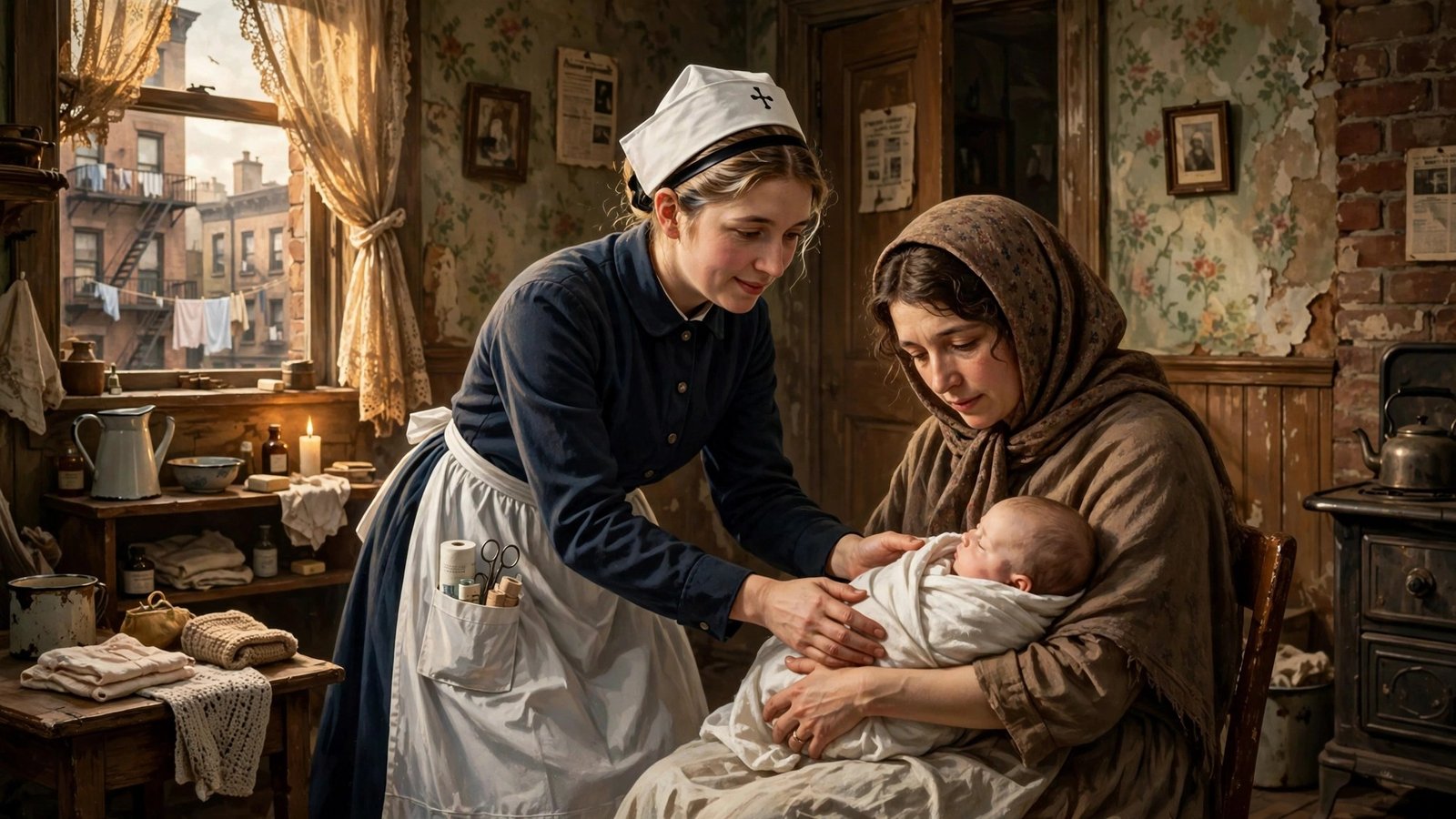
After marrying the architect William Sanger in 1902, Margaret moved to New York City and worked as a visiting nurse among the poor immigrant families of the Lower East Side. She delivered babies, treated the sick, and sat with women who begged her for a way to stop having children. Again and again she heard the same story: a woman weakened by childbirth, a husband who would not listen, a family sinking deeper into poverty with every new baby.
One case haunted her more than any other. A young mother named Sadie Sachs, already ill after a dangerous pregnancy, begged her doctor for a way to avoid another. The doctor told her, with a shrug, to tell her husband to sleep on the roof. Sadie became pregnant again, tried to end the pregnancy herself, and died. Sanger later said that she left that house and knew she would never again simply nurse women back to health so they could die the same way. She would change the law instead.
3. The Woman Rebel
In 1914, Sanger launched a magazine called The Woman Rebel, devoted to the idea that women should control their own bodies. The government banned it from the mail under the Comstock laws, and Sanger was indicted on obscenity charges. Rather than face trial, she fled to Europe, where she studied the birth control movement in the Netherlands and England and learned how clinics there helped working women plan their families.
It was during this period that she coined the term “birth control” — a phrase that would become the name of a worldwide movement. When she returned to the United States in 1915, the charges against her were dropped, and she was ready to fight in the open.
4. The Brownsville Clinic
On 16 October 1916, Margaret Sanger, her sister Ethel Byrne, and their friend Fania Mindell opened the first birth control clinic in the United States, in the poor neighbourhood of Brownsville, Brooklyn. Women queued around the block. In nine days, the clinic saw more than four hundred women before the police raided it and arrested all three women.
Sanger refused to pay the fine and spent thirty days in jail. Her sister went on hunger strike in prison. The case went to court, and although Sanger lost, the judge made a ruling that changed everything: he said that doctors could give contraceptive advice for medical reasons. That narrow exception became the crack in the law through which the whole birth control movement would eventually pass.
5. A Campaigner Who Would Not Quit
Arrest did not frighten Sanger; it made her famous. She toured the country giving lectures, wrote books, and built an organisation. In 1921 she founded the American Birth Control League, which later became the Planned Parenthood Federation of America. She opened more clinics, trained doctors, and argued her case in court after court.
She was a tireless organiser and a gifted writer. Her books, including Woman and the New Race (1920) and The Pivot of Civilization (1922), carried her argument to a wide audience. She believed that birth control was not only a women’s issue but a question of health, of poverty, and of freedom itself.
6. The Fight in the Courts
For decades, Sanger fought the Comstock laws in the courts. In 1936, a federal court ruled in United States v. One Package that doctors could receive contraceptives through the mail — a landmark victory that effectively ended the ban on birth control information for physicians. It was the result of twenty years of patient legal work, and it opened the door for clinics across the country.
Sanger understood that changing minds was as important as changing laws. She spoke to doctors, to clergy, to politicians, and to ordinary women, always making the same simple case: that no woman should have to risk her life because she could not prevent a pregnancy.
7. The Birth Control Pill
In her seventies, Margaret Sanger played a decisive role in one of the great medical breakthroughs of the twentieth century. In the early 1950s, she met the scientist Gregory Pincus and the wealthy donor Katharine McCormick, and together they funded the research that produced the first oral contraceptive. The birth control pill was approved in the United States in 1960.
Sanger was eighty years old when the pill became available. She had spent nearly fifty years working for a simple, safe way for women to control their fertility, and she lived to see it happen. The pill changed the lives of millions of women, allowing them to plan their families, pursue education, and build careers — exactly what Sanger had argued for all along.
8. The Woman Behind the Cause
Margaret Sanger was a complicated and passionate person. She was a brilliant speaker and organiser, a devoted mother of three children, and a woman who loved beauty, travel, and good conversation. She was also stubborn, impatient with opposition, and willing to make alliances that later drew criticism. Some of her early writings used language about eugenics that is shocking today, and historians continue to debate that part of her record honestly.
What is not in doubt is the core of her work: she believed that women should be free, and she spent her life making that freedom real. She did not wait for permission, and she did not accept that the law as it stood was the law as it had to stay.
9. Opposition and Courage
Sanger faced opposition from almost every direction. The Catholic Church condemned her work. The government prosecuted her. Some doctors refused to help her. She was arrested, denounced in the press, and threatened. She answered it all with the same calm determination: she kept opening clinics, kept writing, kept speaking, and kept going to court.
Her courage was not the courage of a single dramatic moment. It was the courage of a lifetime — of showing up, year after year, for a cause that most respectable people considered scandalous. That kind of persistence is rarer, and harder, than a single act of bravery.
10. A Global Movement
Sanger’s work did not stop at America’s borders. In 1952, she helped found the International Planned Parenthood Federation, which brought family planning to countries around the world. She travelled to India, Japan, and Europe, meeting leaders and doctors and arguing that birth control was a human right, not a privilege of the rich.
Today, family planning services reach hundreds of millions of people in almost every country on earth. The idea that women should be able to plan their families is now accepted in most of the world — a change so complete that it is hard to remember a time when it was a crime even to talk about it.
11. Lessons from Margaret Sanger’s Life
Margaret Sanger’s life teaches several lessons that reach far beyond her own cause. The first is that personal experience can become public purpose: her mother’s death and her years as a nurse gave her a mission that no one else could have given her. The second is that the law is not fixed — it can be changed by people who are willing to break it, challenge it, and argue against it for decades. The third is that a single person, armed with conviction and persistence, can move the world.
Her life also teaches the value of thinking in the long term. Sanger did not win in a year, or in ten years. She worked for half a century, and the greatest victories — the court rulings, the pill, the global movement — came late in her life. She kept going because she believed the cause was right, not because success was quick.
12. Why Margaret Sanger Still Matters
Margaret Sanger died in Tucson, Arizona, on 6 September 1966, just eight days short of her eighty-seventh birthday. By then, birth control was legal in the United States, the pill was in use, and Planned Parenthood was a national institution. She had lived to see the world she fought for begin to arrive.
Her name remains one of the most famous — and most debated — in the history of women’s rights. But the heart of her legacy is simple and enduring: she believed that women should own their own bodies and their own futures, and she spent her life making that belief real. On Face Zem, her story stands as a reminder that the most important changes often begin with one person who refuses to look away.
Checklist: Lessons from Margaret Sanger
- Turn personal experience into purpose, as Sanger turned her mother’s death into a lifelong cause.
- Do not accept an unjust law as permanent — challenge it in court, in print, and in public.
- Be willing to pay the price for your convictions, as Sanger did when she chose jail over a fine.
- Build organisations that outlast you, so the work continues after you are gone.
- Think in decades, not months — Sanger’s greatest victories came after fifty years of work.
- Speak plainly about what matters, even when the subject makes people uncomfortable.
Frequently Asked Questions
Who was Margaret Sanger?
Margaret Sanger (1879–1966) was an American nurse and campaigner who founded the birth control movement in the United States. She opened the first birth control clinic in America in 1916, founded the organisation that became Planned Parenthood, and helped bring about the birth control pill.
Why was birth control illegal in her time?
The Comstock laws of the 1870s made it a federal crime to distribute information about contraception. Sanger believed these laws harmed poor women most, because wealthy women could already get help privately, while poor women were left with no options at all.
What happened at the Brownsville clinic?
In October 1916, Sanger opened a birth control clinic in Brownsville, Brooklyn. It served more than four hundred women in nine days before the police raided it. Sanger was arrested and spent thirty days in jail rather than pay a fine.
What is Planned Parenthood?
Planned Parenthood grew out of the American Birth Control League, which Sanger founded in 1921. It became one of the largest providers of reproductive health care in the United States, offering contraception, testing, and education.
Did Margaret Sanger help create the birth control pill?
Yes. In the early 1950s, Sanger helped bring together the scientist Gregory Pincus and the donor Katharine McCormick, whose funding made the research possible. The pill was approved in the United States in 1960, when Sanger was eighty.
What is Margaret Sanger’s legacy today?
Her legacy is the idea that women should be free to decide when and whether to have children. Birth control is now legal and widely available in most of the world, and family planning is recognised as a basic part of health care — a change she spent her whole life working for.
Bottom line
Margaret Sanger was a nurse who saw women suffering and dying for lack of a simple freedom, and she spent fifty years fighting to give it to them. She was arrested, jailed, and denounced — and she never stopped. She opened clinics, founded organisations, changed the law, and helped create the birth control pill. Her success was not wealth or fame. It was a world in which millions of women could plan their lives on their own terms. That is a success worth remembering, and worth learning from.
Note: This article is a general historical account of Margaret Sanger’s life and work, written for Face Zem. It is intended as an inspiring success story, not as medical or legal advice.
Read more on Face Zem: Florence Nightingale Success Story, Elizabeth Blackwell Success Story, and Clara Barton Success Story.

Keep what speaks to you.
Leave room for your own perspective.


