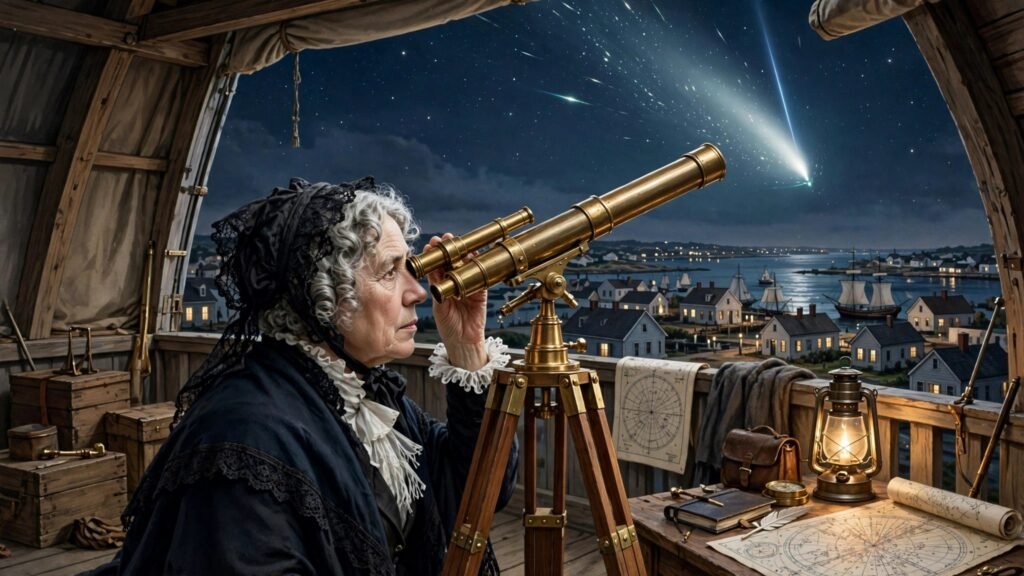
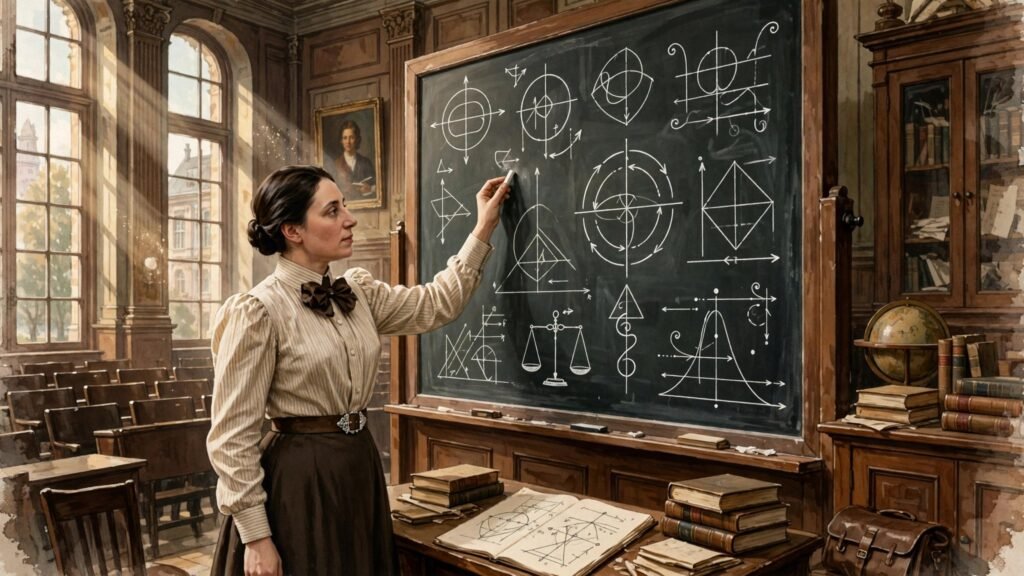
Vera Rubin looked at the night sky and saw something that should not have been there. The stars at the edges of galaxies were moving far too fast, and by every law of physics known in the 1960s, they should have flown off into the darkness. Instead, they stayed. Something invisible was holding them in place, and Vera Rubin was the scientist who proved it was real.
Her discovery changed astronomy forever. Before Rubin, most scientists believed that what we could see was more or less all there was. After her work, the universe turned out to be mostly made of something nobody could see at all. Today we call it dark matter, and it is one of the biggest ideas in modern science. Yet Rubin spent much of her career fighting to be taken seriously, working in a field that often closed its doors to women.
This is the story of how a curious girl from Philadelphia became one of the most important astronomers of the twentieth century, and what her life can teach anyone who has ever been told that their dreams do not fit them. Her journey is a reminder that the biggest discoveries often begin with a simple question that everyone else has stopped asking.
Key takeaways
- Vera Rubin proved that galaxies spin too fast for their visible mass, revealing the existence of dark matter.
- She was rejected from Princeton because it did not accept women into its astronomy programme, so she built her career through Vassar, Cornell and Georgetown instead.
- Her careful measurements of more than 60 spiral galaxies showed the same impossible pattern again and again.
- Rubin worked for decades without the major awards her male colleagues received, yet her work reshaped cosmology.
- Her greatest lesson is persistence: keep measuring, keep questioning, and trust the evidence even when the world doubts you.

Vera Rubin at a Glance
| Fact | Detail |
|---|---|
| Full name | Vera Florence Cooper Rubin |
| Born | 23 July 1928, Philadelphia, Pennsylvania |
| Died | 25 December 2016, Princeton, New Jersey |
| Education | Vassar College, Cornell University, Georgetown University |
| Field | Astronomy and astrophysics |
| Greatest discovery | Evidence for dark matter from galaxy rotation curves |
| Key collaborator | Kent Ford, who built the sensitive spectrograph she used |
| Main workplace | Carnegie Institution of Washington |
| Honours | National Medal of Science, Gold Medal of the Royal Astronomical Society |
| Legacy | The Vera C. Rubin Observatory in Chile is named after her |
A Girl Who Loved the Stars
Vera Florence Cooper was born in Philadelphia in 1928, the younger of two daughters. Her father was an electrical engineer, and her mother worked at Bell Telephone. From an early age, Vera was fascinated by the sky. As a child, she would watch the stars move across the heavens from her bedroom window, tracking their slow march with a patience that would later define her science.
When she was ten years old, her family moved to Washington, D.C., and her father helped her build a small telescope from a cardboard tube. She would take it out on clear nights and look at the Moon, the planets and the stars. She read books about astronomy and dreamed of becoming an astronomer, a goal that seemed almost impossible for a girl in the 1930s and 1940s.
At school, she was an excellent student, especially in science and mathematics. Her teachers encouraged her, but the world around her sent a different message. Astronomy was a man’s field, and very few women were allowed to study it at the highest levels. Vera did not let that stop her. She decided early that she would find her own way in.
Vassar: Where She Found Her Calling
In 1944, Vera won a place at Vassar College, one of the few colleges in America where a woman could study astronomy seriously. Vassar had a long tradition of women astronomers, and its observatory gave Vera her first real chance to do science with her own hands. She spent nights at the telescope, learning to observe, measure and record the sky.
At Vassar, she met the astronomer Maria Mitchell’s legacy in the very walls of the observatory. Mitchell had been America’s first woman astronomer a century earlier, and her example showed Vera that women had belonged in this science all along. Vera graduated from Vassar in 1948 with a degree in astronomy, the only student in her class to major in the subject.
But the next step was harder. She applied to Princeton University for graduate study, only to be told that Princeton did not accept women into its astronomy programme. The rejection was not about her ability. It was about her sex. Princeton would not admit women to its graduate programme until 1961, and Vera could not wait thirteen years for the door to open.
Cornell and a Controversial Idea
Vera chose Cornell University instead, where she studied physics under the great physicist Philip Morrison. For her master’s thesis, she took on a bold question: did galaxies move in an orderly way, or was the universe more chaotic than anyone thought? She analysed the motions of galaxies and argued that they seemed to rotate around some unknown centre, a claim that went against the accepted wisdom of the time.
Her thesis was presented at a meeting of the American Astronomical Society in 1950, and the reaction was dismissive. Some senior astronomers ridiculed the idea, and the paper was not published in a major journal. Vera was a young woman with no reputation, and her findings were simply brushed aside. It was a painful lesson in how science can fail when it refuses to listen.
Yet the experience did not make her bitter. It made her careful. She learned that a bold claim needed unshakeable evidence, and she decided that from then on, her data would be so good that no one could ignore it. That determination would shape the rest of her career, and it is a lesson worth remembering for anyone whose ideas have been dismissed too quickly.
Georgetown, Marriage and Family
After Cornell, Vera married Robert Rubin, a mathematician she had met at Cornell, in 1948. The couple moved to Washington, D.C., where Robert worked at the Applied Physics Laboratory. Vera enrolled at Georgetown University for her doctorate, studying under the physicist George Gamow, one of the founders of the Big Bang theory.
Georgetown was a different kind of challenge. Vera was now a wife and soon a mother, and she was expected to put her family first. She had four children over the next decade, and she raised them while continuing her research. She worked from home when she had to, took the children to the university when she could, and kept going when the world told her to choose between family and science.
She earned her PhD from Georgetown in 1954, with a thesis on how galaxies cluster together. It was solid, careful work, and it showed the same independence of mind that had marked her master’s thesis. But the academic world still had little room for her. Universities rarely hired women as astronomers, and for years she worked in part-time and research positions rather than holding a proper faculty post.
The Question Nobody Could Answer
By the 1960s, Vera Rubin was working at the Carnegie Institution of Washington, where she began a collaboration that would change science. She teamed up with Kent Ford, an instrument maker who had built an extraordinarily sensitive spectrograph, a device that could measure the light from distant galaxies with remarkable precision.
Together, they set out to measure how fast stars move inside spiral galaxies. The physics was simple. A galaxy is like a spinning disc, and gravity should hold it together. Stars near the centre should move fast, and stars at the edge should move slowly, because there is less mass pulling them in. That was what every textbook predicted.
But Rubin and Ford found something else. When they measured the Andromeda galaxy, our nearest large neighbour, the stars at the edge were moving just as fast as the stars near the centre. The rotation curve was flat, not falling as expected. It was as if the galaxy was far heavier than it looked, with most of its mass hidden from view.
The Flat Rotation Curves
Rubin and Ford did not stop at one galaxy. Over the next decade, they measured more than 60 spiral galaxies, and every single one showed the same impossible pattern. The outer stars moved too fast. The only explanation was that galaxies contain far more mass than the stars we can see, and that this extra mass is spread out in a vast, invisible halo around each galaxy.
The result was published in 1970, and at first the reaction was sceptical. Some astronomers suggested that the measurements were wrong, or that the gas at the edges of galaxies was behaving strangely. But Rubin’s data was careful and consistent, and as other astronomers repeated her measurements, the result held. The flat rotation curves were real.
By the late 1970s, the evidence was overwhelming. The universe contained a kind of matter that did not shine, did not absorb light, and could only be detected by its gravity. Scientists began to call it dark matter, and today we believe it makes up about 27 percent of the universe, far more than all the ordinary matter combined. Vera Rubin’s careful measurements had revealed most of the cosmos.
Decades at the Carnegie Institution
After the rotation curve work, Rubin spent decades at the Carnegie Institution of Washington, where she continued to study galaxies and their motions. She measured the rotation curves of galaxies in different environments, from lonely galaxies in the field to crowded clusters, and the same pattern appeared everywhere. The evidence for dark matter only grew stronger with each new measurement.
She also turned her attention to the motions of galaxies themselves, studying how they move through the universe in large streams. Her work showed that galaxies are not scattered randomly but are pulled by the gravity of vast structures, including regions of space with enormous hidden mass. Once again, her careful measurements revealed that the visible universe is only a small part of the whole.
At Carnegie, Rubin became a central figure in American astronomy. She served on committees, advised young researchers, and used her position to push for fairer treatment of women in the field. She never stopped observing, and she never stopped asking questions. Even in her seventies and eighties, she was still writing papers, still measuring, and still arguing that the universe had more to teach us.
Fighting for a Place at the Telescope
Rubin’s career was marked by the obstacles she faced as a woman in astronomy. When she wanted to observe at the Palomar Observatory in California, the great telescope there had only one bathroom, and it was labelled for men. Rubin taped a paper skirt to the door to make it a women’s bathroom, a small act of defiance that became famous in astronomy.
She was also the first woman to be allowed to observe at Palomar, a privilege that had been denied to women before her. She took the opportunity and did the work that would make her name, but she never forgot how many barriers had been placed in her path. Throughout her life, she spoke out about the need to welcome women and girls into science, arguing that astronomy lost talent every time it turned someone away.
Her own experience made her a mentor to many young astronomers, especially women. She encouraged them to trust their measurements, to ask difficult questions, and to keep going when the establishment doubted them. Like Katherine Johnson, whose calculations sent astronauts to the Moon, Rubin showed that brilliance can come from people the system tried to exclude.
Recognition That Came Too Slowly
Despite the importance of her discovery, Vera Rubin never received the Nobel Prize, a fact that many astronomers still regard as an injustice. The Nobel is not awarded after death, and Rubin died in 2016 without ever receiving it. Her colleagues have often noted that the dark matter discovery was one of the most important in twentieth-century physics, and that the prize committee’s failure to honour her remains a blemish on the award’s history.
She did receive many other honours. In 1993, she was awarded the National Medal of Science, America’s highest scientific honour, by President Bill Clinton. In 1996, she became only the second woman to receive the Gold Medal of the Royal Astronomical Society, more than 150 years after the first. She was elected to the National Academy of Sciences and served as its vice president.
Rubin herself was modest about the honours and the omissions alike. She said that she was happy to have done the work, and that the discovery itself was the reward. That attitude is part of what made her so admired. She was driven by curiosity, not by prizes, and her example still inspires scientists who work for the joy of understanding rather than for recognition.
The Rubin Observatory and a Living Legacy
Rubin’s legacy is now written across the sky itself. In 2019, the Large Synoptic Survey Telescope in Chile was renamed the Vera C. Rubin Observatory in her honour. When it begins its full survey of the heavens, it will map billions of galaxies and help scientists understand dark matter and dark energy in ways Rubin could only have dreamed of.
The observatory is a fitting tribute. It will do exactly the kind of patient, careful observation that Rubin practised all her life, only on a scale she never imagined. Every night, it will photograph the sky and measure the universe, building on the work she started with a telescope, a spectrograph and a question nobody else was asking.
Her influence also lives on in the generations of astronomers she mentored and inspired. Many of today’s leading cosmologists, men and women alike, trace their interest in dark matter back to Rubin’s work. She proved that a single scientist, armed with good data and stubborn curiosity, can change how humanity sees the universe. Like Marie Curie, who opened new frontiers in physics and chemistry, Rubin showed that the most important discoveries often come from those who refuse to accept the limits others set for them.
Lessons from Vera Rubin’s Life
Vera Rubin’s life holds lessons that reach far beyond astronomy. First, trust the evidence. When her measurements contradicted the textbooks, she did not throw the measurements away. She checked them, repeated them and trusted what they showed. That is the heart of science, and it is a useful rule for life as well.
Second, keep going after rejection. Rubin was turned away by Princeton, dismissed at a conference, and overlooked for the highest honours. None of it stopped her. She simply found another route, did better work, and let the results speak. Persistence is not glamorous, but it is the quality that turns talent into achievement.
Third, make room for others. Rubin spent her later years fighting for women in science, because she knew how much talent was being wasted. Like Sally Ride, the first American woman in space, she understood that opening doors for others is part of the work itself. Success means more when it helps the next person through.
Checklist: Think Like Vera Rubin
- Ask the question everyone else has stopped asking.
- Measure carefully, and measure more than once.
- Trust your data, even when it contradicts the textbooks.
- Keep going after rejection, and find another route if the door is closed.
- Help the next person through the door you had to force open.
- Let curiosity, not prizes, be the reason you do the work.
Frequently Asked Questions
What did Vera Rubin discover?
Vera Rubin discovered that stars at the edges of spiral galaxies move far too fast for the visible mass of the galaxy to hold them in place. Her measurements of more than 60 galaxies showed the same flat rotation curves, providing the strongest early evidence that galaxies contain large amounts of invisible dark matter.
What is dark matter?
Dark matter is a form of matter that does not emit, absorb or reflect light, so it cannot be seen directly with telescopes. Scientists know it exists because of its gravitational effects, such as the way it holds galaxies together. It is believed to make up about 27 percent of the universe, far more than all ordinary matter.
Why didn’t Vera Rubin win a Nobel Prize?
Vera Rubin never received the Nobel Prize, although many astronomers believe her dark matter work deserved one. She died in 2016, and Nobel Prizes are not awarded after death. Her omission is widely discussed as one of the prize committee’s most notable oversights.
What is the Vera C. Rubin Observatory?
The Vera C. Rubin Observatory is a large telescope in Chile, named in Rubin’s honour in 2019. It will survey the entire southern sky every few nights, mapping billions of galaxies and helping scientists study dark matter and dark energy on an unprecedented scale.
Was Vera Rubin the first woman astronomer?
No, but she followed in a proud tradition. Maria Mitchell was America’s first woman astronomer in the nineteenth century, and Vassar College, where Rubin studied, had a long history of women in astronomy. Rubin became one of the most influential astronomers of the twentieth century, male or female.
What can young scientists learn from Vera Rubin?
Young scientists can learn to trust their evidence, to keep going after rejection, and to ask bold questions. Rubin was told that women could not do astronomy at the highest level, and she proved otherwise through patient, careful work. Her life shows that curiosity and persistence matter more than permission.
Bottom line
Vera Rubin looked at the sky, found that it did not behave the way the textbooks said it should, and refused to look away. Her measurements of spinning galaxies revealed dark matter, one of the greatest discoveries in the history of astronomy, and changed our understanding of the universe forever. She did it despite rejection, despite a field that tried to exclude her, and despite working for decades without the recognition she deserved.
Her story is a reminder that the universe still holds secrets, and that the people who find them are often the ones who were never supposed to be in the room. If you have ever been told that your dreams do not fit you, remember Vera Rubin, and keep measuring the sky.
Note: This article is a general historical account of Vera Rubin’s life and work, written for readers of Face Zem. Scientific details are presented in simple terms for a general audience, and estimates such as the share of dark matter in the universe reflect the current scientific consensus.

Keep what speaks to you.
Leave room for your own perspective.