Grace Hopper was a mathematician who became a rear admiral, a teacher who became a legend, and a programmer who changed the way the whole world talks to computers. Born in 1906, she lived long enough to see the machine she helped to tame become part of everyday life. Her story is one of curiosity, stubbornness, and a refusal to accept that something could not be done.
When Hopper joined the United States Navy in 1943, computers were room-sized machines that only a handful of specialists could operate. She helped to program the Harvard Mark I, one of the first large-scale computers ever built. Then she did something far more radical: she decided that computers should understand ordinary English words, not just numbers. Most of her colleagues thought the idea was impossible. She proved them wrong.
By the time she retired — twice — Grace Hopper had invented the first compiler, helped to create COBOL, one of the most widely used programming languages in history, and taught generations of programmers to think differently. She was known for her wit, her energy, and her famous advice: it is easier to ask forgiveness than it is to get permission. This is her success story, and the lessons it holds for anyone who wants to build something new.
Key takeaways
- Grace Hopper took apart seven alarm clocks as a child — and put them all back together. Curiosity was her first teacher.
- She joined the Navy in 1943 and programmed the Harvard Mark I, one of the first large-scale computers.
- In 1952 she built the first compiler, a program that translates human-readable instructions into machine code.
- She led the creation of COBOL, a programming language written in plain English that powered business computing for decades.
- Her rule for innovators: it is easier to ask forgiveness than it is to get permission.

1. The Girl Who Took Apart the Clocks
Grace Brewster Murray was born on 9 December 1906 in New York City, the eldest of three children. Her father ran an insurance company, and her mother loved mathematics. The Murray household was unusual for its time: both parents believed that girls should be educated just as seriously as boys, and they filled the house with books, puzzles, and encouragement.
At the age of seven, Grace became fascinated by alarm clocks. She wanted to know how they worked, so she took one apart. Then another. Then another — seven in total — until her mother finally limited her to one clock at a time. The remarkable part was not that she dismantled them. It was that she put every single one back together, and they all worked.
That habit never left her. Hopper spent her whole life taking complex things apart to understand them, then putting them back together in a better form. It was the same instinct that would later lead her to dismantle the idea that computers could only understand numbers.
2. A Mathematician in a World of Men
Grace attended Vassar College, where she studied mathematics and physics, graduating in 1928. She went on to Yale University, earning a master’s degree in 1930 and a PhD in mathematics in 1934 — one of the first women to do so. At a time when very few women pursued advanced mathematics, Hopper was already setting a pace that others would follow for decades.
She returned to Vassar as a professor of mathematics, and for nearly a decade she taught. She was a gifted teacher, known for making difficult ideas clear and for her patience with students who struggled. Teaching would remain central to her life: long after she became famous, she still believed that the most important thing she could do was explain an idea so that someone else could use it.
When the United States entered the Second World War, Hopper wanted to serve. She was thirty-six, underweight for military service, and a mathematics professor — not the obvious candidate for the Navy. She tried to enlist and was turned down. She tried again. Eventually the Navy relented, and in 1943 she was sworn in as a lieutenant in the United States Naval Reserve.
3. Joining the Navy
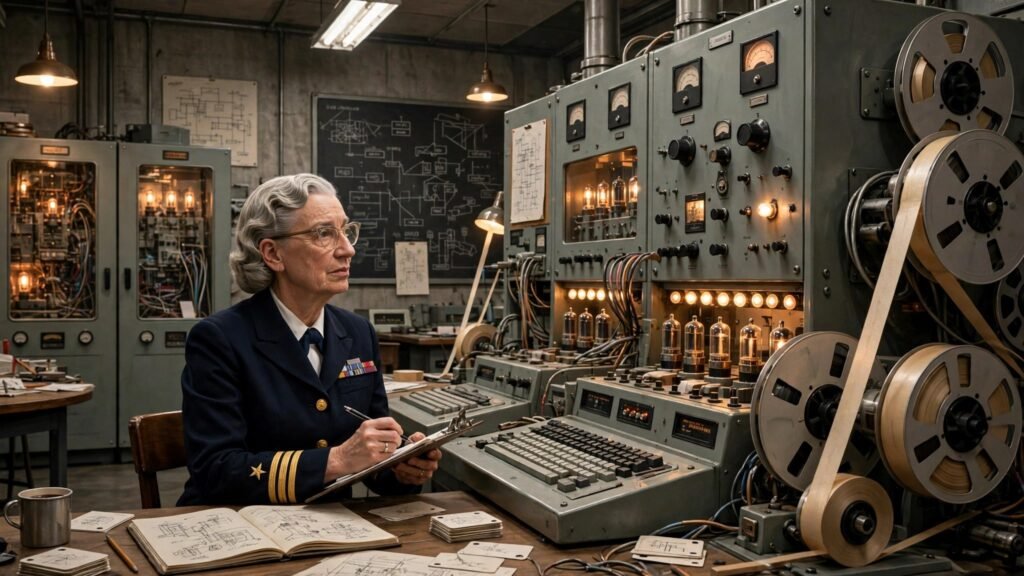
Hopper was sent to Harvard University, where the Navy had a secret project: the Harvard Mark I, a giant electromechanical computer built by Howard Aiken. The machine was fifty-one feet long, eight feet high, and weighed five tons. It could perform calculations that would take a human mathematician weeks, but programming it was slow, painstaking work done by hand.
Hopper became one of the first programmers of the Mark I. She wrote the machine’s operating manual — a five-hundred-page book that became the standard reference for early computing. She also worked on the Mark II and Mark III computers as the project grew.
The Navy gave her something she had never had before: a problem big enough to deserve her full attention, and a team of brilliant people to solve it with. It also gave her a discipline that shaped her career. In the Navy, she learned to plan, to document, and to deliver — habits that would serve her in every project that followed.
4. The Harvard Mark I
The Mark I was not a computer in the modern sense. It had no screen, no keyboard, and no memory as we know it. Programs were fed in on punched paper tape, and the machine clattered through calculations with relays and counters. A single computation could take hours.
Hopper’s job was to translate mathematical problems into the sequences of instructions the machine could follow. It was tedious, exacting work, and she was superb at it. She also had a talent for spotting what was wrong when the machine misbehaved — a skill that made her the person everyone called when a program failed.
Working on the Mark I taught her the central problem of early computing: the machines were powerful, but the people who needed them could not use them. Every program had to be written in the machine’s own language, step by painful step. Hopper began to wonder whether the machine could be taught to do some of that work itself.
5. The First Compiler
After the war, Hopper left Harvard and joined the Eckert-Mauchly Computer Corporation, where she worked on the UNIVAC I, the first commercial computer in the United States. It was there, in 1952, that she had her most famous idea.
Programmers at the time wrote every instruction in machine code — long strings of numbers that told the computer exactly what to do. Hopper believed there was a better way. She proposed a program that could translate instructions written in a form closer to human language into machine code automatically. She called it a compiler.
Her colleagues were sceptical. One famously told her that computers could not understand English, because computers only understood arithmetic. Hopper’s answer was characteristic: she built the compiler anyway. The A-0 system, completed in 1952, was the first compiler ever created. It proved that a computer could be given instructions in a symbolic language and translate them itself — an idea that underpins every programming language used today.
6. FLOW-MATIC and the English-Language Idea
Hopper did not stop at the compiler. She believed that programming should be accessible to people who were not mathematicians — to businesspeople, administrators, and anyone with a problem to solve. In 1955 she developed FLOW-MATIC, the first programming language to use English-like commands.
Instead of writing numbers, a programmer could write instructions such as “INPUT INVENTORY FILE” and “COMPARE PRODUCT-NO”. The idea was radical: it treated the computer as a tool for ordinary work, not just for scientific calculation. Many experts dismissed it. They said that business data processing was not real computing, and that English was too imprecise for machines.
Hopper disagreed, and she had a powerful argument: FLOW-MATIC worked. It was used to process real business data on the UNIVAC, and it proved that a language built from words could be just as precise as one built from numbers. The success of FLOW-MATIC set the stage for her greatest project.
7. COBOL: The Language of Business
In 1959, Hopper was part of a committee that set out to create a common business programming language. The result was COBOL — the Common Business-Oriented Language. It was based directly on FLOW-MATIC, and it used English words for its commands, so that a program could be read almost like a document.
COBOL became one of the most successful programming languages in history. It ran the payrolls, the bank accounts, the airline reservations, and the government records of the world. Decades after its creation, COBOL programs were still processing the majority of the world’s business transactions. The language Hopper helped to build quietly became the backbone of the global economy.
Her role in COBOL was not only technical. She was its most persuasive advocate, travelling the world to convince businesses and governments to adopt it. She understood that a good idea is not enough — someone has to champion it, explain it, and refuse to let it be ignored.
8. The Bug That Became Legend
One of the most famous stories in computing comes from Hopper’s work on the Harvard Mark II. In 1947, the machine stopped working, and the team traced the fault to a moth trapped in one of its relays. Hopper and her colleagues removed the insect and taped it into the logbook, with the note: “First actual case of bug being found.”
The story is often told as the origin of the word “bug” for a computer error, though engineers had used the term long before. What the moth really shows is Hopper’s approach to problems: find the fault, record it, fix it, and move on. She kept the logbook entry as a joke, but it became a piece of computing history — the moth is now preserved in the Smithsonian Institution.
Hopper loved the story because it captured something true about her work. Computers, she liked to say, were not mysterious. They did exactly what they were told. When something went wrong, there was always a reason, and a good programmer would find it.
9. “It’s Easier to Ask Forgiveness Than Permission”
Hopper’s most quoted piece of advice was born from experience. In the Navy, and later in business, she often had ideas that her superiors did not understand or did not want. Her solution was simple: do the work first, show the result, and ask for permission afterwards.
“It’s easier to ask forgiveness than it is to get permission,” she said — and she lived by it. When she built the first compiler, she did not wait for approval. When she pushed for English-language programming, she did not wait for a committee to agree. She built the thing, demonstrated that it worked, and let the results speak.
The advice has become a mantra for innovators in every field. It is not a licence to be reckless — Hopper was disciplined, thorough, and careful with other people’s money and time. It is a reminder that the greatest risk in any organisation is not trying something new. It is waiting so long for permission that the opportunity passes.
10. The Nanosecond
Hopper was one of computing’s great teachers, and her most famous teaching tool was a piece of wire. She would hand out lengths of wire, each about eleven point eight inches long, and explain that this was the distance light travels in a nanosecond — a billionth of a second. It was her way of making an abstract number real.
She carried bundles of these wires in her handbag and gave them away at lectures, to generals, students, and anyone who asked. When people asked why computers were so slow, she would hold up the wire and say: because light can only travel this far in a nanosecond, and the signals have to travel through the machine.
The nanosecond wires became her signature. They showed how she thought: take something invisible and make it visible, take something complicated and make it simple. She believed that if you could not explain an idea clearly, you did not yet understand it yourself.
11. Retirement — Twice — and the Return
Hopper retired from the Navy in 1966, at the age of sixty, after twenty-three years of service. The Navy promptly called her back. She returned to active duty, and she stayed for another twenty years, rising to the rank of rear admiral — one of the first women to hold that rank in the United States Navy.
Her second career in the Navy was devoted to standards and education. She worked on the standardisation of computer languages, making sure that programs written in one place would work in another. She lectured constantly, travelling the world to teach young programmers and to argue for better, clearer ways of working with computers.
She retired for the second time in 1986, at the age of seventy-nine, as the oldest serving officer in the United States Navy. She was awarded the Defense Distinguished Service Medal, the highest non-combat award in the armed forces. She did not stop working: she joined the Digital Equipment Corporation as a senior consultant and kept lecturing until shortly before her death in 1992.
12. Grace Hopper at a Glance
| Fact | Detail |
|---|---|
| Born | 9 December 1906, New York City |
| Education | Vassar College (1928); Yale University, MA 1930, PhD in mathematics 1934 |
| Navy service | Joined 1943; retired 1986 as Rear Admiral |
| First computer | Programmed the Harvard Mark I (1944) |
| First compiler | A-0 system, 1952 |
| First English-like language | FLOW-MATIC, 1955 |
| Greatest legacy | COBOL, the business language of the world (1959) |
| Famous quote | “It’s easier to ask forgiveness than it is to get permission.” |
| Teaching tool | Nanosecond wires — 11.8 inches of wire |
| Died | 1 January 1992, aged 85; buried at Arlington National Cemetery |
What We Can Learn From Grace Hopper
Grace Hopper’s life offers lessons that reach far beyond computing. She showed that curiosity is a career: the child who took apart alarm clocks became the woman who took apart the assumptions of an entire industry. She showed that expertise is earned by doing the hard work, not by waiting to be invited. And she showed that the best ideas often look impossible until someone builds them anyway.
She also showed the power of teaching. Hopper spent decades explaining computers to people who were afraid of them, and she did it with patience, humour, and a piece of wire. She believed that knowledge only matters when it is shared — a belief that made her one of the most influential figures in the history of technology.
Finally, she showed that age is no barrier to contribution. She did her most important work in her forties and fifties, was called back from retirement at sixty, and was still lecturing in her eighties. Her career is a reminder that it is never too late to start, and never too late to matter.
Checklist: Lessons From Grace Hopper’s Life
- Stay curious — take things apart to understand how they work.
- Do the work first and show the result, instead of waiting for permission.
- Make complex ideas simple enough for anyone to understand.
- Write things down — documentation turns a good idea into a lasting one.
- Teach what you know, and learn from everyone around you.
- Keep going — your most important work may still be ahead of you.
Frequently Asked Questions
Who was Grace Hopper?
Grace Hopper (1906–1992) was an American mathematician, computer scientist, and United States Navy rear admiral. She programmed the Harvard Mark I, invented the first compiler, and helped to create COBOL, one of the most widely used programming languages in history.
What did Grace Hopper invent?
Her most important invention was the compiler — a program that translates human-readable instructions into machine code. She also developed FLOW-MATIC, the first English-like programming language, and led the creation of COBOL.
What is Grace Hopper’s most famous quote?
“It’s easier to ask forgiveness than it is to get permission.” She used it to encourage people to try new ideas instead of waiting for approval, and it remains one of the most quoted lines in technology.
Did Grace Hopper really find a bug in a computer?
In 1947, a moth was found trapped in a relay of the Harvard Mark II computer. Hopper’s team taped it into the logbook with the note “First actual case of bug being found.” The moth is now in the Smithsonian Institution, though engineers had used the word “bug” before this incident.
What is a nanosecond, and why did Hopper carry wires?
A nanosecond is a billionth of a second. Hopper carried pieces of wire, each about 11.8 inches long — the distance light travels in one nanosecond — to help people visualise how fast computers work and why the speed of light limits them.
Why is Grace Hopper still important today?
Every modern programming language relies on the compiler, the idea Hopper pioneered. COBOL still runs much of the world’s business computing. Her approach to teaching, documentation, and innovation continues to shape how software is built.
Bottom line
Grace Hopper took a machine that only specialists could use and made it speak a language the rest of the world could understand. She did it by asking a question nobody else thought to ask, and by refusing to accept that the answer was impossible. Her success was not luck — it was curiosity, discipline, and the courage to build the thing first and ask permission later.
Note: This article is a general historical account of Grace Hopper’s life and work, published by Face Zem for readers interested in the stories of remarkable people.
Read more on Face Zem: Ada Lovelace Success Story, Katherine Johnson Success Story, and Marie Curie Success Story.

Keep what speaks to you.
Leave room for your own perspective.