
The best AI tools for swim spa installation startups in 2026 do far more than answer the phone while your crew is pouring a concrete pad. They turn a tight garden, a sloping driveway or a basement room into a measured installation plan, a swim current sized to the swimmer who will use it, a crane lift that clears the roofline, and a handover record the homeowner can trust. For a new installation business, that combination matters more than any single clever feature, because the first years are won or lost on how many installations you can complete well without dropping the admin that keeps customers safe, warm and willing to recommend you.
A swim spa installation startup is a building, plumbing and electrical business sharing one van, one phone number and one reputation. Every job has a shell to deliver in one piece, a pad to level to within a few millimetres, a power supply to get right, and water to balance across two zones. When any piece slips, the job wobbles: a missed message becomes a lost booking, and a customer who waited all day for a crane that never arrived will not call again.
This guide compares the tools that matter most for a swim spa installation startup, from site surveys and swim-current sizing to crane planning, quoting, scheduling, dual-zone water care, payments and reviews. It focuses on what a small team needs in its first years: simple setup, honest pricing, and tools that work from a phone beside a half-finished pad. You will find a comparison table, a startup checklist, and answers to the questions new owners ask most often.
Key takeaways
- Start with site surveys, swim-current sizing and quoting. Those three systems carry the most revenue and the most trust for a new swim spa installation startup, and AI makes each one faster and less error prone.
- Measure the access route before you quote the job. A shell that cannot reach the garden is the most expensive mistake in swim spa installation, so check gate widths, crane reach and ground bearing before you promise a date.
- Size the swim current to the swimmer, not to the catalogue. Check swimmer ability, intended use and dual-zone temperatures before you recommend a model, because an undersized current is a disappointed customer.
- Record every electrical, plumbing and water-care note in the same place. A searchable installation history beats a glovebox full of paper slips when a homeowner asks why the water turned cloudy.
- Keep the stack small and measure the numbers weekly. Track quote-to-booking time, install days per job, crane rework, repeat service bookings and review growth, and change one thing at a time until the numbers move.
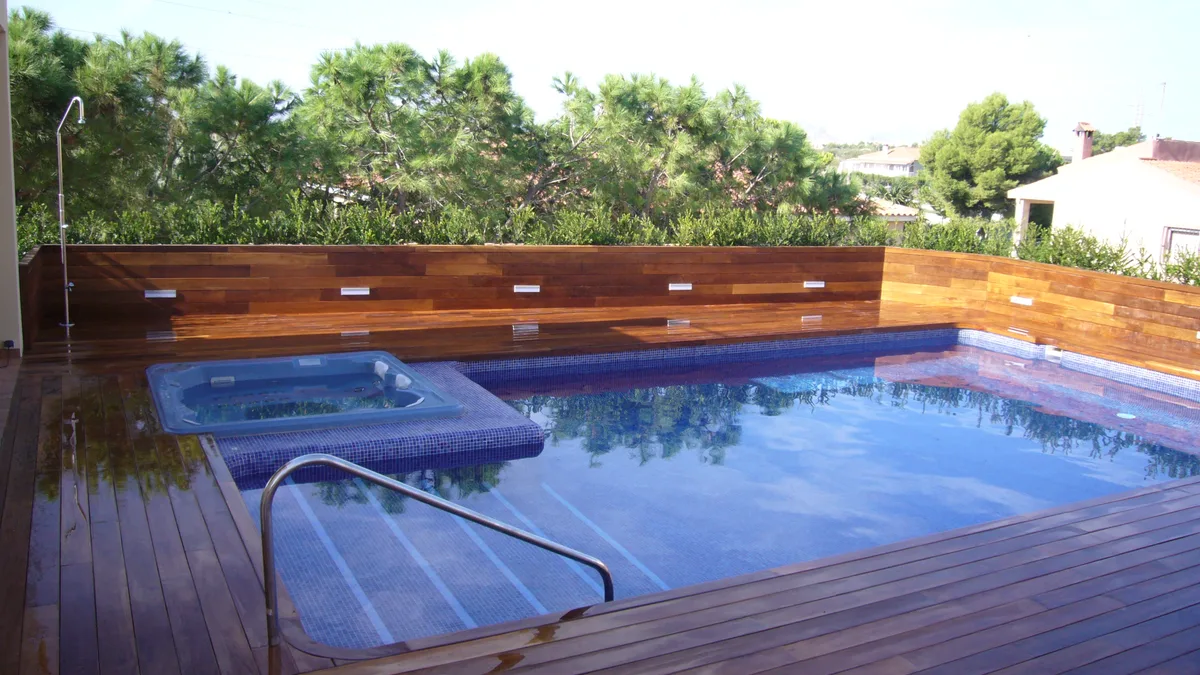
Swim Spa vs Pool vs Hot Tub: Why the Install Is Different
A swim spa is not a small pool and it is not a large hot tub. It is a hybrid: one end holds a swim lane with a powerful adjustable current, the other end holds a warm soak section with hydrotherapy seats and jets, and the two zones often run at different temperatures from a single shell. That hybrid design is exactly what makes installation different from the trades around it, and why the tools in this guide are not the same tools a pool or hot tub business would buy.
A pool is built in place over weeks, and most of the risk sits in the build itself. A swim spa arrives as a finished factory shell, often over four metres long and a tonne when empty, so the risk sits in the delivery: getting that shell from the lorry to the pad without damage, across lawns, through gates and sometimes over a house by crane. The tools that matter here plan the lift, document the access route and prove the pad is level.
A hot tub is simpler still: a single warm-water vessel at one temperature that a small crew can wheel into place. A swim spa needs a heavier electrical supply, often a dedicated circuit, and two water regimes at once: a cooler swim zone and a warmer soak zone. The water-care tools that matter here track both zones separately, because a plan that treats the whole shell as one tub will leave one end wrong every time. If you are coming from the service side, the habits of pool maintenance startups are still worth studying, because the water chemistry discipline transfers directly.
The customer is different too. A pool buyer expects a construction project and a hot tub buyer expects a delivery, while a swim spa buyer expects both at once: fitness equipment that arrives like an appliance and performs like a pool. They ask about current strength, stroke room, energy use and how the shell will get over their fence. The tools that win these jobs answer all four questions in the first hour, with a survey, a sized current, a lift plan and a written quote.
What a Swim Spa Installation Startup Needs First
A new swim spa installation startup needs booked installations before it needs anything else. That shapes every software choice in year one: the tools that pay for themselves first are the ones that turn an enquiry into a surveyed, quoted and scheduled job quickly, because a homeowner comparing three installers will usually book the one who replies first with a clear plan.
After bookings, the next need is proof. Every pad, electrical connection and water reading should be recorded with a photo and a note, because the shell will sit in that garden for years and the installer is the person the homeowner calls when something feels wrong. A searchable record is the cheapest insurance a small business can buy.
Only after bookings and proof should a startup worry about marketing automation or analytics. They do not fix a missed crane booking or a pad poured out of level. The stack below is ordered the way a real business grows: survey and sizing first, quoting and scheduling second, water care and handover third, and growth tools last.
How We Compared the Best AI Tools for Swim Spa Installation Startups
Every tool in this guide was judged on the same practical questions. Does it help a crew install a swim spa shell safely, or does it only help an office send emails? Does it work from a phone at the kerbside, with wet hands and poor signal? Does it keep a record a second crew member can read and trust a month later? And does it pay for itself within the first few installations?
We favoured tools with a clear starting price, a short setup, and a monthly plan a new business can cancel without penalty, and marked down tools that need long onboarding or a yearly contract. Price notes below are approximate 2026 list prices, so check the current plan before you buy.
The Best AI Tools for Swim Spa Installation Startups at a Glance
The table below gives a quick view of where each tool helps most. The sections that follow explain how to use each one on a real job.
| Tool | Best for | Main job on a swim spa install |
|---|---|---|
| Matterport | 3D site surveys | Measuring pads, vaults and access routes |
| 3D Lift Plan | Crane lift planning | Planning safe shell delivery over obstacles |
| Endless Pools | Swim-current sizing | Matching current strength to the swimmer |
| Ondilo ICO | Dual-zone water monitoring | Tracking swim and soak water separately |
| Jobber | Quoting and scheduling | Turning enquiries into booked installs |
| Housecall Pro | Dispatch and messaging | Keeping crews and customers in step |
| Buildertrend | Multi-crew project builds | Running several installs at once |
| CompanyCam | Photo records | Proving pad, wiring and water handover |
| OpenSpace | AI site capture | Tracking progress across the whole job |
The Best AI Tools for Swim Spa Installation Startups in Detail
Nine tools made the final list. Each one solves a specific swim spa problem, and each one is honest about what it does not do.
1. Matterport: Best for 3D Site Surveys
Matterport turns a phone or a 360 camera into a measured 3D model of a garden, driveway or basement room. For a swim spa installer, that model is the difference between guessing and knowing: measure the gate width, the lawn slope and the clear space around the pad from the office, and share the model with the crane company so the lift plan uses real dimensions.
The AI does the measuring work: it labels spaces, stitches the walkthrough into one navigable model, and lets you drop measurement points that stay attached to it. When a homeowner asks whether the shell will fit through the side gate, you can answer with a number, and a second crew member visiting a week later can see exactly what the first visit found. Its limits are honest: a model cannot test ground bearing or confirm the electrical supply, so send a person to check both. Plans start at around twenty dollars a month.
2. 3D Lift Plan: Best for Crane Lift Planning
3D Lift Plan is the specialist tool most installers discover only after their first bad lift. It builds a scaled, three-dimensional plan of a crane lift, showing the crane position, the boom angle, the load path and the clearances over roofs, walls and trees. For a swim spa shell, which must travel in one piece and cannot be tilted the way a hot tub can, that plan is the document that keeps the job safe and the neighbours calm.
A swim spa lift is usually the most expensive single hour of the whole installation. A crane that arrives to find the load path blocked, the ground too soft or the boom too short will charge for the visit and leave, while the shell sits on the lorry. A plan built from the site survey lets the crane operator confirm the lift beforehand, and gives the homeowner a drawing to show a neighbour whose garden the boom will pass over. Use it per job: plan every lift that crosses a roofline or a boundary, and skip it for straightforward kerbside deliveries.
3. Endless Pools: Best for Swim-Current Sizing
Endless Pools is the swim-current system most installers meet first, and its configuration tools are the reason it leads this list. The swim current is the heart of a swim spa: an adjustable flow that lets a swimmer train in place, and the difference between a current that is too weak and one that is too strong is the difference between a customer who swims every morning and one who never uses the spa at all.
The configuration process walks the installer through the questions that decide the current: how strong a swimmer is the buyer? Will the spa be used for training, gentle exercise or rehabilitation? Is the buyer tall enough to need the full swim lane? The answers point to a current strength, a shell length and a pump setup, and the installer can show the customer how the current will feel at each setting before the shell is ordered. The companion app adds value after the install, letting the homeowner adjust the current and track a swim, which turns the handover into a guided first swim.
4. Ondilo ICO: Best for Dual-Zone Water Monitoring
Ondilo ICO is a small floating sensor that watches the water and reports what it finds to a phone. For a swim spa, its value is that it watches both zones as separate bodies of water. The swim end runs cooler and gets more bather load from exercise, while the soak end runs warmer and burns through sanitiser faster, and a single reading for the whole shell will hide the problem in one end until the water turns cloudy.
The sensor tracks temperature, pH and sanitiser levels, and its app turns the readings into a plain instruction: add this much of this product, or wait and test again. For a new installer, that instruction is a training tool, teaching a junior technician what good water looks like and what to do when it drifts. The record is equally useful: when a homeowner calls to say the water feels wrong, the installer can see exactly when the drift started. It does not replace a test strip on install day, and it cannot fix water that is already green. The sensor is a one-off purchase with the app included.
5. Jobber: Best for Quoting and Scheduling
Jobber is the quoting and scheduling core that most small installation businesses settle on, and it fits a swim spa startup because it treats every job as a sequence: enquiry, site visit, quote, booking, install, handover and follow-up. Each stage has a status, a person and a date, so nothing slips between the office and the van.
The quoting tool earns its keep first. A swim spa quote has more lines than a hot tub quote: the shell, the pad or vault, the electrical work, the crane, the delivery, the water care and the handover visit all need a line, and a quote that hides the crane cost in a single total will be questioned later. Jobber lets you show each line clearly, send the quote from the phone at the kerbside, and see the moment the customer opens it, so a follow-up call lands while the quote is still fresh. Scheduling is the second strength: installation days have a strict order, and Jobber holds that order and flags a clash before it happens. Plans start at around thirty dollars a month for a single user.

6. Housecall Pro: Best for Dispatch and Customer Messaging
Housecall Pro is the dispatch and messaging tool for the days when two crews are working at once and the office phone will not stop ringing. It holds the day’s jobs, the crew assigned to each one, the customer messages and the payments in a single view, so the person answering the phone can see the same job the crew sees on site.
Its messaging is the feature customers notice most. An automated text the evening before the install, with the arrival window, the crew names and a reminder to clear the gate, removes most of the morning phone calls. A second message when the shell is on the pad, with a photo, turns an anxious homeowner into a relaxed one, and a short message a week after handover is the cheapest review request a business can send. Plans start at around fifty dollars a month.
7. Buildertrend: Best for Multi-Crew Project Builds
Buildertrend is the project tool for the moment a swim spa startup stops being one crew and becomes a business with several jobs running at once. It holds the schedule, the budget, the documents, the change orders and the customer messages for each installation in one place, and shows the owner which job is on track and which one needs attention.
The schedule matters most for swim spas, because an installation has more trades than a hot tub delivery: a groundworker for the pad, an electrician for the supply, a crane company for the lift, and your own crew for the shell and the water. Buildertrend holds each trade’s dates in sequence, so the electrician is not booked before the pad is poured and the crane is not booked before the ground is confirmed. Change orders are the second strength: when a homeowner adds decking or moves the shell after the quote is signed, each change is recorded as a signed order with a price. It is the most expensive tool here, with plans starting at around three hundred dollars a month, so wait until you are running three or more installs a month.
8. CompanyCam: Best for Photo Records and Handover Proof
CompanyCam is a photo app built for trades, and it solves the simplest problem in swim spa installation: proving what was done, where and when. Every photo taken in the app is stamped with the job, the location and the time, and lands in the job file automatically, so the record builds itself while the crew works.
The photos that matter most are the ones nobody thinks to take: the pad before the pour, with the levels visible; the electrical connection before the cover goes on; the water readings at handover; the shell serial number and the current setting at the first swim. Each one answers a question a customer or supplier will ask months later, and takes ten seconds to capture if the habit is there. The app also makes the handover faster: a crew member walks the homeowner through the photos of their own installation, and the homeowner signs on the phone. That signed record ends most warranty arguments before they start. Plans start at around twenty dollars a month per user.
9. OpenSpace: Best for AI Site Capture and Progress Tracking
OpenSpace turns a walk around a site into a dated, navigable record of how the job looked at that moment. A crew member walks the garden with a phone or a 360 camera, and the software stitches the walk into a model pinned to the site plan, so anyone in the office can open the job and see the pad, the access route and the shell exactly as they stood on that day.
The AI does the organising work a folder of photos cannot: it matches each capture to the plan, dates it, and lets you compare two dates side by side, so the change from a bare lawn to a poured pad to a finished shell is visible in seconds. That comparison shows the homeowner the progress they are paying for, and shows the owner which jobs are moving and which have stalled. Use it on the jobs that justify it: vault installs, sloping gardens, tight access and multi-trade sites. Pricing is quoted per project, so ask for a price against your first three complex jobs.
Choosing Your Starter Stack
A new swim spa installation startup does not need all nine tools on day one. It needs three, chosen in the order the money flows: one tool to survey and size the job, one tool to quote and schedule it, and one tool to prove it was done well. Everything else can wait until the third or fourth installation.
Start with Matterport and Jobber. Matterport wins the quote by measuring the site properly, and Jobber turns the quote into a booked job with a clear schedule. Add CompanyCam in the same week, because the photo habit is easiest to build when the business is small and every job is still memorable. That trio costs less than a hundred dollars a month and covers the whole job from first visit to handover.
Add the specialist tools as the jobs demand them: the 3D Lift Plan for the first lift that crosses a roofline, Ondilo ICO in the handover pack when your first customer asks how to keep the water right, and Housecall Pro when a second crew starts. Buy the tool when a real job needs it, not when a sales page promises it. The routines of hot tub maintenance startups are a useful model for the weekly water-care visits that follow every installation.
What Swim Spa Installation AI Tools Cost in 2026
The honest answer is that the software is the cheap part of a swim spa installation business. A starter stack of Matterport, Jobber and CompanyCam costs roughly seventy to ninety dollars a month, which is less than a single hour of crane hire. The full stack in this guide, including Buildertrend and Housecall Pro, costs roughly four to five hundred dollars a month, which is still less than one delayed installation.
The expensive costs sit elsewhere. A crane lift costs several hundred dollars a visit, and a wasted visit costs the same as a successful one. A pad poured out of level can cost thousands to fix, and a shell damaged in delivery can cost more than the whole year’s software budget. The tools in this guide earn their keep by preventing those costs, not by being cheap themselves, so judge them on the mistakes they stop.
Your Swim Spa Installation Checklist
Use this checklist on every job until it is habit. It is short on purpose: six checks that catch the six mistakes that cost the most money.
- Survey the access route and measure it. Gate width, ground bearing, overhead lines and crane reach, all measured and photographed before the quote is sent.
- Confirm the pad or vault is level. Check the levels yourself on delivery day, and do not accept a pad you have not measured.
- Size the swim current to the swimmer. Confirm swimmer ability, intended use and dual-zone temperatures before the shell is ordered.
- Check the electrical supply with a qualified electrician. Confirm the circuit, the earthing and the isolation before the fill, not after.
- Balance both water zones at handover. Record the readings for the swim end and the soak end separately, and show the homeowner the monitoring app.
- Photograph the handover and get it signed. Pad, wiring, water readings, current setting and serial number, all in the job file before the crew leaves.
Mistakes That Waste Money
The most expensive mistake in swim spa installation is quoting a crane job without a lift plan. The crane arrives, the lift cannot be done safely, the crew stands idle, the homeowner watches, and the bill arrives anyway. A drawing built before the quote is sent costs a fraction of a wasted visit, and it is the single habit that separates installers who keep their margins from installers who lose them.
The second mistake is treating a swim spa like a hot tub. A single-temperature water plan, a light electrical supply and a delivery crew with no lift plan will all fail on a swim spa, because the shell is heavier, the water is split across two zones and the customer expects to train in it. The planning habits of sauna installation startups are a good reminder that every heated room needs its own measurements before the build begins.
The third mistake is skipping the photo record. A disputed pad, a questioned wire and a cloudy-water complaint all become expensive arguments when there is no record, and five-minute conversations when there is. The fourth mistake is buying the whole software stack on day one: a startup paying for Buildertrend before it has three installs a month is paying for a tool it cannot use, and the money would have been better spent on a 360 camera or a digital tester.
Frequently Asked Questions
What is the best AI tool for a swim spa installation startup?
There is no single best tool, because a swim spa installation has three different jobs: surveying and sizing, quoting and scheduling, and proving the work. Start with Matterport for the survey, Jobber for the quote and the schedule, and CompanyCam for the photo record.
How much should a swim spa installation startup spend on software?
A starter stack costs roughly seventy to ninety dollars a month, and the full stack in this guide costs roughly four to five hundred dollars a month. The software is the cheap part of the business: a single wasted crane visit costs more than a month of the full stack, and a pad poured out of level can cost thousands to fix. Judge the tools on the mistakes they prevent, and review the spend every quarter.
How is swim spa installation different from pool installation?
A pool is built in place over weeks, while a swim spa arrives as a finished factory shell that must be delivered in one piece. The risk in a pool build sits in the construction, and the risk in a swim spa install sits in the delivery, the pad and the swim-current sizing. A swim spa also runs two water zones at different temperatures from a single shell.
Can AI tools size a swim current correctly?
AI configuration tools can match a current to a swimmer’s ability and intended use, and they are far better than guessing from a catalogue. They cannot replace a conversation with the swimmer, because two swimmers of the same height and speed can want different things: one wants a hard training current and the other wants a gentle flow for rehabilitation. Use the tool to narrow the choice and confirm it with the swimmer.
Do I need a crane for every swim spa delivery?
No. A straightforward delivery rolls the shell from the lorry to the pad on dollies or a flatbed, and many installs need no crane at all. A crane is needed when the shell must cross a fence, a wall, a roofline or soft ground that a lorry cannot reach. Measure the access route at the survey, build a lift plan for every crossing, and quote the crane as a separate line. Never promise a crane date until the lift plan is confirmed.
Should a new swim spa startup offer a service and maintenance plan?
Yes, and it should be offered at handover, while the water readings are fresh and the customer is happiest. A simple plan with a monthly water check, a quarterly filter clean and an annual service visit turns a one-off installation into repeat revenue. Keep it simple in year one: one visit rhythm, one price, and a sensor that watches the water between visits.
The Bottom Line
A swim spa installation startup succeeds on measurement, not on marketing. Measure the access route, size the current to the swimmer, level the pad, check the power, balance both water zones and photograph the handover, and the rest of the business follows. The nine tools in this guide support those measurements in order: survey and sizing first, quoting and scheduling second, water care and proof third. Buy them in that order and keep the stack small.

Keep what speaks to you.
Leave room for your own perspective.


