A salmon farm is a food-production business that happens to take place in the sea. Before a single fish is sold for the table, somebody has to find a sheltered stretch of salt water with the right depth, current and temperature, moor a set of circular sea pens that can ride out a storm, stock them with smolts that have just made the change from fresh water to salt water, feed the fish every day without wasting a pellet, watch for sea lice every single week, and harvest on a schedule that matches the orders coming in. Get any one of those steps wrong and the farm loses fish to disease, wastes feed, or misses the harvest window that pays the bills. That is why a salmon farm installation startup lives or dies on its process, not just on how good its pens look in a photograph.
Artificial intelligence will not moor a sea pen or lift a net out of the water. What it can do is take the work around the build and make it fast, consistent and cheap: forecasting the currents and temperatures at a pen site before a single anchor is dropped, counting lice on individual fish from underwater cameras, estimating biomass without handling a single fish, matching the daily ration to the appetite of each pen, warning the farmer when oxygen or plankton starts to drift, and keeping a record of every batch from smolt input to harvest. The sea does the growing. The software keeps the growing honest.
This guide compares the nine AI tools that matter most for a salmon farm installation startup in 2026, from pen-site forecasting and sea-pen management to feeding, biomass, lice control, sorting and harvest planning. Every tool below is judged on what a new founder actually needs: useful from the first pen, honest about what it measures, able to grow with the business from a single site to several pens across a bay, and strong on the one problem that defines salmon farming above every other kind of fish farming — sea lice. Pick the site, feeding and lice tools first, then add the management and sorting tools, and only buy the rest once the first harvest is sold. The build comes first, the software follows it, and the fish always come before the dashboard.
Key takeaways
- Start with three tools only: AI pen-site forecasting, AI feeding control, and AI sea-lice counting. Everything else can wait until the first harvest is sold.
- Sea lice are the defining problem of salmon farming, so tools that count lice on individual fish and act on the count pay for themselves faster than any other purchase.
- Salmon are farmed in saltwater sea pens from smolts, so site choice, currents, oxygen and storm exposure matter more than any single piece of pen hardware.
- Feeding is the biggest running cost on a salmon farm, so tools that measure appetite and biomass in each pen protect the margin on every tonne harvested.
- Keep the human in charge of fish welfare, lice treatment decisions, food safety and customer relationships. AI should speed those decisions up, never make them alone.
The best AI tools for salmon farm installation startups at a glance
Use this table to see the whole startup stack before you read the detail. Every row earns its place by winning a job, preventing an expensive mistake, or saving hours of farm work, and the best new installation startups usually pick one strong tool from each row rather than buying everything at once.
| Tool | Best for | What it does best | Starting point |
|---|---|---|---|
| ScootScience | Pen-site forecasting | Ocean forecasts for currents, temperature and plankton at a pen site | Subscription, quote on application |
| AKVA Fishtalk Control | Sea-pen management | Feeding, biomass and lice records for every pen and batch | Licensed per site, quote on application |
| FishGLOBE | Closed-containment pens | Closed salmon pens that keep lice out and water in | System price, quote on application |
| Bluegrove | Feeding and welfare | Underwater cameras that read appetite and welfare in the pen | Hardware plus subscription, quote on application |
| OptoScale | Biomass and lice counting | Camera counts of fish size, weight and lice without handling | Hardware plus subscription, quote on application |
| BioSort | In-pen sorting | Sorting salmon in the pen by size and lice load | Hardware plus subscription, quote on application |
| Stingray Marine | Laser lice removal | Underwater lasers that remove lice from swimming salmon | Hardware plus subscription, quote on application |
| Cermaq iFarm | Individual fish recognition | Recognising individual salmon and tracking their lice over time | Deployed with partner farms, quote on application |
| CleanTreat | Lice bath treatment | Purified lice baths that return clean water to the sea | System price, quote on application |
The salmon farm build, in order
A salmon farm installation is a sequence, and the order matters. The site comes first: a sheltered bay or voe with clean salt water, enough depth under the pens, a current strong enough to carry waste away and bring oxygen in, and protection from the worst of the weather. A founder who gets the water wrong spends the life of the farm fighting it, so the first job is measuring currents, temperature, oxygen and plankton across the seasons, not ordering pens. AI forecasting helps here, but it cannot invent sheltered water that is not there.
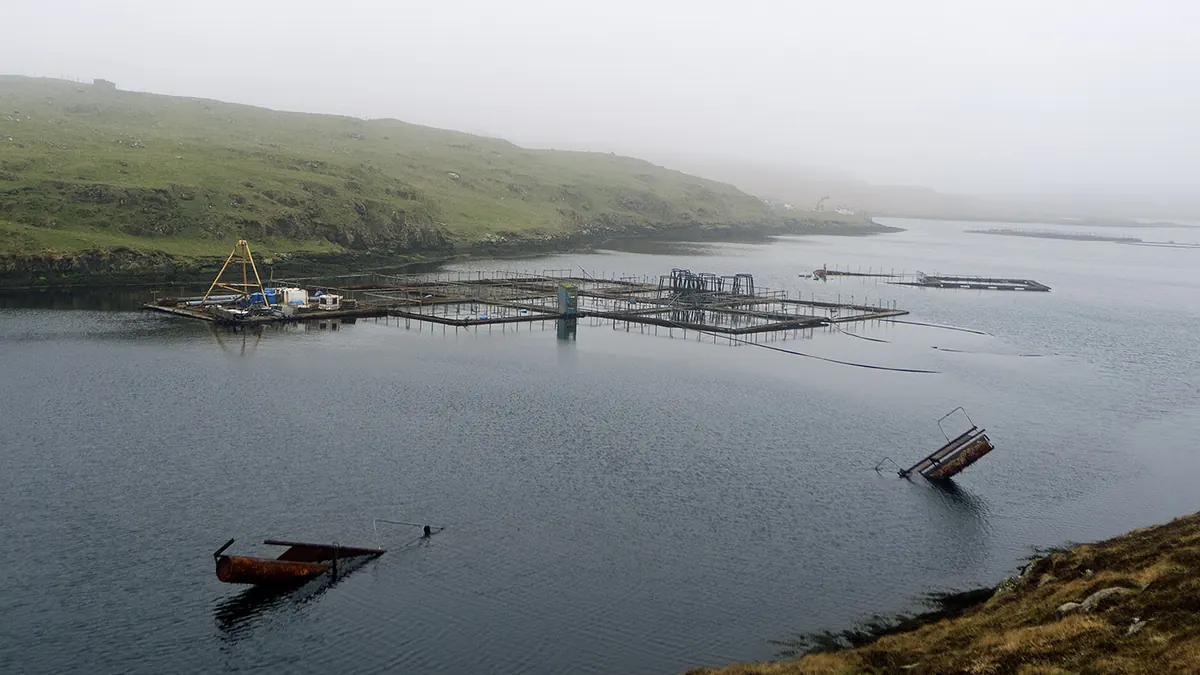
Next come the sea pens themselves: large circular cages of netting held open by floating collars, moored in a grid and anchored to the seabed. Each pen holds fish of one batch, and the nets have to be kept clean, tensioned and inspected, because a torn net is an escape and a fouled net is a dead current. The pens are worked from a feed barge or a workboat, with feed blown through pipes into each pen and cameras watching how the fish respond. A pen that is hard to reach in bad weather is a pen that is hard to feed, and an unfed pen is where growth stalls.
Stocking follows the build. Smolts arrive from a hatchery, young salmon that have made the physiological change that lets them live in salt water, and go into the pens in spring. They grow in the pens for well over a year, fed daily on pellets, while the farmer watches their size, their appetite and, above all, their lice. Sea lice are tiny parasites that attach to the skin of the fish, and in a crowded pen they spread fast. Counting lice is weekly work, and the count decides when to treat, how to treat, and whether the treatment worked. Harvest is the end of the line: fish are crowded gently, pumped aboard a wellboat or harvest vessel, and taken to the processing plant on a schedule that matches the orders coming in. A harvest that arrives a week early is a smaller fish; a harvest that arrives a week late is a fish with more lice. The contrast with the freshwater side of fish farming is sharp: the trout farm installation guide builds raceways on land for fry, while a salmon farm builds pens at sea for smolts, and only the salmon farm faces sea lice as a weekly fact of life.
Site, pens and stocking
The first three tools decide where the farm goes, how the pens are run, and how the fish are kept inside a system that lice cannot walk through. Get the site wrong and no feeding tool can save the farm. Get the pen management wrong and the lice counts mean nothing, because nobody knows which pen they belong to.
ScootScience
ScootScience is the forecasting tool to buy before the first anchor is dropped. It turns ocean models, satellite data and local sensors into forecasts for the water a salmon farm actually lives in: currents at pen depth, water temperature through the season, oxygen levels, and the plankton blooms that can stress or kill fish. A founder uses it to compare candidate sites side by side, to see which bay runs warm in August and which one holds its oxygen, and to plan the working week around the weather window rather than against it.
The practical value shows up in the first season. A site that looks sheltered on a chart can run a current that pushes waste back into the pens, and a site that looks exposed can run clean water all summer. ScootScience makes that difference visible before the moorings are ordered, which is the cheapest moment in the whole build to learn it. It also earns its keep after stocking, when a forecast of warm water and rising lice pressure tells the farmer to count lice sooner and to have a treatment ready rather than discovering the problem at the next routine count.
The honest limit is that a forecast is not a measurement. Pair it with in-pen oxygen and temperature sensors from the first week, and treat it as the planning layer. Used that way, it is the cheapest insurance in the stack: it stops the founder buying a site the sea will punish for twenty years.
AKVA Fishtalk Control
AKVA Fishtalk Control is the farm management system that salmon farmers have used for years to keep every pen, every batch and every lice count in one place. It records smolt inputs, feeding, growth, lice counts, treatments, mortalities and harvest against each pen, so the founder can see at a glance which pen is growing well, which pen is carrying lice, and which batch is ready to harvest. It is the record that turns a set of pens into a farm.
The strength of Fishtalk is that it is built for salmon, not adapted from another kind of farming. It understands pens, smolts, lice counts and harvest by wellboat as first-class facts, not as notes typed into a generic farm diary. A founder who keeps the records in Fishtalk from the first smolt input can answer the questions a buyer, a vet and a regulator will all ask: where did this fish come from, what was it fed, how many lice did it carry, and when was it last treated.
The trade-off is that Fishtalk is a management system, not a sensor. It records the lice count and the feeding; it does not count the lice or decide the ration. Buy it early, because records kept from day one are worth far more than records reconstructed at harvest, but do not expect it to replace the cameras and sensors that feed it numbers.
FishGLOBE
FishGLOBE is the most radical answer to the lice problem in this list: a closed-containment pen that keeps the salmon inside and the lice outside. Instead of an open net, the fish live in a large enclosed structure with water pumped in from depth, below the layer where lice larvae drift, and filtered before it reaches the fish. The result is a pen where lice barely arrive at all, and where the farmer controls the water the fish swim in rather than accepting whatever the sea brings.
For a startup, the appeal is obvious. A closed pen removes the weekly lice count as the deciding event of the farm, cuts the treatments that cost money and stress the fish, and lets the farm sit in a location that an open pen could not use. It also answers the hardest question a new salmon farmer faces from neighbours and regulators: what escapes, and what drifts out of the pens. A closed pen answers that question with a structure rather than a promise.
The honest limit is cost and novelty. A FishGLOBE is major marine engineering, not a net and a collar, so treat it as a site decision, not a tool purchase. It suits a founder with the capital for it who wants lice prevention built into the pen. For everyone else, the open-pen tools below are the practical route.
Feeding and growth in the pens
The next three tools decide how fast the fish grow and how much of the feed budget turns into fish rather than waste. Feeding is the biggest running cost on a salmon farm, so a tool that reads appetite in real time is worth more than a tool that records what was fed yesterday.
Bluegrove
Bluegrove puts underwater cameras and sensors in the pen and reads what the fish are actually doing when the feed arrives. Its system watches feeding behaviour, swimming patterns and welfare signals, and tells the farmer whether the fish are hungry, full, stressed or simply not interested in the pellets on offer. That is the difference between feeding by the clock and feeding by the fish.
The practical value is in the feed bill. Pellets that sink uneaten are money on the seabed, and a ration set by a table rather than by appetite will overfeed on a cold day and underfeed on a warm one. Bluegrove lets the farmer stop the feed when the fish stop eating, and start it again when they are ready, which keeps growth steady and the water clean. It also flags welfare problems early, because fish that change how they swim usually have a reason, and the reason is cheaper to fix on the day it appears than a week later.
The trade-off is that Bluegrove needs cameras in the water and someone watching what they show. Install it on the first pens stocked, not as an afterthought, because feeding habits learned in the first month shape the growth curve for the whole cycle.
OptoScale
OptoScale is the camera system that counts what matters in a salmon pen without handling a single fish: how big the fish are, how fast they are growing, and how many lice each fish is carrying. Its cameras sit in the pen and photograph fish as they swim past, measuring length and weight from the image and spotting lice on the skin. The founder gets a biomass estimate and a lice count from the same pass, without crowding, netting or stressing the fish.
The strength of OptoScale is that it measures the two numbers a salmon farmer argues about most: how much fish is in the pen, and how many lice are on them. A biomass estimate that is five percent out changes the harvest plan, the feed order and the sale, so a camera that measures fish every day beats a sample that measures a hundred fish once a month. A lice count taken from thousands of fish beats a count taken from twenty fish in a net, because lice are patchy and a small sample can miss the pen that needs treatment.
The honest limit is that a camera counts what it can see. Fish that never swim past it are not counted, and a dirty lens in a fouled pen sees nothing. Treat OptoScale as the daily measure and keep the manual lice count as the check, because the two together catch what either one alone would miss.
BioSort
BioSort sorts salmon inside the pen, by size and by lice load, without taking the fish out of the water. Its system guides fish through a sorting unit in the pen, separates the fish that need treatment from the fish that do not, and lets the farmer treat only the fish that carry lice rather than the whole pen. That is the difference between treating a problem and treating a population.
The practical value is in the treatment bill and the fish. A whole-pen treatment stresses every fish in the pen, costs a full dose of whatever is being used, and puts the whole batch off its feed for days. Sorting first means the clean fish keep growing, the lousy fish get treated, and the farm uses less treatment to get the same result. It also means the harvest can be graded in the pen, so the fish that are ready go first and the fish that need more time stay behind.
The trade-off is that BioSort is pen hardware, not software, and it has to be installed and worked into the daily routine. Plan for it when the pens are laid out, because a sorting unit needs space, power and a workboat alongside, and retrofitting it into a crowded pen grid is harder than building it in from the start.

Sea-lice control and fish health
The last three tools are the lice tools, and they are the reason this list looks nothing like a freshwater fish farm list. Sea lice decide the harvest date, the treatment budget and the reputation of the farm, so the tools that count them, remove them and treat them are the tools that decide whether the farm makes money.
Stingray Marine
Stingray Marine removes lice with light. Its underwater laser units sit in the pen and fire short pulses at lice on fish as they swim past, killing the parasite without touching the fish and without putting any chemical in the water. The system watches the pen around the clock, finds the lice, and deals with them one at a time, day after day, while the fish keep feeding.
The practical value is that lice control becomes continuous rather than episodic. Instead of waiting for the weekly count to cross a threshold and then booking a treatment that stresses the whole pen, the farm keeps the lice load low all the time, which keeps the fish growing and keeps the treatment count down. It also answers the resistance problem, because a laser does not breed resistant lice the way a repeated chemical treatment can, and it leaves no residue in the fish or the water.
The honest limit is that a laser system is a capital purchase for every pen it protects, and it works best as part of a lice strategy rather than the whole strategy. Pair it with a counting tool, so the farm knows whether the lasers are keeping up with the lice pressure, and with a treatment tool for the weeks when pressure spikes.
Cermaq iFarm
Cermaq iFarm recognises individual salmon. Its cameras identify each fish by the pattern of dots on its skin, follow that fish through the production cycle, and record its growth and its lice load over time. Instead of a pen average, the farmer gets a history for each fish: how fast it grew, how many lice it carried, and whether it responded to treatment.
The strength of iFarm is that it turns lice from a pen problem into an individual problem. Some fish carry far more lice than others, and some fish grow far faster than others, and a farm that can tell the two groups apart can treat the first group, keep the second group growing, and learn which smolt batches produce the healthiest fish. It also changes the harvest, because fish can be selected by their individual history rather than by a sample that may or may not represent the pen.
The trade-off is that iFarm is deployed with partner farms rather than sold off the shelf, so treat it as a direction rather than a purchase on day one. The lesson still applies from the first pen: count lice on individual fish, keep the history, and let the history decide the treatment.
CleanTreat
CleanTreat is the lice bath that cleans up after itself. Developed by Benchmark, it treats salmon against lice in a bath and then purifies the treatment water before returning it to the sea, so the medicine does its work on the fish and does not drift on to the wild fish and shellfish around the farm. The fish are treated, the water is cleaned, and the farm can show exactly what went back into the sea.
The practical value is in the licence to keep farming. Lice treatments are the most scrutinised part of salmon farming, and a farm that can prove its treatment water was purified has a stronger answer for regulators, neighbours and buyers than a farm that cannot. It also lets the farm treat when it needs to, rather than waiting for a weather window or a wellboat slot, because the purification happens on the farm rather than at sea.
The honest limit is that CleanTreat is a system, not a bottle, and it needs to be planned into the farm from the start. Treat it as the treatment end of a lice strategy that starts with counting and continues with prevention, because a bath is still a treatment, and a farm that only treats will always be behind the lice.
How the tools were compared
Every tool in this guide was judged against the same practical tests. First, it had to fit a salmon farm that grows fish in saltwater sea pens from smolts, because a tool built for a freshwater raceway, a garden pond or a decorative tank will not understand lice, currents or a wellboat. Second, it had to be usable by a small farm team working from a boat, with clear numbers and plain-language alerts, since the busiest hours leave no time for fiddling with software. Third, it had to connect to the other tools a young farm already uses, especially the farm management system, so that lice counts, feeding and growth flow automatically instead of being typed in twice. The harvest end of the business is a different trade again, and the fish market startups guide covers the counters, cold chain and pre-orders that sell the fish once they leave the pens.
What to buy first, and what to wait for
Buy the forecasting, the feeding cameras and the lice counting first. Those three tools decide the site, the feed bill and the treatment bill, which are the three numbers that decide whether the farm makes money. Add the farm management system in the same first order, because records kept from the first smolt input are worth far more than records reconstructed at harvest. Add the sorting and the laser lice control once the first pens are stocked and the lice pressure is known, because those tools are sized to the pressure the farm actually faces. Add the closed-containment pens and the purified bath treatment only when the farm knows its site, its lice and its buyers well enough to judge whether the capital is worth it.
Salmon farm startup checklist
- Confirm the site with a full season of current, temperature and oxygen data before ordering pens.
- Stock smolts in spring, one batch per pen, and record every input in the farm management system.
- Install feeding cameras in the first pens and feed by appetite, not by the clock.
- Count lice every week on individual fish, and keep the history for every pen.
- Have a lice treatment ready before the count crosses the threshold, not after.
- Plan the harvest with the buyers months ahead, and harvest the pens that are ready first.
Frequently asked questions
How much does it cost to start a salmon farm?
More than any land-based fish farm, because the pens, moorings, workboat and feed barge are marine engineering before they are farming. The software in this guide is a small share of the total, and the forecasting and lice tools are the cheapest part of a build that is mostly steel, netting and boats. Budget for the site survey and the first year of lice control before budgeting for any software beyond the first three tools.
Why are sea lice the biggest problem on a salmon farm?
Sea lice are parasites that attach to the skin of salmon in salt water, and in a crowded pen they spread from fish to fish quickly. A heavy lice load damages the skin, slows growth, opens the way to infection, and can force an early harvest. Counting lice weekly and acting on the count is the core routine of salmon farming, and it has no equivalent on a freshwater farm.
Is farmed salmon the same as wild salmon?
No. Farmed salmon are grown in sea pens from smolts, fed on pellets and harvested on a schedule, while wild salmon live free in rivers and the open sea and are caught rather than grown. The wild side of the trade is a different business altogether, and the fishing lodge startups guide covers the lodges that host anglers who fish for wild salmon. A salmon farm sells a farmed fish, and it should say so plainly.
Do salmon farms need a licence?
Yes, in every salmon-farming country. A farm needs consent for the site, the pens, the number of fish, the feed, the lice treatments and the discharge, and the lice counts and treatment records are part of the licence conditions. Keep the records from the first smolt input, because a regulator will ask for them, and a farm that cannot produce them will not keep its licence.
How long does it take to grow a salmon to harvest?
Roughly a year and a half in the sea pens after the smolts go in, on top of the year the smolts spend in the hatchery. Growth depends on water temperature, feed, lice pressure and the genetics of the batch, so the harvest date is a forecast, not a fixed day. The biomass tools in this guide exist to keep that forecast honest, week by week.
What is the first tool a salmon farm startup should buy?
The pen-site forecast, because the site decides everything that follows. A good site forgives a modest feeding tool and a late lice count, while a bad site punishes the best tools in the world. Forecast the site, then buy the feeding cameras and the lice counting, and only then spend on the rest of the stack.
Bottom line
A salmon farm installation startup is a sea-pen business, a smolt business and a sea-lice business, in that order. The site decides the farm, the feeding decides the margin, and the lice count decides the harvest. The nine tools in this guide are the ones that measure those three things honestly, in salt water, in a pen, on individual fish. Buy the forecasting, the feeding and the lice counting first, keep the records from day one, and let the fish, not the dashboard, decide when the farm is ready to grow.

Keep what speaks to you.
Leave room for your own perspective.