
A rice mill installation startup builds the place where paddy becomes rice. Lorries roll in from the farms with sacks or bulk loads of paddy, and the mill takes over: the grain is weighed, tested for moisture, cleaned, dried if it needs it, husked to strip the outer shell, polished to remove the bran layer, graded by size and whiteness, and bagged for buyers. The mill buys paddy and sells milled rice, and that simple fact draws the line around the whole trade. The farm grows the grain and the miller mills it, and the two jobs need different buildings, different machines and different buyers. A rice mill never plants, floods or transplants a field; it starts where the harvest ends.
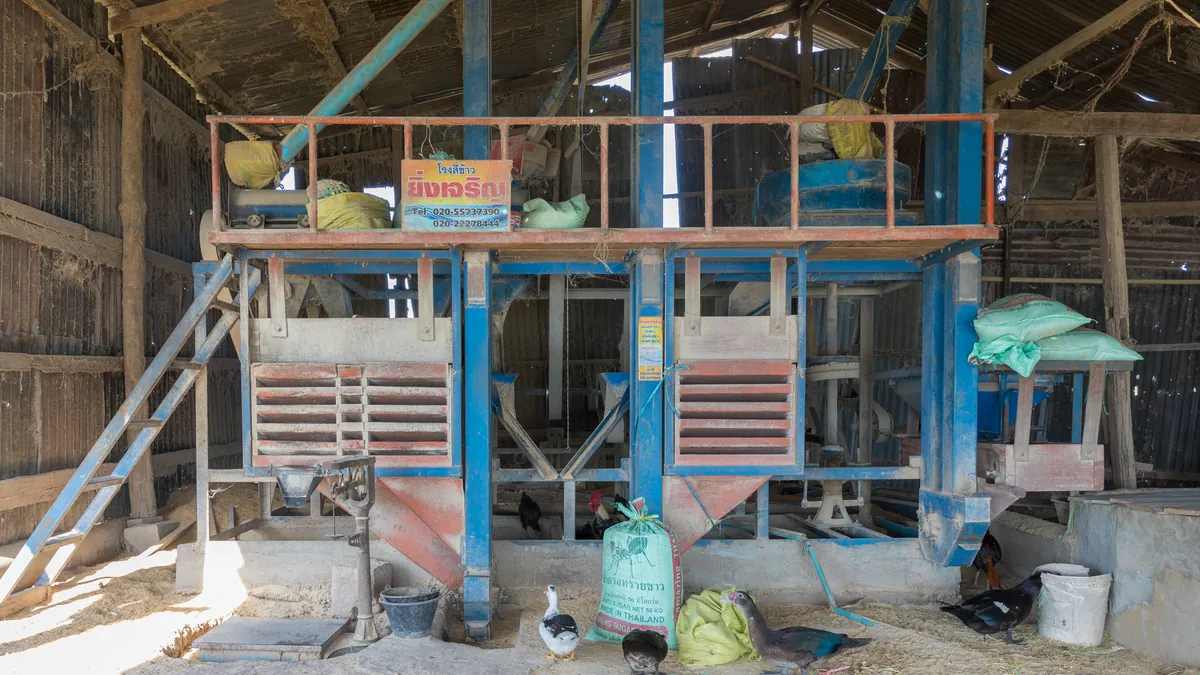
The build itself is a processing line inside a practical shed. There is an intake yard with a weighbridge and a moisture tester, a paddy store that keeps the grain dry and ventilated, a cleaning line that takes out stones, straw and dust, a husker that cracks the husk without breaking the kernel, a polisher that whitens the grain, a grader that sorts whole kernels from broken ones, a bran handling line, and a bagging bench where the finished rice is weighed, sealed and stacked on pallets. Dust control runs through all of it, because rice dust is a fire and health risk as well as a mess. A small mill might process one to five tonnes of paddy an hour; a larger one might do ten or more, but the stages are the same at every size.
The nine AI tools in this guide each sit on one stage of that line. They plan the site and the yard, read the moisture in every load, set the husker so it cracks the shell and spares the kernel, judge the polish and the whiteness, sort the broken rice, track the bran, watch the dust, plan the bagging, and find the buyers who will take the finished rice at a fair price. They make the machines pay, by cutting the losses that eat a new mill alive: wet paddy stored wrong, huskers set too tight, polishers run too long, grades mixed up, and bran sold for nothing.
Key takeaways
- A rice mill processes paddy into milled rice. It buys paddy from farms and sells milled rice onward; it does not grow anything.
- Husking and polishing decide the money. The husker must crack the shell without breaking the kernel, and the polisher must whiten the grain without grinding it away.
- Moisture at intake decides everything downstream. Wet paddy stored warm will spoil, and dry paddy husked too hard will shatter.
- Bran and broken rice are revenue, not waste. A mill that tracks its by-products can add a second income line from the first week.
- Buy the intake and moisture tool first, then the husking tool, then the buyer tool. A mill with dry paddy, a well-set husker and a signed buyer is a business; the rest is refinement.
The nine tools at a glance
| Tool | Stage it serves | What it decides | Buy it when |
|---|---|---|---|
| PaddyIntake Planner AI | Intake and storage | Which loads to accept, and where to store them | Before the first lorry arrives |
| HuskBreak Sense AI | Husking | Husker settings that crack the shell and spare the kernel | Before the husker is switched on |
| PolishGrade Vision AI | Polishing and grading | Whiteness, polish level and grade | When the first polished batch is graded |
| BranFlow Planner AI | By-products | Where the bran goes and what it earns | When bran starts piling up |
| BrokenRice Sort AI | Grading | Whole kernels, broken kernels and brewers rice | When grading becomes a bottleneck |
| PaddyDry Curve AI | Drying | Drying temperature and time for each load | When wet paddy arrives in season |
| MillDust Watch AI | Safety | Dust levels, extraction and explosion risk | Before the mill runs a full day |
| RiceBag Planner AI | Bagging and despatch | Bag sizes, sealing, pallets and loads | When orders start leaving the yard |
| RiceTrade AI | Sales | Buyers, contracts and prices | Before the first tonne is milled |
How a rice mill installation startup actually works
The line runs in one direction, and every stage protects the next one. Paddy arrives and is weighed and sampled. A moisture meter reads the load, because paddy above about fourteen percent moisture cannot be stored safely and paddy below about twelve percent will break in the husker. The cleaning line takes out stones, straw, dust and empty grains. If the paddy is too wet it goes to the dryer, where warm air brings it down slowly; drying too fast cracks the kernel from the inside, and the cracks only show up later, as broken rice in the grader.
Husking comes next. A rubber-roll husker pulls the paddy between two rollers turning at different speeds, and the friction strips the husk away. The gap between the rollers and the difference in their speeds decide the result: too tight and the kernels break, too loose and the paddy passes through still in its husk. The husk is blown away and collected, and the brown rice that comes out still wears its bran layer. Polishing then rubs that layer away in stages, and each pass whitens the grain a little more. Polish too little and the rice looks dull and cooks unevenly; polish too much and the mill is grinding saleable weight into bran dust.
Grading sorts what the polisher produces. Whole kernels go one way, broken kernels another, and the smallest fragments go to brewers rice or animal feed. The bran is collected separately, because it has its own buyers. Bagging weighs the finished rice into sacks, seals them, and stacks them on pallets for the buyer. Through the whole line, dust extraction keeps the air clear and the explosion risk down. A mill that runs this line well loses very little: most of the paddy becomes saleable rice, and the rest becomes bran and broken rice that are sold, not thrown away.
The neighbours on this site draw the line around the rice mill clearly. A flour mill installation startup grinds grain into flour between stones or rollers and then sifts it into grades; its whole point is to turn the kernel into powder, while the rice mill’s whole point is to keep the kernel whole and strip only the husk and the bran. An olive oil mill builds a press house that crushes olives, malaxates the paste and spins it in a decanter to separate the oil; nothing is husked, polished or graded, and the product is a liquid, not a grain. A watermill is a power source, a wheel turned by a stream with a leat and a millpond; a rice mill is a processing line that can run on mains electricity, a diesel generator or a solar array, and the power source is not the trade. A sugar mill crushes cane and boils juice into crystals, and a paper mill turns pulp into sheets on a moving wire; both are processing lines, but neither of them handles paddy, husking or polishing.
The farm is the other side of the fence, and the fence matters. The rice farm grows the crop in flooded paddy fields, with bunds, transplanting and water-level management, and it sells paddy to millers. The rice mill buys that paddy and never touches a field. The two trades meet at the weighbridge, where the farm’s load becomes the mill’s stock, and that handover is exactly where the intake tool earns its keep.
The nine AI tools
Each tool below is named for the job it does in a rice mill, and each one is judged on the same question: does it save paddy, save time, or save a sale? A tool that does none of those three is a decoration, and a new mill cannot afford decorations.
1. PaddyIntake Planner AI: The Best Tool for Testing, Weighing and Storing Every Load
PaddyIntake Planner AI sits at the gate, and it decides what comes in and where it goes. Every load is sampled for moisture and for the share of empty grains, chalky kernels and foreign matter, and the tool records the result against the supplier, the variety and the price paid. Wet loads are flagged for the dryer before they are stored. Dry loads are sent to the driest, best-ventilated bin. Loads with a high share of broken or immature grain are priced down or refused, with the numbers on screen to show the farmer why.
The storage plan is the part new mills get wrong most often. Paddy stored warm and damp will heat, mould and spoil in days, and a single bad load can taint a whole bin. The tool tracks the temperature and moisture of every bin, warns when a bin is warming, and tells the crew which bin to mill first so nothing sits longer than it should. It also keeps the paper trail a buyer will ask for: which farm each batch came from, what its moisture was on arrival, and how long it was stored. When a buyer asks why one lot is whiter than another, the answer is in the intake record.
Buy this tool first, before the first lorry arrives. It is the cheapest insurance a new mill can buy, because every loss downstream starts with a bad load accepted blind or a good load stored wrong.
2. HuskBreak Sense AI: The Best Tool for Setting the Husker Without Breaking Kernels
HuskBreak Sense AI watches the husker, and the husker is where the mill’s money is made or lost. It reads the husking rate, the share of paddy passing through unhusked, and the share of kernels coming out broken, and it recommends the roller gap and the speed difference for each variety and each moisture level. Different varieties husk differently, and paddy at thirteen percent moisture needs a different setting from paddy at eleven percent. A mill that runs one setting all day will break grain all day.
The tool also watches the rollers themselves. Rubber rolls wear, and worn rolls husk badly long before they look worn to the eye. The tool tracks the husking rate against the hours on each set of rolls and warns when the rolls need changing, so the crew changes them on a planned stop instead of discovering the problem in a bin full of broken rice. It also balances the husk aspiration, so the husk is carried away cleanly without taking good kernels with it; kernels in the husk stream are pure loss, and the tool counts them.
A new mill should have this tool running before the husker is switched on for the first paid load. The husker is the most expensive machine in a small mill, and it is also the easiest to misuse.
3. PolishGrade Vision AI: The Best Tool for Whiteness, Polish Level and Grade
PolishGrade Vision AI looks at the rice the way a buyer looks at it, and it does so on every batch instead of once a day. A camera over the polished stream reads the whiteness, the share of kernels still carrying bran streaks, and the share of broken kernels, and it tells the operator whether to add another polishing pass or stop where the grain is. Over-polishing is a quiet loss: every extra pass turns saleable rice into bran dust, and the mill pays for it in weight that leaves as a by-product instead of as rice.
The grading side of the tool sorts the output into the grades the buyers actually pay for. Whole kernels of the top grade go to the premium buyer, the standard grade goes to the wholesale buyer, and the broken rice goes to its own market. The tool keeps a sample image and a whiteness reading for every batch, so when a buyer disputes a grade the mill can show the record instead of arguing from memory. That record is also what lets a new mill price with confidence: it knows exactly what grade it produced, and it can quote that grade instead of guessing.
Install this tool when the first polished batch is graded, and no later. A mill that grades by eye will mix grades, under-price its best rice, and learn about it from the buyer instead of from its own line.
4. BranFlow Planner AI: The Best Tool for Turning Bran into a Second Income
BranFlow Planner AI follows the bran, which is the part of the rice most new mills ignore until it becomes a problem. Polishing strips the bran layer from every kernel, and in a mill running a few tonnes an hour that adds up to sacks of bran a day. Left in a heap it goes stale, attracts pests and becomes a fire risk. Sold fresh, it has buyers: feed mills take it for animal feed, oil extractors take it for rice bran oil, and in some markets it goes to food processors. The logic matches an olive oil mill installation startup, where the pomace left after pressing has its own buyers; rice bran comes from polishing, not pressing.
The tool tracks how much bran each polishing pass produces, how fast it is building up, and which buyer is paying best this week, and it schedules collection before the heap becomes a hazard. It also watches the polish level against the bran yield, so the operator can see the trade in plain numbers: one more pass buys a little more whiteness and costs a measurable weight of rice turned into bran. That trade is worth making when the buyer pays for whiteness, and worth refusing when the buyer pays by weight.
Set this tool up as soon as the bran starts piling up, which in a working mill is the first week. A mill that sells its bran from the start has a second income line; a mill that discovers its bran in a month has a disposal bill.
5. BrokenRice Sort AI: The Best Tool for Recovering Value from Broken Kernels
BrokenRice Sort AI sorts the kernels the husker and the polisher broke, and it recovers money that would otherwise leave as feed. Not all broken rice is equal: large broken pieces still sell as second-grade rice, small broken pieces sell to brewers and food processors, and only the smallest fragments and dust go to feed. A mill that tips all of it into one sack is giving the brewer’s price to the feed buyer.
The tool reads the size distribution of the broken stream and sets the grader screens so each fraction lands in the right sack. It also traces the breakage back to its cause: a rise in breakage after a roller change points at the husker, a rise after a damp load points at the paddy, and a rise late in the day points at tired settings or worn screens. That trace matters, because breakage is a symptom, and the cure depends on where it started. A mill that only sorts the broken rice without asking why it broke will sort broken rice forever.
Bring this tool in when grading becomes a bottleneck, which is usually within the first month of steady running. It pays for itself in recovered grade, and it pays again in the breakage it helps prevent.
6. PaddyDry Curve AI: The Best Tool for Drying Wet Paddy Without Cracking It
PaddyDry Curve AI manages the dryer, and drying is the stage where impatience does the most damage. Wet paddy has to come down to a safe storage moisture, but drying it too hot or too fast cracks the kernel from the inside. The cracks are invisible when the paddy goes into the bin, and they show up weeks later as broken rice in the grader, long after anyone remembers the drying day. The tool sets the drying temperature and the airflow for each load based on its starting moisture, its variety and the weather, and it holds the grain at each step long enough to dry evenly.
The tool also schedules the dryer against the intake queue, so the wettest loads are dried first and nothing waits damp in a heap. In harvest season the loads arrive faster than the dryer can take them, and the order matters: a load at eighteen percent moisture waiting a day is a load at risk, while a load at fifteen percent can wait. The tool keeps that queue visible, and it logs the drying curve for every load, so the mill can show a buyer that the paddy was dried properly and the breakage is not a drying fault.
This tool matters most when wet paddy arrives in season, which is exactly when a new mill is busiest and most tempted to rush. Buy it before the first harvest, not after the first spoiled bin.

7. MillDust Watch AI: The Best Tool for Dust Control and Explosion Safety
MillDust Watch AI watches the air, and in a rice mill the air is a safety system, not a comfort. Rice dust is combustible, and a cloud of it near a spark or a hot bearing can ignite. The tool reads dust levels at the intake, the husker, the polisher and the bagging bench, and it watches the extraction fans and the ducting that carry the dust away. When a level rises, it says where the rise is and what to check first: a blocked duct, a torn filter, a fan running slow, or a spill that needs sweeping before it becomes airborne.
The tool also tracks the slow risks that a crew stops noticing. Bearings that run hot, belts that slip, and motors that draw more current than they should are all early warnings of the heat and friction that ignite dust. The tool logs them, ranks them, and turns them into a short daily list instead of a vague feeling that the mill smells hot. It also keeps the cleaning record, because the cheapest dust control in any mill is a swept floor and an emptied bin, done every day without fail.
Have this tool running before the mill runs a full day. A mill can survive a bad grade; it cannot survive a fire, and dust is the risk a new crew underestimates most.
8. RiceBag Planner AI: The Best Tool for Bagging, Sealing, Pallets and Despatch
RiceBag Planner AI runs the end of the line, where the finished rice becomes a product a buyer will accept. It plans the bag sizes for each order, sets the weigher so every sack is on weight, and checks the seals, because a sack that leaks in the lorry is a claim, not a sale. It prints the labels with the grade, the batch and the weight, so a buyer who finds a problem can trace it to one batch instead of blaming the whole delivery.
The pallet plan is the part that saves the crew’s backs and the buyer’s patience. The tool stacks the pallets by order and by grade, keeps the heaviest sacks at the bottom, and produces a loading order so the lorry is loaded in the order it will be unloaded. It also tracks the stock of bags, thread, labels and pallets, and warns before the mill runs out in the middle of a big order. A mill that runs out of sacks with a lorry waiting is a mill that pays demurrage for its own poor planning.
Set this tool up when orders start leaving the yard regularly. It is a small tool with a visible payoff: fewer short-weight claims, fewer torn sacks, and lorries that leave on time.
9. RiceTrade AI: The Best Tool for Finding Rice Buyers and Pricing Contracts
RiceTrade AI finds the buyers, and a mill without buyers is a warehouse full of rice. It tracks the wholesale price for each grade in the mill’s region, lists the buyers who take each grade, and records what each buyer paid last time, how fast they paid, and whether they rejected any loads. A buyer who pays well but takes six weeks to pay is a different proposition from a buyer who pays less and pays in seven days, and a new mill needs to see that difference in numbers before it signs.
The contract side of the tool is where it earns its keep. It drafts the terms for each sale: grade, whiteness, moisture, broken share, bag size, delivery date and payment terms, and it flags any term the mill cannot meet with its current line. A contract that promises a whiteness the polisher cannot reach is a rejected load waiting to happen. The tool also watches the market: when the price of one grade rises, it tells the mill which grade to push, and when a buyer goes quiet, it suggests the next buyer on the list instead of leaving the mill guessing.
Have this tool working before the first tonne is milled. A mill that mills first and looks for buyers second will sell its first rice at whatever price is offered, and first prices have a habit of becoming the price.
What to buy first
Buy in the order the paddy travels. The intake tool comes first, because it decides what enters the mill. The husking tool comes second, because the husker decides how much of the paddy becomes whole rice. The buyer tool comes third, because a mill needs a customer before it needs a polish grade. The drying tool should be in place before the first harvest, and the dust tool should be running before the first full day. The polishing, bran, broken-rice and bagging tools can follow in the first month, in the order the bottlenecks appear. A mill that buys all nine on day one will spend its budget before it knows which stage is its weakest; a mill that buys in the order the paddy travels will know by the end of the first week.
Budget honestly for the machines as well as the software. The tools in this guide are cheap beside a husker, a polisher and a dryer, and a founder who spends everything on machines and nothing on measurement will run a mill blind. Power is a utility choice, not the trade: unlike a watermill installation startup, where the stream, the leat and the wheel are the whole job, a rice mill runs on mains, diesel or solar.
Checklist: six checks before the first paddy arrives
- Test the moisture meter against a known sample, and write down the reading. A meter that reads two points low will send wet paddy into storage.
- Run the husker empty and then on a trial load, and count the broken kernels before any paid paddy goes through it.
- Walk the dust extraction from intake to bagging, and check every duct, filter and fan by hand.
- Confirm the first buyer in writing, with the grade, the price and the payment terms agreed before milling starts.
- Label every bin with the variety, the arrival date and the moisture reading, so nothing is milled blind.
- Price the bran and the broken rice before the first sack is filled, so the by-products have a buyer from day one.
Frequently asked questions
What is a rice mill installation startup?
It is a small business that builds and runs a rice mill: a processing line that takes in paddy from farms, husks it, polishes it, grades it and bags it as milled rice for buyers. The startup designs the site, installs the machines, and operates the line, usually for a first-time mill owner, a farmer group or a cooperative.
How is a rice mill different from a flour mill?
A flour mill grinds grain into flour and sifts it into grades, so its whole point is to turn the kernel into powder. A rice mill does the opposite: it strips the husk and the bran while keeping the kernel whole, and it grades the kernels by size and whiteness. The machines, the settings and the buyers are all different.
How is a rice mill different from a rice farm?
The farm grows the rice in flooded paddy fields, with bunds, transplanting and water-level management, and it sells paddy to millers. The mill buys that paddy and processes it into milled rice. The farm grows the grain and the miller mills it, and the two jobs need different buildings, different machines and different buyers.
How much paddy does a small rice mill need to stay busy?
It depends on the size of the line, but a useful rule is that a mill running one to two tonnes of paddy an hour needs a steady supply of several hundred tonnes a season, from more than one farm. A mill that depends on a single supplier will stand idle when that supplier’s harvest is late or short, so line up two or three suppliers before the season starts.
What should a new rice mill buy first?
The intake and moisture tool first, the husking tool second, and the buyer tool third. Dry paddy accepted with its moisture known, a husker set to spare the kernel, and a buyer signed before milling starts are the three things that make the first month survivable. The rest of the tools follow in the order the bottlenecks appear.
How long does it take to install a small rice mill?
A small line in an existing shed can be installed and running in a few weeks once the machines are on site, while a new building with a dryer, dust extraction and a proper intake yard takes a few months. The slow parts are usually the power supply, the building work and the first buyer contract, not the machines themselves.
Bottom line
A rice mill is a processing trade, and it pays for care at every stage. Take in dry paddy, store it properly, husk it without breaking it, polish it without grinding it away, grade it honestly, sell the bran and the broken rice, keep the dust down, and have a buyer signed before the first tonne is milled. The nine tools in this guide each guard one of those steps, and together they turn a shed full of machines into a mill that makes money. Start with the intake, the husker and the buyer, and build the rest as the mill earns.

Keep what speaks to you.
Leave room for your own perspective.


