
An oast house is not a barn with a fancy roof. It is a hop-drying kiln, built around one job: moving hot air up through a deep bed of freshly picked hops until their moisture falls from around eighty per cent to about six, without scorching the cones or stripping out the oils that brewers pay for. The stowage stores the crop, the kiln dries it, and the cowl on the roof turns with the wind to pull the damp air out. Get any part of that chain wrong and the hops come out musty, uneven, or burnt, and no brewer will take a second load from the same grower.
That is why an oast house installation startup lives or dies on its first few kilns. A new firm cannot afford a drying floor that sags, a furnace that runs hot on one side, or a cowl that sticks in a fixed position and lets damp air settle back onto the hops. The old skills still matter, and no software replaces a builder who understands brick, timber, and airflow, but the right AI tools now carry much of the measuring, modelling, and paperwork that used to eat a small team’s week. The same kind of digital help already serves AI tools for outdoor kiln installation startups, and the hop kiln is the place where that help pays off fastest, because the drying process is so easy to measure and so expensive to get wrong.
This guide covers the nine tools that matter most for a new oast house installation startup in 2026: the design tools that size the kiln and shape the roof, the drying tools that watch moisture and temperature through every load, and the business tools that handle the hop garden survey, the planning paperwork, and the money. Each one is judged on what it does for a small team on a real farm job, what it costs to start with, and where it still needs a human to check its work.
Key takeaways
- An oast house is a hop-drying kiln, not a conversion or a store: the kiln, the drying floor, and the roof cowl are one drying system, and they must be designed together.
- Start with the kiln design and the drying controls first, because a kiln that dries unevenly will cost a startup its reputation with hop growers and brewers before the business gets going.
- Airflow modelling and moisture sensing are the two tools that save the most money, since they stop a team from rebuilding a drying floor or losing a load of hops to damp.
- Listed-building and planning rules shape almost every oast house job, so a permit tool that reads the local rules early is worth more than a second design tool.
- Nine tools are enough: a small startup should buy the kiln and drying set first, add the survey and permit tools on the second job, and only then spend on the wider business kit.
What makes an oast house different from any other barn
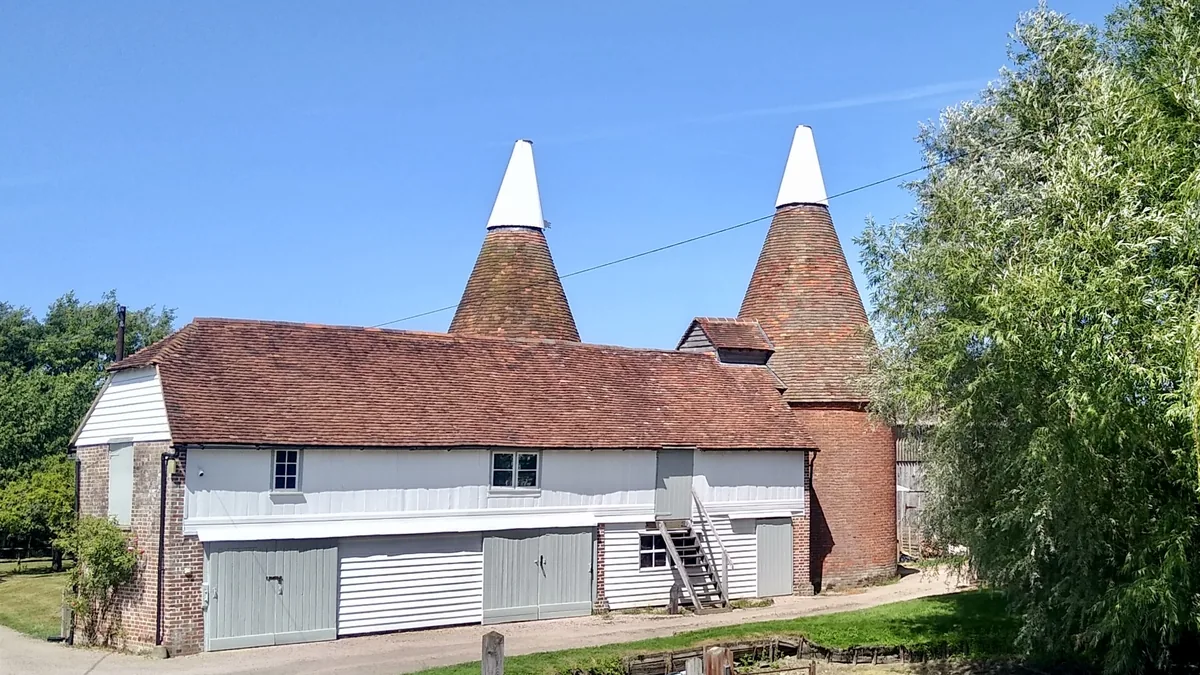
A barn stores things. An oast house changes them. Fresh hops arrive from the hop garden at around eighty per cent moisture, and they leave the kiln at about six per cent, ready to be pressed into pockets and sent to the brewery. Everything about the building serves that change. The furnace sits below, the perforated drying floor sits above it, the hops are spread about a foot deep across that floor, and the hot air rises through the bed and escapes through the cowl. The stowage beside the kiln is where the dried hops cool and are pressed, and where the green hops wait their turn.
The roof is the part most people notice, and it is also the part most often misunderstood. The tall conical roof is not decoration. It creates the draught that pulls air through the hops, and the cowl at its top turns with the wind so the outlet always faces away from the breeze. A cowl that sticks, a roof that leaks, or a kiln with the wrong proportions will dry one side of the bed and leave the other side damp. That is why oast house work rewards installers who measure airflow and temperature rather than guessing, and why the tools in this guide lean so hard on sensing and simulation.
Designing the kiln and the roof
The design stage decides whether the kiln will dry hops evenly for the next fifty years or fight its owners from the first harvest. Three tools cover this stage: one sizes the kiln and sets the drying schedule, one models the air moving through the drying floor, and one shapes the conical roof and the cowl that sits on top of it. Used together, they let a small team show a hop grower exactly how the finished kiln will behave before a single brick is laid.
1. KilnCraft AI: The Best Tool for Kiln Design and Drying Schedules
KilnCraft AI is the tool to buy first, because it answers the question every hop grower asks before signing: how big should the kiln be, and how long will a load take to dry? The installer enters the size of the hop garden, the varieties being grown, the expected yield per acre, and the harvest window, and the tool sizes the kiln, the drying floor, and the furnace to match. It then builds a drying schedule for each variety, with target temperatures and times that the drying team can follow load by load.
What makes it useful on a farm job is that it works from the grower’s real numbers rather than from a generic template. A small garden of dwarf hops needs a different kiln from a large garden of tall varieties, and a grower who picks over three weeks needs a different schedule from one who picks in a single rush. KilnCraft AI holds those differences in its model, so the quote the startup gives is built on the grower’s own harvest rather than on a guess. It also flags the jobs that do not add up, such as a garden too large for a single kiln, before the team has spent a week on drawings.
2. OastFlow Planner: The Best Tool for Airflow Through the Drying Floor
OastFlow Planner models the air moving up through the drying floor, and it exists because uneven airflow is the most common fault in a new kiln. Hot air takes the easiest path, so a floor with a blocked corner or a furnace set slightly off centre will dry one side of the hop bed and leave the other side damp. The tool takes the kiln shape, the floor construction, and the furnace position, then shows where the air will go and where it will stall, with a simple colour map that a grower can understand at a glance.
For a startup, the value is in the rework it avoids. Changing a drying floor after it is built means lifting the floor, reworking the supports, and losing a week of the build, while changing it in the model takes an afternoon. The tool also tests the details that are easy to get wrong on site, such as the gap between the floor battens, the depth of the hop bed, and the size of the cowl opening, and it shows how each one changes the drying time. A team that runs the model before ordering materials will order the right floor once, and the grower will notice the difference in the first harvest.
The tool is at its best when it is used with real measurements from the site. A quick survey of the kiln shell, the furnace position, and the roof opening gives the model something true to work from, and the results are far more reliable than a model built from a sketch. The limit is that it cannot see a blocked flue or a damp wall, so the team should still walk the kiln and look. Used honestly, OastFlow Planner turns airflow from a matter of opinion into a number the whole team can agree on.
3. CowlCAD: The Best Tool for Cowl and Conical Roof Design
CowlCAD designs the part of the oast house that everyone photographs: the tall conical roof and the cowl that turns on top of it. The tool sizes the cone, sets the pitch, and shapes the cowl so it turns freely with the wind and draws damp air out of the kiln. It also produces the cutting lists for the roof frame and the covering, which matters on a roundel where every timber is cut to a curve and a mistake is hard to hide.
The reason this tool belongs on the list is that the roof is where heritage rules and drying performance meet. A cowl that looks right but does not turn will trap damp air in the kiln, and a roof that performs well but looks wrong will fail a planning officer’s inspection on a listed building. CowlCAD holds both requirements at once, showing how a change in the cone angle affects the draught and how a change in the cowl shape affects the silhouette. That lets the startup agree the design with the grower and the planning officer before the roofers arrive, rather than arguing about it on the scaffold.
Drying the hops
Once the kiln is built, the work moves to the drying itself, and this is where a startup earns its reputation. Three tools cover the drying stage: one watches the moisture in the hop bed, one controls the furnace and the kiln temperature, and one prices the drying floor and the work around it. Together they turn drying from a skill held by one experienced worker into a process the whole team can follow, check, and repeat.
4. HopDry Sense: The Best Tool for Hop Moisture Sensing
HopDry Sense is a set of moisture sensors that sit in the hop bed and report how the load is drying, and it is the tool that stops the most expensive mistake in the trade: taking hops off the floor too early or too late. Green hops go in at around eighty per cent moisture and need to come out at about six per cent, and the difference between right and wrong is hard to judge by hand. The sensors read the bed at several depths and show the drying curve on a phone, so the team can see when the load is ready rather than guessing.
The sensors also catch the uneven drying that a new kiln is most likely to suffer. If one corner of the bed is drying faster than the rest, the readings show it while there is still time to rake the hops and even the bed out, rather than after the load is pressed and the damp pocket has gone musty. That early warning is worth more than any single feature, because a spoiled load costs the grower money and costs the installer trust. HopDry Sense also logs every load, so the startup can show a grower the drying record for their own hops and prove the kiln is doing its job.
The tool is simple to fit, which matters on a farm where the team is already busy. The sensors go in with the hops and come out with them, and the readings travel to a phone without any wiring through the kiln. The limit is that sensors measure where they sit, so a team that places them all in the same corner will get a flattering reading and a nasty surprise. Spread them across the floor, check them against a hand sample on the first few loads, and they will become the most trusted tool on the job.
5. KilnTemp AI: The Best Tool for Kiln Temperature and Furnace Control
KilnTemp AI controls the furnace and holds the kiln at the temperature the drying schedule calls for, and it matters because temperature is where hops are most easily damaged. Too cool and the load takes so long that the hops start to spoil in their own damp; too hot and the oils that give beer its aroma are driven off, leaving hops that look dry but brew flat. The tool reads the kiln temperature at several points, adjusts the furnace, and holds the drying curve steady through the night when nobody is watching.
For a startup, the value is in the loads that dry while the team is asleep. Harvest runs around the clock, and a kiln that needs a worker standing beside it all night is a kiln that will be left alone at some point, usually at the worst moment. KilnTemp AI watches the temperature, raises an alert if the furnace falters, and keeps a record of every load’s temperature history. That record is useful twice over: it proves to the grower that the hops were dried properly, and it helps the installer spot a furnace fault before it ruins a load.
The tool also learns from the kiln it serves. After a few loads it knows how quickly that particular furnace heats up and how the temperature moves across the floor, and its control gets steadier with each job. The team should still check the first loads by hand, because a sensor can fail and a model can be wrong, and a quick check with a thermometer costs nothing. With that habit in place, KilnTemp AI turns the furnace from the riskiest part of the job into the most predictable one.
6. DryFloor Estimator: The Best Tool for Drying-Floor Costing and Takeoffs
DryFloor Estimator prices the drying floor and the work around it, and it earns its place because the floor is the part of the job where quotes most often go wrong. A drying floor is a grid of battens with a precise gap between them, laid across joists and covered with a cloth, and the quantities are easy to misjudge. Order too little and the team waits for a delivery while the kiln stands idle; order too much and the margin disappears into spare timber. The tool takes the kiln dimensions and produces the quantities, the cost, and the order list in one pass.
The estimator also handles the small items that sink a quote when they are forgotten: the cloth, the fixings, the access hatch, the rakes and scuppets for moving the hops, and the time to fit the floor level. A startup that prices those items properly will quote higher than a rival that forgets them, and will still finish the job in profit while the rival loses money. The tool’s other strength is speed. A grower who asks for a price on a Tuesday wants an answer before the weekend, and a team that can price a floor in an afternoon will win work from a team that needs a week.
The hop garden, the paperwork, and the money
The last three tools cover the parts of the job that happen away from the kiln: surveying the hop garden that will feed it, getting the planning permission to build it, and getting paid for the work. A startup that only buys design and drying tools will still stall if it cannot survey a garden, clear the paperwork, or invoice properly. These three close that gap, and they are the tools that turn a good kiln builder into a working business.
7. HopYard Survey AI: The Best Tool for Hop Garden Mapping and Yield
HopYard Survey AI maps the hop garden and estimates its yield, and it belongs on the list because the kiln must be sized to the garden that feeds it. The tool takes drone or phone imagery of the garden, maps the rows and the poles, and estimates how much hop the garden will produce in a normal year. That number feeds straight into the kiln design, so the startup can show the grower that the kiln matches the garden rather than asking them to take it on trust.
The survey also helps the team plan the job itself. It shows the access routes for bringing materials in, the space for storing the hops before drying, and the ground conditions around the oast, which matters when a crane or a delivery lorry needs to get close to the building. A startup that surveys the garden before quoting will spot the access problem that would otherwise appear on the first day of the build, when fixing it costs the most. The tool also records the garden year by year, so a grower can see how the crop is changing and the installer can plan the next kiln to match.
8. OastPermit AI: The Best Tool for Planning and Listed-Building Permits
OastPermit AI reads the planning and listed-building rules for the site and builds the application pack, and it is the tool that saves the most time on the jobs where the rules are tightest. Many oasts are listed buildings, and many sit in conservation areas, which means a new kiln or a repaired roof needs permission before work starts. The tool checks the listing, the local plan, and the conservation area rules, then lists what the application needs and drafts the documents the planning officer will expect.
For a startup, the saving is in the weeks that disappear when an application goes in incomplete. A missing heritage statement or a wrong drawing can cost a month, and a month in harvest season can cost the whole job. OastPermit AI checks the pack against the local authority’s requirements before it is submitted, and it flags the gaps while they are still cheap to fix. It also keeps a record of decisions on similar oasts, so the team can see what the local officers accepted before and shape the application to match. That record is not a guarantee, but it is far better than guessing.
The tool does not replace the planning officer or the heritage consultant, and a difficult listing will still need a human to argue the case. What it does is make sure the straightforward jobs go in cleanly and the difficult ones are recognised early, while there is still time to bring in help. A startup that uses it will spend less time waiting on paperwork and more time building kilns, which is where the money is made. The permit stage is also where a team that works on other drying buildings can borrow experience, since the same careful approach serves tobacco barn installation startups that deal with curing barns and their own planning rules.
9. HopLedger: The Best Tool for Invoicing and Grower Payments
HopLedger handles the money: the quote, the invoice, the stage payments, and the record of what each grower owes. It is the least glamorous tool on this list and the one a new startup is most likely to skip, which is a mistake. Oast house jobs are paid in stages, with a deposit, a payment when the kiln shell is up, and a final payment when the first load has dried properly, and a team that loses track of those stages will do work it has not been paid for. HopLedger keeps the stages visible and sends the invoice at the right moment.
The limit is that no invoicing tool chases a late payer by itself, and the team still needs to pick up the phone when a payment slips. What HopLedger does is make sure the slip is noticed in days rather than months, and that the paperwork behind the chase is in order. For a small team, that is the difference between a business that survives its first winter and one that does not, and it is why the tool earns the last place on the list.
How the nine tools compare
The nine tools fall into three groups, and a startup should buy them in that order. The kiln design group decides whether the kiln works. The drying group decides whether the hops survive. The business group decides whether the firm survives. The table below sets out what each tool does, what it costs to start with, and where it fits in the order of buying.
| Tool | What it does best | Best for | Buy it |
|---|---|---|---|
| KilnCraft AI | Kiln sizing and drying schedules | Quoting the first job | First |
| OastFlow Planner | Airflow through the drying floor | Stopping uneven drying | First |
| CowlCAD | Cowl and conical roof design | Roofs that dry and look right | First |
| HopDry Sense | Hop moisture sensing | Knowing when a load is ready | First |
| KilnTemp AI | Furnace and temperature control | Overnight and harvest drying | Second job |
| DryFloor Estimator | Drying-floor costing | Quotes that hold their margin | Second job |
| HopYard Survey AI | Hop garden mapping and yield | Sizing the kiln to the garden | Second job |
| OastPermit AI | Planning and listed-building permits | Listed oasts and tight rules | Before the first listed job |
| HopLedger | Invoicing and grower payments | Stage payments and cash flow | From day one |
The cheapest tool on the list can save the most money: a moisture sensor costs far less than a spoiled load of hops, and a permit check costs far less than a month lost to a refused application. The dried hops from an oast go on to the brewery, so the quality of the drying shapes the beer itself, and the same attention to the end product drives the best brewery startups that buy those hops.
Your first oast house job: a six-point checklist
A first oast house job has more moving parts than a first barn job, and a short checklist keeps the team on track. Run through these six points before the build starts, and again before the first load goes into the kiln.
- Measure the kiln shell and the garden before quoting, so the kiln size, the drying schedule, and the price all rest on real numbers rather than a drawing.
- Model the airflow through the drying floor and check the cowl turns freely, because uneven air and a stuck cowl are the two faults that spoil the most hops.
- Confirm the planning and listed-building position in writing before ordering materials, and allow time for the application if the oast is listed or in a conservation area.
- Fit moisture sensors across the drying floor, not in one corner, and check the first loads by hand so the team learns what the readings mean on that kiln.
- Agree the stage payments with the grower before work starts, with a final payment tied to the first load drying properly, and put it in writing.
- Log every load’s temperature and moisture, and keep the record, because it is the proof that will win the second job from the same grower and the next one from their neighbour.
Frequently asked questions
What is the best AI tool for an oast house installation startup to buy first?
KilnCraft AI, because it sizes the kiln and sets the drying schedule, which are the two numbers every quote depends on. Buy HopDry Sense alongside it, since moisture sensing is what proves the kiln works once it is built. The pair covers the design and the drying, and the rest of the list can wait until the second job.
How much should an oast house installation startup spend on AI tools each month?
A small team should expect to spend a modest monthly sum on the design and drying tools, with the survey and permit tools added per job rather than on a standing subscription. The exact figure depends on how many jobs are running at once, but the tools should pay for themselves if they save one spoiled load of hops or one week of rework in the year.
Can AI really design an oast house without a site visit?
No, and it should not try. The tools in this guide work from measurements, photographs, and the grower’s harvest records, and they still need a site visit to check the kiln shell, the access, and the planning position. What AI does is turn the visit into a design and a quote far faster than working by hand, and it keeps the reasoning visible so the grower can check it.
Do oast house installers need different AI tools from other barn installers?
Yes, because the job is different. A barn installer needs tools for structure and storage, while an oast house installer needs tools for drying, airflow, moisture, and temperature. The overlap is in the business tools, such as quoting and invoicing, but the kiln and drying tools are specific to the hop kiln and would be wasted on a general barn.
How do AI tools help an oast house startup get more work?
They help in two ways. First, they make the quote faster and more convincing, with a sized kiln, a drying schedule, and a survey of the garden to show the grower. Second, they create a record of drying results that the startup can show to the next grower, and in a small farming community that record travels fast. A kiln that dries well is the best advertisement the business will ever have.
Will AI replace oast house installers?
No. The tools measure, model, and record, but the work still needs a builder who can lay a drying floor level, fit a cowl that turns, and judge a load of hops by hand. What AI replaces is the guesswork and the paperwork, and that leaves the installer more time for the skilled work that a grower actually pays for.
The bottom line
An oast house installation startup succeeds by building kilns that dry hops evenly, look right on the farm, and clear the planning rules without delay. The nine tools in this guide cover those three tests: KilnCraft AI, OastFlow Planner, and CowlCAD design the kiln and the roof; HopDry Sense, KilnTemp AI, and DryFloor Estimator run the drying and price it properly; HopYard Survey AI, OastPermit AI, and HopLedger handle the garden, the paperwork, and the money. Buy the kiln and drying tools first, add the rest as the jobs come in, and keep checking the tools against the real kiln, the real hops, and the real grower. A startup that does that will finish its first harvest with a drying record it can show, a grower who will recommend it, and a business that is ready for the second kiln.

Keep what speaks to you.
Leave room for your own perspective.


