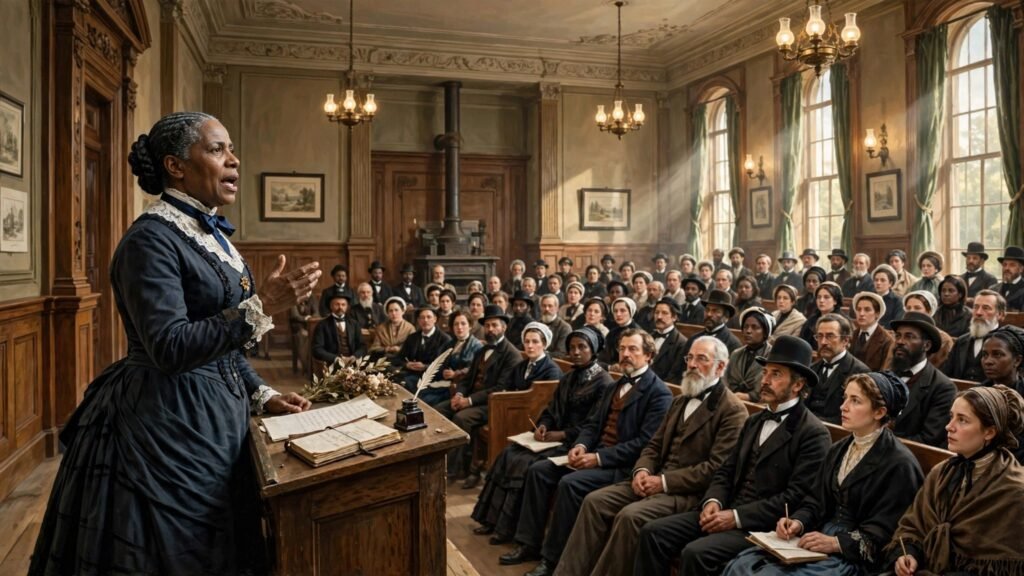
Jane Addams was born into comfort in Cedarville, Illinois, in 1860, the daughter of a successful mill owner and a state senator. She could have lived a quiet, respectable life of privilege. Instead, she chose to move into one of the poorest neighbourhoods in Chicago, live among immigrants who spoke languages she did not know, and spend the next forty-six years fighting poverty, ignorance and war. By the time she died in 1935, she had founded the most famous settlement house in the world, helped create the profession of social work, and become the first American woman to win the Nobel Peace Prize.
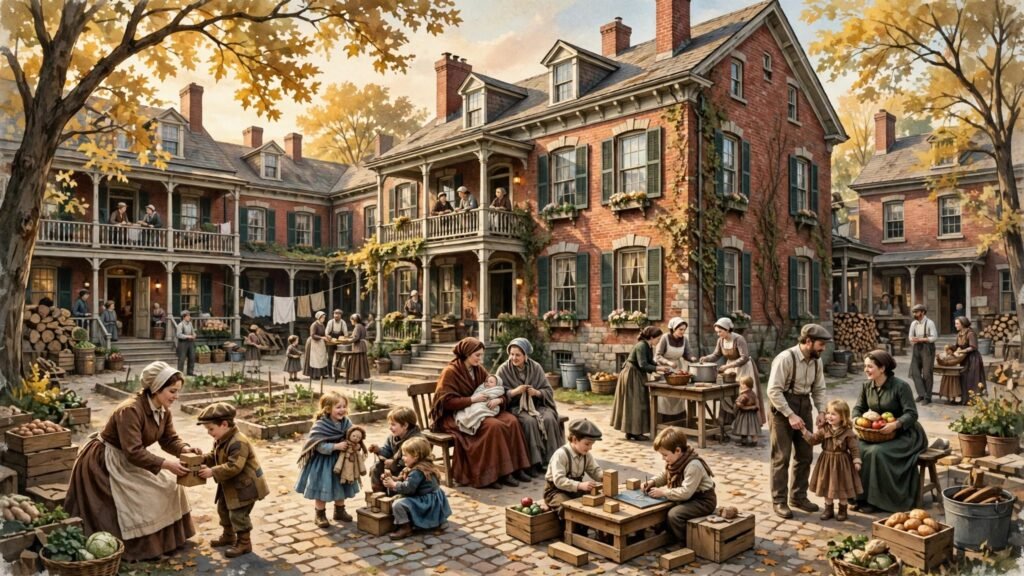
Her story is not one of sudden fame or a single dramatic breakthrough. It is a story of steady, stubborn service. Addams believed that democracy was not just a system of voting but a way of living — that rich and poor, native-born and immigrant, could learn from each other if they simply lived side by side. That belief became Hull House, a settlement on Halsted Street in Chicago that offered kindergartens, clinics, libraries, art classes, a kitchen, a theatre and a home to thousands of people. It also became a laboratory for reform, where careful research into the lives of the poor changed laws on child labour, factory safety and public health.
On Face Zem, we tell the stories of people who turned a vision into something real. Jane Addams did that without wealth, without political office and without ever holding a title. She did it with patience, courage and an unshakeable faith that ordinary people matter. Her life offers lessons for anyone who wants to make a difference — about starting where you are, listening before you act, and refusing to give up when the work gets hard.
Key takeaways
- Jane Addams founded Hull House in Chicago in 1889, one of the first settlement houses in America.
- She helped create the profession of social work and used careful research to change laws on child labour and public health.
- She was a leading voice for peace and women’s suffrage, and co-founded the Women’s International League for Peace and Freedom.
- In 1931 she became the first American woman to receive the Nobel Peace Prize.
- Her lesson for us: real change begins by living among the people you want to help, not above them.
Jane Addams at a Glance
| Fact | Detail |
|---|---|
| Full name | Laura Jane Addams |
| Born | 6 September 1860, Cedarville, Illinois, United States |
| Died | 21 May 1935, Chicago, Illinois (aged 74) |
| Best known for | Founding Hull House settlement in Chicago |
| Profession | Social worker, reformer, author, peace activist |
| Education | Rockford Female Seminary (now Rockford University) |
| Key partner | Ellen Gates Starr, co-founder of Hull House |
| Major honour | Nobel Peace Prize, 1931 — first American woman to win it |
| Other work | Women’s suffrage, child labour reform, public health, peace movement |
| Legacy | Considered the founder of modern social work in America |
1. A Childhood Shaped by Loss
Jane Addams was the eighth of nine children born to John Huy Addams, a prosperous mill owner and Illinois state senator, and Sarah Weber Addams. Her mother died when Jane was only two years old, a loss that marked her deeply. Her father, a friend of Abraham Lincoln, raised her with a strong sense of duty and public service. He believed that wealth carried responsibility, and he expected his children to use their advantages for the good of others.
As a child, Jane suffered from a spinal condition that left her with a curved back and a limp. She was often ill and spent long hours reading. Books became her refuge — and her education. She read widely in history, literature and philosophy, and she developed an early interest in the lives of people very different from herself. Even as a girl, she was troubled by the poverty she saw in the mill town where her father did business.
Her father’s example mattered enormously. He was a man who believed in abolition, in education and in honest government. When he died in 1881, Jane was twenty-one and adrift. She had graduated from Rockford Female Seminary, one of the first institutions of higher learning for women in America, but she had no clear purpose. The next eight years of her life were a long search for one.
2. The Long Search for a Purpose
After graduation, Addams did what many well-educated young women of her time did: she travelled in Europe, studied medicine briefly and then abandoned it, and struggled with depression and poor health. She felt useless. She had an education and an inheritance, but no way to use them that felt meaningful. She later described these years as a time of “moral restlessness” — she knew she wanted to serve others, but she did not know how.
The turning point came during a second trip to Europe in 1887–1888. In London, she visited Toynbee Hall, a settlement house in the East End where educated young people lived among the poor and offered education and help. The idea struck her like lightning. Here was a way to combine her education with direct service — to live among the poor, not as a visitor, but as a neighbour.
She returned to America with a plan and a partner. Her friend Ellen Gates Starr, whom she had met at Rockford, shared her vision. Together they would open a settlement house in Chicago, the fastest-growing city in America, where immigrants from all over Europe were pouring in to work in the stockyards and factories. In September 1889, they moved into a large, rundown house on Halsted Street — Hull House.
3. Hull House: A Home in the Slums
Hull House was named after Charles Hull, who had built the house in 1856. It stood in the Nineteenth Ward, one of the poorest and most crowded districts in Chicago, home to Italian, Irish, German, Jewish, Greek and Polish immigrants. The house itself was large and solid, but the neighbourhood around it was a maze of tenements, saloons and sweatshops.
Addams and Starr did not arrive with a grand plan. They arrived with an open door. They began by offering what the neighbours said they needed: a kindergarten for children whose mothers worked in factories, a reading room, a kitchen where women could learn to cook nutritious food cheaply, and a place where people could simply gather. Within a year, Hull House was running a day nursery, a dispensary, a library and a club for working girls.
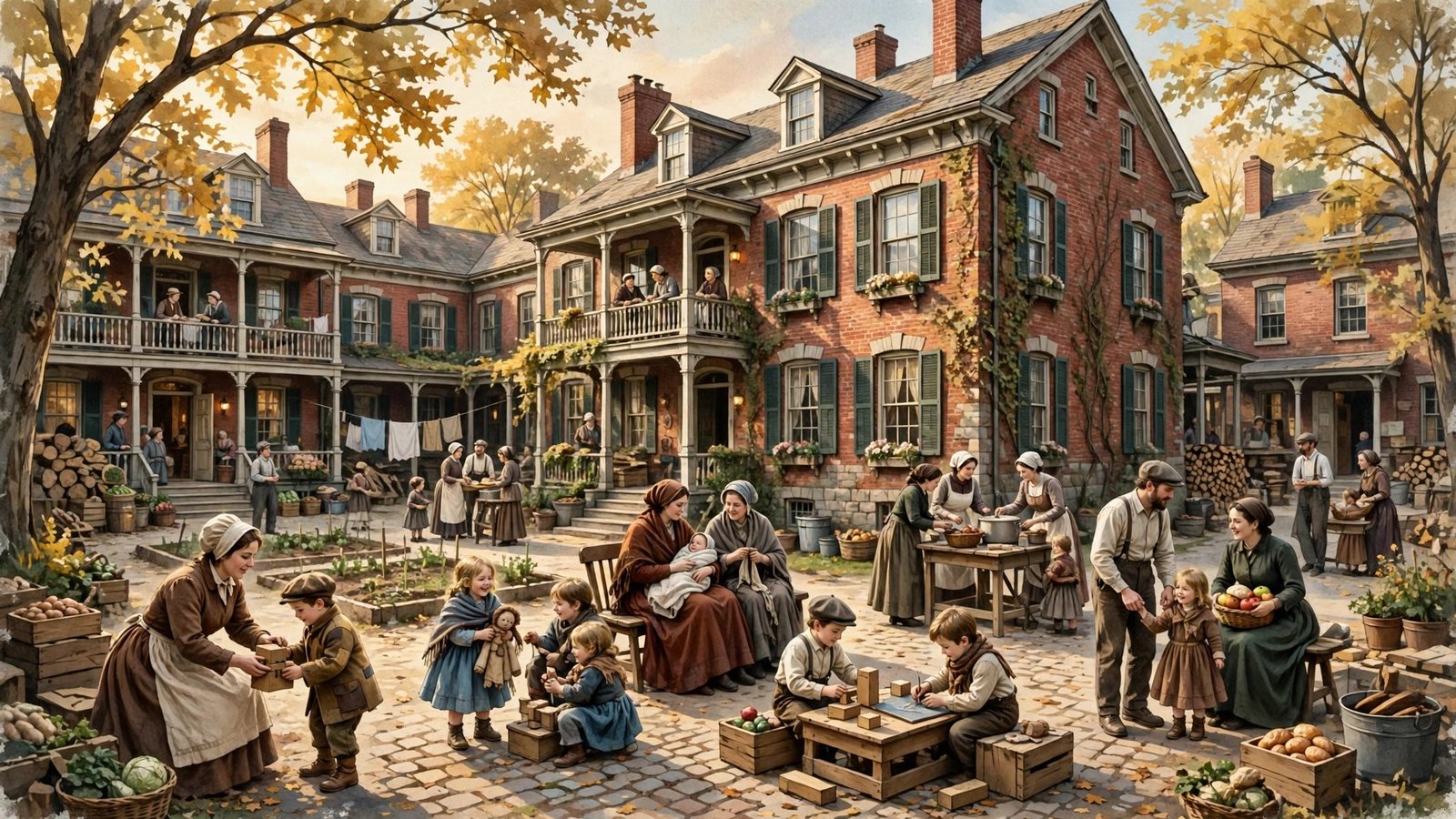
The settlement grew quickly. By the turn of the century, Hull House occupied thirteen buildings and served thousands of people every week. It offered art classes, a theatre, a music school, a gymnasium, a public bath, a coffee house and a labour museum. It was, in Addams’s words, “a place where the best that the past has to offer might be made available to the poorest of the present.” And it was run not from above, but from within — Addams lived there for the rest of her life.
4. Listening Before Acting
What made Hull House different was Addams’s method. She believed that reformers failed when they arrived with ready-made answers. Her rule was to listen first. She spent hours in the kitchens and workshops of her neighbours, learning how they lived, what they feared and what they wanted. She learned Italian and German phrases, attended weddings and funerals, and sat with families in sickness and in grief.
This approach shaped everything Hull House did. When mothers said they needed childcare, Hull House opened a kindergarten. When workers said they were being poisoned by their jobs, Hull House investigated the factories. When immigrants said they were being cheated by landlords and employers, Hull House offered legal help. The settlement was not a charity handing down favours; it was a partnership between equals.
Addams wrote about this philosophy in her famous book Twenty Years at Hull-House (1910). She argued that the rich needed the poor as much as the poor needed the rich — that democracy depended on people of different classes actually knowing each other. It was a radical idea in an age of rigid class divisions, and it remains radical today.
5. Research That Changed Laws
Hull House was not only a place of service; it was a centre of research. Addams and her colleagues — including the pioneering sociologists Florence Kelley and Julia Lathrop — carried out careful studies of wages, working hours, housing conditions and disease in the neighbourhood. They mapped the district house by house, recording the nationality, income and living conditions of every family.
The results were shocking and they were published. Hull-House Maps and Papers (1895) showed that families in the Nineteenth Ward lived on wages that could not feed them, in rooms without light or air, and that children as young as seven worked in factories. The research gave reformers facts they could take to the legislature — and it worked.
Addams used this evidence to campaign for laws limiting child labour, improving factory inspection, and protecting women workers. She served on the Chicago Board of Health and pushed for better garbage collection, clean water and public baths. She was appointed a garbage inspector for her own ward — a job she took seriously, riding through the streets at dawn to make sure the alleys were cleaned. Her work helped to make Chicago, and then America, take public health seriously.
6. The Fight Against Child Labour
Few causes mattered more to Addams than the plight of working children. In the Chicago of the 1890s, children worked in glass factories, canneries and sweatshops, often for twelve hours a day. Many were injured; many never went to school. Addams saw them every day at Hull House — tired, thin, and old before their time.
She became one of the leading voices for child labour reform in America. Working with Florence Kelley, who became the chief factory inspector of Illinois, she helped to pass the Illinois Factory Act of 1893, which limited the working hours of women and children and required factory inspection. It was one of the first such laws in the United States.
The fight was not easy. Factory owners resisted, courts struck down laws, and progress was slow. But Addams never stopped. She helped to found the National Child Labor Committee in 1904, and she supported the creation of the first juvenile court in America, in Chicago in 1899 — a court that treated children as children, not as small adults. Her work laid the foundations for the child labour laws we take for granted today.
7. A Voice for Women’s Rights
Addams was also a leader in the fight for women’s suffrage. She believed that women, who ran the homes and raised the children of the city, had a right to a say in how the city was governed. She argued that the vote was not a privilege but a tool — a way for women to protect their families from bad housing, dirty water and dangerous work.
She served as vice-president of the National American Woman Suffrage Association and campaigned across the country for the vote. In 1912, she seconded the nomination of Theodore Roosevelt for president at the Progressive Party convention — the first time a woman had played such a prominent role at a national political convention. Her support helped to make women’s suffrage a mainstream political issue.
When the Nineteenth Amendment was ratified in 1920, giving American women the right to vote, Addams was sixty years old. She had spent half her life working for it. She celebrated, but she also warned that the vote was only a beginning — that women would need to use it to fight for the poor, the sick and the powerless.
8. The Lonely Stand for Peace
Addams’s greatest test came with the First World War. When war broke out in Europe in 1914, she became one of America’s leading voices for peace. She helped to found the Woman’s Peace Party in 1915 and travelled to Europe as part of a delegation of women who tried, without success, to bring the warring nations to the negotiating table.
When America entered the war in 1917, her stand became deeply unpopular. She opposed the war even as her country embraced it, and she was denounced as unpatriotic, even as a traitor. Newspapers attacked her. The Daughters of the American Revolution expelled her. Former friends turned away. It was the loneliest period of her life.
But she did not retreat. She argued that war solved nothing and that the only lasting peace would come from justice and understanding between nations. After the war, she helped to found the Women’s International League for Peace and Freedom, an organisation that still exists today. Her courage in those years cost her dearly in reputation — but it also earned her, in time, the world’s highest honour for peace.
9. The Nobel Peace Prize
In 1931, Jane Addams was awarded the Nobel Peace Prize, sharing it with the American educator Nicholas Murray Butler. She was the first American woman to receive the prize, and only the second woman ever to win it. The citation honoured her lifelong work for peace, for social justice and for the welfare of the poor.
She was too ill to travel to Oslo to accept the prize in person — she had suffered a heart attack earlier that year. The award was accepted on her behalf, and she received the medal at home in Chicago. She used the prize money to support Hull House and the Women’s International League for Peace and Freedom.
The prize was a vindication. The woman who had been called a traitor in 1917 was now honoured by the world as a peacemaker. Addams herself was characteristically modest about it. She said that the prize belonged not to her but to the movement — to the thousands of women and men who had worked for peace and justice alongside her.
10. The Founder of Social Work
Jane Addams is often called the founder of modern social work, and the title is well earned. Before Hull House, charity in America was mostly about giving money to the poor. Addams showed that real help required something different: living among people, studying their problems scientifically, and working with them to change the conditions that made them poor.
She trained a generation of social workers. Young women and men came to Hull House from all over America and the world to learn her methods, and they carried them back to their own cities. The settlement house movement spread across the country, and the profession of social work grew out of it. The first schools of social work in America were founded by her colleagues and students.
Her books — Democracy and Social Ethics (1902), Twenty Years at Hull-House (1910) and The Second Twenty Years at Hull-House (1930) — remain classics of American social thought. They are still read by students of sociology, history and public policy, and they still challenge us to think about what democracy really means.
11. Her Final Years
In her last years, Addams’s health declined. She suffered from heart trouble and was often confined to her rooms at Hull House, but she continued to work — writing, advising and receiving the stream of visitors who came to see her. She remained the head resident of Hull House until her death, and the settlement was her home for forty-six years.
She died on 21 May 1935, at the age of seventy-four. Her funeral was held at Hull House, and thousands of people — immigrants, workers, students, reformers — came to pay their respects. She was buried in the family cemetery in Cedarville, Illinois, beside her father.
Hull House continued after her death, and the settlement house movement she started went on to shape American life in countless ways. The Jane Addams Hull-House Museum in Chicago preserves her home and tells her story to new generations. Her papers, her books and her example continue to inspire social workers, activists and ordinary people who believe that one person can make a difference.
12. Lessons from Jane Addams’s Life
The first lesson of Jane Addams’s life is to start where you are. She did not wait for a grand opportunity or a perfect plan. She moved into a poor neighbourhood, opened her door, and began with the needs in front of her. Small beginnings, faithfully pursued, became a movement that changed a nation.
The second lesson is to listen before you act. Addams’s greatest strength was not her ideas but her attention. She listened to the people she served, and she let their needs shape her work. That is why Hull House succeeded where so many charities failed — it was built on respect, not pity.
The third lesson is courage. Addams stood for peace when it cost her friends, her reputation and her standing. She stood for the poor when it was unfashionable, and for women when they had no vote. She teaches us that doing the right thing is rarely the easy thing — and that it is worth doing anyway.
Checklist: Lessons You Can Use from Jane Addams
- Start where you are — you do not need wealth or power to help, only willingness.
- Listen before you act — understand people’s real needs instead of guessing them.
- Live among the problem, not above it — closeness builds trust and understanding.
- Use facts, not feelings — careful research turns good intentions into real change.
- Work with others — Addams built Hull House with partners, and movements need teams.
- Stand by your principles — even when it costs you, as her stand for peace did.
Frequently Asked Questions
Who was Jane Addams?
Jane Addams (1860–1935) was an American social worker, reformer and peace activist who founded Hull House in Chicago in 1889 and won the Nobel Peace Prize in 1931. She is considered the founder of modern social work in America.
What was Hull House?
Hull House was a settlement house in a poor immigrant neighbourhood of Chicago. It offered kindergartens, clinics, libraries, art and music classes, a theatre and legal help, and it served thousands of people every week. Addams lived there for forty-six years.
Why did Jane Addams win the Nobel Peace Prize?
She won the Nobel Peace Prize in 1931 for her lifelong work for peace and social justice. She had opposed the First World War, co-founded the Women’s International League for Peace and Freedom, and spent decades campaigning for a just and lasting peace.
What did Jane Addams do for children?
She was a leading campaigner against child labour. She helped to pass the Illinois Factory Act of 1893, supported the first juvenile court in America, and helped to found the National Child Labor Committee. Her work laid the foundations for modern child labour laws.
Was Jane Addams the first American woman to win the Nobel Peace Prize?
Yes. When she received the prize in 1931, she was the first American woman to do so, and only the second woman ever to win the Nobel Peace Prize.
Where can I learn more about Jane Addams?
The Jane Addams Hull-House Museum in Chicago preserves her home and tells her story. Her books, including Twenty Years at Hull-House, are still in print and widely read. On Face Zem, you can also read the success stories of other reformers, including Clara Barton, Florence Nightingale and Helen Keller.
Bottom line
Jane Addams turned a life of privilege into a life of service, and in doing so she changed America. Hull House showed that the poor did not need pity — they needed neighbours, education and justice. Her research changed laws, her courage changed minds, and her example created a profession. She was called a traitor for standing against war, and then honoured by the world as a peacemaker. Her life proves that one person, working steadily and without fanfare, can leave a mark that lasts for generations.
Note: This article is a general historical account of Jane Addams’s life and work, written for Face Zem. Dates and facts are drawn from the public historical record.

Keep what speaks to you.
Leave room for your own perspective.