

It was nearly 11 p.m., and a student was still staring at the same page of chemistry notes. The exam was the next morning. Nothing seemed to stay in his head. Then his cousin sent him one of those motivational stories with morals. It was about a person who stopped digging for gold just before reaching more of it. He read it in less than five minutes. It didn’t magically teach him chemistry. But it changed what he did next.
Instead of thinking, “I can’t finish this,” he picked one chapter, set a 20-minute timer, and started.
Sometimes that’s what a good story does. It doesn’t solve your problem. It helps you look at the problem differently.
Below you’ll find 15 short motivational stories with morals. They’re grouped around situations you may actually recognize: wanting to quit, feeling behind in school, comparing yourself with others, or simply needing a small push.
I’ve also labeled each story as a fable, folk tale, parable, literary story, or documented true story where the origin can reasonably be identified. That matters because a powerful lesson doesn’t need a fake history behind it.
AI Overview: What Are Motivational Stories With Morals?
A motivational story with a moral is a short narrative showing a character facing a problem, making a key choice, and experiencing the clear result. These stories make complex life lessons easier to visualize because you mentally place yourself inside the scenario instead of just receiving abstract advice. Psychological research on narrative transportation shows that becoming absorbed in a story directly changes how you evaluate your own real-world challenges.
Key Takeaways
- You’ll find 15 short stories, most of them readable in a few minutes.
- Each story is labeled by origin, such as fable, folk tale, parable, literary story, or true story.
- Every story has a simple moral rather than leaving you to guess the intended lesson.
- The stories are grouped around real situations such as quitting, exam fear, comparison, patience, and honesty.
- Age guidance is included where it helps parents, teachers, and students choose a suitable story.
- The final 7-Day Story Challenge turns the lessons into small actions you can actually try.
What Is a Motivational Story With a Moral?
A short motivational story with a moral is a brief tale about a person who faces a problem, makes a choice, and sees what happens next. It ends with a simple lesson. These short stories like fables, parables, and real events can help you look at your own setbacks in a new way, calm exam nerves, and start working on hard goals right away.
Short Motivational Stories With Morals When You Feel Like Quitting
Sometimes you don’t need a speech about success. You need a reason to take the next step. These five stories are useful when you’ve started something, lost confidence, or feel tempted to stop.
1. Three Feet From Gold

Origin: Literary success story in Napoleon Hill’s Think and Grow Rich (1937)
Type: Motivational anecdote/allegory
Best for: Teens and adults
A prospector in Colorado discovered a rich vein of gold ore and bought heavy machinery to extract it. Everything started smoothly, but the gold suddenly disappeared when the vein ran out. He kept digging deeper out of sheer frustration, but his efforts yielded nothing.
Eventually, he gave up, sold his machinery to a local junk dealer for a fraction of its cost, and walked away. The junk dealer immediately hired a mining engineer to examine the geological formations inside the mine.
The engineer discovered that the gold vein had merely shifted due to a natural geological fault line. The precious metal sat exactly three feet from where the original prospector had stopped digging.
Moral: A short setback does not mean your goal is impossible.
Try this Today: Spend ten minutes thinking of another plan before you quit a hard task.
Age: 13+
2. The Chinese Bamboo Story

Origin: Modern motivational parable; exact traditional origin is uncertain
Type: Parable
Best for: Students, parents, adults
A farmer plants bamboo. For a long time, almost nothing seems to happen. He waters the ground and keeps caring for it, but there is little visible growth.
Years pass.
Then, in the familiar modern version of the story, the bamboo suddenly shoots upward. The lesson is usually described as hidden growth: work can be happening before you can see the result.
There is an important catch. The popular “five years underground, then rapid growth” version is widely repeated online, but it isn’t a securely documented ancient Chinese tale. Treat it as a modern motivational parable, not as a precise botanical fact or historical Chinese story.
That doesn’t make the lesson useless.
It simply means we should separate the lesson from the claim about its origin.
Moral: Lack of visible progress doesn’t always mean lack of progress.
Try this today: Choose one goal and record one tiny action you will repeat for the next seven days.
Age: 10+
3. The Star Thrower

Origin: Loren Eiseley’s essay “The Star Thrower,” published in The Unexpected Universe in 1969
Type: Literary story
Best for: Teens and adults
A man walks along a beach and sees someone throwing stranded starfish back into the sea. There are far too many starfish on the shore. The scale of the problem makes the man’s effort look almost pointless.
But the person keeps picking them up, one by one. The question underneath the story is simple: if you can’t save everything, is it still worth helping one?
Eiseley’s original work is more complicated than the short motivational version usually shared online. It isn’t simply a cute story about throwing starfish.
But its central image has lasted because it gives a useful answer to a familiar feeling: “My effort is too small to matter.” You don’t always need to solve the whole problem. Sometimes you need to help the part that is directly in front of you.
Moral: Limited impact is still impact.
Try this today: Find one small part of a problem you can actually improve and do only that.
Age: 12+
4. The Cracked Pot

Origin: Traditional folk tale; exact origin is uncertain
Type: Folk tale/parable
Best for: Children, teens, adults
A water bearer carries two pots from a stream to his master’s home.
One pot is perfect. The other has a crack. Every day, the cracked pot loses some water before reaching the house. After years of this, it feels ashamed. It believes it has failed at the job it was made to do.
Then the water bearer points to the path. Flowers are growing along the cracked pot’s side. He had planted seeds there because he knew the leaking water would keep them alive. The story is often described as an Indian tale, but its exact origin is uncertain and versions appear under different cultural labels. That’s worth saying clearly.
Its useful point isn’t that every flaw is secretly wonderful. Sometimes a flaw really does cause problems. The better lesson is that a weakness doesn’t tell the whole story of your usefulness.
Moral: Don’t judge your entire value by one thing you struggle to do well.
Try this today: Write down one weakness and beside it write one situation where your other qualities help.
Age: 7+
5. The Tortoise and the Hare

Origin: Aesop’s fable tradition
Type: Fable
Best for: Children, students, adults
The hare laughs at the tortoise for being slow.
So they race. The hare quickly disappears ahead. Feeling certain that victory is already his, he lies down and falls asleep. The tortoise doesn’t become faster. He simply keeps moving. By the time the hare wakes up, the tortoise is close to the finish line. The hare runs hard, but it is too late.
The Library of Congress Aesop collection gives the familiar lesson plainly: speed isn’t always enough to win a race.
This isn’t a scientific argument that slow people always beat fast people.
It’s a story about consistency and overconfidence.
Moral: Steady effort can beat talent when talent stops paying attention.
Try this today: Work on one important goal for 15 uninterrupted minutes instead of waiting for motivation.
Age: 6+
Motivational Stories for Students With Moral Lessons
School brings its own kind of pressure. You can understand a lesson and still fear the exam. You can study hard and still compare yourself with someone who seems ahead. These four stories work well for classrooms, study groups, or a student who needs a reset.
6. The Boy and the Nettle

Origin: Aesop’s fable tradition
Type: Fable
Best for: Students 7+
A boy touches a nettle and gets stung.
He runs home crying.
His mother tells him that next time he should not approach the nettle timidly. He needs to handle the problem properly rather than making half an effort. The original fable’s moral is about putting strength and care into what you do.
For a student, that doesn’t mean studying until exhaustion. It means replacing vague fear with a specific task.
“I’m bad at math” is a feeling.
“I’m going to solve five algebra problems before dinner” is a plan.
Moral: Fear becomes easier to handle when you turn it into a specific action.
Study habit: Before studying, write one measurable task.
Teacher use: Use this before a lesson where students say, “I can’t do this.”
7. The Wolf and the House Dog

Origin: Aesop’s fable tradition
Type: Fable
Best for: Teens 10+
A hungry wolf meets a well-fed house dog. The dog tells him that life could be easier if the wolf came to live with people.
There would be food. There would be shelter. There would be comfort.
Then the wolf notices a mark around the dog’s neck.
It’s from a collar. The wolf realizes that the comfortable life comes with a loss of freedom. He walks away.
For students, this story can open a useful conversation about comparison. Someone else’s life may look easier because you’re only seeing the visible part.
You don’t know the price attached to it.
Moral: Don’t compare your whole life with the small part of someone else’s life you can see.
Study habit: Compare today’s work with yesterday’s work, not your marks with another student’s marks.
Teacher use: Good for discussions about social media, competition, and peer pressure.
8. The Ant and the Grasshopper

Origin: Aesop’s fable tradition
Type: Fable
Best for: Students 7+
During warm weather, the grasshopper spends his time singing.
The ant keeps working and storing food.
When winter arrives, the grasshopper has nothing prepared.
The old fable is simple, but its message still works for studying: future pressure often becomes smaller when you prepare before it arrives.
There is another side, too.
Don’t turn the story into “work every minute or you’re lazy.” Rest matters. Play matters. A student’s life shouldn’t become a permanent exam.
The useful lesson is preparation, not punishment.
Moral: Small preparation today can protect you from bigger stress later.
Study habit: Review for 15 minutes on the same day you learn something instead of waiting for exam week.
Teacher use: Use it when introducing revision plans or long-term assignments.
9. The Shepherd Boy and the Wolf

Origin: Aesop’s fable tradition
Type: Fable
Best for: Students 8+
A bored shepherd boy repeatedly tricks villagers by shouting that a wolf is attacking the sheep.
Each time, the villagers rush to help. Each time, there is no wolf.
Then a wolf really appears. The boy shouts for help, but nobody believes him. The Library of Congress Aesop fable archive preserves this familiar story with the lesson that repeated lying destroys trust.
For students, honesty isn’t only about avoiding punishment. It’s about protecting something you need every day: credibility. Once people stop trusting your words, even the truth becomes harder for them to recognize.
Moral: Trust takes time to build and very little time to damage.
Study habit: If you didn’t finish an assignment, say so honestly instead of inventing an excuse.
Teacher use: Use this when discussing academic honesty, excuses, or classroom trust.
Short Moral Stories for Kids and Teens
The best story for a child isn’t necessarily the most complicated one.
A six-year-old doesn’t need a lecture about resilience. Give them a character, a problem, and a choice.
Then let them think.
10. The Lion and the Mouse
 ss
Origin: Aesop’s fable tradition
Type: Fable
Best for: Ages 6+
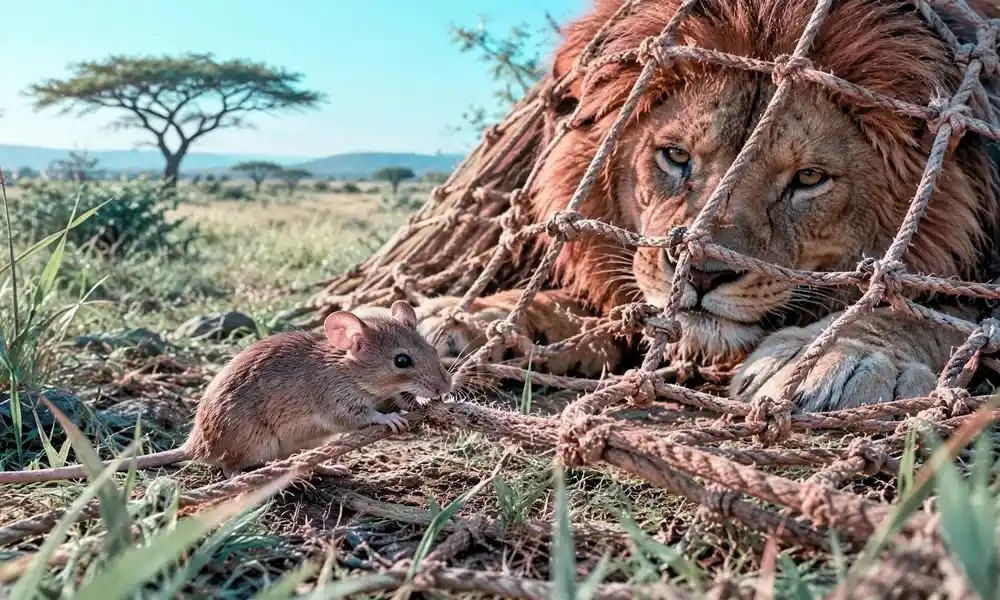
A lion catches a tiny mouse who begs to be released. The lion laughs at the idea that such a small creature could ever help him, but he lets the mouse go anyway.
Later, hunters trap the lion in a net.
The mouse hears him struggling and begins chewing through the ropes.
The lion is freed. The small animal wasn’t powerful in the same way as the lion.
It simply had a skill the lion didn’t have.
Moral: Never assume someone is unimportant because they are small.
Try this today: Ask a child to name one way they helped someone recently.
Reading tip: Stop before the rescue and ask, “What do you think the mouse can do?”
11. The Bundle of Sticks

Origin: Aesop’s fable tradition
Type: Fable
Best for: Ages 6+
An old father worries about his arguing sons.
He gives them a bundle of sticks and asks them to break it.
They try. They can’t.
Then he separates the sticks and gives them one at a time.
Each stick breaks easily.
The lesson is simple enough for a child to understand: together, people can sometimes handle pressure that would defeat them alone. But don’t make the lesson only about “always agree.”
Teams still need honesty, boundaries, and good decisions.
Moral: Cooperation can make difficult problems easier to handle.
Try this today: Give a child one small household task to complete with another person.
Reading tip: Let the child physically hold a few pencils or sticks and test the idea safely.
12. The Fox and the Grapes

Origin: Aesop’s fable tradition
Type: Fable
Best for: Ages 7+
A fox sees grapes hanging high above him.
He jumps. He misses. He jumps again. Still nothing.
Eventually, he walks away and says the grapes probably weren’t worth eating anyway. That’s a funny ending because many people do the same thing in quieter ways.
We fail at something, then suddenly decide we never wanted it. Sometimes that protects our pride. It also keeps us from learning.
Moral: Don’t turn disappointment into an excuse to pretend you never cared.
Try this today: When a child says, “I don’t want it anyway,” ask gently, “Did you really not want it, or were you disappointed?”
Reading tip: Pause before the final line and let the child invent the ending.
True Motivational Stories With Morals
Real motivational stories can be powerful, but they deserve a different label. A true story is not a fable with a famous person’s name added to it. The three examples below have documented dates and records behind their central events.
13. Malala Yousafzai: Keep Going After the Worst Day

Origin: Documented true story
Key dates: 2012 and 2014
Best for: Teens and adults
Malala Yousafzai spoke publicly about girls’ education while living in Pakistan’s Swat Valley.
In October 2012, a Taliban gunman shot her on her way home from school. She survived.
After surgery and rehabilitation in Birmingham, she continued speaking for children’s right to education rather than quietly leaving the issue behind. In 2014, she received the Nobel Peace Prize jointly with Kailash Satyarthi.
She was 17. The point isn’t that courage means never feeling afraid.
Her story shows something more difficult: a person can experience serious harm and still decide that the cause matters enough to continue.
Moral: A painful setback can change your path without having to end your purpose.
Try this today: Write down one thing you still care about, even though progress has been difficult.
Fact-check: Malala’s attack, recovery, activism, and award details are documented in the official Nobel Peace Prize records and the Malala Fund.
14. Terry Fox: The Run That Had to Stop

Origin: Documented true story
Key dates: 1980–1981
Best for: Teens and adults
Terry Fox lost his right leg to bone cancer at 18.
In 1980, at age 22, he began the Marathon of Hope, running across Canada to raise money for cancer research.
He ran with an artificial leg. For 143 days, he covered thousands of kilometres. His goal was to reach the Pacific Ocean.
He didn’t. On September 1, 1980, after running 5,373 kilometres, cancer that had spread to his lungs forced him to stop. This is where the story becomes more useful than the usual “never give up” slogan.
Terry Fox did stop.
His body had reached a limit.
But the goal continued. According to Terry Fox Foundation historical records, his dream of raising one dollar for every Canadian was reached in February 1981, when the fund totaled $24.17 million.
Moral: Success isn’t always finishing the original plan; sometimes it’s moving the purpose forward after the plan changes.
Try this today: Ask yourself whether the goal matters more than the exact way you first planned to reach it.
Fact-check: The dates, distance, medical history, and Marathon of Hope records are documented by the Terry Fox Foundation.
15. Tanni Grey-Thompson: Build Skill, Not Just Confidence

Origin: Documented true story
Key dates: 1988–2004
Best for: Students, athletes, adults
Tanni Grey-Thompson became one of Britain’s most decorated Paralympic athletes.
Her wheelchair-racing career covered five Paralympic Games, from Seoul in 1988 to Athens in 2004.
Across those Games, she won 16 medals: 11 gold, four silver, and one bronze.
That sounds like a finished success story.
But her own account is more practical.
She has described taking time to find the sport she wanted to concentrate on. By age 13, she had chosen wheelchair racing.
The lesson isn’t “believe in yourself and everything works out.”
It’s more useful than that.
Find something worth getting better at, then build the skill.
Moral: Confidence grows stronger when it is backed by practice.
Try this today: Pick one skill and spend 20 minutes practicing it instead of thinking about whether you’re talented.
Fact-check: The Paralympic Games records and her 16-medal career are documented by the International Paralympic Committee.
Fact-Check Box: Famous Motivational Stories Aren’t Always True

This is one place where motivational content often goes wrong.
A story becomes popular because it sounds perfect. Someone fails spectacularly, works harder, succeeds, and then gives us a neat lesson.
Real life is usually messier.
Take the famous story that Michael Jordan was “cut” from his high school basketball team. The basic disappointment is real: as a sophomore at Laney High School, he did not make the varsity squad and played junior varsity instead. But former school staff and a detailed ESPN investigation have challenged the dramatic version that he was simply cut from the team.
Another common example is Albert Einstein supposedly failing mathematics at school. His school record shows strong mathematics and physics performance; the popular story confuses different parts of his education and grading systems. [ABC Science; HISTORY]
That doesn’t mean these stories are useless.
It means the lesson should survive without the myth.
Documented fact: Something supported by reliable records or first-hand documentation.
Reported claim: A reputable source reports it, but the underlying evidence may be limited.
Disputed story: Important parts of the popular version are challenged by available evidence.
Fable or folk tale: A traditional story whose value doesn’t depend on it being historical fact.
That’s a much healthier way to read motivational stories.
How to Tell a Motivational Story So the Moral Sticks
A good story doesn’t need a dramatic voice.
It needs a clear problem. Research by Melanie Green and Timothy Brock in 2000 examined “transportation,” which they described as becoming absorbed in a narrative through attention, imagery, and emotion. Their experiments found that greater transportation was associated with stronger story-consistent beliefs and evaluations. [Green & Brock, 2000]
For a parent or teacher, the practical lesson is simple: don’t rush through the story just to reach the moral.
Try these five steps.
1. Pick one moral
Don’t teach five lessons from one three-minute story.
Choose one.
For example: “Small effort still matters.”
2. Set the scene in two lines
Give the listener enough information to picture the problem.
“A boy had an exam tomorrow. He was sitting at his desk at 10 p.m. and wanted to give up.”
That’s enough.
3. Keep the turn short
The important moment should be easy to see. The character makes a choice.
Something changes.
Move on.
4. Say the moral in your own words
Don’t hide behind a formal sentence.
Instead of “Persistence is a fundamental prerequisite for achievement,” say:
“Keep going when the next step is still worth taking.”
5. Ask one question
This is especially useful with children.
Try:
“What would you do?”
Research on children’s moral learning also suggests that simply hearing a story isn’t the whole process. Asking children to explain what happened and why can help them move from the surface events toward the underlying moral. A 2017 study found that explanation prompts helped 5- and 6-year-olds identify and generalize a story’s moral. More recent findings published in a Child Development journal study on moral reasoning confirm the benefits of discussing narrative fiction with children.
So don’t end every story with a lecture.
Sometimes end it with a question.
Common Mistakes With Moral Stories
Preaching the moral too hard
If you explain the same lesson five different ways, the story starts feeling like homework. Give the reader enough space to think.
Sharing disputed facts as history
A story can be inspirational without being true.
Say “Aesop’s fable” when it’s a fable.
Say “modern motivational parable” when the origin is unclear.
Don’t turn an internet anecdote into a historical fact because it sounds good.
Using a story to dodge a real problem
A story cannot replace practical help. A student with exam anxiety may need a study plan, sleep, support from a teacher, or professional help depending on the situation. A motivational story can open the conversation. It shouldn’t pretend to solve everything.
Using the wrong age level
A complicated literary story may lose a six-year-old. A very simple fable may feel childish to a university student. Match the story to the listener.
Making every character perfect
Real people hesitate. They make poor choices. They change their minds. Even fictional characters become more believable when the struggle feels real.
Practical Application: The 7-Day Story Challenge

Don’t read all 15 stories and then do nothing.
Pick one story each day.
Spend about five minutes on it.
| Day | Story | One question | Tiny action |
| 1 | Three Feet From Gold | Am I quitting too early? | Try one different approach for 10 minutes. |
| 2 | The Tortoise and the Hare | Where do I need consistency? | Work for 15 focused minutes. |
| 3 | The Wolf and the House Dog | What am I comparing unfairly? | Stop one comparison for a day. |
| 4 | The Ant and the Grasshopper | What can I prepare now? | Review one old lesson for 15 minutes. |
| 5 | The Cracked Pot | What strength am I overlooking? | Write down one useful quality you have. |
| 6 | Malala Yousafzai | What still matters to me? | Take one small step toward it. |
| 7 | Terry Fox | Does my goal need a new route? | Change one part of your plan, not the whole goal. |
The challenge is deliberately small.
You don’t need a new personality by next Monday.
You need one action you can repeat.
Conclusion
Remember the student from the beginning? It was nearly 11 p.m. He was still looking at the same chemistry page and thinking about how much he had left to study.
The story about the gold mine didn’t teach him chemistry.
That wasn’t its job. It gave him a different thought: maybe stopping tonight wasn’t the only option.
So he chose one chapter, put his phone aside, and studied for 20 minutes. The next morning, the exam wasn’t suddenly easy. He still forgot a few things. He still felt nervous when the paper landed on his desk. But he knew he had done something useful instead of spending the whole night telling himself he couldn’t.
That’s the part of motivational stories worth keeping. Not the perfect endings. Not the exaggerated success claims.
Not the idea that every problem disappears if you simply “believe.”
A good story gives you a small shift in perspective. Sometimes that is enough to make the next action possible. And when you’re stuck, the next action is usually more valuable than another hundred words of advice.
Frequently Asked Questions
1. What is the moral of a story?
The moral is the main lesson a story wants the reader to understand. It often comes from the character’s choice and its result. A good moral should be specific enough to guide behavior rather than being a vague phrase such as “be successful.”
2. What are the best motivational stories for students?
Stories about persistence, honesty, preparation, and dealing with comparison usually work well for students. “The Tortoise and the Hare,” “The Ant and the Grasshopper,” and “The Shepherd Boy and the Wolf” are simple enough to discuss in class. Real stories such as Malala Yousafzai’s can also work well with older students when the teacher provides historical context.
3. What is a short motivational story with a moral?
It is a brief story in which a character faces a problem, makes a choice, and experiences a result. The lesson is then stated clearly. “The Tortoise and the Hare” is a classic example because its simple race illustrates the value of steady effort.
4. Are motivational stories true?
Some are true, some are based on traditional stories, and some are fictional motivational parables. That’s why the origin matters. Aesop’s stories are fables, while Malala Yousafzai’s and Terry Fox’s stories are documented historical events.
5. What is the difference between a fable, parable, and moral story?
A fable is usually a short teaching story that may use animals as characters. A parable is an illustrative story used to communicate a lesson, often about human behavior or values. “Moral story” is a broader everyday term that can include fables, folk tales, parables, and other short stories with lessons.
6. How do you write a moral story?
Start with one clear lesson. Create a character who faces a problem connected to that lesson, give the character a meaningful choice, and show the result. Keep the story focused on that one conflict, then state the moral in simple language.
7. How do stories change behavior?
A story can make an idea concrete by giving it characters, choices, emotions, and consequences. Research on narrative transportation suggests that becoming absorbed in a story can influence story-related beliefs. That doesn’t mean one story automatically changes behavior; action usually requires practice, discussion, and a realistic next step.
8. What story teaches perseverance?
“The Tortoise and the Hare” is one of the clearest examples because the tortoise succeeds through steady progress. “Three Feet From Gold” also teaches persistence, although it comes from Napoleon Hill’s motivational writing rather than a verified historical event. Terry Fox’s documented story offers a more complicated real-world lesson: perseverance can continue even when the original plan has to stop.
9. What are good moral stories for adults?
Adults may prefer stories that leave room for interpretation rather than giving an obvious lesson. “The Star Thrower,” “The Cracked Pot,” and Terry Fox’s story can open conversations about purpose, limitations, and persistence. The best choice depends on the problem the reader is facing.
10. How do you teach morals through stories?
Tell the story first and avoid explaining every point while you’re telling it. Afterward, ask one question such as, “What would you have done?” or “Why do you think the character made that choice?” Discussion and explanation can help children connect a story’s specific events with a broader moral.
11. What is a good motivational story for someone who wants to quit?
“The Three Feet From Gold” is useful when someone is considering giving up after a setback. “The Tortoise and the Hare” is better when the problem is inconsistency. For a real historical example, Terry Fox’s story shows that perseverance doesn’t always mean physically completing the original plan; sometimes the larger purpose continues through other people.
12. Can a moral story be useful even if it isn’t true?
Yes. A fable can communicate a useful idea without being historical. The important thing is to label it honestly. Readers don’t need a fictional story to be presented as a true event for its lesson to matter.
{
“@context”: “https://schema.org”,
“@type”: “FAQPage”,
“mainEntity”: [
{
“@type”: “Question”,
“name”: “What is the moral of a story?”,
“acceptedAnswer”: {
“@type”: “Answer”,
“text”: “The moral is the main lesson a story wants the reader to understand. It often comes from the character’s choice and its result. A good moral should be specific enough to guide behavior rather than being a vague phrase such as ‘be successful.'”
}
},
{
“@type”: “Question”,
“name”: “What are the best motivational stories for students?”,
“acceptedAnswer”: {
“@type”: “Answer”,
“text”: “Stories about persistence, honesty, preparation, and dealing with comparison usually work well for students. ‘The Tortoise and the Hare,’ ‘The Ant and the Grasshopper,’ and ‘The Shepherd Boy and the Wolf’ are simple enough to discuss in class.”
}
},
{
“@type”: “Question”,
“name”: “What is a short motivational story with a moral?”,
“acceptedAnswer”: {
“@type”: “Answer”,
“text”: “It is a brief story in which a character faces a problem, makes a choice, and experiences a result. The lesson is then stated clearly. ‘The Tortoise and the Hare’ is a classic example because its simple race illustrates the value of steady effort.”
}
},
{
“@type”: “Question”,
“name”: “Are motivational stories true?”,
“acceptedAnswer”: {
“@type”: “Answer”,
“text”: “Some are true, some are based on traditional stories, and some are fictional motivational parables. That’s why the origin matters. Aesop’s stories are fables, while Malala Yousafzai’s and Terry Fox’s stories are documented historical events.”
}
},
{
“@type”: “Question”,
“name”: “What is the difference between a fable, parable, and moral story?”,
“acceptedAnswer”: {
“@type”: “Answer”,
“text”: “A fable is usually a short teaching story that may use animals as characters. A parable is an illustrative story used to communicate a lesson, often about human behavior or values. ‘Moral story’ is a broader everyday term that can include fables, folk tales, parables, and other short stories with lessons.”
}
},
{
“@type”: “Question”,
“name”: “What story teaches perseverance?”,
“acceptedAnswer”: {
“@type”: “Answer”,
“text”: “‘The Tortoise and the Hare’ is one of the clearest examples because the tortoise succeeds through steady progress. ‘Three Feet From Gold’ also teaches persistence, and Terry Fox’s documented story offers a real-world lesson about continuing a purpose when plans change.”
}
}
]
}