
Key Takeaways
- Jack the Ripper and the Black Dahlia remain famous examples of historic unsolved cases.
- The Zodiac Killer investigation generated letters, forensic work, and a large FBI file, but the killer was never conclusively identified.
- The JonBenét Ramsey murder remains an active investigation, according to Boulder Police.
- The Golden State Killer case shows how newer DNA techniques can solve crimes that remained open for decades.
- A case being “solved” does not always mean every question about it has been answered.
- The safest way to understand true crime is to separate documented evidence from theories and online speculation.
True crime cases are real criminal investigations and legal cases involving actual crimes, victims, suspects, and court outcomes. Some are solved through arrests and convictions, while others remain unsolved for decades.
The cases below focus on famous and important investigations, with clear explanations of what happened, what investigators found, and where each case stands.
True Crime Cases: What Are They?
A true crime case is a real criminal matter investigated by police or other authorities and, when applicable, handled through the courts.
These cases can involve murder, kidnapping, serial offenses, disappearances, fraud, organized crime, or other serious crimes. Some end with a conviction. Others remain open, unresolved, or disputed.
That last point matters.
When you read about a crime online, it is easy to see a suspect’s name repeated so often that the person starts to sound guilty. But a suspect, an arrested person, and a convicted offender are not the same thing.
A good true-crime case summary should tell you what is known, what is alleged, and what remains uncertain.
Famous True Crime Cases

There are thousands of documented criminal cases around the world. A useful list shouldn’t pretend that the six most famous cases are automatically the six most important.
The cases below are included because they show different sides of criminal investigation: unidentified offenders, long-running investigations, major forensic developments, and cases that ended in convictions.
Jack the Ripper Case
Status: Unsolved
In 1888, a series of murders in London’s Whitechapel area were attributed to a killer who became known as Jack the Ripper. The FBI’s historical archive describes the homicides as unsolved and notes that FBI behavioral expert John Douglas later analyzed the case in 1988.
The difficulty with this case is separating the historical record from the legend that grew around it. There were murders. There was a major police investigation. There were suspects and theories. But there is no court-established identity for Jack the Ripper.
That’s why modern claims that a particular person was definitely the killer need to be treated carefully. A theory can be interesting without being proven.
Why the case matters: it became one of the earliest crime investigations to receive enormous public and press attention, and it still shows how difficult an investigation becomes when the evidence is incomplete and decades have passed.
Zodiac Killer Case
Status: Unsolved
The Zodiac case grew out of a series of attacks in Northern California in the late 1960s. The person calling himself “Zodiac” sent letters and coded messages to newspapers, and the FBI’s released files contain extensive investigative and laboratory material connected to those communications.
The letters are one reason this case has stayed in the public imagination. They gave investigators physical material to examine, while also giving the public something to decode and debate.
But that’s exactly where readers need to be careful.
The existence of a letter or a proposed solution to a cipher does not, by itself, prove the identity of the person who sent it. The FBI archive shows the investigation and forensic work; it does not provide a confirmed identification of the killer.
Why the case matters: it is a good example of how physical evidence, communications, public attention, and later theories can become mixed together over many years.
Black Dahlia Murder Case
Status: Unsolved
Elizabeth Short was 22 when she was murdered in Los Angeles in January 1947. The FBI says her body was discovered on January 15, and investigators quickly identified her through fingerprints. The Bureau assisted the Los Angeles Police Department by checking records, interviewing people and investigating possible leads.
One detail is particularly revealing: identifying the victim was much easier than identifying the killer.
The FBI had Short’s fingerprints in its records from earlier encounters, which allowed authorities to establish who she was. Investigators also examined fingerprints associated with an anonymous letter, but the prints did not match records in the FBI’s files.
The murderer was never found.
The case is still listed by the FBI among its historic major cases, and the Bureau describes the murder as unsolved.
Why the case matters: it shows that solving a homicide requires more than identifying the victim. Investigators also need reliable evidence connecting a person to the crime.
JonBenét Ramsey Case
Status: Ongoing investigation
JonBenét Ramsey was six years old when she was reported missing from her Boulder, Colorado, home on December 26, 1996. She was later found dead inside the house, and her death was ruled a homicide.
This is one case where the current status really matters.
Boulder Police says the investigation remains active. Its current case page says detectives have followed more than 21,016 tips, letters and emails and have spoken with more than 1,000 people in connection with the crime. Police also say they continue to work with DNA experts and law-enforcement partners.
The department’s 2025 update also says investigators conducted new interviews, collected new evidence, and tested and retested evidence as DNA technology developed.
So it would be misleading to describe the case simply as an old mystery that police stopped investigating.
It remains an open homicide investigation.
Why the case matters: it demonstrates why old cases shouldn’t automatically be treated as closed. New laboratory methods can give investigators another opportunity to examine evidence.
Ted Bundy Murder Cases
Status: Solved/convicted for multiple murders
Ted Bundy’s case is very different from Jack the Ripper or the Zodiac Killer.
Bundy was convicted of multiple murders in Florida. In 1979, a Miami jury convicted him of murdering two women at Florida State University, and in 1980 an Orlando jury convicted him of abducting and murdering 12-year-old Kimberly Leach. He was sentenced to death and was executed in Florida on January 24, 1989.
There is an important distinction here.
Bundy was convicted of specific crimes. He also confessed to additional killings, and investigators have linked him to other deaths over the years. Those additional cases shouldn’t automatically be described as convictions simply because he confessed or was suspected.
That distinction becomes even more important as forensic technology improves. In 2026, DNA evidence was reported to have conclusively linked Bundy to the 1974 killing of 17-year-old Laura Ann Aime in Utah, helping resolve another long-running case.
Why the case matters: it shows that a criminal case can continue producing new information even after the main suspect has been convicted and is no longer alive.
Golden State Killer Case
Status: Solved; conviction and sentence
The Golden State Killer case is one of the clearest modern examples of an old investigation being solved with newer investigative methods.
Joseph James DeAngelo was identified in 2018 through investigative genetic genealogy, more than three decades after his last known murder in 1986. In 2020, he pleaded guilty to 13 murders and 13 kidnapping charges and admitted additional crimes.
He was sentenced in August 2020 to 11 consecutive life terms without the possibility of parole for the murders, along with additional sentences for kidnapping and weapon enhancements.
What makes this case especially useful to study is the timeline. The crimes did not suddenly become solvable because investigators found a simple missing clue. Instead, decades of investigation were combined with newer DNA-based methods that eventually helped identify DeAngelo.
Why the case matters: it shows why evidence from an old case should not always be considered useless simply because traditional investigative methods failed.
Unsolved True Crime Cases
Unsolved cases are a major part of true-crime research, but the label needs some care.
A specialist database such as Casepin currently lists hundreds of unsolved files worldwide and separates “unsolved” from “cold” cases. It defines its broader unsolved collection around cases where no one has been convicted, while cases whose active investigation has stalled may receive a separate cold label.
For readers, a simple comparison helps:
| Case | Year | Location | Status | Main reason it remains notable |
| Jack the Ripper | 1888 | London | Unsolved | Killer never conclusively identified |
| Black Dahlia | 1947 | Los Angeles | Unsolved | Extensive investigation produced no confirmed killer |
| Zodiac Killer | 1960s | California | Unsolved | Killer’s identity remains unconfirmed |
| JonBenét Ramsey | 1996 | Colorado | Ongoing | Police continue investigating |
| Golden State Killer | 1970s–1980s | California | Solved | Identified decades later through genetic genealogy |
| Ted Bundy cases | 1970s–1980s | Several U.S. states | Solved/convicted in multiple cases | Multiple convictions and later forensic developments |
The table also shows why putting every famous case under the same “unsolved mystery” label can be misleading. Some cases remain open. Some have convictions. Some contain unresolved questions even after a conviction.
Solved True Crime Cases
A solved case usually means investigators have reached a much stronger conclusion about who committed the crime, often followed by a prosecution or conviction.
But don’t stop at the word solved.
Ask what actually happened.
Was a suspect identified?
Was someone arrested?
Were charges filed?
Did the case reach trial?
Was there a guilty plea?
Was there a conviction?
Did an appeal change anything?
The Golden State Killer case is a good example because the identification, guilty plea and sentence are all documented parts of the case record.
That is much more informative than simply putting “solved” beside the case name.
Unsolved vs. Cold Cases: What’s the Difference?
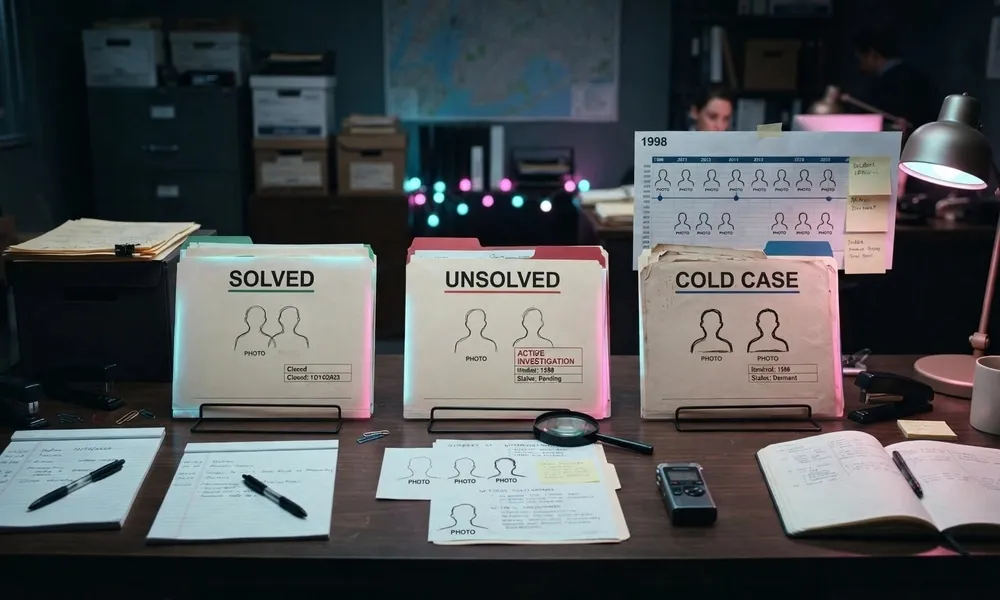
An unsolved case is a criminal case that has not reached a definitive resolution, such as a conviction.
A cold case generally refers to an investigation where active leads have stalled and investigators have not been able to move the case forward in the normal way.
The terms overlap, but they are not always identical.
That’s why a careful case database may label a case “unsolved” while separately marking it “cold.” Casepin currently uses both labels in its worldwide unsolved collection.
The practical lesson is simple: check how the source defines the status before repeating it.
True Crime Case Status: Solved, Unsolved, or Ongoing?
This is one of the easiest places to misunderstand a criminal case.
Think of the legal process as a series of steps:
Suspect identified → arrest → charge → trial or plea → conviction/acquittal → appeal
Not every case goes through every step.
Someone can be suspected without being arrested. Someone can be arrested without being convicted. And a conviction can later be challenged or overturned.
JonBenét Ramsey is a useful example of why current status matters: Boulder Police currently describes that investigation as ongoing and says it continues to work with DNA experts and other agencies.
On the other hand, DeAngelo’s case reached a guilty plea and sentencing.
So when researching true crime cases, don’t reduce everything to one word.
Important True Crime Cases and Why They Matter
Fame isn’t a perfect measure of importance.
A case may be remembered because:
- it remained unsolved despite a major investigation
- new forensic technology helped solve it
- it exposed problems in an investigation
- it produced an important court decision
- it changed investigative practice
- it became a landmark example of a particular type of evidence
- it remained relevant because new evidence appeared decades later
The Golden State Killer investigation is a good example of the forensic angle. DeAngelo was identified through investigative genetic genealogy after decades had passed.
The Black Dahlia case shows something different. Investigators were able to identify Elizabeth Short quickly, but identifying the victim did not lead them to her killer.
And the JonBenét Ramsey investigation shows another side of the story: old evidence can still be revisited as forensic technology changes.
That is why the best true-crime cases to study aren’t always the most dramatic ones. They’re the ones that teach you something about how investigations actually work.
True Crime Cases Around the World
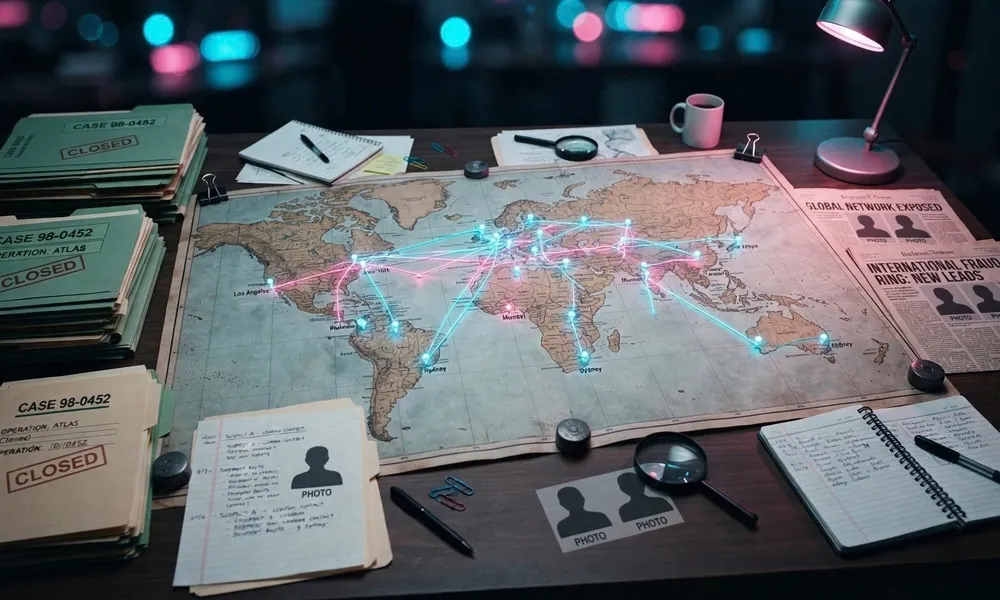
True crime isn’t limited to the United States or Britain.
International case collections now make it possible to explore investigations across many countries and regions. Casepin, for example, currently organizes thousands of case files worldwide and allows users to explore them by legal status and location.
For a reader, geography can be a useful starting point.
A case investigated in one country may involve very different:
- police procedures
- court systems
- evidence rules
- reporting standards
- terminology
- privacy laws
So when reading an international case, don’t assume that the legal terms mean exactly the same thing everywhere.
That’s another reason a good case summary should name the country and explain the legal outcome rather than simply saying someone was “found guilty” or “cleared.”
How to Research True Crime Cases
If you want to understand a case properly, don’t start with the most dramatic video or social-media thread you can find.
Start with the strongest evidence available.
A sensible research order is:
- Official police or government records when available.
- Court records and judgments for charges, convictions and appeals.
- Reputable investigative reporting for context and developments.
- Original interviews or documents when their authenticity can be established.
- Secondary databases as a starting point, not the final authority.
The FBI’s historical archive is useful for cases it investigated because it provides original records and case material, including extensive files on cases such as the Zodiac Killer.
The same principle applies to local investigations. For JonBenét Ramsey, the Boulder Police Department’s own case page is much more useful for the current investigation status than an old documentary or social-media post.
Keep Fact and Theory Separate
This is probably the most important habit in true-crime research.
A confirmed fact is directly supported by reliable evidence.
A reported claim is something a credible source says happened, but the underlying claim may not be independently established.
A disputed claim is something credible sources disagree about.
An estimate is a calculated or approximate figure.
A theory is an explanation that may be interesting but hasn’t been established as fact.
Once you start keeping those categories separate, true-crime stories become much easier to understand.
Famous True Crime Cases Compared
| Case | Period | Location | Status | What makes it important |
| Jack the Ripper | 1888 | London | Unsolved | Historic unidentified-killer investigation |
| Black Dahlia | 1947 | Los Angeles | Unsolved | Major investigation without a confirmed killer |
| Zodiac Killer | 1960s | California | Unsolved | Letters, codes and extensive investigation |
| JonBenét Ramsey | 1996 | Colorado | Ongoing | Long-running homicide investigation and continuing DNA work |
| Ted Bundy | 1970s–1980s | U.S. | Solved/convicted in multiple cases | Multiple trials and later forensic developments |
| Golden State Killer | 1970s–1980s | California | Solved/convicted | DNA-based identification after decades |
The useful thing about this table isn’t the number of cases.
It’s the difference between them.
Some are unresolved. One is still actively investigated. Others ended with convictions. That gives you a better picture of true crime than a list where every case is presented as the same kind of mystery.
Conclusion
The interesting thing about true crime cases isn’t simply that some of them are shocking or mysterious.
It’s what they show about real investigations.
The Black Dahlia and Zodiac cases show how a large investigation can still end without a confirmed killer. JonBenét Ramsey shows that an old homicide can remain an active investigation decades later. And the Golden State Killer case shows that evidence that once seemed difficult to use can become much more valuable when technology changes.
So when you read a true-crime story, look past the dramatic headline. Ask what is actually proven, what is still disputed, what the legal outcome was, and whether the case status has changed.
That’s the difference between simply reading a crime story and actually understanding the case.
True Crime Cases: Frequently Asked Questions
What are the most famous true crime cases?
Some of the best-known include the Jack the Ripper murders, Zodiac Killer case, Black Dahlia murder, JonBenét Ramsey homicide, Ted Bundy murder cases and Golden State Killer investigation. They are famous for different reasons, so they shouldn’t all be treated as the same type of case.
What are the most famous unsolved true crime cases?
Jack the Ripper, the Zodiac Killer and the Black Dahlia murder are among the most famous historic unsolved cases. JonBenét Ramsey is another major unresolved homicide, although Boulder Police currently describes it as an ongoing investigation rather than simply an inactive cold case.
What is the difference between a cold case and an unsolved case?
An unsolved case has not been definitively resolved. A cold case generally refers to an investigation where active leads have stalled. The exact definitions can vary, so check the terminology used by the investigating agency or database.
Does a solved crime always mean someone was convicted?
No. “Solved” can be used in different ways depending on the source. Identification of a suspect, an arrest, a charge and a conviction are separate stages. For a reliable article, it is better to state exactly what happened rather than relying on the word “solved.”
Which true crime cases were solved with DNA evidence?
The Golden State Killer case is a major example. Joseph DeAngelo was identified in 2018 through investigative genetic genealogy after decades had passed, and he later pleaded guilty to 13 murders and 13 kidnapping charges.
Can an old true crime case still be solved?
Yes. Old evidence can sometimes become more useful when forensic technology improves or investigators discover new information. The Golden State Killer case is a strong example of this. Boulder Police also says it continues to test and retest evidence in the JonBenét Ramsey investigation as DNA technology develops.
Where can I find reliable information about true crime cases?
Start with official police, government and court records when they are available. Then use reputable reporting for context and developments. Specialist databases can help you discover cases, but important claims should ideally be checked against the original record.