A grow room installation startup does not sell plants. It sells a finished room: four walls that hold light in, air that moves in the right direction, and a climate that stays steady while the lights run hot. The client hands over a spare bedroom, a garage corner or a basement, and the installer hands back a sealed, reflective, ventilated growing space with lights hung at the right height, an extraction fan that actually clears the air, and a controller that keeps temperature and humidity inside a narrow band. Everything the business installs serves that room fit-out, and that is what makes it a different trade from the growing methods that can sit inside the finished space.
The work starts with measurement, not shopping. A good installer maps the room first: ceiling height, wall area, electrical capacity, where fresh air can enter and where stale air can leave, and how much heat the lights will throw off at full power. Only then does the lighting plan, the fan size, the reflective lining and the climate kit get chosen, because every one of those decisions depends on the volume of the room and the watts going into it. The AI tools in this guide earn their place by doing that maths for you: modelling light coverage across the canopy, sizing extraction to the room volume, tracking temperature and humidity against a vapour pressure deficit target, and turning a survey into a quote before the client loses patience.
This guide compares nine tools that cover the whole fit-out, from the first light plan to the final invoice. They were chosen for a startup budget and a startup workflow: tools that a two-person crew can learn in a week, that pay for themselves on the first few jobs, and that keep the room, not the growing method, at the centre of the work. A hydroponic garden installation is a different job — a water-based growing method that can sit in any space — while a grow room is the space itself, built once and built properly.
Key takeaways
- A grow room is a room fit-out — lights, extraction ventilation, reflective walls, climate control and layout — not a growing method or a glass structure.
- Size the fan to the room volume and the light wattage first; most failed grow rooms are under-ventilated, not under-lit.
- Map light coverage with a meter app before fixing hanging heights, so every corner of the canopy gets even light.
- Reflective wall lining is the cheapest performance gain in the whole build, and it is often the step installers skip.
- Quote the full fit-out — shell, lights, ventilation, climate kit and labour — as one surveyed job, not as a pile of parts.
The 9 tools at a glance
| Tool | Room job it solves | Best for |
|---|---|---|
| Gavita Pro RS 2400e LED | Lighting layout and even canopy coverage | Main light plan |
| Photone | Measuring light levels with a phone | Verifying hanging height |
| AC Infinity Cloudline T8 | Extraction ventilation sized to the room | Air exchange and heat removal |
| Can-Lite carbon filter | Odour control on the exhaust | Discreet, clean-smelling rooms |
| Gorilla Grow Tent | Modular room shell with reflective lining | Fast room builds |
| ORCA Grow Film | Reflective wall lining for built rooms | Maximising light from every watt |
| Pulse One | Climate monitoring and vapour pressure deficit | Remote room checks |
| Quest 70 dehumidifier | Humidity control under full lighting | Steady, dry air |
| Jobber | Quoting, scheduling and invoicing | Running the business |
The table above is the short version. The rest of this guide takes each tool in turn, explains the room problem it solves, and shows how a new installation startup uses it on a real job. The order follows the order of a real build: light first, then air, then the room itself, then climate, then the paperwork that gets you paid.
Lighting: getting the light plan right
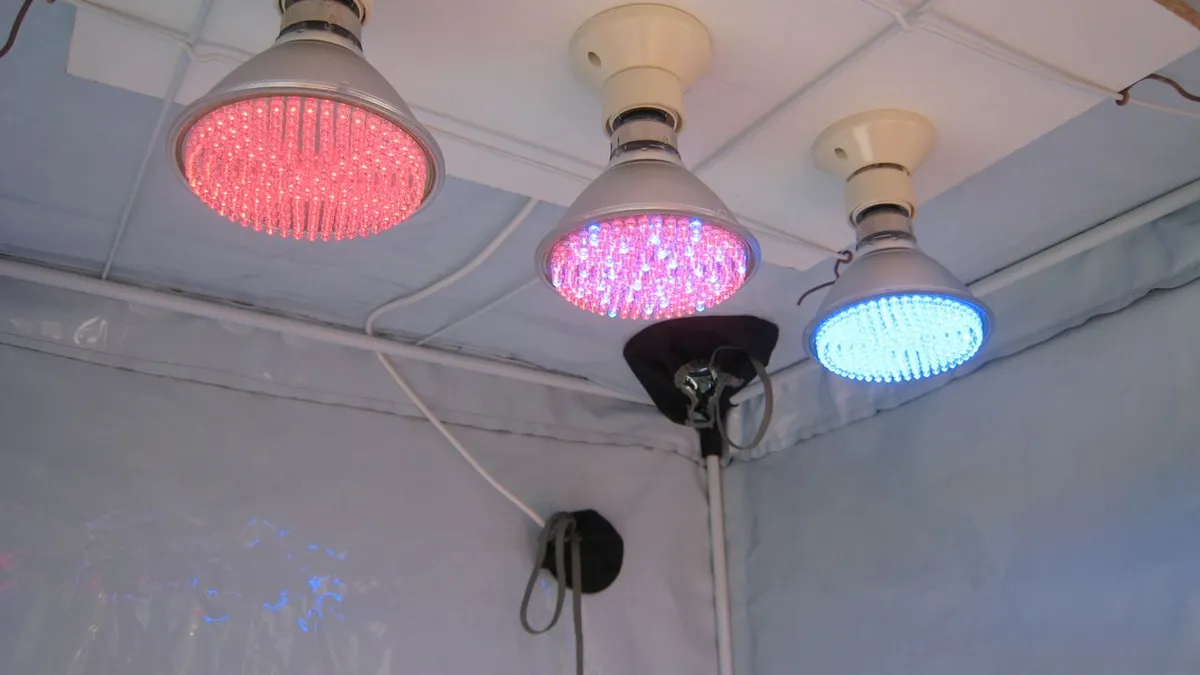
Lighting is the first decision in a grow room because it drives every other decision. The wattage and layout of the lights decide how much heat the room must shed, how big the extraction fan must be, how much power the circuits must carry, and how high the ceiling needs to be. A startup that plans the light first rarely has to redo the ventilation later, while a startup that buys lights last usually finds the room cannot cope with them. The two tools in this section cover the plan and the proof: one designs the coverage, the other measures it once the lights are hung.
1. Gavita Pro RS 2400e LED
The Gavita Pro RS 2400e LED is a full-spectrum bar-style fixture built for exactly the kind of rectangular room a grow room installer works with, and that shape is the point. Bar lights spread their output across a wide, even footprint instead of concentrating it in a hot centre, which means the canopy below gets similar light levels at the edges and in the middle. For an installer, that evenness is the whole job: a room where the middle plants stretch and the edge plants stall is a room the client will complain about, however bright the centre reads on a meter.
On a survey, the fixture earns its keep in the planning stage. Its published light maps show coverage and intensity at a range of hanging heights, so an installer can work out how many fixtures a room needs before ordering anything. A small spare room might take a single fixture hung high, while a long garage room needs two or three in a row with their footprints overlapping slightly. The RS 2400e runs at a power level that suits a dedicated circuit, and its dimming range lets the installer set a lower level for young plants and a higher one for a mature canopy without moving the hardware. That flexibility matters on handover day, when the client needs a simple setting to start with and room to grow into.
2. Photone
Photone turns an ordinary phone into a light meter, and for a grow room installer that is the difference between guessing and proving. The app measures photosynthetic photon flux density, the PPFD figure that describes how much usable light actually reaches the canopy, using the phone camera and a diffuser. An installer walks the room after hanging the lights, holds the phone at canopy height in a grid pattern, and reads whether the corners match the centre. If they do not, the hanging height or the spacing changes before the client ever sees the room.
The value for a startup is in the handover. Clients cannot see light the way they can see a painted wall, so a room can look finished while delivering half the light it should in one corner. A Photone reading at handover, recorded in the job file, shows the client the room is even and gives the installer a baseline to return to if the client later reports weak growth in one spot. It also settles arguments about hanging height quickly: raise the fixture, re-measure, and watch the numbers even out instead of debating it.
Ventilation and air: extraction, filtration and fresh air
A grow room without proper ventilation is a sealed box with a heater inside it, and the heater is the lighting rig. Lights warm the air, plants release moisture, and without a fan moving that air out and fresh air in, temperature climbs, humidity climbs, and the room becomes a place where mould thrives and plants stall. Ventilation is therefore the second decision on every job, sized to the room volume and the light wattage, and it is the system clients notice first when it is wrong: a hot room, a smell in the hallway, or a fan that roars all night. The two tools in this section cover the two halves of the air system: the fan that moves the air, and the filter that cleans it on the way out.
3. AC Infinity Cloudline T8
The AC Infinity Cloudline T8 is an inline duct fan that has become the default extraction choice for small and medium grow rooms, and the reason is control rather than raw power. The fan pairs with a digital controller that ramps its speed up and down against temperature and humidity targets, so it runs quietly when the room is cool and works harder when the lights push the temperature up. That behaviour is what a client actually lives with: a fan that hums gently at night and only spins up on a hot afternoon, instead of a fan that runs flat out from the moment the lights switch on.
Sizing the fan is the installer skill that the tool supports rather than replaces. The room volume in cubic feet, multiplied by the number of air changes the room needs per minute, gives the baseline airflow, and then the installer adds headroom for the carbon filter, for long duct runs, and for hot summers. The T8 sits in the middle of the range, which makes it the right starting point for the spare rooms and garage conversions a startup sees most often. Its eight-inch ducting moves serious air without the noise penalty of a larger fan forced to run slowly, and its controller can trigger on temperature or humidity, so the same fan handles both the heat problem and the moisture problem.
4. Can-Lite carbon filter
The Can-Lite carbon filter is the part of the air system that the neighbours never smell, and that is the whole point of it. A grow room exhaust carries the scent of whatever is growing, and in a home that scent travels through hallways, into bedrooms and out of windows. A carbon filter scrubs that air as it passes through, trapping odour molecules in activated carbon before the air leaves the building. For a startup, it is the difference between a room the household accepts and a room the household argues about.
Choosing the filter is a matching exercise with the fan. The filter must be rated for at least the airflow the fan delivers, and it must suit the duct size, so an eight-inch fan pairs with an eight-inch filter and the pair is sized together, never separately. The Can-Lite range covers the room sizes a startup meets, and its lighter casing makes it easier to hang from a ceiling or a tent frame without extra bracing. Hang it inside the room at the top, connect it to the fan with a short duct run, and make sure the air passes through the filter before it passes through the fan: that order protects the fan from dust and keeps the filter doing the work it was built for.
The room itself: shell, walls and layout
Once the light plan and the air plan exist, the room itself has to be built to hold them. A grow room shell does two jobs: it keeps light in so the room runs efficiently, and it keeps the growing environment separate from the rest of the house so humidity and heat stay where they belong. Some clients want a permanent built room with lined walls and a sealed door, while others want a modular tent that can be taken down when they move. A good installer offers both, plans both the same way, and never lets the shell be an afterthought, because a leaky room wastes every watt the lights produce. The two tools in this section cover the shell and the surface inside it.
5. Gorilla Grow Tent
The Gorilla Grow Tent is a modular room shell: a heavy fabric tent with a reflective interior, a strong frame, and ports for ducting and cables, that gives a client a finished grow room without any building work. For a startup, it is the fastest route to a completed job, because the shell arrives as a kit, assembles in an hour or two, and can be installed in a rented flat or a spare room where permanent alterations are not allowed. That matters commercially: a large share of early clients are renters or first-time growers who want a proper room but cannot knock through walls.
The tent earns its reputation on its frame and its fabric. The poles are thicker than the budget alternatives, which matters when the frame carries heavy bar lights, a carbon filter and a fan all at once, and the fabric is dense enough to block light leaks that would otherwise spill into the room at night. Height-adjustable extensions let the installer add headroom for tall plants or high-hung lights, and the observation window lets the client check the room without opening the door and disturbing the climate. An installer who has fought with a sagging budget tent understands why the stronger frame is worth quoting.
6. ORCA Grow Film
ORCA Grow Film is a reflective wall lining that turns the walls of a built grow room into part of the lighting system. Bare plaster absorbs light, white paint reflects some of it, and a purpose-made reflective film reflects far more of it back toward the canopy, including light that would otherwise be wasted on the walls. For the client, the result is simple: the same lights deliver more usable light to the plants, because less of it is lost to the room. For the installer, it is the cheapest performance gain in the whole build, and it is the step most often skipped by builders who do not understand growing rooms.
Installing the film well is a craft job, and that is why it belongs in a professional quote rather than a do-it-yourself afternoon. The walls must be clean, dry and smooth first, because dust and damp stop the film bonding and bubbles trap moisture behind it. Sheets go up with generous overlaps, seams are taped, and edges are sealed around sockets, vents and the door frame so no bare wall shows. Corners get particular care, since a wrinkled corner throws shadows across the canopy. An installer who photographs the finished lining before the lights go in has proof of a tidy job and a useful image for the next quote.
Climate: monitoring and humidity control
Light and air set the room up, but climate is what the room does all day while nobody is watching. Temperature and humidity swing with the lights: the room warms up when the lights come on, cools when they go off, and humidity rises as plants release moisture into air that has nowhere to go. Left alone, those swings stress plants and invite mould. Managed properly, with a monitor that watches the room around the clock and a dehumidifier that answers when the air gets wet, the climate stays inside a narrow band and the plants grow steadily. The two tools in this section cover the watching and the answering.
7. Pulse One
The Pulse One is a small environmental monitor that hangs in the grow room and reports temperature, humidity, light and vapour pressure deficit to a phone app, and vapour pressure deficit is the number that separates a serious grow room from a guessing game. VPD describes how strongly the air pulls moisture from the leaves, and it depends on both temperature and humidity together, so a room can show a reasonable temperature and a reasonable humidity while still sitting at a VPD that stresses the plants. The Pulse One calculates it continuously and shows whether the room is in the comfortable band or drifting toward trouble.
For a startup, the monitor earns its place at handover and after it. At handover, the installer shows the client the live readings and the target band, which turns an abstract promise about climate into numbers the client can check. After handover, the installer can check the room remotely when the client calls with a worry, and tell in seconds whether the room is hot, wet, or fine — instead of driving across town to look at a thermometer. That remote check saves the business hours every month, and it makes the client feel looked after without a site visit.
8. Quest 70 dehumidifier
The Quest 70 is a compact dehumidifier built for the warm, wet air of a grow room, and it solves the problem that surprises new growers most. Plants release a remarkable amount of water into the air, and in a sealed room that water has nowhere to go except onto cool surfaces, where it condenses and feeds mould. A domestic dehumidifier struggles in that environment because it is designed for a living room, not a room full of transpiring plants under hot lights. The Quest 70 is designed for the job: it pulls serious moisture out of warm air, drains it away through a hose, and keeps running without the constant emptying that makes domestic units a chore.
Sizing the dehumidifier starts with the plants, not the room. A mature canopy in a medium room can release litres of water a day, and the dehumidifier must remove that water at the same rate or the humidity climbs night after night. The Quest 70 suits the rooms a startup builds most often, and its drain hose means it can run unattended for weeks, which is exactly what a client needs when they go on holiday. Install it low in the room, where the dampest air sits, and run the drain to a sink or a floor drain so the client never has to think about it.
Running the business: quoting, scheduling and invoicing
The tools above build the room. The tool in this section builds the business, and a startup that neglects it ends up doing excellent rooms for little money and wondering why the bank balance never grows. A grow room installation is a surveyed job with real variation: room sizes differ, electrical work differs, access differs, and a flat price quoted over the phone will be wrong in one direction or the other on almost every job. The business needs a system that turns a survey into a proper quote, a quote into a scheduled job, and a finished job into an invoice that gets paid. That system is the ninth tool.
9. Jobber
Jobber is job management software built for small trade businesses, and it fits a grow room installation startup because it follows the shape of the work. A client enquiry becomes a quote, the quote lists the shell, the lights, the ventilation, the climate kit and the labour as separate lines, and the client approves it on their phone. Once approved, the job appears on the schedule, the crew sees the address, the room measurements and the kit list, and the office sees the day taking shape. When the room is finished, the quote converts into an invoice with one tap, and the client pays online instead of waiting for a paper bill to arrive in the post.
The quoting workflow is where Jobber earns its fee on the first job. A startup can build a template for a standard room fit-out — survey, shell, lights, fan, filter, lining, monitor, dehumidifier, labour — and adjust the quantities to the room instead of writing every quote from scratch. That consistency stops the two most common pricing mistakes: forgetting a line item and charging different prices for the same work. It also makes the quote look professional, which matters when the client is comparing your surveyed price with a rival who guessed a number over the phone.
The scheduling and payment features pay for themselves more quietly. Automated reminders cut the no-shows that waste a crew morning, route planning keeps two jobs a day realistic instead of optimistic, and online payments shorten the gap between finishing a room and seeing the money. The client history also builds over time: every room you installed, every filter you promised to replace, and every service visit you offered sits in one record, so the maintenance calls that keep the business steady through quiet months are easy to find and easy to make. For a one-van startup, that record is the difference between a business and a series of one-off jobs.
Grow room installation checklist
Use this checklist on every survey and every handover. It follows the order of a real build, and a job is not finished until every item on it is checked.
- Measure the room, the ceiling height and the electrical capacity before quoting anything, and note where fresh air enters and stale air leaves.
- Plan the light layout first, check coverage with a meter at canopy height, and confirm the hanging height before fixing any fixture.
- Size the extraction fan to the room volume plus the heat of the lights, and match the carbon filter to the fan airflow and duct size.
- Line the walls with reflective film or fit a modular tent shell, sealing every seam, corner and edge so no bare wall or light leak remains.
- Mount the climate monitor at canopy height, set the temperature and humidity targets, and confirm the dehumidifier drains away without emptying.
- Hand over the room with recorded light readings, the controller settings, the filter replacement date and a written quote-to-invoice record.
Frequently asked questions
How much does a grow room installation cost?
A small spare-room fit-out usually costs less than a garage conversion, because the shell already exists and the work is mostly lights, ventilation, lining and climate kit. The price moves with the room size, the light wattage, the length of ducting, and whether the electrical work needs a new circuit. A proper quote follows a survey and lists each part separately, so the client can see what the shell, the lights, the fan and the labour each cost instead of guessing from a single round number.
Do I need planning permission for a grow room?
An indoor grow room inside an existing home rarely needs planning permission, because it is an internal fit-out rather than a new structure. The work that does need attention is electrical: new circuits and high-wattage lighting should be installed or checked by a qualified electrician, and the installation should comply with local building and electrical rules. A reputable installer explains this at the survey stage and includes the electrical work in the quote rather than leaving the client to arrange it afterwards.
What is the difference between a grow room and a greenhouse?
A grow room is an indoor space fitted out with lights, ventilation, reflective walls and climate control, while a greenhouse is a glazed structure that relies on daylight. The two builds share an interest in climate, which is why many installers study greenhouse installation startups alongside grow rooms, but the work is different: a grow room installer controls every variable with equipment, while a greenhouse installer works with the sun, the seasons and a glass shell.
Can a grow room be installed in a rented home?
Yes, and a modular tent shell is the usual answer, because it gives the tenant a finished room without permanent alterations to the property. The tent, lights, fan and climate kit can be removed when the tenancy ends, and the room returns to its original state. Tenants should still check the tenancy agreement and tell the landlord, and the installer should avoid any work that damages walls or ceilings, such as drilling for ducting without permission.
How loud is a grow room extraction fan?
A well-installed fan is a background hum rather than a roar, and the difference comes from sizing and mounting. A fan that is correctly sized for the room runs at part speed most of the time, while an undersized fan runs flat out and still struggles. Hanging the fan on vibration-damping mounts, using smooth ducting with gentle bends, and keeping the duct run short all cut noise further. Clients who work or sleep near the room should hear the fan demonstrated before the installer leaves.
What does a grow room installation startup charge for a service visit?
Most startups charge a call-out fee plus an hourly rate, with parts such as a replacement carbon filter billed separately. A yearly service visit that checks the fan, swaps the filter, cleans the lining and re-measures the light levels is a common package, and it is often sold at handover when the room is new and the client is most receptive. Pricing the visit clearly at the start avoids awkward conversations later, and it gives the business the recurring income that smooths out quiet months.
Bottom line
A grow room installation startup succeeds by treating the room as the product: a sealed, reflective, ventilated space where light, air and climate are planned together and proven with measurements before handover. The nine tools in this guide cover that build from end to end, from the light plan and the meter that verifies it, through the fan and filter that move and clean the air, to the shell, the lining, the climate monitor and the dehumidifier that hold the room steady. None of them is expensive on its own, and together they cost less than a single failed room that has to be rebuilt. For a client comparing options, a herb garden installation shows how small-scale indoor growing works, but a grow room is the bigger commitment: a proper room, built once, that serves whatever the client grows in it for years. Start with the survey, size everything to the room, and let the tools do the maths.

Keep what speaks to you.
Leave room for your own perspective.