When Mae Jemison was a little girl in Chicago, she looked up at the night sky and told her teacher she wanted to be a scientist. The teacher looked back at her and said, “Don’t you mean a nurse?” Mae did not argue. She simply decided, quietly and completely, that she would become both a doctor and an astronaut — and then she spent the next twenty-five years proving that a Black girl from the South Side of Chicago could do exactly what she said she would do.
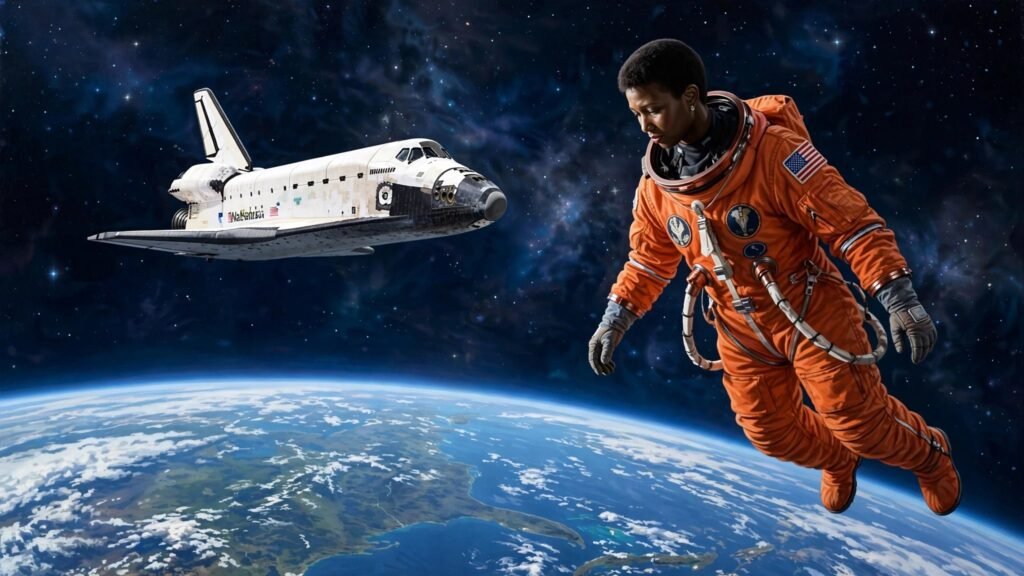
On September 12, 1992, the space shuttle Endeavour lifted off from the Kennedy Space Center in Florida, and Mae Jemison became the first Black woman to travel into space. For eight days she orbited the Earth, conducting experiments in life sciences and materials science, watching the planet turn beneath her, and carrying with her a poster of Judith Jamison, a photograph of Bessie Coleman, and a banner from her sorority, Alpha Kappa Alpha. She had waited five years for that flight, and when it finally came, she made it count.
This is the story of how a curious child who loved science fiction became a doctor, a Peace Corps medical officer, and a NASA astronaut — and of the lessons her life holds for anyone who has ever been told their dream is too big. Face Zem brings you her journey, from a Chicago classroom to the stars.
Key takeaways
- Mae Jemison became the first Black woman in space aboard the shuttle Endeavour on September 12, 1992.
- She earned degrees in chemical engineering and African studies from Stanford at just 20, then a medical degree from Cornell.
- Before NASA, she served as a Peace Corps medical officer in Sierra Leone and Liberia, running health programmes in West Africa.
- After leaving NASA in 1993, she founded the Jemison Group and the Dorothy Jemison Foundation, and leads the 100 Year Starship project.
- Her life proves that refusing to choose between your passions — science, medicine, art, and service — is itself a path to success.

1. A Childhood in Decatur and Chicago
Mae Carol Jemison was born on October 17, 1956, in Decatur, Alabama. Her father, Charlie Jemison, was a roofer and carpenter; her mother, Dorothy Jemison, was an elementary school teacher. When Mae was three years old, the family moved to Chicago, Illinois, in search of better opportunities. It was there, on the South Side, that she grew up — a curious, restless child who spent hours in the public library and watched the Apollo missions on television with wide-eyed wonder.
Her mother filled the house with books and encouraged her daughter’s questions rather than shutting them down. Her father built things with his hands and showed her that making and fixing were forms of thinking. Between them, they gave Mae something precious: the belief that learning was not a chore but an adventure. She collected rocks, studied the stars, and read science fiction — especially the works of writers who imagined worlds beyond Earth.
2. The Teacher Who Said “Nurse”
When Mae was in kindergarten, her teacher asked the class what they wanted to be when they grew up. Mae said she wanted to be a scientist. The teacher replied, “Don’t you mean a nurse?” The moment stayed with Mae for the rest of her life — not because it hurt her, but because it showed her how narrow other people’s expectations could be.
She understood, even as a small child, that the teacher was not being cruel. The teacher simply could not imagine a Black girl becoming a scientist, because she had never seen one. Mae decided that the answer was not to argue but to become the example. Years later, she would say that the problem was never her dream — it was the limits of other people’s imagination.
3. Stanford at Sixteen
Mae was so far ahead of her classmates that she graduated from high school at sixteen and entered Stanford University in 1973. She was one of very few Black students, and one of very few women, in the engineering programme. The isolation was real: she later recalled feeling that she had to prove herself every single day, in every single class.
But Stanford also gave her freedom. She studied chemical engineering, and she also studied African and Afro-American studies, refusing to choose between science and the humanities. She danced, choreographed, and performed with the Black Students Union. In 1977, at the age of twenty, she graduated with a Bachelor of Science in chemical engineering and a Bachelor of Arts in African and Afro-American studies. She had already shown the pattern that would define her life: she would not be one thing when she could be many.
4. Becoming a Doctor
From Stanford, Mae went to Cornell Medical College in New York, earning her Doctor of Medicine degree in 1981. She completed her internship at Los Angeles County–USC Medical Center, and then she made a choice that surprised many of her classmates: instead of pursuing a lucrative private practice, she joined the Peace Corps.
Medicine, for Mae, was never just a career. It was a way to serve. She had grown up hearing her mother talk about the dignity of every child, and she believed that a doctor’s skill belonged where it was needed most — not only where it paid best.
5. The Peace Corps Years in West Africa
From 1983 to 1985, Mae served as a Peace Corps medical officer in Sierra Leone and Liberia. She was responsible for the health of hundreds of volunteers spread across remote villages, and she managed clinics, vaccination programmes, and emergency evacuations in places where the nearest hospital could be a day’s journey away.
The work was hard and sometimes frightening. She treated malaria, delivered babies, and once performed emergency surgery in conditions that would have tested any doctor. But it also taught her something NASA would later value enormously: how to stay calm, make decisions with incomplete information, and lead people through uncertainty. When she later applied to NASA, she could honestly say she had already worked in the most demanding environments on Earth.
6. Applying to NASA
In 1985, Mae saw a recruitment notice for NASA’s astronaut programme. The space shuttle Challenger had not yet been lost, and NASA was looking for scientists and doctors to fly as mission specialists. She applied — and then, in January 1986, the Challenger disaster killed seven astronauts and grounded the programme for nearly three years.
Many applicants walked away. Mae did not. She reapplied when NASA reopened applications, and in June 1987 she was selected as one of fifteen candidates from more than two thousand applicants. She was the first Black woman ever chosen for NASA’s astronaut programme. She spent the next five years training: flying jets, learning Russian, studying the shuttle’s systems, and preparing for a mission that kept being delayed.
7. The Flight of Endeavour: September 1992
On September 12, 1992, the space shuttle Endeavour launched on mission STS-47, a joint American-Japanese science mission called Spacelab-J. Mae Jemison was the mission specialist, and she became the first Black woman to travel into space. The mission lasted eight days, during which the crew conducted forty-four experiments in life sciences and materials processing.
Mae’s own experiments included studying how the body adapts to weightlessness and how frog embryos develop in space. She also carried symbolic cargo: a poster of the dancer Judith Jamison, a photograph of Bessie Coleman — the first Black woman to earn a pilot’s licence — and a banner from her sorority. When she looked down at Earth from orbit, she later said, she felt both very small and very connected to everything below.
8. Life in Orbit
Life aboard the shuttle was a mixture of wonder and hard work. The crew worked in shifts around the clock, and Mae’s days were filled with experiments, checklists, and radio calls to mission control. She also found time to notice the small, strange beauties of weightlessness: a drop of water floating like a jewel, the sunrise appearing sixteen times a day, the silence of the stars.
She has said since that the most important thing she learned in space was perspective. From orbit, the borders between countries are invisible. The Earth is one blue world, and the problems that divide people look very small from two hundred miles up. It is a view she has carried into everything she has done since.
9. Leaving NASA and Starting Again
Mae left NASA in March 1993, less than a year after her flight. She could have stayed and flown again, but she wanted to build something of her own. She founded the Jemison Group, a company that develops science and technology projects, and the Dorothy Jemison Foundation for Excellence, named after her mother, which runs science camps for children.
Her best-known project through the foundation is The Earth We Share, an international science camp that brings teenagers together from around the world to solve real problems — from clean water to climate change. The idea is simple and radical: give young people a hard problem, trust them with it, and watch what they can do.
10. The 100 Year Starship
In 2011, the United States Defense Advanced Research Projects Agency (DARPA) awarded a grant to the Dorothy Jemison Foundation for the 100 Year Starship project. The goal is as bold as it sounds: to make human travel to another star possible within a hundred years. Mae leads the project, bringing together scientists, engineers, artists, and writers.
The project is not really about building a starship tomorrow. It is about asking what humanity would need — in science, in medicine, in energy, in cooperation — to attempt something that large. Mae likes to say that the journey to the stars begins with the decision to take the first step, and that every great voyage in history started with someone willing to imagine it.
11. A Star on Screen: Star Trek and Beyond
In 1993, Mae appeared as Lieutenant Palmer in an episode of Star Trek: The Next Generation, becoming the first real astronaut to appear on the show. It was a fitting honour: she had grown up watching the original Star Trek and had been inspired by Nichelle Nichols’s character, Lieutenant Uhura, one of the first Black women in a leading role on American television.
She has since written books, including her memoir Find Where the Wind Goes (2001), given lectures around the world, and been inducted into the National Women’s Hall of Fame and the International Space Hall of Fame. She speaks Russian, Japanese, and Swahili, dances, and still insists that science and art belong together.
12. Mae Jemison at a Glance
| Fact | Detail |
|---|---|
| Born | October 17, 1956, Decatur, Alabama |
| Raised | Chicago, Illinois |
| Education | Stanford University (BS chemical engineering, BA African studies, 1977); Cornell Medical College (MD, 1981) |
| Peace Corps | Medical officer in Sierra Leone and Liberia, 1983–1985 |
| NASA selection | June 1987, first Black woman astronaut candidate |
| Spaceflight | STS-47, Endeavour, September 12–20, 1992 |
| Historic first | First Black woman to travel into space |
| After NASA | Founder of the Jemison Group and the Dorothy Jemison Foundation |
| Big project | Leader of the 100 Year Starship project |
| Honours | National Women’s Hall of Fame (1993); International Space Hall of Fame (2004) |
Lessons from Mae Jemison’s Life
Mae Jemison’s story is not really about space. It is about what happens when a person refuses to accept the limits other people set for them. Her teacher could not imagine a Black girl becoming a scientist, so Mae became one anyway. Her classmates could not imagine a doctor becoming an astronaut, so she did both. The world could not imagine a starship, so she started building the case for one.
There are practical lessons here, too. Mae prepared for every opportunity long before it arrived: she studied engineering, then medicine, then fieldwork, then flight training, so that when NASA called, she was ready. She also kept her curiosity wide — dancing, languages, writing — because she understood that a narrow life makes a narrow mind, and narrow minds do not reach the stars.
Perhaps the deepest lesson is the one she learned looking down at Earth from orbit: that the planet is one, and that the divisions people draw on maps are not visible from space. If a girl from Chicago can look at the sky and decide to go there, then the rest of us can look at our own lives and decide to go further than anyone expects.
Checklist: Lessons You Can Use from Mae Jemison
- Refuse the limits other people set for you — become the example they could not imagine.
- Do not choose between your passions; let science, art, and service strengthen each other.
- Prepare before the opportunity arrives, so that when it comes, you are ready.
- Seek out hard places to serve — they teach you more than easy ones ever will.
- Keep learning new skills, languages, and ideas throughout your life.
- Dream at a scale that frightens you, then take the first small step toward it.
Frequently Asked Questions
When did Mae Jemison go to space?
Mae Jemison flew aboard the space shuttle Endeavour on mission STS-47, which launched on September 12, 1992, and returned on September 20, 1992. She was the first Black woman to travel into space.
What did Mae Jemison do before NASA?
She earned degrees in chemical engineering and African studies from Stanford, a medical degree from Cornell, and then served as a Peace Corps medical officer in Sierra Leone and Liberia from 1983 to 1985.
What experiments did she do in space?
During the eight-day Spacelab-J mission, the crew conducted forty-four experiments in life sciences and materials science. Mae’s work included studying how the body adapts to weightlessness and how frog embryos develop in space.
What is the 100 Year Starship project?
It is a project led by Mae Jemison’s Dorothy Jemison Foundation, funded by a DARPA grant, with the goal of making human travel to another star possible within a hundred years by advancing the science, technology, and cooperation such a journey would require.
Did Mae Jemison appear on Star Trek?
Yes. In 1993 she appeared as Lieutenant Palmer in an episode of Star Trek: The Next Generation, becoming the first real astronaut to appear on the show. She had grown up inspired by the series.
What is Mae Jemison doing now?
She leads the 100 Year Starship project, runs the Dorothy Jemison Foundation and its Earth We Share science camps, and lectures and writes about science, space, and education around the world.
Bottom line
Mae Jemison did not become the first Black woman in space by accident. She did it by deciding, as a child, that other people’s expectations were not her limits — and then by spending decades preparing herself, in classrooms, clinics, villages, and training jets, for a chance that might never come. When it did come, she was ready. Her life is proof that the biggest dreams are not the ones you should give up on; they are the ones worth preparing for.
If you take one thing from her story, let it be this: the sky is not the limit. It is only the beginning. And the next person to reach it may be someone who, right now, is being told their dream is too big — just as a teacher once told a little girl in Chicago that she meant “nurse” when she said “scientist.”
For more stories of pioneers who refused to stay earthbound, read about Sally Ride, the first American woman in space, and Valentina Tereshkova, the first woman in space — and about Neil Armstrong, the first person to walk on the Moon.
Note: This article is a general historical account of Mae Jemison’s life and achievements, written for Face Zem. Dates, missions, and milestones are drawn from public historical records.

Keep what speaks to you.
Leave room for your own perspective.