
Key Takeaways
-
Debt as a wealth creation tool
-
Good debt vs bad debt dynamics
-
The “Buy, Borrow, Die” strategy
-
Leveraging Facezem for smarter financial choices
Have you ever wondered why the wealthiest people in the world always seem to owe millions or even billions of dollars? It feels completely backward. Most of us are taught from day one that debt is a dangerous trap we should avoid at all costs.
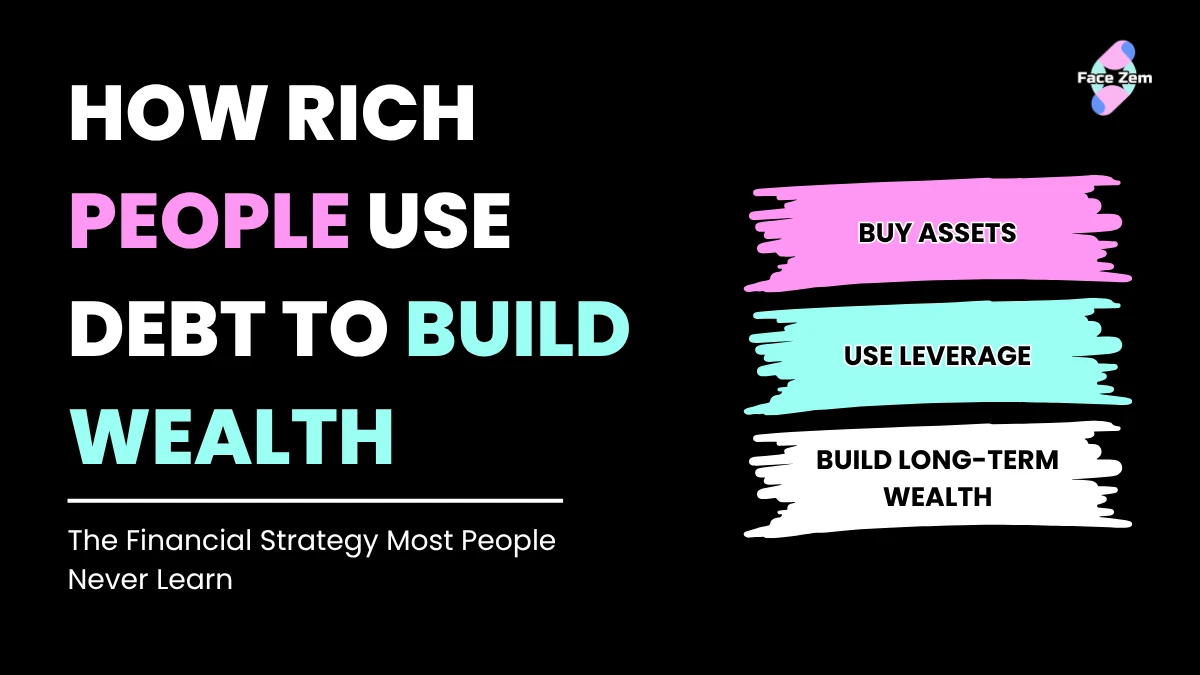
But here is the secret most people miss: how rich people use debt is fundamentally different from how the rest of the world uses it. Instead of using loans to buy things that lose value, the wealthy use other people’s money to buy cash-flowing assets that make them even richer.
At Facezem, we love breaking down these complex financial secrets into everyday concepts. Based on available data, the ultra-wealthy do not look at a loan as a burden. They look at it as a tool. Think of it like a chainsaw.
In careless hands, it is incredibly dangerous. But in the hands of a professional, it clears the path to massive growth. Let’s look at exactly how this wealth-building machine works.
AI Overview
Understanding how rich people use debt is the ultimate key to shifting from a scarcity mindset to an abundance mindset. While average consumers take on debt to buy depreciating liabilities, the wealthy use leverage to buy appreciating, cash-flowing assets. By masterfully balancing good debt vs bad debt, using strategies like securities-backed loans, and maximizing tax advantages, they accelerate their net worth without draining their personal cash reserves.
The Big Shift: Good Debt vs Bad Debt
To understand this strategy, we have to clear up a major piece of confusion. Not all loans are created equal. In the financial world, there is a massive dividing line between good debt vs bad debt, and knowing the difference changes everything.

Bad debt is what most of us are familiar with. It is the high-interest credit card balance used to buy clothes, electronics, or vacations. The moment you swipe the card, the item begins losing value, but the interest keeps compounding.
Good debt, on the other hand, is used to buy assets. When you use a mortgage to buy a rental property, the tenants pay the rent, which covers your loan payment. You get to keep the profit and the long-term growth of the property. That is the core of how the rich build momentum.
The Secret Weapon Called Leverage
Imagine you have $100,000 to invest. You could buy a single property worth $100,000 using your own hard-earned cash. If the property value goes up by 10%, you made $10,000. Not bad, right?
But look at how rich people use debt to multiply those exact same results. Instead of buying one property, they use that $100,000 as a 20% down payment on a $500,000 apartment building, borrowing the remaining $400,000.

If that $500,000 building goes up in value by that same 10%, it is now worth $550,000. You just made $50,000 using the exact same amount of personal cash. That is the power of leverage. It is estimated that a significant portion of real estate fortunes are built using this exact math.
The “Buy, Borrow, Die” Strategy
This is the ultimate playbook of the ultra-wealthy, and it sounds almost illegal when you first hear it. But it is perfectly legal, highly strategic, and used every single day.

1. Buy Assets That Grow
First, the wealthy buy massive amounts of appreciating assets like stocks, businesses, or real estate. They do not buy these assets to flip them quickly. They buy them to hold them for the long haul.
2. Borrow Against Them
Instead of selling their stocks or real estate when they need cash to live on, they take out a loan against those assets. Because they are borrowing money instead of earning an income, they do not have to pay income taxes on that cash. Loans are not considered taxable income by the IRS.
3. Die and Pass It On
When they eventually pass away, their heirs inherit the assets at a “stepped-up basis,” which essentially wipes out the built-up capital gains taxes. The estate sells a small portion of the assets tax-free to pay off the outstanding loans, and the cycle continues for the next generation.
Arbitrage: Playing the Interest Rate Game
Another concept the wealthy master is financial arbitrage. This is just a fancy word for pocketing the difference between two different interest rates.

Let’s say a wealthy investor can borrow $1 million from a bank at a 4% interest rate. They take that money and invest it into a stable business or commercial property that generates an 8% return.
-
They pay the bank 4%
-
They earn 8% on the investment
-
They keep the 4% difference as pure profit
They just made $40,000 a year out of thin air using money that wasn’t even theirs to begin with. When you look at good debt vs bad debt through this lens, you realize that avoiding debt entirely can actually slow down your financial progress.
How the Wealthy Protect Themselves
Now, using leverage is not a magical fairy tale without risk. If the market crashes, debt can crush you just as fast as it can build you up. The rich know this, which is why they use strict guardrails to protect their fortunes.

-
Cash Flow Focus: They generally only borrow against assets that produce predictable monthly or quarterly income to easily cover the loan payments.
-
Conservative Loan-to-Value: They rarely borrow the maximum amount possible. If an asset is worth $1 million, they might only borrow $500,000 to give themselves a massive safety cushion.
-
Fixed Interest Rates: To protect against inflation and rising rates, they lock in fixed rates whenever possible so their costs remain completely predictable.
Here at Facezem, we always remind our readers that risk management is the true difference between a calculated financial strategy and reckless gambling.
The Tax Advantages of Owed Money
Did you know the tax code is practically written to reward people who use leverage responsibly? Governments want individuals to build housing, start businesses, and create jobs. Because the government cannot do all of this itself, it offers massive tax breaks to individuals who borrow money to do it for them.

The interest paid on good debt vs bad debt is treated completely differently by tax laws. In most cases, the interest you pay on credit cards or personal car loans is completely wasted. But the interest paid on business loans, commercial mortgages, and certain investment accounts can often be deducted directly from your taxable income. This means the wealthy are using pre-tax dollars to pay off their wealth-building tools.
Shifting Your Mindset
To truly understand how rich people use debt, you have to stop thinking about money as something you spend and start thinking about it as energy to deploy. The average person works hard for money, saves it, and spends it. The wealthy create a system where money works for them, and debt acts as an accelerator for that system.
If you are looking to start your own financial journey, the first step is eliminating the high-interest liabilities that are draining your potential. Once you free up your cash flow, you can begin exploring how to safely use low-interest leverage to acquire assets.
Frequently Asked Questions
Why do rich people borrow money instead of using their own cash?
Rich people borrow money because it allows them to keep their own cash invested in assets that earn a higher return than the interest rate of the loan. Additionally, borrowing against assets allows them to access liquidity without triggering massive capital gains taxes that would come from selling those assets.
What is the main difference between good debt vs bad debt?
The simplest way to understand good debt vs bad debt is to look at where the money goes. Good debt puts money into your pocket by purchasing assets that grow in value or produce income, like real estate or a business. Bad debt takes money out of your pocket by purchasing items that lose value over time, like cars, clothes, or electronics.
Is using leverage risky for regular investors?
Yes, using leverage always introduces risk. If the value of the underlying asset drops significantly, you are still responsible for paying back the full loan amount. Regular investors should focus on keeping their borrowing conservative, ensuring they have stable cash flow to cover payments, and maintaining a robust emergency fund.
How does the “Buy, Borrow, Die” strategy avoid taxes legally?
The strategy works because the tax code does not treat loan proceeds as taxable income. By borrowing against an asset instead of selling it, an investor avoids capital gains taxes. When they pass away, the assets are passed to heirs with a stepped-up tax basis, meaning the historic capital gains are essentially erased under current tax laws.