A new dog crate can feel like a surprisingly expensive purchase, especially when you are already paying for food, vet visits, toys, and all the other things a new dog needs. Prices for a decent crate range from around thirty dollars for a small wire model to well over two hundred dollars for a large, heavy-duty one, and the premium brands can cost even more. When the crate is only one item on a long shopping list, it is tempting to grab the cheapest option on the shelf and move on, yet that quick decision often costs more in the long run when a flimsy crate bends, rusts, or gets chewed through within a few months.
The good news is that saving money on a dog crate does not mean buying a bad crate. It means knowing what your dog actually needs, which features are worth paying for, and where the real bargains hide. A well-chosen crate lasts for years, keeps your dog safe and comfortable, and can even be resold when you no longer need it. The trick is to spend your money on size, strength, and durability, and to skip the extras that look impressive in the store but add nothing to your dog’s comfort. A little research before you buy can easily cut the price in half, and the strategies in this guide work whether you have a tiny puppy or a giant breed.
In this guide, you will learn how to pick the right size the first time, how the three main crate types compare on price and lifespan, where to find genuine discounts, and when to buy so you never pay full price. You will also learn how to check a secondhand crate for safety, which accessories are worth the money, and how to avoid the common mistakes that force owners to buy a second crate six months later. If you want a broader plan for cutting everyday costs, our guide to the best ways to save money in 2026 covers the habits that make every purchase, including pet supplies, easier on your budget.
Key takeaways
- Measure your dog and buy the right size once, because a crate that is too small or too big usually has to be replaced.
- Wire crates with a divider panel are the best value for most owners, since one crate can grow with a puppy.
- Compare prices across at least three sellers and wait for a holiday sale, when crates are often discounted by thirty to fifty percent.
- Secondhand crates can save you half the price or more, but always inspect the latch, wires, and tray before paying.
- Skip decorative covers and premium bedding at first, and spend the savings on a sturdy crate and a washable pad instead.
Why Dog Crates Cost More Than You Expect
Dog crates seem like simple boxes, so the price tags catch many new owners off guard. The cost comes from the materials, the size, and the engineering that keeps a strong, anxious, or teething dog safely inside. A small crate for a toy breed uses far less steel or plastic than a crate built for a German Shepherd, and that difference shows up directly in the price. Heavy-gauge wire, reinforced corners, escape-proof latches, and a thick removable tray all add manufacturing cost, and brands that test their crates for safety charge more for that assurance. When you see two crates of the same size with a fifty-dollar price gap, the difference is usually the thickness of the wire, the quality of the latch, and the warranty behind it.
Retail markup is the second reason crates feel expensive. Pet stores, like furniture stores, mark up bulky items heavily because they take up floor space and cost a lot to ship. A crate that costs forty dollars wholesale can easily sell for ninety dollars on a store shelf, and the same crate might sell online for sixty dollars from a warehouse seller with lower overheads. This is why comparing prices matters so much with crates: the product is identical, but the price changes dramatically depending on where you buy it. Online marketplaces, warehouse clubs, and direct-from-brand sales regularly undercut pet store prices by twenty to forty percent, and that gap is pure savings if you are willing to wait a few days for delivery.
The third hidden cost is buying twice. Many owners buy a small crate for a puppy, then discover six months later that the dog has outgrown it and needs a larger one. Others buy a cheap crate that a determined chewer destroys, or a soft-sided crate that a nervous dog claws through on the first night. Each replacement costs as much as the first crate, and sometimes more, because the second purchase is usually urgent. The cheapest way to buy a crate is almost always to buy the right one first, even if it costs a little more upfront. A wire crate with a divider panel, for example, lets a puppy grow into the full space without you buying a second crate, and that single purchase can save you the entire cost of an upgrade.
What Size Crate Does Your Dog Actually Need
Size is the single most important decision you will make, and it is the one owners get wrong most often. A crate should be large enough for your dog to stand up without crouching, turn around comfortably, and lie down stretched out, but not so large that your dog can use one corner as a bathroom and the other as a bed. For house training, the space matters enormously: dogs naturally avoid soiling their sleeping area, and a crate that is too roomy removes that instinctive pressure. This is why the divider panel matters so much for puppies. It lets you block off the extra space while your puppy is small, then move the panel back as your dog grows, so one crate serves from eight weeks to adulthood.
To measure your dog, stand them on a flat surface and measure from the tip of the nose to the base of the tail, then add two to four inches. Next, measure from the top of the head, or the tip of the ears for upright-eared breeds, down to the floor, and add two to four inches again. Those two numbers give you the minimum length and height of the crate. If your dog is a puppy, look up the expected adult size for the breed and buy for that adult size, using the divider to keep the space small for now. Buying for the adult size feels like overspending when your puppy is tiny, but it is far cheaper than buying a puppy crate and an adult crate within the same year.
The table below gives typical crate sizes by weight, but always measure your own dog, because breeds vary widely in shape. A long, low dog like a dachshund needs length more than height, while a tall, narrow dog like a greyhound needs height more than width. If your dog falls between two sizes, choose the larger one, since a slightly roomy crate is safer and more comfortable than one that is slightly too tight. Remember that the price jumps sharply with size: a large crate can cost twice as much as a medium one, so getting the size right protects both your dog’s comfort and your wallet.
| Dog weight | Typical crate size | Best for | Typical price range |
|---|---|---|---|
| Up to 10 pounds | 18 to 22 inches | Toy breeds, small puppies | 25 to 45 dollars |
| 11 to 25 pounds | 24 inches | Beagles, French bulldogs, corgis | 35 to 60 dollars |
| 26 to 40 pounds | 30 inches | Border collies, Australian shepherds | 45 to 80 dollars |
| 41 to 70 pounds | 36 inches | Labradors, golden retrievers, boxers | 60 to 110 dollars |
| 71 to 90 pounds | 42 inches | German shepherds, huskies, pit bulls | 80 to 150 dollars |
| Over 90 pounds | 48 inches and up | Great Danes, mastiffs, Newfoundlands | 120 to 250 dollars |
Wire, Plastic, or Soft-Sided: Which Crate Type Saves You Most
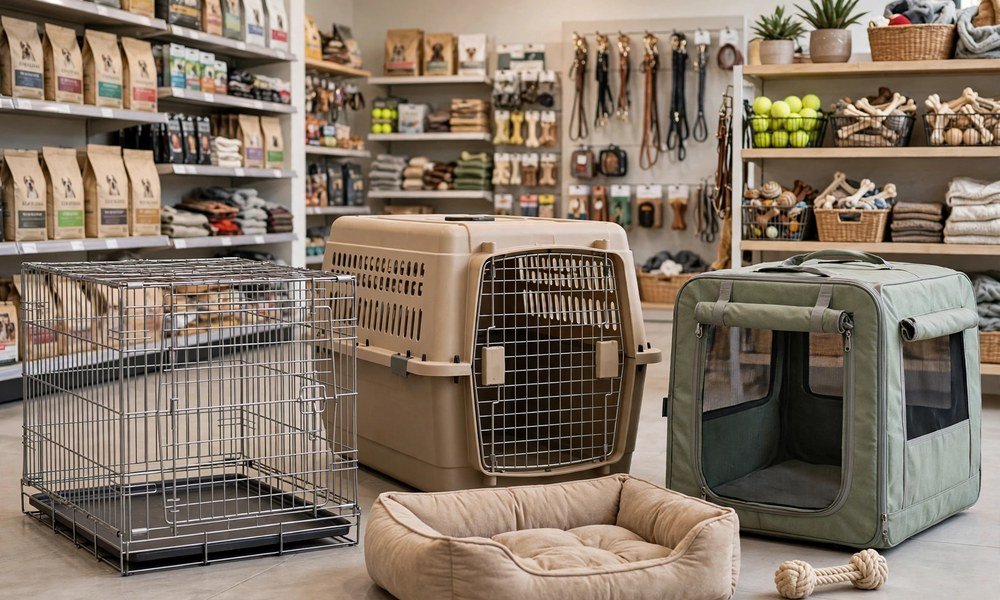
Wire crates are the best value for most dog owners, and they are the easiest place to save money without giving up quality. A wire crate offers excellent airflow, good visibility for your dog, and a fold-flat design that makes it easy to store or move. Most wire crates come with a divider panel and a removable plastic tray, which means one purchase covers the puppy stage and the adult stage. Prices for a good wire crate run from about thirty dollars for the smallest size to around one hundred and fifty dollars for the largest, and they go on sale constantly. The main weakness of a wire crate is that a determined chewer or escape artist can bend the wires or work the latch, so very strong or anxious dogs may need a heavier-gauge model, which costs more but still lasts longer than replacing a bent crate.
Plastic travel crates, often called kennels, are the best choice if you fly with your dog or need a crate that doubles as a car carrier. They are sturdier against chewing, offer more privacy, and meet most airline requirements for cargo travel. The downside is price: a large airline-approved plastic crate can cost one hundred and fifty to three hundred dollars, and it does not fold flat, so storage is harder. Plastic crates also have less airflow, which matters in warm climates. If you do not fly with your dog, a plastic crate is usually a worse value than a wire crate, because you pay more for a feature you will never use. If you do fly, however, buying one crate that works at home and on the plane is far cheaper than buying two separate crates.
Soft-sided crates are the lightest and most portable option, and they are popular for small dogs, for travel, and for dog shows. They fold down to almost nothing, weigh only a few pounds, and look more like furniture than a cage, which some owners prefer. The problem is durability: a soft-sided crate is made of fabric over a light frame, and most dogs can chew or claw through it if they are motivated. They are also harder to clean after an accident. A soft-sided crate is a good second crate for travel or for a calm, crate-trained dog, but it is a risky first crate for a puppy or a dog that is still learning to settle. If you buy one, choose a model with a sturdy frame and a washable cover, and treat it as a travel accessory rather than your dog’s main home.
When you compare the three types over five years, the wire crate usually wins on total cost. A seventy-dollar wire crate that lasts five years costs fourteen dollars a year, while a forty-dollar soft-sided crate that needs replacing every year costs twice as much over the same period. Heavy-duty crates made from thick steel or aluminium cost two hundred to five hundred dollars, and they are worth it only for dogs that have destroyed standard crates, since a normal dog will never test those limits. For most owners, the smart move is a mid-range wire crate from a reputable manufacturer, bought on sale, with a divider panel included. That single purchase covers training, travel to the vet, and everyday use, and it holds its resale value well if you ever decide to sell it.
Where to Buy a Dog Crate for Less
Online retailers are usually the cheapest place to buy a new dog crate, because they sell in high volume and do not pay for pet store floor space. Large online pet stores run frequent sales, and their prices on crates are often twenty to thirty percent below the price in a physical store. The catch is shipping: crates are bulky, so check whether delivery is free before you celebrate a low price, because a twenty-dollar shipping charge can erase the entire saving. Many online sellers offer free shipping over a certain order amount, so adding a bag of food or a toy you already need can unlock free delivery and make the deal even better. Always compare the total price including shipping, not just the headline price.
Warehouse clubs and discount stores are another strong option, especially for large crates. These stores stock one or two crate models in a limited range of sizes, but the prices are often the lowest you will find anywhere, and the quality is usually solid. The trade-off is choice: you may find a thirty-six-inch crate at a great price but no forty-two-inch option, so this route works best if your dog fits a common size. Discount stores also carry crates seasonally, so stock can disappear quickly. If you see a good crate at a warehouse club price, buy it rather than waiting, because the next delivery may not arrive for months, and the price may not be repeated.
Buying directly from the manufacturer is worth checking too, because brands run clearance sales on their own websites when a model is being replaced. A crate that is being discontinued may be discounted by forty percent or more, even though it is identical in every way that matters to the outgoing model. Signing up for a brand’s email list can unlock a first-order discount of ten to fifteen percent, and that discount often stacks with a sale price. Just be careful with email sign-ups: use them for the brands you are genuinely considering, and unsubscribe once you have bought, so your inbox does not fill up with offers for things you no longer need. The same comparison habit that saves money on big household purchases applies here as well, and it is the same approach we describe in our guide to how to save money on a new mattress in 2026, where checking several sellers before buying can cut the price by a third or more.
The Best Times of Year to Buy a Dog Crate
Timing is one of the easiest ways to save money on a dog crate, because crates go on sale in predictable patterns. The biggest discounts usually arrive during the major holiday sales in late November, when online and physical retailers cut prices across pet supplies. Crates are often included in these sales at thirty to fifty percent off, and the largest sizes, which are normally the most expensive, see the deepest cuts. If you can plan ahead and buy during one of these sales, you can save fifty dollars or more on a large crate, which is the single biggest saving most owners will ever make on this purchase.
Other good windows include the spring sales, when retailers clear winter stock, and the back-to-school period, when pet supply stores run promotions aimed at families settling into new routines. Pet adoption events also matter: when shelters run adoption drives, nearby pet stores often discount crates, beds, and starter kits to encourage new owners. Even if you are not adopting, these promotions are open to everyone, and they are a good time to buy. If your dog is a puppy, try to buy the crate before the puppy arrives, because a rushed purchase at full price is the most expensive kind.
Buying a Secondhand Dog Crate Safely
A secondhand crate is often the cheapest way to get a good crate, because crates hold up well and owners sell them when their dog outgrows one or no longer needs one. Local classified ads, community groups, and secondhand marketplaces are full of crates at half the retail price or less, and large crates, which are the most expensive new, are the ones with the biggest secondhand discounts. A crate that sold for one hundred and twenty dollars new may sell for forty dollars used, and if it was only used for a few months by a puppy, it may be in near-perfect condition. The key is to inspect before you pay, because a crate with a broken latch or a bent door is not a bargain at any price.
Start by checking the frame and the door. Open and close the door several times, and make sure the latch clicks firmly into place and cannot be pushed open from the inside. Look at every wire or joint for bends, rust, or cracks, and press on the corners to check that the crate still feels rigid. A crate that wobbles or flexes is either damaged or a low-quality model, and neither is worth buying. Check the tray by sliding it in and out; it should move smoothly and sit flat, without cracks or warping. If the tray is cracked, ask the seller to lower the price by the cost of a replacement, or walk away, because a replacement tray is surprisingly expensive on its own.
Crate Accessories Worth Paying For, and Ones to Skip
The accessories sold alongside crates are where many owners overspend, because stores bundle crates with covers, beds, toys, and water bowls that look essential but are not. The one accessory worth paying for is a good washable crate pad. A pad that fits the crate exactly, washes easily, and dries quickly will be used every day, and it protects both the tray and your dog’s joints. A cheap pad that bunches up or falls apart after two washes is a false economy, so spend a little more here and save elsewhere. A second worthwhile purchase is a set of zip ties or carabiner clips for extra security if your dog has learned to work a latch, since these cost almost nothing and prevent an escape.
Crate covers are useful but rarely worth the premium price. A cover adds privacy and reduces draughts, which helps some dogs settle, but a simple blanket draped over the top and sides does the same job for free. If you want a proper cover, buy it after your dog is settled, not before, because some dogs chew or pull at covers and destroy them within days. The same logic applies to decorative crate furniture and crate end tables: they look attractive in a living room, but they cost two or three times as much as a standard crate and do not make your dog any more comfortable. Spend the difference on better food or a vet check instead.
Water bowls that clip to the crate door are a mixed purchase. They are handy for long crate stays, but many dogs knock them over, and a spilled bowl means a wet dog and a wet crate. A better approach is to offer water before and after crate time, and to keep crate sessions short enough that your dog does not need to drink inside. Toys are another area where less is more: one safe, durable chew toy is enough for crate time, and rotating toys keeps them interesting without buying a new one every week. Remember that the running costs of dog ownership add up quickly, so keeping the extras simple protects your budget in the long run, just as planning your pet’s diet does, and our guide to how to save money on pet food in 2026 shows how small weekly savings on food can add up to hundreds of dollars over a year.
Your Dog Crate Savings Checklist
- Measure your dog from nose to tail and head to floor, then add two to four inches, before you look at any crate.
- Choose a wire crate with a divider panel so one crate lasts from puppyhood to adulthood.
- Compare the total price, including shipping, across at least three sellers before buying.
- Set a price alert and wait for a holiday sale or clearance event when possible.
- Inspect any secondhand crate in person, testing the latch, the tray, and every corner for damage.
- Skip decorative covers and premium bedding at first, and spend the savings on a sturdy crate and a washable pad.
Frequently Asked Questions
How much should I expect to pay for a good dog crate?
Most owners pay between forty and one hundred and twenty dollars for a good wire crate, depending on size. Small crates cost twenty-five to forty-five dollars, medium crates cost forty-five to eighty dollars, and large crates cost eighty to one hundred and fifty dollars. Heavy-duty crates for strong chewers or escape artists cost two hundred dollars or more. If you buy during a holiday sale or secondhand, you can often pay half of these prices, and a well-kept crate keeps much of its value if you resell it later.
Is it better to buy a crate that is too big or too small?
Neither is ideal, but a slightly larger crate is safer than one that is too small. A dog in a crate that is too small cannot stand, turn, or lie down comfortably, and that causes stress and joint problems. A crate that is too large can slow down house training, because the dog may soil one corner and sleep in another. The best solution is a crate that fits your adult dog with a divider panel, so you can make the space smaller while your puppy is young and expand it as your dog grows.
Can I use a secondhand crate for a new puppy?
Yes, as long as you inspect it carefully and clean it thoroughly before use. Check that the latch works, the wires are straight, the tray is intact, and the crate feels rigid. Wash the tray with hot soapy water, disinfect the frame with a pet-safe cleaner, and let it dry fully. Replace any fabric that comes with it. Avoid crates with rust, bent doors, or a strong smell that does not disappear after cleaning, and avoid crates from unknown sources if the previous dog was ill.
Do I need a different crate for travel?
For car trips, your home wire crate usually works fine if it fits in the vehicle and can be secured so it does not slide. For air travel, you will need an airline-approved plastic crate that meets the carrier’s size and ventilation rules, and you should confirm the requirements with the airline before buying, since rules vary. A soft-sided crate is convenient for short trips and for calm, crate-trained dogs, but it is not suitable for a puppy or a dog that chews. Buying one crate that serves at home and in the car is the cheapest option for most owners.
How long will a dog crate last?
A good wire or plastic crate lasts five to ten years with normal use, and many owners use the same crate for several dogs. The tray is usually the first part to wear out, and replacement trays are sold separately for fifteen to thirty dollars. Soft-sided crates last one to three years, depending on how much the dog chews or scratches them. Cleaning the crate regularly, keeping it dry, and storing it indoors when it is not in use will extend its life, and a crate that is still in good condition can be sold secondhand for a reasonable price.
What is the cheapest way to get a dog crate?
The cheapest reliable route is a secondhand wire crate bought locally, inspected in person, and cleaned before use, which often costs half the retail price or less. If you prefer a new crate, the cheapest route is to set a price alert, wait for a holiday sale, and buy a mid-range wire crate with a divider panel from an online seller with free shipping. Borrowing a crate from a friend or a rescue group is another option worth asking about, especially for a puppy that will outgrow the first size quickly, and some rescue groups lend crates to new adopters for free.
The Bottom Line
Saving money on a new dog crate comes down to three decisions: buy the right size once, choose a wire crate with a divider panel, and pay a sale price instead of a full price. Measure your dog, compare at least three sellers, and wait for a discount when you can. A secondhand crate in good condition is often the best deal of all, and a little patience with price alerts can save you fifty dollars or more on a large crate. Spend your money on strength and durability, skip the decorative extras, and put the savings toward a washable pad and a safe chew toy. Your dog will be comfortable, your home will be calmer, and your budget will be better off.
Note: Prices in this guide are typical 2026 ranges and vary by size, brand, and seller, so always check the current price before buying. Measure your own dog rather than relying on breed averages, and ask your vet if you are unsure about the right size. If your dog shows signs of distress, injury, or extreme anxiety in a crate, stop using it and speak to your vet or a qualified dog trainer, because no saving is worth your dog’s safety or wellbeing.

Keep what speaks to you.
Leave room for your own perspective.