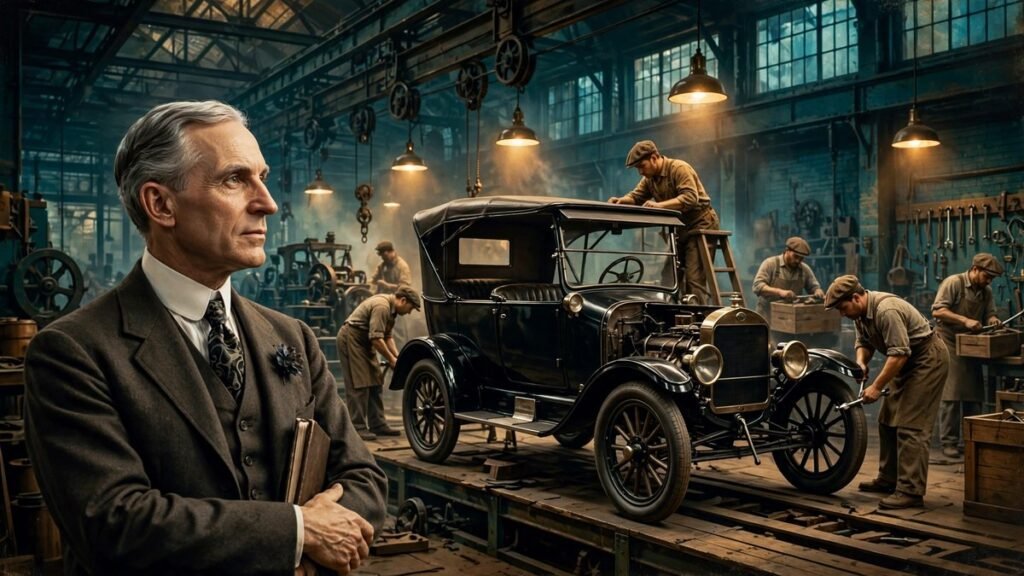
Henry Ford did not invent the automobile, and he did not invent the factory. What he did was far more important: he made the car something ordinary people could own, and in doing so he changed how the world moved, worked and lived. Born on a farm in Michigan in 1863, Ford grew up repairing watches and farm machinery, fascinated by engines and frustrated by how expensive and unreliable early cars were. He believed a car should be simple, strong, affordable and easy to repair, and he spent more than a decade chasing that idea through failures, bankruptcies and sceptics who told him the automobile was a rich man’s toy.
The breakthrough came in 1908 with the Model T, a plain, sturdy car that cost a fraction of its rivals and could handle muddy country roads that defeated fancier machines. But the Model T alone was not the revolution. The revolution was how Ford built it. In 1913 his team introduced the moving assembly line, cutting the time needed to build a car from more than twelve hours to about ninety minutes. Prices fell year after year, and by the 1920s more than half the cars on American roads were Model Ts. Ford had turned a luxury into a necessity, and the modern consumer economy was born in the process.
Ford’s story is also a story of contradictions. He paid his workers far more than anyone else, then fought their unions fiercely. He built a company that democratised travel, then resisted change so stubbornly that his own firm nearly fell behind. He was a farm boy who became one of the richest men in history, yet he never lost his suspicion of bankers, experts and inherited wealth. This is the full story of how Henry Ford did it, what it cost him, and what his life still teaches anyone trying to build something that lasts.
Key takeaways
- Henry Ford did not invent the car, but he made it affordable: the Model T dropped from $850 in 1908 to $260 by 1925.
- The moving assembly line, introduced in 1913, cut Model T build time from over 12 hours to about 90 minutes.
- In 1914 Ford doubled wages to $5 a day, cutting worker turnover and creating customers who could afford his own cars.
- More than 15 million Model Ts were built between 1908 and 1927, putting America, and then the world, on wheels.
- Ford’s later stubbornness is the cautionary half of the story: refusing to update the Model T let rivals like General Motors overtake him.
From a Michigan Farm to the Machine Shop
Henry Ford was born on 30 July 1863 on a farm in Greenfield Township, Michigan, near Detroit. His father William was an Irish immigrant farmer who expected his son to take over the land. Henry had other ideas. As a boy he took apart watches and put them back together, and by his teens he was the neighbourhood repairman for anything with gears. At sixteen he left the farm for Detroit, where he worked as an apprentice machinist and spent his evenings repairing watches in a jewellery shop.
The sight that changed his life came in 1876, when he saw a steam-powered road engine clanking along a country lane. Ford later said he knew in that moment that the horse was finished. He returned to the farm for a few years, married Clara Bryant in 1888, and worked as an engineer at the Edison Illuminating Company in Detroit, rising to chief engineer. Edison himself encouraged Ford’s experiments with a petrol engine, and in his spare time Ford built his first vehicle in a brick shed behind his house.
That first vehicle, the Quadricycle, was finished in 1896. It had four bicycle wheels, a two-cylinder engine and no brakes to speak of, and Ford had to knock down part of the shed wall to get it out. It worked, and it convinced him that a practical automobile was possible. What he still lacked was money and a business that could survive long enough to build cars at scale.
Two Failures Before the Ford Motor Company
Ford’s first company, the Detroit Automobile Company, was founded in 1899 and failed within two years. Its cars were expensive, unreliable and slow to build, and Ford argued constantly with his backers about quality versus speed. His second venture, the Henry Ford Company, ended in 1902 when he walked out after a dispute with his partners, who renamed it Cadillac. Two failures in three years would have ended most careers. Ford treated them as tuition.
What he carried away from those failures was a clear picture of what not to do. Cars should not be handmade luxuries for the rich. They should be built from interchangeable parts, assembled quickly, and sold at a price a working family could afford. In 1903, with $28,000 raised from a group of Detroit investors, he founded the Ford Motor Company for the third time, at the age of forty. The early years were still a struggle: the company nearly ran out of money in its first months, and it built a series of models, from the Model A through the Model S, each one teaching Ford something new about design and production.
The turning point was a legal battle. The Association of Licensed Automobile Manufacturers claimed a patent on the petrol automobile and tried to drive Ford out of business. Ford refused to pay, fought the case for eight years, and won in 1911. The victory made him a folk hero and cleared the way for everything that followed. He was now free to build the car he had always imagined.
The Model T: A Car for the Great Multitude
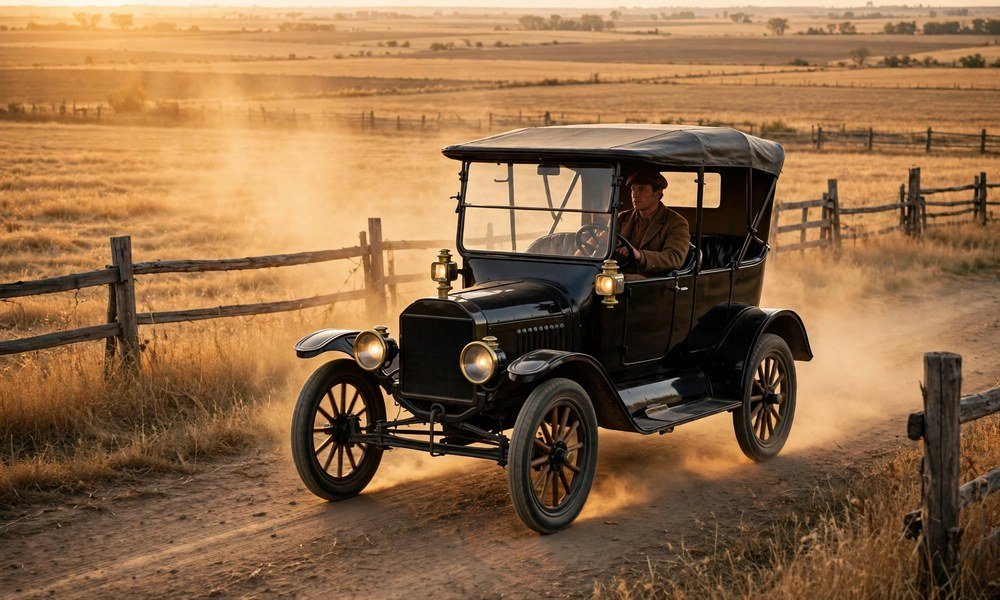
Introduced in October 1908, the Model T was deliberately plain. It had a 20-horsepower engine, a top speed of about 45 miles per hour, and a high chassis that could clear ruts and rocks on unpaved roads. It was light, tough and easy to repair, and a farmer could fix most problems with basic tools. The price was $850, already far below most rivals, and Ford’s famous promise was that he would build a car for the great multitude.
The Model T became a phenomenon. Farmers used it to haul goods and power farm machinery. Doctors used it to reach patients in bad weather. Families used it for Sunday drives that would have been impossible on horseback. Ford’s dealers sold cars as fast as the factory could make them, and demand kept growing. Between 1908 and 1927, more than 15 million Model Ts were built, a production record that stood for decades.
Like other builders of lasting companies, Ford understood that a product succeeds when it solves a real problem for ordinary people. The same instinct drove Howard Schultz to turn a small Seattle coffee chain into a global ritual, and it explains why the Model T mattered more than any faster or fancier car of its era.
The Assembly Line Changes Everything
By 1913 demand for the Model T was so high that Ford’s factory could not keep up. His engineers, led by William Klann and others, studied how workers moved and how parts flowed through the plant. Their answer was the moving assembly line: a conveyor belt that carried each car chassis past workers who each performed one small, repeated task. The first line, for flywheel magnetos, cut assembly time from twenty minutes to five. When the system was applied to the whole car, build time fell from more than twelve hours to about ninety minutes.
The results were extraordinary. Output soared, costs fell, and Ford cut the price of the Model T year after year. By 1916 it sold for $360, and by 1925 it cost just $260. A car that had once been a luxury was now within reach of a factory worker’s wages. Ford’s factories also pioneered standardised parts, so any Model T could be repaired with parts from any other, and a vast dealer network spread across America and then the world.
There was a human cost, and Ford knew it. Assembly line work was repetitive and exhausting, and workers quit in droves. In 1913 the company’s annual turnover was over 300 percent, meaning it had to hire three workers for every job each year. The assembly line was a triumph of engineering, but it was also a test of how a company treats the people who make its products.
The $5 Day: Paying Workers Enough to Buy the Product
Ford’s answer, announced in January 1914, shocked the business world: he doubled the minimum daily wage to $5, more than twice the going rate, and cut the working day from nine hours to eight. Newspapers called it madness, and shareholders threatened to sue. Ford’s reasoning was practical as well as moral. He wanted to keep his best workers, reduce the cost of constant hiring and training, and, in his own words, create customers. A worker who earned $5 a day could afford to buy a Model T, and many did.
The policy worked. Turnover collapsed, productivity rose, and thousands of men queued outside Ford’s gates for jobs. The $5 day also spread through American industry as rivals raised wages to compete for workers. Ford had shown that higher pay could be a business strategy rather than a charitable gesture, and the idea that workers should earn enough to buy what they make became a foundation of the twentieth-century economy.
How Ford Built an Empire
The Model T made Ford enormously wealthy, but his ambition went further than cars. He built the River Rouge complex, the largest factory in the world, where iron ore, coal, timber and rubber entered one end and finished cars left the other. He bought mines, forests, railways and ships so that his company controlled its own supply chain from raw material to showroom. At its peak, the Rouge employed more than 100,000 workers.
Ford also understood the power of a simple, consistent brand. The Model T came in one colour for years, black, because black paint dried fastest on the assembly line, and Ford joked that customers could have any colour they wanted as long as it was black. The joke became legend, and the car’s reliability did the rest of the selling. Ford spent little on advertising compared with his rivals, because the product and the price spoke for themselves.
| Milestone | Year | Why it mattered |
|---|---|---|
| Quadricycle built | 1896 | Ford’s first working automobile, built in a shed behind his house |
| Ford Motor Company founded | 1903 | Third attempt after two failures, with $28,000 in capital |
| Model T launched | 1908 | Affordable, durable car for ordinary families; priced at $850 |
| Moving assembly line | 1913 | Build time fell from 12+ hours to about 90 minutes |
| $5 day introduced | 1914 | Wages doubled, turnover collapsed, workers became customers |
| 15 millionth Model T | 1927 | Model T production ends after a record-breaking run |
| Model A launched | 1927 | Ford’s successor car, built after a six-month factory shutdown |
The Other Side of Henry Ford
No honest account of Henry Ford ignores his flaws. He was a brilliant engineer and a difficult man. He distrusted experts, bankers and universities, and he ran his company as a personal kingdom, firing executives who disagreed with him and spying on his own workers. His anti-union stance hardened over the years, and in the 1930s his security chief Harry Bennett used intimidation against union organisers, a policy that damaged Ford’s reputation and led to violent clashes with workers.
Ford also held and published prejudiced views, including antisemitic writings in his newspaper, the Dearborn Independent, for which he later apologised. These are not footnotes; they are part of the record, and they remind us that great achievement does not make a person admirable in every respect. The lesson is not to excuse the flaws but to learn from both halves of the life.
His greatest business mistake came from the same stubbornness. By the mid-1920s, customers wanted comfort, colour and style, and General Motors was offering exactly that with its annual model changes and instalment buying. Ford refused to change the Model T for years, insisting that what had worked would keep working. By the time he finally shut the line down in 1927 to build the Model A, General Motors had overtaken Ford in sales. The man who had revolutionised the industry had been revolutionised past.
Lessons from the Ford Story
The first lesson is to solve for the customer nobody else is serving. Ford’s rivals built cars for the rich; he built one for the farmer, the doctor and the factory worker, and the market he unlocked was vastly larger than the one he left behind. The second lesson is that process is a product. The assembly line was not a car, but it was the innovation that made the car affordable, and it mattered as much as any engine design.
The third lesson is that treating workers well can be a competitive advantage. The $5 day was attacked as reckless, yet it cut turnover, raised quality and created a generation of customers. The fourth lesson is the cautionary one: the habits that make a founder successful can become the habits that hold a company back. Ford’s refusal to adapt nearly destroyed the company he built, and only a painful reinvention saved it.
That pattern of bold beginnings followed by the hard work of reinvention appears in many great success stories. Jack Ma built Alibaba from nothing and kept reinventing it as the internet changed, while Jan Koum turned a simple idea for private messaging into WhatsApp by refusing to compromise on what users actually wanted. Ford belongs in that company, not because he was flawless, but because his idea was bigger than any single product.
Checklist: What Henry Ford Teaches Builders Today
- Start with the customer everyone else ignores, not the one everyone else is chasing.
- Make the process as important as the product: speed, cost and consistency are features.
- Pay people well enough to stay, and well enough to buy what you make.
- Standardise parts and systems so quality does not depend on one person’s skill.
- Control your supply chain where it matters, so shortages cannot stop you.
- Never let yesterday’s success stop you from changing: the market moves whether you do or not.
Frequently Asked Questions
Did Henry Ford invent the automobile?
No. Cars were being built in Europe and America before Ford, by inventors such as Karl Benz and the Duryea brothers. Ford’s achievement was making the car affordable and reliable for ordinary people, and inventing the mass-production system that made that possible.
How many Model Ts were built?
More than 15 million Model Ts were built between 1908 and 1927. It was the best-selling car in history for decades, and by the early 1920s more than half of all cars on American roads were Model Ts.
What was the $5 day?
In January 1914, Ford doubled his workers’ minimum pay to $5 a day and cut the working day to eight hours. The move slashed employee turnover, boosted productivity, and meant his own workers could afford to buy the cars they built.
Why was the Model T only available in black?
For most of its production run the Model T was sold only in black because black paint dried fastest on the moving assembly line. Early Model Ts came in other colours, but as production sped up, black became the standard to keep the line moving.
What happened to the Ford Motor Company after the Model T?
Ford shut down Model T production in 1927 and retooled his factories for the Model A, which sold well. The company later became one of the world’s largest car makers, and the Ford family still controls it today through special voting shares.
What is Henry Ford’s lasting legacy?
Ford’s legacy is mass production, the affordable car, and the idea that ordinary workers should earn enough to take part in the prosperity they help create. His methods spread to every industry, from electronics to food, and shaped the modern world.
The Bottom Line
Henry Ford’s success story is the story of an idea that was bigger than a car. He believed that a machine built for everyone would change everyone’s life, and he was right. The Model T put America on wheels, the assembly line remade manufacturing, and the $5 day rewrote the relationship between employers and workers. His fortune followed from that idea, not the other way around.
His failures are part of the lesson too. The same stubbornness that carried him through two bankruptcies and an eight-year patent fight later blinded him to a changing market. The builders who last are the ones who keep Ford’s curiosity and discipline while avoiding his refusal to change. Build for the multitude, pay people properly, perfect the process, and never stop listening to what the world is asking for next.
Note: Figures in this article, including Model T prices and production totals, are widely reported historical estimates and may vary slightly between sources. This story is published for inspiration and education.

Keep what speaks to you.
Leave room for your own perspective.