
Amelia Earhart did not become a legend because she was fearless. She became a legend because she was afraid, prepared anyway, and flew through it. When she took off alone across the Atlantic Ocean in 1932, she was a young woman from Kansas with a leather jacket, a single-engine aeroplane, and a belief that women belonged in the sky just as much as men did. The world had told her, in a hundred polite and impolite ways, that flying was not a woman’s work. She answered not with an argument but with a flight log full of records that no one could argue with.
Her story still matters because it is not only a story about aviation. It is a story about how a person builds a life around a purpose, how courage is practised in small steps before it is tested in large ones, and how a legacy can outlive a life. Earhart never reached the end of her final flight, yet her name is known in almost every country on earth. She showed that success is not always measured by arriving safely. Sometimes it is measured by how far you are willing to go, how many doors you open for the people who come after you, and how honestly you live the values you claim to hold.
This is the full story of Amelia Earhart: the restless child who climbed trees and collected newspaper clippings about women who achieved great things, the young nurse and social worker who discovered flying almost by accident, the pilot who broke record after record, and the trailblazer whose disappearance in 1937 turned her into a mystery the world has never stopped trying to solve. It is also a practical story, full of lessons about preparation, persistence, and the quiet discipline that makes bold dreams possible. Face Zem tells her story because it belongs at the heart of what success really means.
Key takeaways
- Amelia Earhart was the first woman to fly solo across the Atlantic Ocean, completing the crossing in 1932 in just under 15 hours.
- She set many aviation records, including the first solo nonstop flight by a woman across the United States and the first solo flight from Hawaii to the United States mainland.
- Her success was built on careful preparation, sponsorship, public speaking, and writing, not on luck or reckless daring.
- She used her fame to open doors for women in aviation, helping to found the Ninety-Nines, an organisation for women pilots.
- Her disappearance during a 1937 attempt to fly around the world remains unsolved, but her legacy as a pioneer of courage and equality endures.
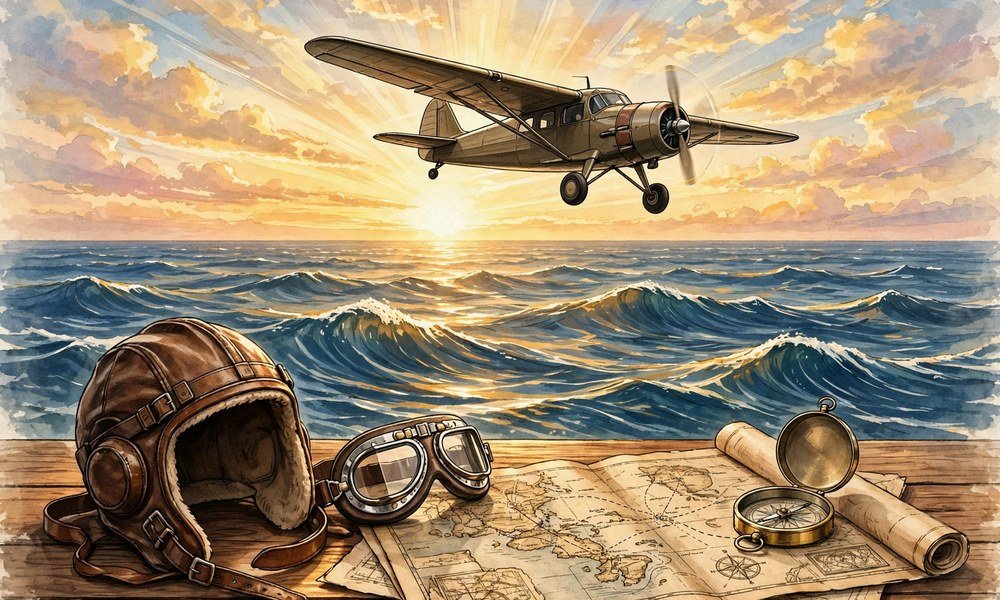
The Girl Who Wanted to See the World
Amelia Mary Earhart was born on 24 July 1897 in Atchison, Kansas, in the home of her grandparents. Her father, Edwin Earhart, worked for a railway company, and her mother, Amy, came from a well-known local family. Amelia and her younger sister Muriel, who was nicknamed Pidge, grew up in a household that was loving but often unsettled, because Edwin’s work moved the family from town to town and his drinking created financial strain. The girls spent long stretches living with their grandparents in Atchison, a house with a wide porch, a library full of books, and a view of the Missouri River that made the world beyond Kansas feel close and possible.
From the start, Amelia was not the kind of girl her neighbours expected her to be. She climbed trees, collected insects, built a homemade roller coaster in a toolshed, and rode a sled belly-first down steep hills. She kept a scrapbook of newspaper cuttings about women who had achieved remarkable things in medicine, politics, and sport. She loved reading, and she loved the idea that a woman could choose a life that was useful, adventurous, and entirely her own. Her grandmother worried about her tomboy ways, but Amelia’s mother encouraged her daughters to read widely, think for themselves, and never accept that being a girl was a limitation.
School was a mixed experience. Amelia attended several schools as the family moved, and she was a bright, curious student who did well in science and literature. She finished high school in Chicago and then studied at Ogontz School near Philadelphia. She left Ogontz early to train as a nurse’s aide in Toronto during the First World War, working in a military hospital and caring for wounded soldiers. The work was hard, long, and often heartbreaking, but it taught her discipline, compassion, and the value of staying calm under pressure. Those qualities would serve her well in the cockpit, where panic is the most dangerous passenger of all.
After the war, Amelia tried several paths. She studied medicine briefly at Columbia University, worked as a social worker in Boston, and taught English to immigrant families. She was searching for a purpose, and she did not yet know what it was. She had seen an aeroplane at a fair in Toronto in 1918, and a pilot had flown low over her head as if to scare her. She stood her ground. Two years later, at a flying exhibition in California, she took her first short flight as a passenger. It lasted ten minutes. When she landed, she knew with complete certainty that she wanted to fly. She later wrote that she had found the thing she was meant to do, and from that moment she worked toward it with a focus that surprised everyone who knew her.
Learning to fly in 1921 was expensive, unusual, and difficult for a woman. Amelia worked as a telephone operator, a truck driver, a stenographer, and a photographer to pay for lessons. Her instructor was Neta Snook, one of the first women pilots in the United States, who taught her in a Curtiss JN-4 biplane nicknamed the Canuck. Amelia bought her first aeroplane the same year, a bright yellow Kinner Airster she called the Canary, and she practised takeoffs and landings until her hands knew the controls without thinking. In October 1922, she set her first record, flying to an altitude of 14,000 feet, the highest any woman had flown at the time. She was twenty-five years old, and she had only been flying for a year.
The early years of her flying career were a mixture of triumph and hardship. The aviation industry was small, dangerous, and dominated by men who did not always welcome women. Aeroplanes were unreliable, weather forecasting was primitive, and many pilots died in crashes. Amelia crashed the Canary and walked away, repaired it, and flew again. She sold the aeroplane when money ran short, worked as a social worker in Boston, and kept flying whenever she could. She understood something that many ambitious people miss: a dream is not a single dramatic decision. It is a series of small, practical choices made over years, often while doing ordinary work to pay the bills.
The Atlantic Crossing That Changed Everything
Amelia Earhart became famous in 1928, when she was invited to be the first woman to cross the Atlantic by air. The flight was organised by the publisher George Palmer Putnam, who was looking for a woman pilot to match the achievement of Charles Lindbergh, who had flown solo across the Atlantic the year before. Amelia was chosen because she was a capable pilot, a good writer, and a poised public speaker. She flew as a passenger, with pilot Wilmer Stultz and mechanic Louis Gordon handling the controls, in a Fokker Friendship named for the friendship between the United States and Britain. The crossing took just over twenty hours, and when the aeroplane landed in Wales, Amelia was suddenly one of the most famous women in the world.
Fame brought attention, but Amelia was determined that it should also bring opportunity. She did not want to be celebrated only as a passenger. She wrote a book about the flight, gave lectures across the country, and used the money to buy a better aeroplane and keep flying. She married George Putnam in 1931, after telling him plainly that she would not accept a traditional marriage that confined her to a house. Putnam, to his credit, understood. He became her manager, promoter, and partner, and he supported her flying even when it frightened him. Their partnership was unusual for its time, built on mutual respect and a shared understanding that Amelia’s work mattered.
In May 1932, five years after Lindbergh’s crossing, Amelia Earhart flew solo across the Atlantic. She took off from Harbour Grace in Newfoundland in a red Lockheed Vega, intending to land in Paris. The flight was brutal. She flew through storms, icing, and mechanical trouble. A leak in the fuel line sent petrol dripping onto her shoulder. A crack in the exhaust manifold sent flames licking from the engine. She flew through the night with no radio contact, navigating by compass and by the stars. After fourteen hours and fifty-six minutes, she landed in a pasture near Londonderry in Northern Ireland, startling a farmer who came to see what had fallen from the sky. She was the first woman to fly solo across the Atlantic, and only the second person ever to do it alone.
The welcome she received was extraordinary. She was given a ticker-tape parade in New York, awarded the Distinguished Flying Cross by the President of the United States, and celebrated in London and Paris. But the most important thing about the solo Atlantic flight was not the celebration. It was the proof it offered. Amelia had shown that a woman could fly alone, in bad weather, over open ocean, in a single-engine aeroplane, and survive. She had turned a symbol into a fact. Young women who had been told that flying was not for them could now point to a woman who had done it, and the argument was over.
Amelia understood the power of that proof, and she used it deliberately. She became the first president of the Ninety-Nines, an organisation founded in 1929 for women pilots, and she worked tirelessly to support other women in aviation. She encouraged women to learn to fly, to take engineering courses, and to demand a place in an industry that had been closed to them. She also understood that her public image mattered. She designed her own flying clothes, endorsed products, and wrote magazine articles, because she knew that a woman pilot who looked competent and professional would be taken more seriously than one who did not. Her success was not only about skill in the air. It was about skill in building a career, a reputation, and a movement.
Records, Endorsements and a Life in the Public Eye
After the Atlantic crossing, Amelia Earhart kept setting records. In August 1932, she became the first woman to fly solo nonstop across the United States, from Los Angeles to Newark, New Jersey, in just over nineteen hours. In January 1935, she became the first person to fly solo from Honolulu, Hawaii, to Oakland, California, a crossing of more than two thousand miles over open ocean that many experienced pilots had considered too dangerous to attempt. Later that year, she flew solo from Los Angeles to Mexico City, and from Mexico City to Newark. Each flight was carefully planned, sponsored, and publicised, because Amelia understood that aviation records were not only personal achievements. They were also demonstrations that air travel was becoming safer, more reliable, and more useful for ordinary people.
Like many public figures, Amelia faced criticism. Some people said she was only famous because of her looks, her husband’s publicity, or her luck. Some pilots resented the attention she received when they had flown further or faster without recognition. Amelia rarely answered her critics directly. She answered them by flying. She also answered them by being honest about her fears. She never claimed to be fearless. She said that courage was the price that life exacted for granting peace, and that the most difficult thing was the decision to act. The rest, she said, was merely tenacity. That attitude, more than any single record, is the reason her story still resonates. She made courage sound like something ordinary people could practise, not something only heroes possessed.
The Final Flight: Flying Around the World
By 1936, Amelia Earhart had achieved almost everything a pilot could achieve. She had crossed the Atlantic alone, crossed the United States alone, and crossed the Pacific alone. The one great challenge that remained was a flight around the world, following the equator as closely as possible. It was the most ambitious flight anyone had attempted, and it would require a specially equipped aeroplane, a navigator, careful planning, and sponsorship. Amelia, working with Purdue University and the Lockheed Aircraft Company, acquired a twin-engine Lockheed Electra, fitted with extra fuel tanks, radio equipment, and navigation instruments. Her navigator was Fred Noonan, an experienced former Pan American Airways navigator who knew the Pacific routes well.
The first attempt, in March 1937, ended in failure before it had properly begun. The Electra crashed on takeoff in Honolulu, damaged but repairable, and Amelia and Noonan were unhurt. The aeroplane was shipped back to California for repairs, and the flight was replanned to go in the opposite direction, from west to east, taking advantage of seasonal winds. The second attempt began on 1 June 1937, from Miami, Florida. Amelia and Noonan flew across the Caribbean, South America, Africa, the Middle East, India, Southeast Asia, and Australia. They covered more than twenty thousand miles in a month, landing in towns and cities where crowds gathered to see the famous pilot and her navigator. The flight was a triumph of planning, endurance, and teamwork, and for a while it looked as if they would succeed.
On 2 July 1937, Amelia and Noonan took off from Lae, New Guinea, heading for Howland Island, a tiny speck of land in the middle of the Pacific Ocean, less than two miles long and barely above sea level. The flight was about two thousand five hundred miles, and it was the most difficult leg of the journey. Howland Island was so small that finding it required precise navigation and radio communication with a United States Coast Guard cutter, the Itasca, which was stationed nearby. Amelia’s radio transmissions were heard, but they were faint and intermittent. Her last confirmed messages suggested that she was low on fuel and could not see the island. Then the transmissions stopped. Despite one of the largest search operations in history, involving ships, aeroplanes, and thousands of people, no trace of Amelia, Noonan, or the Electra was ever found.
The disappearance of Amelia Earhart became one of the great mysteries of the twentieth century. Theories have multiplied over the decades. Some say she ran out of fuel and ditched in the ocean. Some say she landed on a remote island and survived for a time. Some say she was captured, or that she lived under another name. Searchers have examined islands, reefs, and ocean floors, and they have found tantalising clues but no conclusive proof. The mystery is part of her legend, but it should not overshadow her life. Amelia Earhart’s story is not defined by how it ended. It is defined by what she did while she was alive, and by the doors she opened for others.
The Legacy She Left Behind
Amelia Earhart’s legacy is visible in every cockpit where a woman sits at the controls, in every classroom where a girl is encouraged to study science and engineering, and in every organisation that supports women in fields where they are still underrepresented. The Ninety-Nines, the organisation she helped to found and led as its first president, still exists today, supporting women pilots around the world. Her books, articles, and speeches are still read, and her name is still invoked whenever someone talks about courage, equality, and the freedom to choose an unconventional life. She became a symbol, but she was also a real person who worked hard, made mistakes, learned from them, and kept going.
Her influence extends beyond aviation. She showed that a woman could be both feminine and fiercely independent, both graceful and tough, both a public figure and a serious professional. She refused to choose between being a wife and being a pilot, between being fashionable and being competent, between being famous and being useful. She insisted on being all of those things at once, and she did it with a lightness and humour that made her achievements feel accessible rather than remote. Young people who read her story often say the same thing: she made them believe that their own dreams, however unlikely they seemed, might be possible. That is a rare and precious gift.
Her story also offers a useful corrective to the way success is often presented. Amelia Earhart did not succeed because everything went smoothly. She succeeded because she kept going when things went wrong. She crashed aeroplanes, ran out of money, faced scepticism, and lost friends in aviation accidents. She learned from each setback and tried again. Her success was not a straight line from talent to triumph. It was a winding path, full of detours, disappointments, and second chances. That is how most real success stories work, and it is why her story is more encouraging than the simple version in which a hero is born great and never struggles.
Like other trailblazers whose stories Face Zem celebrates, Amelia’s courage was not only about flying. The Maya Angelou success story shows a different kind of courage, the courage to turn pain into poetry and to speak truth to power, and it reminds us that success takes many forms. The Sheryl Sandberg success story shows how a modern leader built a career at the top of the technology industry while arguing that women should lean into opportunity rather than away from it. And the Malala Yousafzai success story shows a young woman who risked her life for the right of girls to go to school, and who turned survival into a global campaign for education. Together, these stories form a picture of success that is not about wealth or fame alone, but about using your gifts to open doors for others.
What We Can Learn from Amelia Earhart
The first lesson is that preparation is the foundation of courage. Amelia did not fly across the Atlantic on a whim. She studied, practised, planned, and tested her equipment. She knew her aeroplane, her route, and her limits. When things went wrong in the air, she had the knowledge and the calm to deal with them. Courage without preparation is recklessness. Courage with preparation is a skill that can be learned, practised, and improved. Anyone who wants to attempt something difficult should start not by being brave, but by being prepared.
The second lesson is that small steps lead to large achievements. Amelia did not start by flying across an ocean. She started with a ten-minute flight, then flying lessons, then a small aeroplane, then a record, then a longer flight, then a longer one still. Each step built her skill and her confidence. She understood that a large goal becomes manageable when it is broken down into smaller goals, each of which can be achieved and celebrated. That is true for any ambition, whether it is learning a new skill, starting a business, or changing a career. You do not need to see the whole path. You need to see the next step, and then the one after that.
The third lesson is that success is more powerful when it is shared. Amelia could have kept her achievements to herself, but she chose to use them to help other women. She founded an organisation, mentored young pilots, wrote articles, gave lectures, and advised students. She understood that a single success is a personal achievement, but a success that inspires others is a legacy. The people who are remembered longest are often not those who achieved the most for themselves, but those who made it easier for others to achieve.
The fourth lesson is that failure is part of the journey. Amelia crashed, ran out of money, and failed in her first attempt to fly around the world. She did not let those failures define her. She treated them as information, learned what she could, and tried again. That attitude is the difference between people who give up and people who succeed. Failure is not the opposite of success. It is a normal part of success, and it is often the most useful teacher. The question is not whether you will fail, but whether you will learn from failure and keep going.
The fifth lesson is that you do not need permission to pursue your dreams. Amelia lived at a time when women were expected to marry, stay at home, and avoid risk. She did not ask for permission to fly. She found a way to pay for lessons, found a teacher, found an aeroplane, and flew. She negotiated her marriage on her own terms, built a career on her own terms, and lived her life on her own terms. That does not mean she ignored other people. She listened to advice, accepted help, and worked with partners. But she did not wait for the world to tell her that she was allowed to fly. She flew, and the world caught up.
Amelia Earhart at a Glance
| Milestone | Date | What it meant |
|---|---|---|
| Born in Atchison, Kansas | 24 July 1897 | A restless, bookish child who loved adventure and independence |
| First flight as a passenger | December 1920 | A ten-minute flight that convinced her she was meant to fly |
| First altitude record | October 1922 | Flew to 14,000 feet, the highest any woman had flown |
| First woman across the Atlantic | June 1928 | Crossed as a passenger in the Fokker Friendship, became famous |
| First woman to fly solo across the Atlantic | May 1932 | Harbour Grace to Northern Ireland in 14 hours 56 minutes |
| First woman solo across the United States | August 1932 | Los Angeles to Newark nonstop in just over 19 hours |
| First solo flight Hawaii to mainland USA | January 1935 | Honolulu to Oakland, more than 2,000 miles over open ocean |
| World flight attempt begins | June 1937 | Miami departure with navigator Fred Noonan, 20,000 miles flown |
| Disappeared near Howland Island | 2 July 1937 | Last radio contact over the Pacific; never found |
Your Amelia Earhart Success Checklist
- Start with preparation, not bravado: study, practise, and plan before you attempt something difficult.
- Break a large goal into small steps, and celebrate each step as you complete it.
- Find a mentor or teacher who has done what you want to do, and learn from their experience.
- Build a support network of people who believe in your goal and will help you when things go wrong.
- Use your success to help others, whether by mentoring, teaching, or opening a door for someone else.
- When you fail, treat it as information, learn what you can, and try again with a better plan.
Frequently Asked Questions
Why is Amelia Earhart so famous?
Amelia Earhart is famous because she was the first woman to fly solo across the Atlantic Ocean, in 1932, and because she set many other aviation records in the 1920s and 1930s. She was also a writer, public speaker, and advocate for women in aviation, and her disappearance during a flight around the world in 1937 made her one of the most enduring figures of the twentieth century.
Was Amelia Earhart the first person to fly across the Atlantic?
No. Charles Lindbergh was the first person to fly solo across the Atlantic, in 1927. Amelia Earhart was the first woman to fly across the Atlantic as a passenger, in 1928, and the first woman to fly solo across the Atlantic, in 1932. She was the second person ever to fly solo across the Atlantic.
What happened to Amelia Earhart?
Amelia Earhart and her navigator Fred Noonan disappeared on 2 July 1937, during a flight from Lae, New Guinea, to Howland Island in the Pacific Ocean. Their last radio messages suggested they were low on fuel and could not find the island. Despite extensive searches, no wreckage was ever conclusively found, and the most widely accepted explanation is that the aeroplane ran out of fuel and was lost at sea.
What was the Ninety-Nines?
The Ninety-Nines is an international organisation for women pilots, founded in 1929. Amelia Earhart was its first president. The organisation was named for the 99 women pilots who were its founding members, and it still exists today, supporting women in aviation through scholarships, mentoring, and community.
Did Amelia Earhart write any books?
Yes. Amelia Earhart wrote several books, including a book about her 1928 Atlantic crossing and a book about her solo Atlantic flight and her flying career. She also wrote many magazine articles about aviation, women, and travel, and she was a popular public speaker who lectured across the United States.
What can young people learn from Amelia Earhart today?
Young people can learn that courage is a skill that can be practised, that preparation matters more than talent alone, that failure is a normal part of success, and that you do not need permission to pursue a dream. Her story also teaches the importance of using your success to help others, and of choosing a life that is useful, adventurous, and true to your own values.
The Bottom Line
Amelia Earhart’s success story is not a fairy tale. It is the story of a real woman who worked hard, took calculated risks, failed, learned, and tried again, until she achieved things that no woman had achieved before. She did not have special advantages. She had curiosity, discipline, and a refusal to accept that the world as it was had to stay that way. She flew because she loved flying, and she kept flying because she believed that every flight proved something important: that women could do what men could do, that aviation could change the world, and that a single person, with enough preparation and persistence, could change what was possible.
Her disappearance is a tragedy, but it is not the whole story. The whole story is a life lived fully, bravely, and generously, in the service of a dream that was larger than herself. Amelia Earhart once said that the most effective way to do it is to do it, and she lived by that advice. She did not wait for the perfect moment, the perfect aeroplane, or the perfect conditions. She prepared as well as she could, and then she flew. That is the lesson that endures, and it is a lesson that anyone can apply, in any field, in any time, in any place. The sky is not the limit. The limit is only the courage to begin.
Note: This article celebrates the life and achievements of Amelia Earhart as an inspirational success story. The circumstances of her disappearance in 1937 remain unresolved, and this article presents the most widely accepted historical account. Face Zem publishes success stories to inspire readers to pursue their own goals with courage, preparation, and persistence.

Keep what speaks to you.
Leave room for your own perspective.


