Groceries are one of the few expenses almost every household faces every single week, and in 2026 they have become one of the easiest places to find real savings. Food prices have stayed high, but the gap between a careless shopper and a careful one has never been wider. Two families can buy almost the same food and end up with weekly bills that differ by fifty dollars or more, simply because one of them plans, compares, and shops with intention while the other does not. The good news is that none of the habits that close that gap are difficult. They are small, repeatable choices that add up to hundreds or even thousands of dollars over a year.
Saving money on groceries is not about eating worse food or giving up the meals your family loves. It is about cutting the waste that hides inside an ordinary grocery budget: the impulse buys, the food that spoils before it is eaten, the premium brands that taste the same as the store brand, and the trips to the store that happen without a list. When you remove that waste, the food on your table stays just as good, and sometimes it gets better, because planned meals tend to be more varied and more home-cooked than last-minute ones. This guide walks through the strategies that work best in 2026, from meal planning and smart shopping to storage, cooking, and the apps and loyalty programs that can quietly lower your bill every week.
What follows is practical and realistic. You do not need to adopt every idea at once, and you do not need to become a coupon expert to see results. Start with the three or four strategies that fit your life, track your spending for a month, and then add more. Many households find they can cut their grocery bill by twenty to thirty percent without feeling deprived at all. The money you save can go toward an emergency fund, paying down debt, or simply breathing a little easier at the end of the month. That is the real prize: not a smaller grocery bill for its own sake, but the freedom that comes from spending less on something you have to buy anyway.
Key takeaways
- Plan your meals and shop from a list — it is the single most effective way to cut impulse spending and food waste.
- Store brands and bulk staples usually deliver the same quality as name brands for far less money.
- Shop sales, use loyalty programs and cashback apps, and compare unit prices instead of shelf prices.
- Reduce waste by using what you already have, storing food properly, and cooking in batches.
- Track your grocery spending monthly so you can see what is working and adjust before costs creep back up.
Start With a Meal Plan
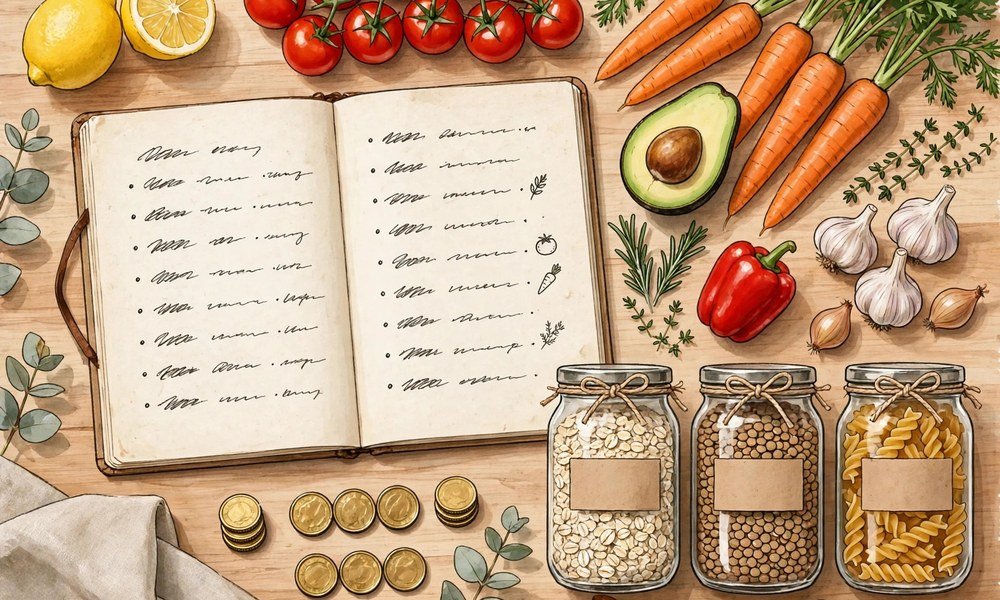
Meal planning is the foundation of every other grocery saving strategy, because it turns shopping from a guessing game into a mission. When you sit down once a week and decide what your household will eat for the next seven days, you buy only what those meals require. You stop buying ingredients you already have, you stop buying food that will sit unused in the fridge, and you stop making expensive last-minute trips for a single missing item. A plan also ends the daily question of what is for dinner, which is the moment when many families give up and order takeout instead.
A good meal plan does not need to be elaborate. Choose five or six dinners for the week, leave one night flexible for leftovers or a simple meal, and build the plan around what is already in your pantry and freezer. Check the weekly sales flyer before you plan, and let the best deals shape two or three of your meals. If chicken thighs are on sale, plan two chicken dinners. If seasonal vegetables are cheap, build meals around them. This kind of flexible planning saves more than a rigid plan ever will, because it follows the prices instead of fighting them.
Keep a running list of the meals your household actually likes and rotates well. Most families eat the same twenty or so meals again and again, and writing them down removes the mental effort of planning from scratch each week. A simple notebook, a notes app, or a whiteboard on the fridge all work. The goal is to make planning take ten minutes, not an hour. Over a month, a household that plans its meals typically spends noticeably less than one that shops without a plan, and the food waste drops sharply too. Pair your plan with one of the best budgeting methods for 2026 so your grocery spending fits inside a clear monthly target instead of drifting upward unnoticed.
Shop With a List and Stick to It
The shopping list is the meal plan in action. Write it from the plan, check your pantry and fridge before you leave, and treat it as a commitment rather than a suggestion. Shoppers who use a list spend less than shoppers who browse, and the reason is simple: a list removes decisions from the store, where every display, smell, and end-cap is designed to make you buy something extra. The average impulse item may cost only a few dollars, but several of them on every trip add up to a large sum over a year.
Organize your list by store section — produce, dairy, meat, pantry, frozen — so you move through the store efficiently and are less tempted to wander down aisles you do not need. Shop alone when you can, because extra hands in the cart tend to add extra items. Avoid shopping when you are hungry, since hunger reliably increases both the number of items and the total bill. And give yourself a simple rule: if it is not on the list, it does not go in the cart unless it replaces something of equal value that you are removing.
It also helps to shop less often. Every extra trip to the store is another chance to buy things you did not plan to buy. Many households save money by moving from three or four small trips a week to one large weekly shop, with perhaps one short midweek trip for fresh items. Fewer trips also mean less fuel and less time spent shopping. If you find yourself at the store almost daily, try a two-week experiment with a single weekly shop and see how much your spending drops.
Compare Unit Prices, Not Shelf Prices
The price on the shelf tag tells you what a package costs, but the unit price tells you what the food inside it costs, and the difference matters. A large bag of rice that costs more than a small bag is usually cheaper per ounce, but not always — sometimes the medium size is the best deal, and sometimes a sale makes the smaller package cheaper. The unit price, printed on most shelf labels, lets you compare fairly across sizes and brands in seconds. Make a habit of glancing at it, especially for staples you buy every week like coffee, cereal, cooking oil, and laundry detergent.
Unit pricing is also the key to knowing whether a bulk buy is actually a bargain. Warehouse clubs can save money on items you use quickly, but they can waste money on items that spoil before you finish them. A giant tub of spinach is only a bargain if you eat it before it wilts. A bulk pack of chicken is only a bargain if you freeze most of it the day you bring it home. Before buying in bulk, ask three questions: will we use it all before it expires, do we have room to store it, and is the unit price genuinely lower than the regular store price? If the answer to any of these is no, skip it.
Keep a simple price book, even a mental one, for the ten or fifteen items you buy most often. When you know that your usual coffee is four dollars a bag at one store and six at another, you can spot a real sale instantly and stock up when the price is right. Over time this knowledge becomes second nature, and you stop paying full price for anything you buy regularly.
Choose Store Brands and Generic Products
Store brands have changed dramatically in the past decade. In blind taste tests, store-brand versions of pantry staples, canned goods, frozen vegetables, dairy, and paper products frequently match or beat the name brands they sit beside, at prices twenty to forty percent lower. The biggest savings come from the items you buy most often: milk, eggs, bread, pasta, rice, canned tomatoes, frozen vegetables, and cleaning supplies. Switching just these staples to store brands can cut a weekly bill by ten dollars or more without any change to what your family eats.
The best approach is to test store brands one category at a time. Start with the items where brand differences are smallest, such as sugar, flour, salt, and canned beans. Then move to dairy and frozen goods. Keep buying the name brand only for the two or three items where your family genuinely notices a difference, and be honest about whether the difference is real or just habit. Many households discover that after a month of store brands, nobody can tell the difference at all.
Generic products also shine in the pharmacy and household aisles. Store-brand medicines contain the same active ingredients as the name brands, and store-brand cleaning products usually work just as well. Since these items are often bought at the grocery store anyway, switching them to generics is an easy extension of the same habit. The savings are real money, and unlike a coupon, they require no extra effort once you have made the switch.
Buy Seasonal and Local Produce
Fresh produce is cheapest when it is in season, because supply is high and transport costs are low. Strawberries in June cost far less than strawberries in January, and they taste better too. Building your meals around seasonal produce is one of the most pleasant ways to save money, because it naturally adds variety to your cooking through the year. In spring, asparagus, peas, and leafy greens are affordable. In summer, tomatoes, corn, zucchini, and berries are at their best and cheapest. In autumn, squash, apples, and root vegetables take over. In winter, citrus, cabbage, and potatoes offer the best value.
Farmers markets can be excellent for seasonal produce, especially near closing time when vendors discount what remains, but compare prices before assuming the market is always cheaper. Some markets are more expensive than supermarkets, while others are far cheaper. A good rule is to buy your seasonal staples wherever they cost least, and to use the market for items that are genuinely fresher or cheaper there. If you have space, a small garden can also cut costs: herbs, tomatoes, lettuce, and peppers are easy to grow and expensive to buy, and even a few pots on a balcony can save money across a summer.
Frozen vegetables and fruit deserve a place in every budget. They are picked and frozen at peak ripeness, they cost less than fresh out-of-season produce, and they never spoil in the fridge. Keep frozen peas, broccoli, spinach, mixed berries, and mango on hand for smoothies, stir-fries, soups, and side dishes. Canned produce is another affordable option, especially tomatoes, beans, and corn, which are pantry workhorses. Just check the labels and choose versions without added sugar or excess sodium where possible.
Use Sales, Coupons, and Loyalty Programs
Every major grocery chain now runs a loyalty program, and in 2026 these programs are where many of the best prices hide. Digital coupons, member-only prices, and personalized offers can cut ten to twenty percent from a weekly shop, but only if you actually use them. Before each shop, spend five minutes checking the store app for coupons on items already on your list. Clip only what you need — a coupon for something you would not otherwise buy is not a saving, it is spending.
Sales cycles are predictable. Most grocery items go on sale every six to eight weeks, which means you can stock up on non-perishables when the price is lowest and avoid buying them at full price in between. Pasta, canned goods, cereal, coffee, and cleaning supplies all follow this pattern. When your regular coffee drops to its lowest price, buy enough for six weeks. When pasta is on sale, fill a shelf. This stockpile approach works best for items with a long shelf life that your household uses steadily.
Cashback apps and rebate apps add another layer of savings on top of store sales. They typically return a small percentage on everyday items or offer rebates on specific products, and the amounts add up over a year. Credit cards that offer extra cashback on groceries can help too, but only if you pay the balance in full every month — interest charges erase any grocery savings many times over. The safest approach is to treat every discount as a bonus on top of a plan you would follow anyway, not as a reason to buy more.
Reduce Food Waste
Food waste is the silent leak in most grocery budgets. The average household throws away a surprising share of the food it buys, and every item in the bin is money spent for nothing. Reducing waste starts with the plan and the list, but it continues in the kitchen. Store food properly so it lasts: keep herbs in water like flowers, store lettuce with a paper towel to absorb moisture, freeze bread you will not use within a few days, and keep your fridge at the right temperature so dairy and produce stay fresh longer.
Use what you have before you buy more. A weekly fridge clean-out, where you check what needs using and build a meal around it, prevents the forgotten leftovers and wilting vegetables that end up wasted. Cook with the ingredients that are closest to expiring first. Turn stale bread into croutons or breadcrumbs, turn ripe bananas into muffins or smoothies, and turn leftover vegetables into soup, stir-fry, or an omelette. A pot of soup or a tray of roasted vegetables at the end of the week can turn several small leftovers into a real meal.
Batch cooking is one of the most effective waste-reduction habits. Cook a large pot of rice, beans, soup, or stew on the weekend, portion it into containers, and freeze what you will not eat within three days. Batch cooking saves money in three ways: it uses cheaper ingredients in larger quantities, it prevents the weeknight takeout order that happens when there is nothing ready to eat, and it turns leftovers into planned lunches instead of waste. Freezing is your friend here — label containers with the contents and the date so nothing gets lost in the back of the freezer.
Cook More and Eat Out Less
Home cooking is almost always cheaper than eating out, and the gap is largest for everyday meals. A restaurant meal for a family of four can easily cost five times as much as the same meal cooked at home, and even takeout adds up fast when it becomes a weekly habit. Cooking at home does not have to mean elaborate dinners every night. Simple meals — pasta with vegetables, rice and beans, sheet-pan chicken with potatoes, soup with bread — are fast, cheap, and satisfying. The trick is having a few reliable recipes you can make without thinking, so cooking feels easier than ordering.
Breakfast and lunch are the easiest places to start. Making coffee at home instead of buying it saves a surprising amount over a year, and packing lunch instead of buying it can save hundreds of dollars a month for a working adult. Keep lunch simple: leftovers from dinner, a sandwich with fruit, or a grain bowl made from batch-cooked ingredients. If mornings are rushed, prepare lunch the night before so it is ready to grab on the way out.
That said, eating out is not the enemy — it is a treat that works best when it is planned rather than accidental. Set a monthly dining-out budget and enjoy it guilt-free, knowing that your everyday meals are handled at home. When you do eat out, look for lunch specials, early-bird menus, and restaurants that offer good value, and skip the extras like drinks and desserts that inflate the bill. A planned dinner out once a week is far cheaper than five unplanned takeout orders.
Shop the Right Stores and the Right Times
Not all grocery stores charge the same prices, and the differences can be large. Discount grocers often sell the same staples for twenty to thirty percent less than full-service supermarkets, and they are worth a regular visit for pantry items, dairy, and produce. Many households save the most by splitting their shopping: a weekly trip to a discount store for the bulk of the shop, and a smaller trip to a regular supermarket for the few items the discount store does not carry. The extra stop takes a little more time, but the savings usually justify it.
Timing matters too. Shopping early in the morning or late in the evening can mean first pick of markdowns on bakery items, meat, and produce nearing its sell-by date. These markdowns are often fifty percent off and perfectly fine if you cook or freeze the item the same day. End-of-day bakery markdowns are a classic example: bread, rolls, and pastries at half price, frozen at home for later use. Clearance shelves and discount bins are worth a quick look on every trip, but only for items you actually use.
Online grocery shopping can also save money, though it works differently. It removes impulse buying almost entirely, because you cannot wander the aisles, and it makes it easy to compare prices and track your total before you check out. Delivery fees and tips can eat into the savings, so compare the total cost carefully, and consider pickup, which is often free. For some households, a mix works best: online ordering for the weekly staple shop, and a short in-store trip for fresh produce and meat where seeing the quality matters.
Grow Your Savings Habit
Grocery savings work best when they are part of a bigger financial picture. The money you save on food should have somewhere to go, or it will quietly disappear into other spending. Decide in advance where your grocery savings go. Many households find that moving the savings into a separate account each month makes the habit stick, because the growing balance is visible proof that the effort is paying off. Even fifty dollars a month becomes six hundred dollars a year, and that is real money.
An emergency fund is one of the best destinations for grocery savings, because it turns a small weekly habit into genuine financial security. Learning how to build an emergency fund in 2026 gives your savings a clear purpose and a clear target, and the grocery money you save each week can be the steady contribution that builds it. If you are already carrying debt, grocery savings can also speed up repayment, and the combination of lower spending and faster debt payoff can change a household’s finances within a year.
The long-term goal is not to obsess over every cent but to build a set of habits that run on autopilot. Once meal planning, list shopping, store brands, and waste reduction become routine, they take almost no extra effort, and the savings continue month after month. That is the difference between a one-week grocery challenge and a lasting change. The families who save the most on groceries are rarely the ones who try hardest for a single week; they are the ones who build simple systems and follow them for years. If your grocery bill has been squeezing your budget, learning how to stop living paycheck to paycheck in 2026 can help you put these grocery strategies into a wider plan that frees up money every single month.
| Strategy | Typical Monthly Saving | Effort Required | Best For |
|---|---|---|---|
| Meal planning and list shopping | $80–$150 | Low — 10 minutes a week | Every household |
| Store brands and generics | $40–$80 | Low — switch once | Staples and household goods |
| Buying seasonal produce | $30–$60 | Low — follow the seasons | Fresh food lovers |
| Sales, coupons and loyalty apps | $30–$70 | Medium — check apps weekly | Regular shoppers |
| Reducing food waste | $50–$100 | Low — better storage and planning | Busy families |
| Cooking at home more often | $100–$200 | Medium — cooking habit | Takeout regulars |
| Shopping discount stores | $40–$90 | Low — one extra stop | Budget-conscious shoppers |
Your Grocery Saving Checklist
- Plan next week’s meals before you shop, and build the list from the plan.
- Check your pantry, fridge, and freezer first so you never buy duplicates.
- Compare unit prices on staples and stock up when the price hits its lowest point.
- Switch your most-bought items to store brands and test the difference honestly.
- Use loyalty apps and digital coupons only for items already on your list.
- Freeze leftovers and batch-cooked meals the same day, labelled with the date.
Frequently Asked Questions
How much can I realistically save on groceries in 2026?
Most households can save twenty to thirty percent on their grocery bill by planning meals, shopping with a list, switching to store brands, and cutting waste. For a family spending eight hundred dollars a month on groceries, that is roughly one hundred sixty to two hundred forty dollars a month, or about two thousand to three thousand dollars a year. Start with the easiest changes and add more over a few months.
Is meal planning really worth the time?
Yes. Ten minutes of planning each week typically saves far more than ten minutes of shopping time and prevents the unplanned purchases that inflate a grocery bill. It also reduces food waste and ends the daily stress of deciding what to cook. Families who plan consistently report lower bills, less waste, and calmer evenings.
Are store brands really as good as name brands?
For most pantry staples, dairy, frozen vegetables, and household products, store brands match name brands in quality and often come from the same manufacturers. Taste differences are usually small or nonexistent. Test them one category at a time and keep the name brand only where your family genuinely notices a difference.
Should I buy in bulk to save money?
Bulk buying saves money only when you use everything before it expires and the unit price is genuinely lower. It works best for non-perishables like rice, pasta, canned goods, and cleaning supplies, and for meat and bread that you freeze immediately. Avoid bulk perishables like fresh produce and dairy unless you can use them quickly.
Do cashback and coupon apps actually help?
Yes, when used on items you would buy anyway. Loyalty programs, digital coupons, and cashback apps can return ten to twenty percent on a weekly shop. They stop helping when they tempt you to buy things you do not need, so clip coupons only for items already on your list and treat the savings as a bonus, not a reason to spend more.
What is the best way to stop wasting food?
Plan meals around what you already have, store food properly, and use leftovers deliberately. A weekly fridge check, batch cooking, and freezing portions the same day they are cooked will cut waste sharply. Most households waste the most food on fresh produce and leftovers, so those are the two areas to watch first.
The Bottom Line
Saving money on groceries in 2026 comes down to a handful of habits that anyone can build: plan your meals, shop with a list, compare unit prices, choose store brands, buy seasonal food, use sales and loyalty programs wisely, waste less, and cook at home more often. None of these habits requires special skill or a big change in lifestyle, and together they can return hundreds of dollars a month to your household budget. Start with the three that feel easiest, track your spending for a month, and watch the savings appear. The food on your table will stay just as good, and your budget will finally have room to breathe.
Note: Grocery prices vary by region, store, and season, so the savings figures in this article are typical ranges rather than guarantees. Your results will depend on your household size, where you shop, and how consistently you follow the strategies. Use the ideas here as a starting point, adapt them to your life, and adjust your budget as prices change through the year.

Keep what speaks to you.
Leave room for your own perspective.