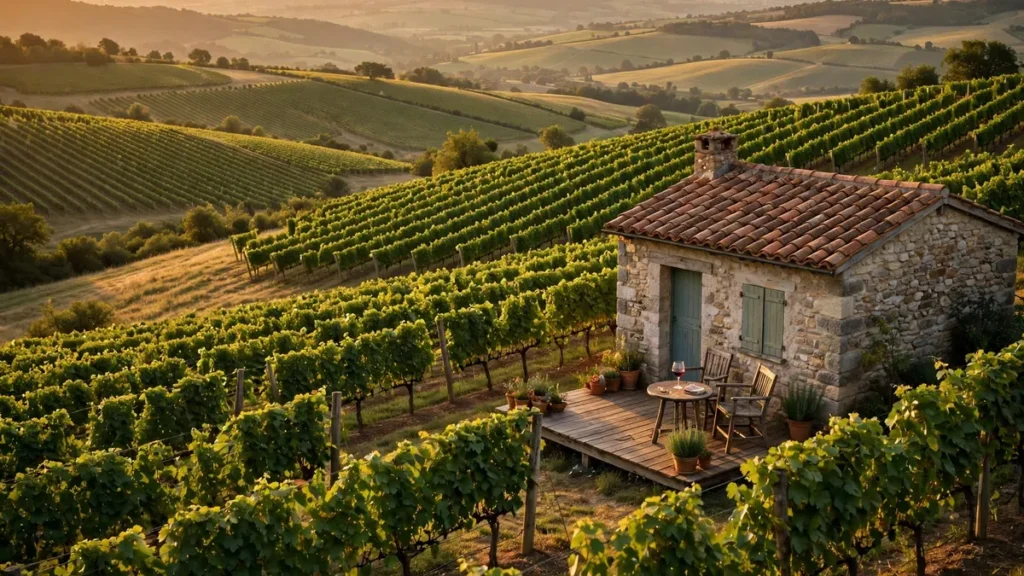
The best AI tools for vineyard stay startups in 2026 help a brand-new wine-country lodging business do the work of a much larger hospitality team from the very first harvest season. A vineyard stay is not a hotel that happens to sit near grapevines, and it is not a winery with a spare bedroom. It is a place where guests sleep among the vines: a cottage or a handful of rooms on a working vineyard, with tastings on the terrace, breakfast made from the garden, and the chance to watch the harvest happen outside the bedroom window. The rooms, the wine, and the land are one product, and guests book the whole experience, not just a bed.
That combination is what makes a vineyard stay both special and hard to run. A small team, often just the founders and one or two helpers, has to sell rooms and wine at the same time. A guest books a two-night harvest stay that includes a tasting, a vineyard walk, and a case of wine shipped home, and each part needs a room, a time slot, a guide, and the right stock. The tasting room can only hold so many people at once. The harvest crew needs the same paths the guests walk. A cottage needs cleaning and resetting between guests, and a wine club member arriving for a weekend expects a different welcome from a first-time visitor. If the systems behind those bookings do not talk to each other, the cracks show fast: a tasting gets double booked, a guest is charged for a case that was never shipped, or a room sits empty on a perfect autumn weekend because the price never moved.
This guide compares the best AI tools for vineyard stay startups across the jobs that decide whether a young vineyard stay survives its first seasons: bookings and property management, tasting and harvest experiences, guest communication, pricing for wine-country seasons, check-in and access, cleaning and turnovers, and vineyard stay money. Every tool is judged on the same practical tests. Does it understand a stay that sells rooms and wine together? Does it pay for itself in saved time, saved empty nights, or extra bookings? Can a small team set it up without hiring a specialist? The lessons here also overlap with the wider wine world, and the guide to the best AI tools for winery startups covers the vineyard and cellar side of the business, while the guide to the best AI tools for farm stay startups covers the rural lodging side. Use the table to shortlist, then read the detailed sections before you spend a dollar.
Key Takeaways
- Start with the vineyard stay’s biggest cost or biggest risk, usually empty rooms, slow replies to guest messages, or messy turnovers, and pick one AI tool that attacks it directly.
- Booking, property management, and dynamic pricing tools give most vineyard stays their fastest return, because they fill rooms and lift rates in the first season.
- Choose tools that sell rooms, tastings, and wine together in one booking, so a guest never has to book a stay and a tasting in two separate places.
- Guest experience matters as much as bookings, because a vineyard stay that delights guests earns five-star reviews, repeat visits, and wine club sign-ups that cost nothing in commission.
- Test every tool on one cottage, one tasting season, or one booking season first, measure the result for thirty days, and only then roll it out across the whole vineyard stay.

Best AI Tools for Vineyard Stay Startups at a Glance
The table below gives a quick comparison of the nine tools covered in this guide. Use it to shortlist candidates, then read the detailed sections before choosing. Prices change, so treat the figures as a guide to the tier each tool sits in rather than a quote.
| Tool | Best for | Typical starting cost | Setup effort | Standout strength |
|---|---|---|---|---|
| Little Hotelier | Bookings and property management | From around $109 per month | Moderate | One calendar for rooms, tastings, and add-ons |
| ThinkReservations | Reservations for small inns | From around $59 per month | Moderate | Built for small lodging teams |
| Beyond | Dynamic pricing for stays | From around 1% of revenue | Low | Rates that move with wine-country demand |
| Wheelhouse | Dynamic pricing and forecasting | From around $19 per month | Low | Clear price suggestions per night |
| Hospitable | Guest messaging automation | From around $49 per month | Low | Replies that sound like a person wrote them |
| Operto Guest | Smart check-in and access | From around $99 per month | Moderate | Keyless entry tied to the booking |
| Duve | Guest experience and upsells | From around $49 per month | Low | Guides, tastings, and wine sales in one place |
| Canary Technologies | Guest messaging and check-in | From around $79 per month | Moderate | Contactless check-in with upsells |
| TurnoverBnB | Cleaning and turnover automation | From around $8 per cleaning | Low | Turnovers scheduled without phone calls |
What Makes a Vineyard Stay Startup Different From Other Startups
A vineyard stay lives by the wine calendar, not by the quarter. Decisions made in winter decide what can be sold at harvest, and a mistake in pricing a crush weekend cannot be undone with a software update. Bud break, flowering, veraison, and harvest all pull in different directions, and a guest who arrives to find a tractor blocking the terrace and a locked tasting room will leave a review that travels faster than any advertisement. AI tools for a vineyard stay must respect that rhythm and help the founder plan ahead, react quickly, and keep records that make next season better than this one.
The third difference is that the workplace is a working vineyard and the guest is part of it. Tools must survive dust, heat, and bright sun, and they must work when the internet signal disappears behind a hill or inside a stone barn. The best AI tools for vineyard stay startups work from a phone, accept photos and voice notes, store data on the device, and sync later. A guest-facing tool must also be simple enough for a guest who has just driven three hours through wine country and wants to find their cottage, not read a manual.
The 9 Best AI Tools for Vineyard Stay Startups in 2026
1. Little Hotelier
Little Hotelier is a property management system built for small hotels, inns, and boutique stays, and it fits a vineyard stay because it treats rooms, experiences, and extras as one booking. A founder can list two cottages and a tasting room on the same calendar, set different prices for harvest weekends and quiet winter weeks, and take bookings from the vineyard stay website and from the big booking sites without double booking a single night. The channel manager keeps every listing in step, so a room sold on one site disappears from the others within minutes.
Setup takes a few days rather than a few hours, because the founder has to load rooms, rates, photos, and policies. The monthly cost sits in the middle of the range for small lodging software, and it pays for itself when it stops one double booking or fills one empty weekend. The main limit is that it is a lodging system first: it will not run the vineyard or the cellar, and a founder still needs a separate way to track wine stock. For a vineyard stay with up to a dozen rooms, it is a strong home base for bookings.
2. ThinkReservations
ThinkReservations is a reservation system designed for bed and breakfasts, inns, and small boutique properties, and it suits a vineyard stay that wants a simple, honest booking flow. Guests see live availability, pick their dates, add a tasting or a harvest experience, and pay a deposit without calling anyone. The founder sees a clean reservation book, a guest list for the week, and a clear picture of which rooms are empty on which nights.
The trade-off is scope. ThinkReservations does not try to be a full revenue management platform, and it does not manage cleaning teams or smart locks. A vineyard stay that grows past a handful of rooms may eventually want a bigger system. For the first one or two seasons, though, its simplicity is the point: a founder who is pruning vines in the morning and pouring tastings in the afternoon needs a booking system that runs quietly in the background, and this one does.
3. Beyond
Beyond is a dynamic pricing platform for short stays and small lodging businesses, and it earns its place at a vineyard stay because wine-country demand moves in sharp seasonal waves. Harvest weekends, wine festival dates, and long autumn weekends can command far higher rates than a rainy Tuesday in February, and a fixed price leaves money on the table in the busy weeks and empty rooms in the quiet ones. Beyond watches local demand, nearby listings, and booking pace, then suggests a price for every night.
Beyond usually charges a small share of revenue rather than a flat fee, which suits a startup because the cost scales with the money it helps earn. The main limit is that it prices rooms, not wine: it will not tell a founder what to charge for a tasting or a case of wine. Used alongside a booking system, though, it is one of the fastest ways to lift revenue without adding a single room or a single guest.
4. Wheelhouse
Wheelhouse is a pricing and forecasting tool for vacation rentals and small stays, and it fits a vineyard stay that wants clear, explainable price suggestions. Every night gets a recommended rate, and the founder can see why: demand in the area, the day of the week, the season, and how far ahead the booking is being made. That transparency matters for a founder who knows the vineyard calendar better than any algorithm and wants to check the machine’s reasoning against their own knowledge of harvest dates and local events.
Wheelhouse starts at a low monthly price, which makes it easy to trial for a single season. It does not handle bookings, guest messages, or cleaning, so it works best paired with a property management system. For a vineyard stay founder who wants to understand pricing rather than hand it over blindly, its clear explanations and forecasts make it a strong choice.
5. Hospitable
Hospitable is a guest messaging platform that uses AI to answer the questions every small lodging business hears a hundred times: what time is check-in, where do we park, is breakfast included, can we bring our dog, and what time is the tasting? For a vineyard stay, where the founder may be in the vines or in the cellar when a message arrives, fast replies are the difference between a booking and a guest who moves on to the next listing. Hospitable drafts and sends answers in the founder’s own tone, and it knows the booking details, so it can answer with the right cottage name, the right dates, and the right tasting time.
Hospitable is priced per property at a level a small vineyard stay can afford, and it usually pays for itself in saved hours and in bookings that would otherwise have gone cold while the founder was busy. The limit is that it needs good information to work well: the founder has to load house rules, tasting times, and directions once, and keep them current. Done well, it makes a two-person vineyard stay answer guests like a team of ten.
6. Operto Guest
Operto Guest is a smart check-in and access platform for vacation rentals and small stays, and it solves a real vineyard stay problem: guests arrive at all hours, often after a long drive through wine country, and the founder cannot always be at the gate to hand over a key. Operto Guest sends each guest a unique door code that works only for their stay, along with check-in instructions, the cottage Wi-Fi details, and a short guide to the vineyard. When the guest leaves, the code stops working.
The AI side shows up in the way Operto Guest reads the booking and builds the right arrival experience for each guest. A wine club member arriving for a harvest weekend gets a different welcome message from a first-time guest arriving midweek, and a guest who booked a tasting sees the tasting time in their check-in guide. The platform also connects with smart locks and noise sensors, so a founder can see that a guest has arrived safely without standing at the door, and can spot a problem, such as a door left open, before it becomes a complaint.
Setup is moderate because it involves smart locks and a little configuration, and the monthly cost is higher than a simple messaging tool. For a vineyard stay with cottages spread across the property, though, keyless entry removes a daily chore and a common source of guest frustration. It also keeps the arrival experience consistent when the founder is busy with the harvest or a tasting.
7. Duve
Duve is a guest experience platform that bundles check-in, guest guides, upsells, and communication into one place, and it fits a vineyard stay because the guest experience is the product. A guest opens one link and finds everything: the cottage, the tasting times, the vineyard walk, the breakfast menu, and the wine list. They can book a tasting, order a case of wine to be shipped home, or add a picnic basket, all without calling anyone or waiting for an email reply.
For the founder, Duve turns the guest stay into a small shop that runs itself. The AI suggests which upsells to show to which guest: a harvest walk for the guest who booked a long weekend in October, a wine club invitation for the guest who ordered three bottles, a late checkout for the guest whose flight leaves in the evening. The platform also collects guest details at check-in, which means the founder knows who is arriving, what they booked, and what they might want, before they step out of the car.
Duve starts at a modest monthly price and is quick to set up, because much of it is built from templates the founder fills in once. The main limit is that it is a guest-facing layer, not a booking engine: it works best on top of a property management system that already holds the reservations. For a vineyard stay that wants guests to discover tastings, wine, and experiences on their own, it is one of the most direct ways to earn more from every stay.
8. Canary Technologies
Canary Technologies offers guest management tools built around contactless check-in, messaging, and upsells, and it suits a vineyard stay that wants a polished arrival without a front desk. Guests check in from their phone before they arrive, verify their details, and receive their room and tasting information in one place. The founder sees a live list of who has checked in, who is arriving today, and who still needs a nudge.
The messaging side of Canary Technologies is where the AI does its work. It drafts replies to guest questions, sends pre-arrival messages with directions and gate codes, and follows up after checkout with a review request and a wine club invitation. Because it knows the booking, it can tailor each message: a guest who booked a tasting gets the tasting time, and a guest who booked a harvest stay gets the harvest walk details. The upsell features let a founder offer a late checkout, a private tasting, or a wine shipment at the moment the guest is most likely to say yes.
Canary Technologies is priced for small and mid-sized lodging businesses, and setup takes some care because the check-in flow has to match the vineyard stay’s real arrival process. The main limit is that it is a guest management layer rather than a full property management system, so it pairs with a booking engine rather than replacing one. For a vineyard stay that wants every guest to arrive informed and welcomed, it is a strong fit.
9. TurnoverBnB
TurnoverBnB is a cleaning automation platform for short stays, and it fits a vineyard stay because turnovers are where small lodging businesses quietly fall apart. A cottage needs cleaning between every guest, the laundry needs doing, the glassware needs restocking, and the tasting glasses need to be ready for the next group. TurnoverBnB watches the booking calendar and creates a cleaning job automatically whenever a guest checks out, assigns it to a cleaner, and sends them a checklist with photos of how each room should look.
The AI side of TurnoverBnB shows up in the scheduling and the checklists. It learns how long each cottage takes to clean, staggers jobs so the cleaner is not asked to do three cottages at once, and adjusts the checklist for each stay: a harvest weekend with a full house needs more glassware and more towels than a midweek stay for two. Cleaners confirm each task with a photo, so the founder can see the cottage is ready without walking over to check it in person. If a guest checks out late or a booking changes, the schedule updates on its own.
TurnoverBnB charges per cleaning rather than a flat monthly fee, which suits a vineyard stay with a seasonal pattern: the cost is low in the quiet winter months and rises only when the rooms are actually turning over. It does not handle bookings or guest messages, so it works alongside a property management system. For a founder who has spent too many afternoons cleaning cottages between tastings, it is the tool that gives the day back.
How to Choose the Best AI Tools for Your Vineyard Stay
Start with the job that hurts most. If rooms sit empty, start with pricing and a booking system. If guests wait hours for a reply, start with messaging. If turnovers eat every afternoon, start with cleaning automation. A vineyard stay does not need nine tools on day one; it needs one tool that fixes the biggest problem, used well, for a full season.
Next, check that the tools work together. A booking system that cannot share dates with the cleaning tool will create double work, and a pricing tool that cannot read the booking calendar cannot price what it cannot see. Before buying, ask each vendor which systems it connects with, and test the connection on one cottage before rolling it out. The cheapest tool is rarely the cheapest if it does not talk to the rest of the stack.
Finally, judge every tool by the guest. A vineyard stay sells a feeling: waking up among the vines, tasting wine where it was made, and being looked after by people who love the land. Any tool that makes that feeling stronger, by answering faster, checking in more smoothly, or freeing the founder to spend time with guests, is worth its price. Any tool that adds friction, confusing messages, or clumsy check-ins should go, no matter how clever it looks.
Pricing, Return on Investment, and Pilot Planning
A vineyard stay startup should expect to spend roughly $150 to $400 a month on its first AI tool stack, plus a small share of revenue for dynamic pricing. That is far less than hiring even a part-time front desk worker, and the return usually shows up in three places: more nights sold, higher rates on peak nights, and hours saved every week. A single extra booking a month often covers the whole stack.
The smart way to buy is to pilot one tool at a time. Pick one cottage and one season, set a clear measure before starting, such as occupancy, average nightly rate, or hours spent answering messages, and compare the result after thirty days. If the number moves, keep the tool and add the next one. If it does not, cancel it and try a different approach. Most of the tools in this guide offer a trial or a monthly plan, so a founder is never locked into a year of a tool that does not work.
Watch out for the hidden costs. Some tools charge per property, some per booking, and some per cleaning, so the total depends on how the vineyard stay actually operates. Add up the real monthly cost across the whole stack before committing, and remember that a tool that saves five hours a week is worth far more than its subscription if those hours go into the vineyard or into time with guests.
Common Mistakes Vineyard Stay Startups Should Avoid
The most common mistake is buying too much software too early. A founder who has not yet hosted a single guest does not need nine tools; they need a booking system and a way to answer messages. The rest can wait until the first season shows what actually hurts.
The third mistake is forgetting the wine. A vineyard stay that sells rooms well but never offers a tasting, a case of wine, or a wine club invitation is leaving its best revenue on the table. The tools in this guide earn their place partly because they make it easy to sell the wine alongside the room. A guest who leaves with a case of wine is a guest who will order again, and a guest who joins the wine club is a guest who will come back.
Vineyard Stay Startup Checklist
- Pick one problem to fix first, usually empty rooms, slow replies, or messy turnovers, and choose the tool that attacks it directly.
- Load rooms, rates, photos, tasting times, and house rules into the booking system before the first guest arrives.
- Set pricing rules with a floor and a ceiling, and let dynamic pricing move rates inside those limits for harvest and festival weekends.
- Write guest messages once in the founder’s own voice, then let the AI send them on schedule for every booking.
- Test check-in and keyless entry with a friend before the first paying guest, and fix every confusing step.
- Measure one number for thirty days after each new tool, such as occupancy or hours saved, and keep only the tools that move it.
Frequently Asked Questions
What are the best AI tools for vineyard stay startups in 2026?
The strongest starting stack combines a small property booking system such as Little Hotelier or ThinkReservations, a dynamic pricing tool such as Beyond or Wheelhouse, a guest messaging platform such as Hospitable or Canary Technologies, and a cleaning tool such as TurnoverBnB. Add a guest experience layer such as Duve or smart check-in through Operto Guest once the basics are running smoothly.
How much do AI tools for a vineyard stay cost each month?
Most vineyard stay startups spend roughly $150 to $400 a month on their first tool stack, plus a small share of revenue for dynamic pricing. A single extra booking a month often covers the whole stack, and per-cleaning tools cost little in the quiet winter months when rooms turn over less often.
Do AI vineyard stay tools work without good internet?
The best tools work from a phone, store data on the device, and sync when the signal returns, which matters on a vineyard where the signal can disappear behind a hill or inside a stone barn. Guest-facing tools should be simple enough for a guest to use after a long drive, with no app download and no manual to read.
Can a small vineyard stay afford AI tools?
Yes. Most of the tools in this guide start under $100 a month or charge per booking or per cleaning, so a vineyard stay with two or three cottages can afford them from the first season. The key is to start with one tool, measure the result for thirty days, and only add the next tool when the first one has paid for itself.
Will AI tools replace the personal touch of a vineyard stay?
No. AI handles the repetitive work, such as answering the same guest questions, sending check-in codes, and scheduling cleanings, so the founder has more time to spend with guests at the tasting table and in the vineyard. The personal touch is the product, and the tools exist to protect it, not replace it.
How do I earn more from a vineyard stay startup?
Sell the room and the wine together. Offer tastings, harvest walks, and picnic baskets as add-ons at booking, invite happy guests to join the wine club, and make it easy to ship a case of wine home after the stay. The guide to the best AI tools for wine tasting room startups covers the tasting side in more depth.
The Bottom Line
A vineyard stay succeeds when the rooms, the wine, and the welcome all work together, and the best AI tools for vineyard stay startups exist to make that happen with a small team and a realistic budget. Start with the biggest problem, pick one tool that fixes it, and measure the result for a full season. Add the next tool only when the first one has earned its place. The vines will still need tending, the tastings will still need pouring, and the guests will still want a founder who loves the land, but the machinery behind the stay can run quietly on its own, leaving the founder free to do the work only a person can do.

Keep what speaks to you.
Leave room for your own perspective.


