A steam room installation startup builds a room, not a shower. The job is a dedicated tiled steam chamber, built from the studs out: a steam generator sized to the volume of the room, a vapour-tight envelope that keeps steam in and water out of the structure, a sloped ceiling that sheds condensation, tiled bench seating, a floor drain, and a control mounted safely outside the hot zone. When it is done well, the customer steps into a sealed chamber that fills with soft, even steam in minutes and dries out cleanly afterwards. When it is done badly, the steam finds every gap, and the call-back costs more than the job earned.
That full-build scope is what makes this trade different from its neighbours. A steam shower adds a generator to an existing shower, which is a conversion, not a build. A sauna is a dry-heat timber room with a heater and ventilation, which is a different kind of heat altogether. A steam room is wet heat in a sealed, fully tiled box, and every trade on the job has to work to the same waterproofing plan. The tools in this guide are picked for that reality: generator sizing, vapour sealing, chamber design, tiling and drainage, and the quoting and scheduling that keeps a small crew busy.
This guide compares nine AI tools for steam room installation startups in 2026, covering the generator, the tiling, the sealing and the drainage, and the business side that pays for it all. Each tool was judged on four tests: does it solve a problem specific to steam, can a small crew learn it in a week, does it reduce call-backs, and does it help the business as well as the build. The nine below passed all four, and none of them appears in the neighbouring guides for saunas, steam showers or standard showers.
Key takeaways
- A steam room is a dedicated tiled steam chamber built from scratch, not a generator added to an existing shower and not a dry-heat sauna.
- Generator size follows room volume, wall material and ceiling height, and getting it wrong is the most expensive mistake in the trade.
- The vapour-tight envelope matters more than any single product: membrane, boards, grout and seals have to work as one system.
- Price the full build, including the generator, the electrical circuit, the drain and the control, or the margin disappears.
- Nine tools cover the whole job, from 3D chamber design to AI phone answering, and all nine are fresh against the sauna, steam shower and shower guides.

What a steam room installation startup actually builds
Start with the room itself. A custom steam room is a small, dedicated chamber, usually between four and twelve square metres, with walls and a ceiling that are fully tiled over a waterproofed shell. The ceiling slopes, often by around two inches per foot, so condensation runs down the walls instead of dripping on the people below. The bench is tiled, not timber, and it is built into the structure so there is nowhere for water to hide. The floor falls gently to a drain, the steam head sits low on the wall away from the seating, and the control sits outside the room where it stays dry.
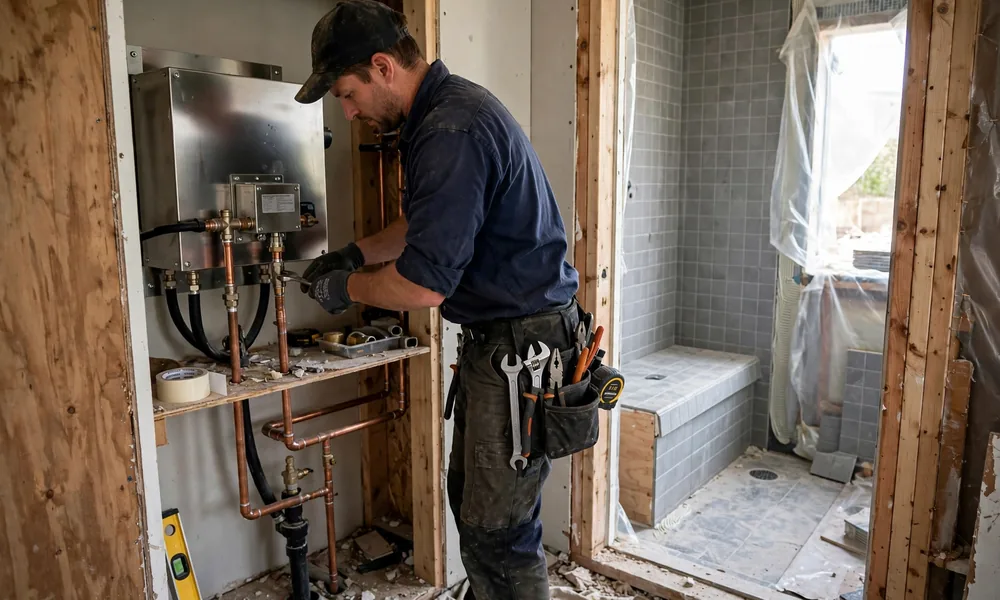
The generator is the heart of the system, and it lives outside the steam room, usually in a closet, a vanity cupboard or a heated basement, within the distance limit the maker specifies. It needs a water feed, a drain line for its automatic flush, and a dedicated electrical circuit, most often 240 volts. The pipe run between the generator and the steam head is short, insulated and laid to a fall, because steam that condenses in the pipe arrives as hot water instead.
The distinction from a conversion matters commercially as well as technically. A steam shower installation adds a generator and a sealed door to a shower the customer already has, and the crew can often finish in days. A custom steam room is a build measured in weeks, with framing, waterproofing, tiling, plumbing and electrics all sequenced around each other. The ticket is bigger, the margin is better, and the customer expects a room, not an upgrade.
The sauna comparison is just as important. A sauna installation is a dry-heat timber room with a heater, benches and ventilation, and the wood itself is part of the experience. A steam room is the opposite in almost every detail: tile instead of timber, wet heat instead of dry, a sealed envelope instead of ventilation, and a generator and drain instead of a heater and a vent. The two trades share a customer and a wellness market, but almost no tools, materials or failure modes. A crew that builds both needs to keep the two checklists separate, because a sauna detail applied to a steam room, such as a flat ceiling or an unsealed timber bench, will fail within months.
How we chose these nine tools
Every tool on this list passed the same four tests. First, it has to solve a problem specific to steam rooms, such as generator sizing, vapour sealing, chamber design or drainage, rather than being a generic business app with a new label. Second, a small crew has to be able to learn it in a week and use it on a real job without a training course. Third, it has to reduce call-backs, because a steam room that leaks, drips or never gets hot is the most expensive mistake in this trade. Fourth, it has to help the business as well as the build, through quoting, scheduling, reviews or follow-up. Freshness was checked against the three neighbouring guides before anything was written: none of the nine products below appears in the sauna guide, the steam shower guide or the shower guide.
The 9 best AI tools for steam room installation startups
| Tool | Best for | Where it fits |
|---|---|---|
| SteamSpa | Generator sizing for full chambers | Design and specification |
| Schluter-KERDI | Vapour-tight sheet membrane | Waterproofing the shell |
| Wedi | Backer board, bench and ceiling panels | Building the chamber |
| Mapei Kerapoxy | Epoxy grout that survives steam | Tiling and finishing |
| Chief Architect | 3D chamber design and bench layout | Design and client sign-off |
| Procore | Multi-trade project management | Running the build |
| JobNimbus | Quoting, scheduling and CRM | Sales and diary |
| Housecall Pro | Dispatch, invoicing and customer messages | Day-to-day operations |
| Nextiva | AI phone answering and reviews | Winning the next job |
1. SteamSpa: best for generator sizing for full chambers
SteamSpa makes steam generators in a range of kilowatt ratings, and its sizing guidance is built around the thing that decides a steam room: the volume of the chamber and the material of its walls. A tiled room loses heat faster than a room lined with lighter material, a high ceiling adds volume the generator has to fill, and a glass panel or an uninsulated outside wall adds load that a rule of thumb will miss. SteamSpa publishes sizing tables that account for those factors, so a startup can size from measurements instead of guessing, and the quote can name a specific kilowatt rating with a reason behind it.
For a full custom chamber, that matters more than for a conversion, because the room is bigger, the ceiling is higher and the customer expects even heat from floor to bench. An undersized generator is the classic steam room failure: the room gets warm, never hot, and the customer calls back in the first month. An oversized one cycles hard and shortens its own life. SteamSpa’s range lets a startup standardise on two or three sizes for the rooms it builds most often.
2. Schluter-KERDI: best for vapour-tight sheet membrane
Schluter-KERDI is a sheet waterproofing membrane that goes on the walls and ceiling before a single tile is set, and it is the layer that makes a steam room possible at all. Steam is water vapour under pressure, and it will find any gap in a loosely sealed surface, condense inside the wall, and rot the framing from the inside out. A bonded sheet membrane, with sealed seams and corners, turns the whole chamber into a single waterproof envelope. The tiler can see where the envelope is complete, the seams are testable, and the system has a track record in wet rooms that a startup can explain to a cautious customer.
The practical advantage for a small crew is that the membrane sets the sequence of the job: frame, board, membrane, then tile, with each layer inspected before the next covers it. Photograph the membrane before tiling, and those photographs become the most valuable file in the job record: they prove the envelope was complete and settle any argument about a later leak.
3. Wedi: best for backer board, bench and ceiling panels
Wedi makes foam-core building panels that are waterproof through their whole thickness, and they solve three steam room problems at once. First, they replace cement board as the tile substrate, so the wall behind the tile is already waterproof rather than relying on a coating. Second, they come as pre-formed bench, niche and sloped-ceiling elements, so the bench and the ceiling fall can be built from panels instead of framed and shaped by hand. Third, they are light and cut with a knife, so a two-person crew can carry and fit a whole chamber without a labourer.
For a startup, the pre-formed elements are the real win. A sloped ceiling framed in timber takes time and invites error, because the fall has to be even across the whole room. A wedi ceiling panel arrives with the slope built in, and the bench elements arrive ready to tile. That shortens the build by days and lets the quote rest on known hours rather than hope.
4. Mapei Kerapoxy: best for epoxy grout that survives steam
Mapei Kerapoxy is an epoxy grout, and in a steam room the grout is not a cosmetic detail. Ordinary cement grout is porous, and in a chamber that fills with steam daily it absorbs moisture, stains, and eventually harbours the mould that customers notice first and forgive last. Epoxy grout is effectively waterproof once cured, it resists staining, and it holds its colour in constant humidity. It costs more per bag and sets faster, so the tiler works in smaller areas, but on a steam room the grout lines are the difference between a room that still looks new in year three and one that looks tired in year one.
The startup angle is the call-back. A customer who sees dark or crumbling grout assumes the whole room is failing, even when the membrane behind it is perfect, and the visit to fix it costs a day. Specifying epoxy grout on every steam room, and writing it into the quote so the customer can see it, removes that call entirely.
5. Chief Architect: best for 3D chamber design and bench layout
Chief Architect is home design software with proper 3D modelling, and for a steam room startup it earns its keep before the first stud is cut. A steam room is a small space where every measurement matters: the bench depth decides whether two people can sit comfortably, the ceiling slope decides where condensation runs, the steam head position decides who gets a blast of hot steam, and the door swing decides whether the room is usable at all. A 3D model lets the customer see all of that and sign off on the bench height and the control position before the build starts.
The model also becomes the working document for the trades. The electrician can see where the generator circuit and the control cable run, the plumber can see the drain fall and the steam pipe route, and the tiler can see the tile layout and the bench dimensions. Changes made on screen cost nothing; changes made after tiling cost a week.
6. Procore: best for multi-trade project management
Procore is construction project management software, and a full steam room build is a multi-trade project in miniature. The framer, the electrician, the plumber and the tiler all need to be on site in the right order, and a single missed visit pushes the whole job by days. Procore keeps the schedule, the drawings, the change orders and the site photographs in one place, so the person running the job can see what is done, what is next and who is holding it up, without a string of phone calls.
For a startup running one build at a time, that visibility is the difference between a four-week job and a six-week job, and the extra two weeks are pure cost. The change-order log matters most: steam room customers change their minds about tile, bench layout or controls more than almost any other trade customer. Logging each change with a price and a signature keeps the job profitable and the relationship friendly.
7. JobNimbus: best for quoting, scheduling and CRM
JobNimbus is a CRM and job management tool built for contractors, and it covers the part of a steam room startup that happens before the build: the quote, the diary and the customer record. A steam room quote has more lines than a shower quote, because it includes the generator, the membrane system, the bench build, the tiling, the drain, the electrical circuit and the control, and a missed line is a lost margin. JobNimbus lets a startup build a quote template with every line already in it, so the same job is priced the same way every time, and the customer gets a clear, itemised proposal instead of a single round number.
The scheduling side is just as useful. A full build takes weeks, and the diary has to hold the survey, the design sign-off, the material order, the build itself and the handover, with the trades slotted in between. JobNimbus keeps the customer record attached to the job from the first call to the final invoice, so when the customer rings two years later about a service visit, the crew can see the generator size and the control type without digging through old emails.
8. Housecall Pro: best for dispatch, invoicing and customer messages
Housecall Pro is field service software for small trade businesses, and it runs the day-to-day side of a steam room startup: dispatching the crew, sending the invoice, and keeping the customer informed. A steam room build generates a lot of small messages, from confirming the survey to announcing the tile delivery to booking the handover, and each one is a chance to look professional or disorganised. Housecall Pro automates the routine messages, sends the invoice the moment the job is signed off, and takes the card payment on the spot, which shortens the gap between finishing a job and being paid for it.
The review request is the feature that pays for the tool. A steam room is a showpiece, and a customer who has just stepped into their finished chamber is at their most enthusiastic. Housecall Pro can send the review request the day after handover, while the experience is fresh, and those reviews are what win the next job.
9. Nextiva: best for AI phone answering and reviews
Nextiva is a business phone system with AI answering, and it solves the oldest problem in a small trade business: the phone rings while the crew is on site, and the call goes to voicemail. A steam room customer is a high-value caller who has already decided to spend serious money, and if the call is missed, the next builder on their list gets the job. Nextiva’s AI assistant can answer, take the details, book the survey and send a summary, so the enquiry is captured even when both hands are holding a tile cutter.
The follow-up matters as much as the answer. Nextiva keeps the call history, the messages and the review requests in one place, so the startup can see which enquiries turned into surveys, which surveys turned into jobs, and where the leads are coming from. For a business that only needs a handful of jobs a month to stay busy, that visibility is worth more than a bigger advertising budget.
Sizing the generator: the maths that decides the job
Generator sizing starts with volume. Measure the length, width and height of the chamber, multiply them, and the result is the cubic footage the generator has to fill with steam. Then adjust for the room itself: tiled walls and a tiled ceiling lose heat faster than lighter linings, a glass door or a glass panel adds load, an outside wall that is not insulated adds more, and a ceiling above eight feet adds volume that a flat calculation will understate. Most makers publish a sizing table that walks through those adjustments, and a startup should work from the table on every job, not from memory.
The cost of getting it wrong is asymmetric. An undersized generator leaves a room that is warm but never truly steamy, and the customer will notice on the first use. The fix is a bigger generator and a second visit. An oversized generator costs more to buy, cycles on and off, and wears itself out faster. The right size is the one the table gives for the measured room, and the quote should name it. Keep the pipe run short and insulated too, because a long, uninsulated run steals heat before the steam arrives.
Sealing the chamber: membranes, boards and grout
Sealing is a system, not a product. The membrane keeps vapour out of the structure, the boards give the membrane a stable, waterproof substrate, the grout keeps water out of the tile joints, and the sealant closes the junctions where the wall meets the bench, the ceiling and the door frame. A weakness in any one of those layers becomes the leak that the other three cannot prevent, so the startup should specify all four as a set and never let a customer delete one of them to save money.
Sequence matters as much as materials. The boards go up first, the membrane goes over them with sealed seams and corners, the tiles go over the membrane, and the grout and sealant finish the surface. Each layer should be inspected and photographed before the next one covers it, because a membrane seam hidden under tile can never be checked again. Pay attention to the penetrations too: the steam head, the control cable, the light fittings and the drain are all holes in the envelope, and each one needs its own sealing detail.
Tiling, bench seating and drainage
Tiling a steam room is slower than tiling a bathroom, and the quote should reflect that. The tiles are usually large format, which shows every uneven spot in the substrate, and the ceiling tiles have to be set overhead on a slope, which is the hardest tiling in the trade. The bench has to be tiled on its top, its front and its ends, with no sharp edges where a bather will sit. The grout has to be epoxy, the sealant has to be steam rated, and the whole room has to be left to cure before the generator is switched on.
The bench deserves its own line in the design. It should be deep enough to sit on comfortably, usually around eighteen inches, and high enough that the bather’s feet reach the floor, usually around eighteen inches from the floor to the seat. A bench that is too shallow is useless, a bench that is too high leaves feet dangling, and a bench built from timber instead of tile will not survive the steam. Pre-formed bench elements make the dimensions repeatable, and the 3D model should show the bench before the build starts.
Drainage is the quiet part of the job that causes the loudest complaints. The floor should fall gently to a single drain, the drain should be sized for the steam generator’s flush cycle as well as for the water that follows a steam session, and the trap should be accessible. A floor that ponds will grow mould in the corners, and a drain that gurgles will convince the customer the plumbing is wrong. Test the fall with a bucket of water before the tiling is signed off, and test the drain with the generator running before handover. None of this is new to a good bathroom tradesperson, but the standard is higher than in a shower installation, which can tolerate a small mistake in a seal or a fall because the water is only there for a few minutes a day. A steam room fills with vapour for half an hour at a time, every day, and it will find the mistake.
Pricing a full steam room build
Price the whole build, not the visible parts. The quote should list the generator, the membrane system, the boards and bench elements, the tiles and epoxy grout, the drain and plumbing, the electrical circuit, the control, the door, and the labour for each trade. A customer who sees a single round number will compare it with a conversion price and walk away, while a customer who sees an itemised build will understand what they are buying. The itemised quote also protects the startup when the customer changes the tile or the bench layout, because the change can be priced as a line rather than argued about afterwards.
Allow for the hidden costs. The generator needs a dedicated circuit, which may mean a consumer unit upgrade. The steam pipe may need a longer run than expected, which means insulation and access panels. A sensible startup adds a contingency of around ten percent for those items and says so in the quote. Do not compete on price with conversions: a steam room build is a premium job, and competing with a conversion price means cutting the membrane, the grout or the generator size, and each of those cuts becomes a call-back.
Startup checklist: six steps before you take a deposit
- Survey and measure the room, including ceiling height, wall materials, outside walls and glass, and size the generator from the maker’s table.
- Model the chamber in 3D, agree the bench height and depth, the ceiling slope, the steam head position and the control position, and get the design signed off.
- Specify the sealing system as a set, membrane, boards, epoxy grout and sealant, and write it into the quote so it cannot be deleted later.
- Book the trades in order, frame, board, membrane, tile, plumbing and electrics, and photograph each layer before the next covers it.
- Test the floor fall, the drain and the generator on a full steam cycle before handover, and log the generator size and control type.
- Hand over with a demonstration, a written care guide and a review request the next day, and book the first service visit before you leave.
Frequently asked questions
What is the best AI tool for a new steam room installation startup?
There is no single best tool, because the job has two halves. For the build, the generator sizing and the sealing system decide whether the room works, so start with the generator tables and the membrane, board and grout system. For the business, the quoting and scheduling tools decide whether the startup survives, so add a contractor CRM and a field service app before the diary fills up.
How is a steam room different from a steam shower?
A steam shower is a conversion: a generator and a sealed door added to a shower the customer already has, usually finished in days. A steam room is a dedicated tiled chamber built from the studs out, with its own framing, waterproofing, bench seating, sloped ceiling, drain and controls, usually built over weeks. The steam room costs more and needs a bigger team, but it is a different product, and a startup should sell it as one.
How do I size a steam generator for a steam room?
Measure the chamber’s length, width and height, multiply them for the volume, then adjust for the wall and ceiling materials, the ceiling height, any glass panels and any uninsulated outside walls, using the generator maker’s sizing table. Tiled rooms and high ceilings need more power than the raw volume suggests. Name the kilowatt rating in the quote, keep the pipe run short and insulated, and log the size in the job record for the service visit.
Do I need a sloped ceiling in a steam room?
Yes. A flat ceiling collects condensation and drips cold water on the people below, which is the most common comfort complaint in a new steam room. A ceiling sloped by around two inches per foot carries the condensation down the walls instead. Pre-formed ceiling panels arrive with the slope built in, which is faster and more reliable than framing the fall by hand.
How much does a steam room installation cost?
A full custom steam room costs far more than a steam shower conversion, because it includes framing, waterproofing, tiling, a generator, a dedicated electrical circuit, drainage and a control, as well as the bench and the door. The exact figure depends on the size of the room, the tile chosen and the generator rating, which is why an itemised quote matters.
Should a steam room startup offer a service and maintenance plan?
Yes, and it should be sold at handover. A steam room needs its generator flushed and descaled, its seals checked and its grout inspected, and a yearly visit keeps the room working and the customer loyal. The service book also smooths out quiet months, because maintenance visits fill the diary between full builds.
Bottom line
A steam room installation startup is a full-build trade: a dedicated tiled chamber, a sized generator, a vapour-tight envelope, a sloped ceiling, a tiled bench and a drain, all delivered as one system. The nine tools in this guide cover that system end to end, from 3D design and generator sizing through membranes, boards and epoxy grout to quoting, dispatch and AI phone answering, and all nine are fresh against the sauna, steam shower and shower guides. Build the envelope properly, size the generator from the table, price the whole job, and the steam room will do what it is supposed to do: fill with even steam, dry out cleanly, and bring the next customer to your door.

Keep what speaks to you.
Leave room for your own perspective.