A spray booth is not a room with a fan in it. It is a controlled finishing environment, and the difference between a booth that earns money and one that eats it comes down to four systems working together: airflow that carries overspray away from the work, filtration that catches it before it reaches the fan or the street, lighting that shows the painter the truth about the finish, and curing that hardens the coating on schedule. Get any one of those wrong and the other three cannot save the job. A booth with strong airflow but tired filters will spray dust onto wet paint. A booth with bright lights but weak curing will look finished and stay soft for days.
That is why a spray booth installation startup is a different business from a general workshop fit-out. A workshop installer worries about benches, machines and storage. A booth installer worries about air changes per hour, filter pressure drop, colour temperature, flash-off times and the local rules on volatile organic compounds. The customer is not buying a box. They are buying a finish they can repeat, day after day, without rework, without complaints from neighbours and without a visit from an inspector that ends in a shutdown notice.
Artificial intelligence has reached this trade the same way it reached every other skilled trade: not as a robot that replaces the installer, but as software that does the maths faster and hardware that watches the booth while the painter works. Airflow simulation that once needed an engineering consultancy now runs in a browser. Booth controls log temperature, humidity and filter load and tell the owner when to change a filter. Spray guns read out their own pressure. This guide compares the nine tools that matter most for a spray booth installation startup in 2026, chosen because each one solves a booth problem rather than a general workshop problem.
Key takeaways
- A spray booth is four systems, not one: airflow, filtration, lighting and curing must be designed together, because a weakness in any one of them shows up as a defect in the finish.
- Simulate the airflow before you build anything. Cloud CFD tools let a small startup prove a booth design on screen instead of discovering dead spots after the customer has paid.
- Buy the booth for its controls as much as its steel. Smart booths that log temperature, humidity and filter pressure drop pay for themselves in fewer reworks and fewer wasted filters.
- Filters and curing are where young startups lose money quietly. Monitoring filter load and curing with infrared heat, rather than guessing, protects both margins and finish quality.
- Compliance is part of the product. A booth that cannot show its airflow, filtration and emissions figures will cost the customer more in permits and fines than the booth itself.
What a spray booth really is
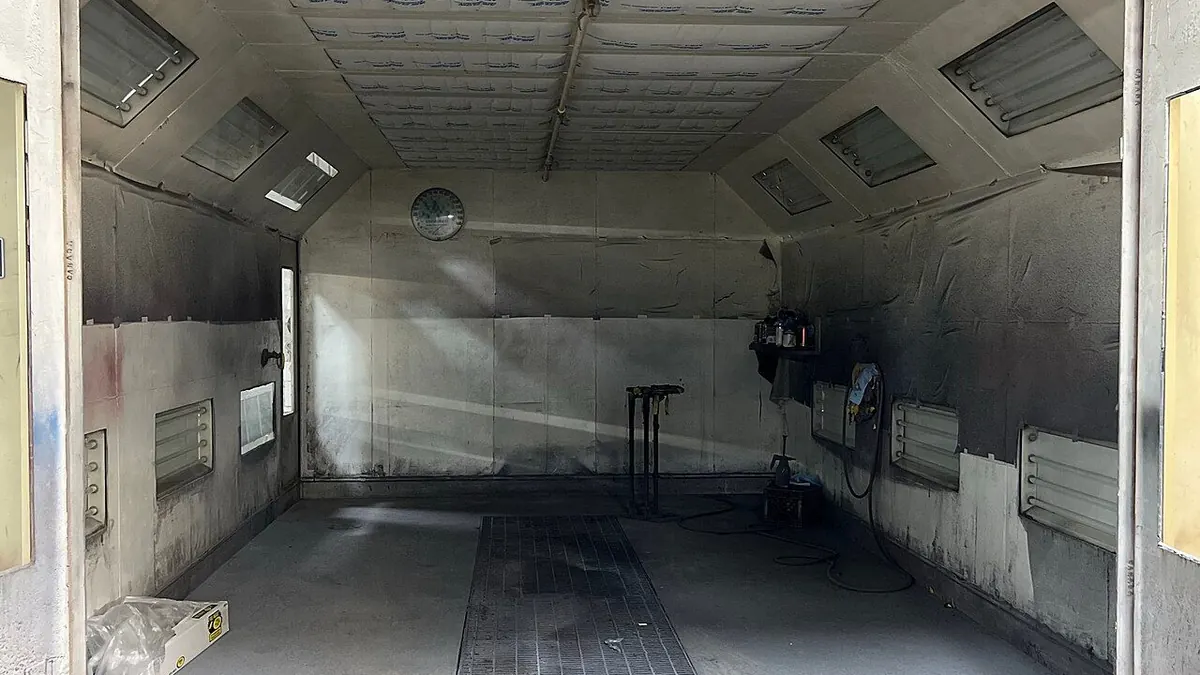
Strip away the marketing and a spray booth is a ventilated enclosure built to do three jobs at once. It protects the painter from the coating they are spraying, it protects the coating from the dust in the air, and it protects everyone outside from the overspray and fumes. Every design decision flows from those three jobs. The enclosure keeps the work in one place. The fan and ducting move a steady stream of air across the work and out through filters. The filters catch the solids. The lights let the painter see what they are doing. The curing system, whether heated air or infrared lamps, finishes the job. Most booths a new installer fits sit inside body shops, so it helps to know the wider trade, including the AI tools for auto body shop startups that those customers already use.
Airflow is the system that matters first, because it decides whether the booth works at all. In a crossdraft booth, air enters at one end and leaves at the other, travelling horizontally across the work. In a downdraft booth, air enters through the ceiling and leaves through the floor, which gives the cleanest finish and the highest price. A semi-downdraft booth splits the difference. The right choice depends on what the customer sprays, how big the work is and what they can spend. What does not change is the physics: air must move at a steady speed across the whole working area, with no dead spots where overspray hangs and no fast lanes that dry the coating before it levels. A booth that moves air unevenly will produce an uneven finish, and no amount of skill at the gun can fix that.
Filtration is the system that protects the fan, the ducting and the neighbourhood. Intake filters clean the air coming in. Exhaust filters catch the overspray going out. As filters load up with paint solids, the air slows down, and the booth slowly stops doing its job. The smarter approach is to watch the pressure drop across the filter and change it when the numbers say so. That single habit is one of the cheapest quality improvements a booth startup can sell to its customers.
Lighting is the system customers notice last and regret ignoring first. A painter cannot correct what they cannot see, and ordinary workshop lighting hides orange peel, runs and thin spots until the customer sees them in daylight. Booth lighting needs to be bright, even and close to daylight in colour, with fixtures placed so the painter is never working in their own shadow.
Curing is the system that decides when the job is really finished. A coating that looks dry can still be soft underneath, and a panel that leaves the booth too early will pick up marks, dust and fingerprints that no amount of polishing will remove. Heated booths cure by raising the air temperature for a set time, while infrared curing works faster by heating the panel directly, which suits spot repairs and small parts.
The nine tools at a glance
| Tool | What it does for a booth startup | Best for |
|---|---|---|
| SimScale | Cloud airflow simulation before the build | Proving a booth design on screen |
| Global Finishing Solutions | Booth design, build and smart controls | Full booth supply and installation |
| Accudraft | Smart paint booths with touchscreen controls | Energy-efficient downdraft booths |
| Dürr EcoInCure | Automated curing for high-volume finishing | Production lines and large shops |
| Graco | Electrostatic spray equipment with data logging | High transfer efficiency spraying |
| SATAjet X 5500 DIGITAL | Digital spray gun with pressure readout | Repeatable gun setup, job after job |
| DeVilbiss | Spray guns and air management systems | Everyday production spraying |
| Viledon | Booth filtration and filter monitoring | Clean air and predictable filter costs |
| IRT | Infrared curing with smart controls | Fast spot repairs and small parts |
Design and airflow: prove the booth before you build it
The most expensive mistake in this trade is building the booth first and testing the airflow second. Once the steel is up and the fan is bolted in, changing the design means cutting, re-welding and re-spending. The tools in this section let a startup test a design on a screen and walk into an installation with numbers instead of guesses.
1. SimScale: the best tool for airflow simulation before the build
SimScale is a cloud-based engineering simulation platform, and for a spray booth startup its most valuable feature is computational fluid dynamics, the same kind of airflow modelling that car makers use to test a body shape. A booth installer can build a model of a proposed booth, set the fan speed, the filter layout and the position of the work, and watch the air move through the space on screen. Dead spots show up as still patches. Fast lanes show up as streaks. The installer can move an intake, resize a duct or change a fan and run the model again, all before a single sheet of steel is ordered.
What makes SimScale practical for a startup, rather than only for large engineering firms, is that it runs in a browser and rents computing power by the job instead of demanding a workstation and a licence that costs more than the booth. A small team can run a simulation for one project, pay for what it used, and move on.
For a spray booth startup, the real value is commercial as much as technical. A customer choosing between two installers will pick the one who can show them a picture of the air moving evenly across their car, their cabinet or their component, rather than the one who promises it will be fine.
2. Global Finishing Solutions: the best tool for full booth supply and smart controls
Global Finishing Solutions, known across the trade as GFS, is one of the largest spray booth manufacturers in the world, and for a startup that installs booths rather than building them from sheet steel, it is the closest thing to a complete answer. GFS supplies the booth, the air handling, the controls and the support, which means the installer can sell a system that has been tested as a system instead of assembling parts from five suppliers and hoping they agree with each other.
The reason GFS earns its place in this guide is its controls. Modern GFS booths use intelligent control panels that manage the spray cycle and the cure cycle as separate modes, hold temperature and humidity to set points, and log what the booth did on every job. That matters for a startup because the handover becomes a training session with numbers: the customer learns what the booth should read when it is working well, and the installer can be called back with a log file instead of a vague complaint that the finish looks wrong.
GFS also offers design and layout support, which is where a young installer gets the most value. The company has built booths for car body shops, industrial finishers, aerospace suppliers and wood finishers, so it has seen the mistakes a startup has not made yet. Its engineers can advise on booth size, airflow type, ducting routes and make-up air, and that advice is part of what the customer pays for when they buy a branded booth rather than a cheap import. A startup that partners with a manufacturer like this is selling experience it does not yet have on its own, and that is a sensible way to start.
The trade-off is cost. A GFS booth costs more than a no-name booth of the same size, so sell it on running costs and finish quality rather than on price.
3. Accudraft: the best tool for energy-efficient downdraft booths
Accudraft builds paint booths with a focus on energy efficiency and smart controls, and its downdraft booths are a good example of what a modern booth should be. Air enters through a filtered ceiling, travels down across the work, and leaves through a filtered floor, which is the cleanest airflow pattern available and the one that produces the fewest defects. The company pairs that with touchscreen controls that let the painter switch between spray and cure modes, set temperatures and see the booth’s status at a glance.
Energy is the running cost that surprises new booth owners most. A booth fan and heater can use more electricity and gas in a month than the rest of the workshop combined, and a booth that runs its heater at full power when it does not need to will quietly eat the profit on every job. Accudraft’s controls address this by managing the cure cycle properly, bringing the booth up to temperature, holding it there for the right time, and shutting down cleanly instead of running hot all afternoon.
For an installation startup, Accudraft is also attractive because the booth arrives as an engineered package with clear installation requirements. The installer knows the footprint, the ducting sizes, the electrical load and the clearances before the delivery truck arrives, which means the site work can be planned properly and the installation finished on schedule.
The honest limitation is that a downdraft booth needs a pit or a raised floor for its exhaust, which means more building work and a higher installed price than a crossdraft booth. A startup should be straight about that with customers: the downdraft booth gives the best finish and the lowest rework rate, but it needs a building that can take it.
Booth hardware and controls: the steel, the fan and the brain
A booth is only as good as its controls. The steel keeps the overspray in, the fan moves the air, but the control panel is what turns those parts into a finishing system that behaves the same way on a cold Monday morning as it did on a warm Friday afternoon. The tools in this section are the hardware that does the actual spraying and curing, and the reason they belong in a guide about artificial intelligence is that each one now carries sensors, data and automation that used to need a person standing beside it. A booth is also only one part of a fitted workshop, and the AI tools for workshop installation startups cover the benches, machines and storage around it.
4. Dürr EcoInCure: the best tool for automated curing at scale
Dürr is one of the biggest names in industrial painting, and its EcoInCure system is built for customers who cure a lot of work and cannot afford to guess. EcoInCure cures coatings using a controlled combination of heat and airflow, with the process tuned to the coating and the part rather than left to a timer and a thermostat. Sensors watch the temperature of the part itself, not just the air around it, and the system adjusts as it goes, which means every part leaves the oven with the same cure instead of the first part being under-cured and the last one over-baked.
For a spray booth installation startup, Dürr matters for a different reason: it sets the standard that industrial customers will measure a new installer against. A customer who runs a production line will ask about cure curves, energy use per part and repeatability, and a startup that can talk about those numbers will be taken seriously.
The honest truth is that most spray booth startups will not install a Dürr system in their first year. It is industrial equipment for industrial customers, with an industrial price. Its place in this guide is as the top end of the curing market and the direction the trade is moving: curing is becoming a measured, logged, repeatable process rather than a matter of leaving the part in the booth and hoping. A startup that understands that direction can sell simpler curing systems with the same language, and can grow into Dürr-scale work as its customers grow.
Where EcoInCure does become directly relevant is when a startup wins a contract with a manufacturer, a fleet operator or a large body shop group. Those customers cure hundreds of parts a week, and the energy and rework savings from proper curing control pay for the system quickly.
5. Graco: the best tool for high-efficiency electrostatic spraying
Graco is the name most professional painters reach for when they want spray equipment that works all day without drama, and its electrostatic systems are the most relevant part of its range for a booth startup. Electrostatic spraying charges the paint particles as they leave the gun, so they are attracted to the work instead of drifting past it. The result is higher transfer efficiency, which means more paint lands on the part and less ends up in the filters, the ducting and the air. For a booth owner, that means lower paint bills, longer filter life and less overspray to clean up.
Modern Graco equipment adds data to that efficiency. Its systems log fluid pressure, flow and gun settings, and its newer controls let a shop record the settings that produced a good finish and repeat them on the next job. That is artificial intelligence in the practical sense that matters to a painter: not a chatbot, but a memory. A shop that sprays the same bumper, cabinet or component every week can store the recipe and stop re-learning it every Monday morning.
For an installation startup, Graco is also a useful partner because the equipment is standard across the trade. Painter recruitment is easier when the guns in the booth are ones the painter has used before, and maintenance is easier when parts and service are available everywhere.
The cost of electrostatic equipment is higher than a conventional gun, and it needs proper earthing and maintenance to work safely, which is something the installer must explain and the customer must accept.
6. SATAjet X 5500 DIGITAL: the best tool for repeatable gun setup
SATA is the German spray gun maker whose guns sit in body shops all over the world, and the SATAjet X 5500 DIGITAL is the model that best shows where spray guns are heading. It is a high-end gravity-feed gun with a digital pressure display built into the handle, which means the painter can see the exact inlet pressure at the gun instead of guessing from a regulator on the wall. That single number is the difference between a finish that repeats and a finish that changes with the weather, the compressor and the length of the hose.
The digital readout matters because spray gun setup is the most operator-dependent part of the whole booth process. Two painters can hold the same gun, spray the same paint and get different results, and the difference is usually pressure, distance and speed. A gun that shows its own pressure removes one of those variables entirely. A shop can write the pressure on the job card, and the next painter can set the same number and get the same result. That is a small thing that solves a large problem: the Monday finish that looks nothing like the Friday finish.
For a booth installation startup, the SATAjet X 5500 DIGITAL is the gun to recommend when the customer cares about quality and is willing to pay for it. It is not the cheapest gun, and a startup should not pretend otherwise. But it is the gun that body shop owners ask for by name, which means specifying it makes the booth easier to sell and the painter easier to hire. It also pairs naturally with a well-designed booth: the gun delivers the paint properly, and the booth delivers the air properly, and neither one has to compensate for the other.
What the display does is make skill measurable, which is what a business needs when it is training staff, quoting jobs and guaranteeing a finish.
Finishing and filtration: the gun, the filter and the cure
The last three tools cover the parts of the booth the customer touches every day: the gun, the filter and the curing lamp. These are the parts that wear out and get blamed when the finish goes wrong, so they are where a startup shows its value after installation.
7. DeVilbiss: the best tool for everyday production spraying
DeVilbiss has been making spray guns for over a century, and its modern range, including the DV1 and Tekna guns, is built for shops that spray all day. The guns are designed for easy cleaning and consistent atomisation, which matters more than any single feature when a shop is pushing work through the booth. DeVilbiss also makes air management systems, including regulators and filters that sit between the compressor and the gun, so the air reaching the paint is clean, dry and at the right pressure. For a booth startup, specifying DeVilbiss means the customer gets equipment their painter already knows, parts that are easy to find, and a gun that can be rebuilt rather than replaced. It is the dependable choice, and dependable is what a production shop pays for.
8. Viledon: the best tool for booth filtration and filter monitoring
Viledon, the filtration brand of Freudenberg, makes the filter media that sits in booth ceilings, floors and exhausts, and it is the quiet hero of this guide. A booth’s filters decide how clean the air is and how hard the fan has to work, and Viledon publishes the data that lets an installer choose the right filter for the right job instead of guessing. Its paint arrestor media is designed to hold a large amount of paint solids before the pressure drop rises, which means longer life between changes and steadier airflow across that life. For a startup, the selling point is simple: a filter that lasts longer and keeps the air moving is cheaper than a cheap filter that chokes the booth in a week. Pairing Viledon filters with a pressure gauge across the filter bank turns filter changes from a calendar guess into a measured decision.
9. IRT: the best tool for fast infrared curing
IRT, from Hedson, makes infrared curing lamps that heat the panel directly instead of heating the whole booth, and for spot repairs and small parts that speed is hard to beat. A bumper or a door that would take an hour in a heated booth can be cured in minutes under an IRT lamp, which means the booth is free for the next job sooner and the shop finishes more work in a day. Modern IRT units add smart controls that measure the panel temperature and adjust the lamps automatically, so the coating cures evenly without the painter standing there watching it. For a spray booth startup, IRT is the add-on that makes a booth more profitable from day one: it costs far less than a second booth and turns waiting time between jobs into working time.
What a spray booth installation costs
A small crossdraft booth for a body shop or joinery workshop typically costs a five-figure sum installed, while a large downdraft booth with a pit, make-up air and full controls can cost several times as much, and the building work often adds a third on top of the booth price. A startup should quote the whole job, not just the booth: delivery, installation, ducting, electrical work, commissioning and training are all part of the price, and a customer who discovers them later will not come back. The running costs matter too. Energy is the biggest, followed by filters, paint and maintenance, and a booth that costs more to buy but less to run will usually win that argument over three years.
Compliance and safety: the part you cannot skip
A spray booth is a regulated workplace, and a startup that ignores that fact will not last long. The booth must move enough air to keep the painter safe, the filters must catch the overspray, and the exhaust must meet local rules on emissions and neighbours. Volatile organic compounds in the coatings are the main concern, and the choice of coatings, the booth design and the local permit all connect. Fire safety matters too: paint overspray is flammable, so the booth needs proper electrical fittings, clean filters and a housekeeping routine that nobody skips.
Spray booth startup checklist
- Prove the airflow on screen with a simulation before ordering steel or fans.
- Choose the booth type for the work and the building, not for the catalogue price.
- Specify filters with published data and fit a pressure gauge across the filter bank.
- Fit booth lighting close to daylight colour and check it with the painter, not just the electrician.
- Match the curing system to the coating and the throughput, and test it on real panels.
- Hand over a written pack: airflow figures, filter schedule, cure settings and compliance notes.
Frequently asked questions
What is the best AI tool for a spray booth installation startup to buy first?
Start with airflow simulation, such as SimScale, because it improves every job you quote and protects you from the most expensive mistake in the trade: building a booth that does not move air evenly. The booth hardware comes next, and a smart booth from GFS or Accudraft is the right second step.
How much should a spray booth startup spend on AI tools each month?
Budget a few hundred a month for software such as simulation time and business tools, and treat the booth hardware as a capital cost in the quote, not a monthly subscription. The software pays for itself when it wins one job a quarter that a rival loses on guesswork.
Can AI really design a spray booth?
It can test a design, not invent one. Simulation shows how air will move through the booth you propose, and smart controls manage the booth you built, but the design still needs a person who understands airflow, filtration and the coatings the customer sprays.
Do spray booth installers need different AI tools from general workshop installers?
Yes. A workshop installer needs layout and dust extraction tools, while a booth installer needs airflow simulation, booth controls, filtration data and curing control. The two trades overlap on the building, but the booth is a finishing system with its own physics and its own rules, so the tool list is different.
How do spray booth startups find their first customers?
Body shops, joiners and industrial finishers are the first calls, and a simulation report or a reference installation is the best sales tool. Many new installers also work as subcontractors for booth manufacturers, which brings steady work while the direct customer list grows. Others start in a related trade first, and starting a mobile car detailing business is one route that builds a customer list a booth can later serve.
What should a spray booth startup charge for an installation?
Quote the whole job, including delivery, ducting, electrics, commissioning and training, and show the customer the running costs as well as the price. A booth that is cheap to buy and expensive to run will cost the customer more in three years than a better booth, and a startup that proves that wins the job honestly.
The bottom line
A spray booth startup succeeds by selling a finish, not a box. The tools in this guide, from airflow simulation to infrared curing, all serve that one goal: a booth that moves air evenly, filters it properly, lights the work honestly and cures it on schedule, job after job. Start with the simulation, buy the booth for its controls, watch the filters and the curing, and hand over the paperwork that proves the booth works. Do that, and the first customer becomes the reference that wins the next ten.

Keep what speaks to you.
Leave room for your own perspective.