
The best AI tools for pressure washing service startups in 2026 do more than tidy up the diary while a crew is out on a job. They run the whole service operation: they answer a property manager at midnight, price a car park by the square metre, build a route that keeps three vans moving instead of sitting in traffic, and chase the invoice before the month ends. A pressure washing service is not a one-person side job with a borrowed machine. It is a service business with crews, vans, water tanks, chemical stock, repeat contracts and customers who expect the same result on the tenth visit as on the first.
That service shape is what makes the software choice different from the choice a solo operator makes. A single washer needs a booking page and a card reader. A service business needs dispatch that knows which crew has the surface cleaner, quoting that understands a retail park is priced nothing like a driveway, and a contract calendar that never lets a quarterly hotel clean slip. When any of those pieces fail, the cost is not a missed afternoon. It is a lost commercial contract, a van driving empty across town, or a crew standing on site without the right nozzle.
This guide compares nine named tools for a pressure washing service startup, judged on the work a service business actually does: multi-crew scheduling, fleet and route planning, commercial quoting, contract renewals, review collection and payment collection. You will find a comparison table, a startup checklist and answers to the questions new service owners ask most often, all written for teams that clean for property managers, hotels, retailers and housing associations as well as for homeowners.
Key takeaways
- Start with one job platform that covers booking, quoting, dispatch and payments, and add specialist tools only when that platform is working.
- Choose quoting tools that price commercial surfaces by area, staining and access, because a car park, a forecourt and a driveway are three different jobs.
- Route planning pays for itself in a fleet business, since a van that drives empty between jobs burns fuel, water and paid crew hours.
- Win commercial work with contract reminders and site histories, not one-off quotes, because repeat contracts are steadier income than new residential bookings.
- Measure quote conversion, travel time, chemical cost per job and contract renewal rate every week, and change one thing at a time until the numbers move.
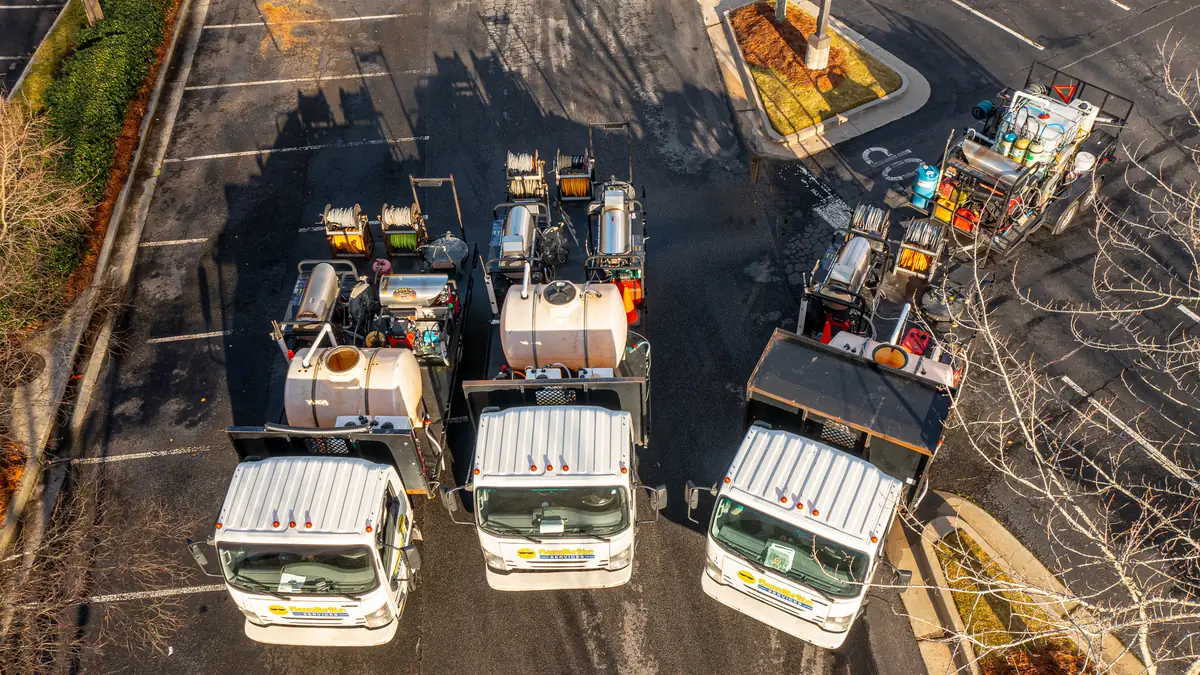
Best AI Tools for Pressure Washing Service Startups at a Glance
The table below gives a quick view of where each tool helps most in a pressure washing service business. The sections that follow explain how to use each one on real service jobs, what to look for before you pay and where small service teams usually go wrong.
| Tool | Main job | Best for | Watch out for |
|---|---|---|---|
| Jobber | Quoting, scheduling, invoicing | Service teams of two to ten | Add-ons can raise the monthly bill |
| Housecall Pro | Booking, dispatch, payments | Fast-growing residential and commercial mix | Some features need the higher plan |
| ServiceTitan | Full field service platform | Multi-crew firms chasing contracts | Price and setup suit larger teams |
| Workiz | AI phone answering and dispatch | Teams losing calls while on site | Check AI call pricing carefully |
| FieldEdge | Dispatch, fleet and job tracking | Crews working across a wide area | Learning curve for new office staff |
| ServiceM8 | Job cards, checklists, invoicing | Small crews that live on their phones | Reporting is lighter than rivals |
| NiceJob | Review requests and referrals | Building a local reputation fast | Works best alongside a job platform |
| Birdeye | Reviews, listings and messaging | Multi-site commercial service firms | Can be more than a startup needs |
| Route4Me | Route planning for fleets | Days with many stops and several vans | Needs accurate job durations to work well |
What AI Actually Does for a Pressure Washing Service
AI in a pressure washing service is not a machine that holds the wand. It is software that reads the patterns in bookings, messages, routes and reviews, then acts on them faster than an owner juggling a phone and a pressure hose can. A booking assistant can answer a facilities manager at ten at night, ask the right questions about the car park, the forecourt and the bin store, and offer the next free slot before a rival replies in the morning. A dispatch tool can notice that two jobs are ten minutes apart and place them back to back, saving a cross-town drive with a loaded trailer.
The most useful AI features for a service business are practical ones. Smart replies draft answers to common questions about prices, availability, what soft washing means and whether a roof can be washed safely. Automatic reminders cut no-shows, which are one of the quietest profit leaks in this trade, because a missed commercial clean still costs fuel, water and a morning. Job checklists adjust themselves to the surface, so a concrete forecourt gets a different list from a painted wooden deck or a tiled roof. Photo check-ins let a crew prove a job is done well, and a manager can review quality across three crews without visiting every site.
Jobber
Jobber is the most common starting point for a pressure washing service, and the reason is simple: it covers the whole job in one place. A customer request becomes a quote, the quote becomes a scheduled job, the job becomes an invoice, and the invoice becomes a payment, all without retyping the address. For a service business with two or three crews, that single flow matters more than any single clever feature, because every handover between systems is a place where a job gets lost.
Its quoting tools suit service work well. You can build templates for a driveway, a house wash, a retail forecourt and a car park, each with its own pricing logic, and let the customer approve online. The AI-assisted quoting and follow-up nudges chase quotes that have gone quiet, which is where a surprising amount of service revenue hides. A quote sent on Monday and forgotten by Wednesday is a lost job, and a polite automatic reminder often recovers it.
Jobber also handles the recurring side of a service business. You can set a hotel forecourt to repeat every quarter and a housing association estate to repeat every six months, and the diary fills itself. The trade-off is cost: the plan that includes the best quoting, automation and client hub features is not the cheapest, and add-ons for text messaging and extra users add up. Start on the plan that covers your crew count, and check the full monthly cost, including message charges, before you commit.
Housecall Pro
Housecall Pro is built for speed, and speed wins service work. When a property manager messages three firms about a stained forecourt, the firm that replies first with a clear time usually wins the job. Housecall Pro answers online bookings around the clock, sends confirmations and reminders, and lets the crew see the day on a phone, including the address, the surfaces, the water source and any access notes.
Its dispatch board is the part service owners praise most. You can drag jobs between crews, see who is free, and send a customer a live arrival update, which cuts the phone calls that interrupt a crew mid-job. Payments are taken on site by card, and invoices go out the same day, so cash flow stays healthy even in a busy spring when the diary is full and the office is stretched.
The watch-out is that some of the strongest features, including the deeper automation and marketing tools, sit on the higher plans. A startup with one van may find the entry plan enough for the first months, then need to step up as soon as a second crew joins. That is a normal path, but budget for the step up in advance so the price rise does not arrive as a surprise in the same month you hire.
ServiceTitan
ServiceTitan is the heavyweight option, and it suits a pressure washing service that is already thinking in contracts rather than single jobs. It brings together scheduling, dispatch, quoting, customer records, marketing and reporting in one system, and it is designed for firms running several crews across a city or a region. If your goal is to hold contracts with hotel groups, retail parks and housing associations, this is the platform those contracts are easiest to manage on.
Its strength is the customer record. Every site keeps a history of what was cleaned, when, for how much, with which chemicals and with which photos, so the next quote is built from facts rather than memory. The reporting shows which contracts make money and which ones quietly lose it, which is information a growing service firm needs before it signs the next three-year deal. The AI features help with call handling, booking and follow-up, so the office can keep up when the phones get busy.
The trade-off is honest and large: ServiceTitan costs more than the tools above, and it takes longer to set up properly. A two-person startup will find it heavy, and the onboarding will eat weeks that could have been spent washing. Choose it when you have at least two crews and a pipeline of commercial work that justifies the price, not before.
Workiz
Workiz earns its place on this list because of the phone. A pressure washing service loses more work to unanswered calls than to any other single cause: the crew is on a noisy site, the owner is driving, and the caller simply rings the next firm. Workiz offers an AI phone assistant that answers, asks about the job, books a slot and takes the details, so the call becomes a booking instead of a missed opportunity.
Beyond the phone, Workiz is a solid dispatch and scheduling tool. Jobs are assigned to crews, the crew sees the route and the checklist, and the office sees progress in real time. Invoicing and payments are built in, and the system sends reminders that reduce no-shows. For a service business that depends on inbound calls from property managers and homeowners, that combination of answering and dispatch is worth more than a prettier dashboard.
Check the pricing of the AI answering carefully, because it is often charged by usage, and a busy month of calls can cost more than expected. Also test the AI on the questions your customers actually ask, such as whether a roof can be soft washed or how long a car park will take, and make sure the answers it gives match the answers your crew would give.
FieldEdge
FieldEdge is a field service platform built for teams that work across a wide area with several crews, which is exactly how a pressure washing service grows. Its dispatch tools let the office see every crew, every job and every van on one screen, and move work around when a job overruns or a van needs a repair. That visibility is the difference between a day that recovers from a delay and a day that falls apart.
It handles the commercial side of service work well. Quotes can be built for large sites, service agreements can be tracked, and the job history for each customer is kept in one place, with photos and invoices attached. The mobile app gives the crew the job details, the checklist and the customer notes, and lets them record time, materials and photos as they go, so the office does not have to chase paperwork at the end of the week.
The learning curve is real. Office staff who are used to a diary and a phone will need training, and the first month will feel slower than the old way. Give the rollout a proper fortnight, train one person first, and only then bring the crews on. A platform this capable only pays off when the whole team actually uses it.
ServiceM8
ServiceM8 is the lightest tool on this list, and for a small service crew that is a virtue. It turns each job into a card with the address, the surfaces, the checklist, the photos and the invoice, and it lives on the phone the crew already carries. There is no heavy desktop system to learn, and a new operator can be shown the app in an afternoon.
Its checklists suit pressure washing well. A driveway card can list sweeping, pre-treating stains, washing in even passes, rinsing and checking the edges. A forecourt card can list the chemical dwell time, the surface cleaner passes and the final rinse. The crew ticks each step as they go, the office sees the job complete in real time, and the customer gets a tidy invoice with before and after photos attached.
The trade-off is reporting. ServiceM8 tells you less about which jobs make money and which contracts are worth renewing than the bigger platforms do. That is fine for a startup with one or two crews, and it becomes a reason to move up later. Use it while the team is small, and keep an eye on the month when the questions you ask outgrow the answers it gives.
NiceJob
NiceJob does one thing and does it well: it turns finished jobs into reviews. A pressure washing service lives on its local reputation, and the best moment to ask for a review is while the customer is still looking at a clean forecourt. NiceJob sends a short, polite request after each job, with a direct link to leave a review, and it reminds the owner to reply to every review, good or bad.
The AI helps by drafting review replies and follow-up messages in a natural tone, and by spotting the customers most likely to refer a neighbour or a fellow property manager. Referrals are the cheapest work a service business ever wins, and a steady stream of recent reviews is what makes a new customer choose your firm over a rival with no reviews at all. Before and after photos make the request stronger, and NiceJob makes it easy to share them.
Remember that NiceJob is a reputation tool, not a job platform. It works best alongside Jobber, Housecall Pro or ServiceM8, where the job data already lives. Budget for both, and judge NiceJob on the number of new reviews each month, not on how clever its dashboard looks.
Birdeye
Birdeye is the broader reputation and messaging platform, and it suits a pressure washing service that operates across several towns or holds contracts with chains. It gathers reviews from the places customers actually look, keeps business listings accurate across the web, and puts messages from email, text and social channels into one inbox so nothing gets missed.
For a service firm, the listing accuracy matters more than it first appears. A property manager searching for a washer will trust the firm whose opening hours, service area and phone number are the same everywhere, and distrust the one whose details disagree. Birdeye also helps with review management at scale: when three crews finish ten jobs a day, the review requests, replies and follow-ups need a system, not a memory.
The watch-out is scope. Birdeye can be more than a startup needs, and its price reflects that. Choose it when the business has several crews, more than one depot or a real multi-site commercial book. Before that point, a smaller review tool will do the same job for less money.
Route4Me
Route4Me is the specialist on this list: it plans routes, and it plans them for fleets. A pressure washing service with several vans loses money every time a van drives empty across town, and a route tool that groups jobs by area, orders them sensibly and leaves realistic gaps for setting up, washing and packing away is worth more than it costs. It also warns you before you double-book a crew that is already committed.
Its strength is the detail. A route that ignores trailer parking, one-way streets and the time needed to fill a water tank will look efficient on a map and fail on the road. Route4Me lets you set those constraints, and lets the crew report a delay in one tap, move the next job and notify the customer with a realistic new time. That single feature saves more goodwill than any other part of the system, because a customer who hears about a delay before they have to ask stays a customer.
Seasonal work makes routes even more important. In spring, residential driveways and house washes come in waves, and a good route tool helps you work street by street, so neighbours see the clean results and ask for a quote. In autumn, commercial work and roof cleaning fill the diary, and the tool should group those larger jobs so the crew is not crossing town between a small driveway and a large car park. The only requirement is accurate job durations: a route built on guessed times will still run late, so measure real job times for a month first.
How to Choose AI Tools for a Pressure Washing Service
Start with your biggest pain, not the shiniest feature. If bookings are slipping through because you reply late, a booking tool comes first. If quotes take too long because every forecourt is a different size, a quoting tool comes first. If crews are confused about where to go and what surface they are cleaning, a scheduling and checklist tool comes first. If cash flow is the problem, a payments tool with deposits and same-day card payments comes first. Write down the one problem that costs you the most money each week, then buy the tool that fixes that problem.
Next, check how the tool fits a washing day. Can an operator open it with wet hands and see the next job in two taps? Does it work when the signal is weak on a rural property or a large commercial site? Can the owner change a job time from a phone while driving between sites? Does it record which surfaces were cleaned, which chemicals were used and which nozzles were fitted? If the answer to any of those questions is no, the tool will slow your team down on the days when speed matters most. Then look at pricing honestly. A tool that charges per user can become expensive fast when you add a second crew, while a tool that charges per job can punish you in a busy spring. Ask for the full price, including card fees, text message charges and any add-ons for quoting or reviews. A cheap tool that misses quotes is more expensive than a dearer tool that wins them. Finally, test the tool on real jobs for two weeks before you commit. A demo on a clean screen tells you nothing about how it behaves on a wet forecourt at seven in the morning.
Running a Fleet and Winning Commercial Contracts
A pressure washing service becomes a real business the day it stops chasing single jobs and starts holding contracts. A hotel that needs its forecourt cleaned every quarter, a retail park that needs its walkways washed every month, and a housing association that needs its estates cleaned every spring are worth more than a hundred one-off driveways, because the work is booked before the season starts and the price is agreed in advance. The tools above earn their keep by making those contracts easy to run.
Contract work needs a site history. A property manager with several sites wants to see which car parks were cleaned, when, and for how much, and a tool that keeps a clear history for each site, with photos and invoices, makes it easy to win the next contract. It also helps with pricing, because you can see the true cost of each site over a year and price the next contract accordingly. That is the level of service that separates a service firm from a washer with a van, and it is worth reading the guide to the best AI tools for pressure washing companies when you are planning the step from startup to multi-crew firm, because it shows which tools scale well when you add a second crew and which ones are better suited to a single operator.

Fleet discipline is the other half of the service. Vans, trailers, surface cleaners, hoses and nozzles all need servicing, and a breakdown in the middle of a busy week can cost more than the repair. A good system reminds you when a machine is due for a service, records which nozzle was used on which surface, and flags when chemical stock is running low. Chemicals need safe storage, safe mixing and safe disposal, and the crew needs to know which surfaces and plants to protect. A tool that keeps safety data sheets, mixing ratios and plant protection steps with the job record means the crew can check them on site instead of guessing.
Soft washing deserves a special note in a service business, because commercial clients often ask for it on rendered walls, roofs and delicate surfaces where high pressure would cause damage. The chemical mix, the dwell time and the rinse are different from a driveway wash, and the quoting and checklists must reflect that. The guide to AI tools for soft washing startups is a useful companion here, because it covers the low-pressure methods, the chemical tracking and the safety steps that a general pressure washing guide can only touch on.
What a Pressure Washing Service Should Spend on Software
Most service startups can begin with one job platform and keep monthly software costs modest. A single platform that covers quoting, scheduling and payments, plus a review tool, is enough for the first year, and the cost is usually recovered by the first two or three jobs that would otherwise have been lost to a slow reply or a missed call. Add tools only when a clear problem, such as slow quotes or missed calls, is costing more than the tool.
As the fleet grows, the maths changes. A second van means a second crew, and a tool charged per user suddenly costs twice as much. A route tool that saves an hour of driving a day pays for itself in fuel alone, and a review tool that brings in one extra commercial enquiry a month pays for itself many times over. Review the stack every quarter: cancel the tool nobody opens, upgrade the one the crews rely on, and never pay for two tools that do the same job. Residential washing shares some habits with indoor cleaning work, so the advice in the guide to AI tools for cleaning startups is a useful cross-check on pricing and staffing, but judge every tool against pressure washing surfaces and fleet work first.
Pressure Washing Service Startup Checklist
Use this checklist before you pay for any tool.
- Pick one job platform for booking, quoting, dispatch and payments before adding anything else.
- Set up surface-based quote templates for driveways, house washes, roofs, forecourts and car parks.
- Build a route plan that groups jobs by area and protects time for large commercial jobs.
- Write a checklist for each surface, with the right nozzle, mix and safety steps, and keep it short enough that a crew will read it on site.
- Record before and after photos on every job, ask for a review the same day, and log chemical use and machine hours.
- Review quote conversion, travel time, cost per job and contract renewals every week and fix one thing.
Frequently Asked Questions
What is the best AI tool for a pressure washing service startup?
There is no single best tool. Start with one job platform that handles booking, surface-based quoting, dispatch and payments well, then add a route tool and a review tool only when the first one is working. For most service startups, Jobber or Housecall Pro is the right first platform, with ServiceTitan as the step up when commercial contracts grow.
How much should a pressure washing service spend on software?
Most startups can begin with one platform and keep monthly software costs modest. Add tools only when a clear problem, such as slow quotes, missed calls or late invoices, is costing more than the tool. Revisit the stack every quarter and cancel anything the crews do not use.
Can AI quote a car park or a forecourt accurately?
AI can build a good quote from an address and photos, but it needs clear templates and a human review. Large commercial sites, steep roofs and heavy oil staining should always trigger a site visit, because one badly priced contract can wipe out the profit from ten small jobs.
How do AI tools help with commercial contracts?
They keep a history for each site, send renewal reminders before a contract ends, and draft follow-up messages that mention the last clean by name. That record is what wins the renewal, because the property manager can see exactly what was done, when and for how much.
Do crews actually use these tools on site?
Yes, when the tool is simple enough to open with wet hands and shows the next job in two taps. Keep checklists short, put the address, surfaces and access notes on one screen, and train new operators with photos of a good result so they know what finished looks like.
What should a service startup buy first, routes or reviews?
Buy the job platform first, then the tool that fixes your biggest leak. If vans are driving empty between jobs, buy route planning. If the diary is full but new enquiries are thin, buy a review tool. Either way, measure the result for a month before adding anything else.
The Bottom Line
A pressure washing service is won on the diary, the route and the contract book, not on the wand alone. Choose one job platform that your crews will actually use, add route planning when the fleet grows, and let reviews and contract reminders do the quiet work of filling next season before this one ends. Start small, measure weekly, and let the tools earn their place one saved hour at a time.

Keep what speaks to you.
Leave room for your own perspective.


