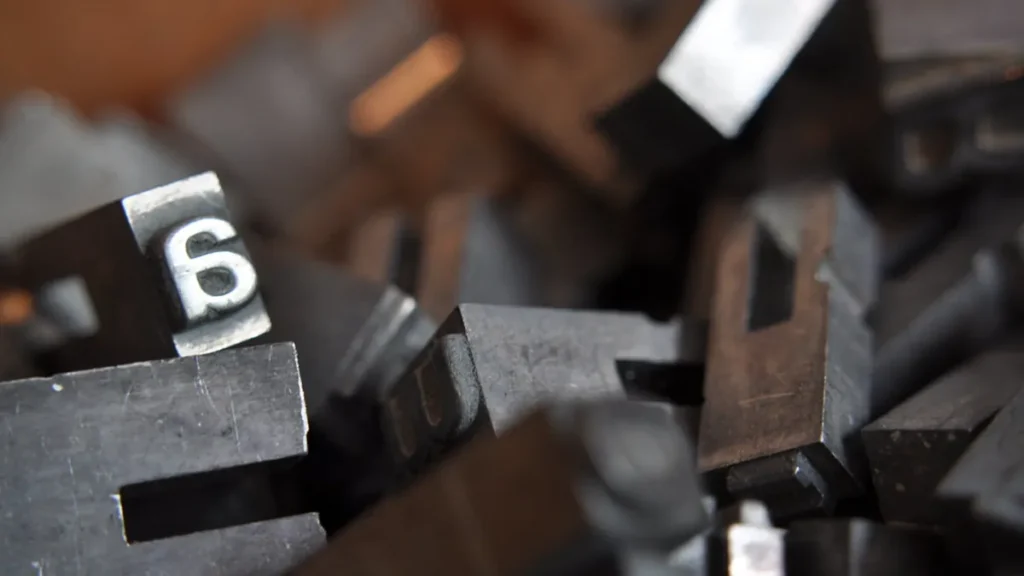
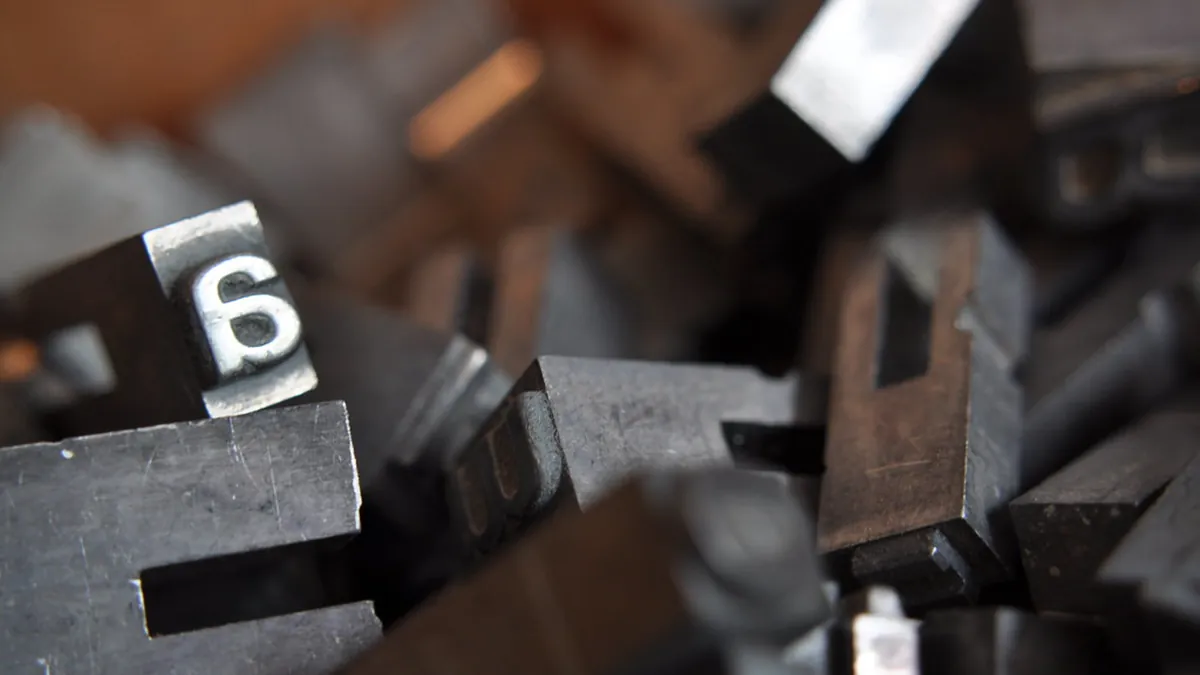
A letterpress workshop is built around one old idea that still works: single letters of metal type, set by hand, locked into a steel frame, inked, and pressed into paper. Each letter is a separate piece of type, picked from a case, set in a composing stick, and transferred to a galley. The lines are locked in a chase with wooden and metal furniture and tightened with quoins until the forme is solid. A sheet of paper is fed to the press, the platen closes, and the type leaves its impression in the fibres. That impression, the shallow dent you can feel with a fingertip, is the whole product. It is what a customer pays for when they order letterpress stationery, and no digital printer can fake it.
Letterpress is a type trade, not a picture trade. The work starts with words, and the workshop is arranged around that fact. The type room holds the cases, the composing benches, and the stone or steel imposing surface where formes are made up. The press room holds the platen press or flatbed cylinder press, the ink bench, and the paper store. A proofing bench sits between the two, where a hand proof is pulled and read before the run starts. Compare that with a block printing workshop, where the image is carved into a wooden block and printed onto cloth in repeat patterns: the block trade works in pictures on fabric, while the letterpress trade works in type on paper, and the two workshops need different rooms, different kit, and different skills.
Starting a letterpress workshop in 2026 means installing all of this from scratch: choosing a press that fits the room, buying type that is complete and in good condition, setting up inking and paper handling, and pricing jobs so the business pays for the press. The nine AI tools in this guide cover that installation job by job. They plan the type room, measure type height, lock up the chase, set the impression, mix the ink, gauge the paper, proof the forme, schedule the press, and quote the work. None of them replaces the compositor or the press operator. Each of them removes a piece of guesswork from the setup, so the first jobs come off the press clean.
Key takeaways
- Letterpress prints with movable type locked in a chase on a platen or flatbed press, and the product is the impression the type leaves in paper.
- Install the type room first: cases, composing benches, and an imposing surface, because every job starts with setting type.
- Impression depth and ink are set by measurement, not by feel alone; a heavy impression crushes type and a light one leaves a ghost.
- Paper choice decides the result as much as the press does; grain direction, weight, and softness all change the impression.
- Quote every job from press time, paper, ink, and make-ready, and proof the forme before the run, not during it.
At a glance: the nine tools
| Tool | What it plans | Best for | Starting point |
|---|---|---|---|
| TypeCase Sort AI | Type inventory and case layout | Buying and sorting second-hand type | Free case audit |
| TypeHigh Measure AI | Type height and make-ready | Levelling a mixed forme | Free height check |
| ChaseLock Planner AI | Forme layout and lock-up | First-time chase work | Free lock-up plan |
| ImpressionDepth AI | Platen pressure and packing | Even impression across the forme | Free pressure reading |
| InkRoller Mix AI | Ink mixing and roller setting | Matching colours and inking evenly | Free mix recipe |
| PlatenPress Schedule AI | Press time and job order | Running the press room week to week | Free weekly plan |
| PaperFeed Gauge AI | Paper stock, grain, and feeding | Choosing and handling paper | Free stock check |
| ProofPress Check AI | Proofing and error checking | Catching mistakes before the run | Free proof scan |
| LetterpressQuote AI | Job pricing and quotes | Quoting stationery and invitations | Free quote builder |
Setting up the type room
The type room is where every letterpress job begins, and it is the room a founder should install first. A press with no type is a heavy ornament, but a full type room with a small press is already a working business. The room needs good light, because the compositor reads tiny letters all day, and it needs dry air, because damp rusts type and swells wooden furniture. Benches should stand at elbow height, cases should tilt toward the compositor, and the imposing surface should sit at the centre of the room so a locked forme can be carried a short distance to the press. The three tools in this section cover the type itself: what you own, whether it is the right height, and how it is locked up ready to print.
TypeCase Sort AI
TypeCase Sort AI is the tool for the most common letterpress problem: buying a job lot of second-hand type and not knowing what is in it. A founder who buys type at auction or from a closing printer usually gets several cases at once, some full, some mixed, some with sorts missing. The tool photographs each case, reads the letters, and builds an inventory by typeface, size, and sort, so the founder knows exactly which letters are present and which are short. A case of 12-point Caslon with no lowercase e is a decoration, not a working case, and this tool finds that out before the money is spent, or at least before the first job is promised.
The inventory feeds straight into the case layout. TypeCase Sort AI plans which cases go on the racks nearest the composing bench, putting the faces used most often at hand height and the display sizes higher up. It flags duplicate faces that can be sold on, and it lists the sorts worth buying to complete a font, which is almost always cheaper than buying another whole case. For a startup, that matters: type is bought by the case, priced by the pound, and a founder who knows exactly what is missing spends a fraction of what a founder guessing spends. The tool also records the condition of each sort, noting worn or damaged letters that will print soft and should be pulled from the case.
TypeHigh Measure AI
TypeHigh Measure AI answers a question that decides whether a forme prints at all: is every piece of type the same height? Letterpress type is made to type high, 0.918 inches in most shops, and a single low sort prints pale while a single high sort punches through the paper. A founder buying old type will always find mixed heights, because type from different foundries, and type that has been planed down after damage, does not match. The tool measures sorts with a gauge and a camera, records the height of each piece, and sorts the type into matched sets, so a forme is built from type that stands level.
The measurement feeds into make-ready, the levelling work done under the forme. TypeHigh Measure AI maps the forme and shows where packing should go under low areas, and where a high sort should be pulled and replaced rather than forced down. It keeps a record for each face, so a compositor setting a job in 14-point Garamond knows before starting whether that face runs true or needs extra make-ready time. That record is also the buying guide: a face that measures consistently is worth keeping, and a face that varies by several thousandths of an inch across its sorts will cost more in make-ready time than it ever earns, however handsome it looks in the case.
ChaseLock Planner AI
ChaseLock Planner AI plans the lock-up: the arrangement of type, furniture, and quoins inside the chase that holds the forme rigid while the press runs. A loose forme is dangerous, because type can lift out under pressure and damage the press, and a badly planned forme wastes paper, because the margins come out uneven and the sheet has to be trimmed to save it. The tool takes the job size, the paper size, and the type area, and lays out the furniture plan, showing where each piece goes and which quoins to tighten in which order, so the forme locks up square and tight on the first attempt.
The plan is drawn for the chase the workshop actually owns, which is why the tool asks for the chase size during setup. A small platen press takes a small chase, and a forme planned for a larger chase will not fit, so the tool keeps a profile of each chase in the shop and plans only within it. It also plans for the gripper edge and the feed, marking the part of the sheet the press needs to hold, so the type area never runs into the grippers. For a founder learning lock-up, the step-by-step tightening order matters as much as the layout: quoins are tightened in pairs, opposite sides together, and the tool walks the operator through that sequence until it becomes habit.
Running the press
The press room is where the workshop earns its money, and it is also where the most expensive mistakes happen. A platen press is a simple machine, a flat bed carrying the forme and a flat platen carrying the paper, brought together by a toggle or a crank, but the settings around it are fiddly: the pressure, the ink, and the order of jobs. Too much pressure and the type bites through the paper and wears fast; too little and the print is a ghost. Too much ink and the letters fill in; too little and the print is patchy. The three tools in this section handle those settings and the working week, so the press runs steadily instead of stopping every hour for an adjustment.
ImpressionDepth AI
ImpressionDepth AI sets the depth of the impression, the shallow dent that marks a letterpress print. The tool reads proof sheets with a camera and measures how deep each letter sits in the paper, then tells the operator how much packing to add or remove behind the forme. Packing is the stack of paper or card behind the type that raises it toward the platen, and a sheet too many makes the impression heavy on one side, while a sheet too few leaves it light. The tool maps the impression across the whole forme, so the operator can see that the left side is heavy and the right side is light, instead of guessing from a single proof.
That map is the difference between a print that looks even and one that does not. A forme with a large solid area and a line of small type will always print unevenly if it is packed flat, because the solid area takes more pressure than the small type. ImpressionDepth AI spots that pattern and suggests spot packing, thin pieces of paper placed under the heavy areas only, which is the traditional fix done with measurements instead of memory. It also watches for the signs of too much pressure: type that shows through the back of the sheet, paper that cracks along the impression, and faces that wear shiny after a short run, and it warns the operator before the type is damaged.
InkRoller Mix AI
InkRoller Mix AI mixes the ink and sets the rollers. Letterpress ink is a stiff paste, mixed by weight from base colours, and a colour mixed by eye on Monday will not match the same colour mixed by eye on Friday, which matters when a customer orders more stationery to match the first batch. The tool records each mix as a formula, weighs the components, and stores the recipe, so a reprint uses the same ink in the same proportions. It also adjusts the formula for the paper, because the same ink looks darker on soft cotton than on hard smooth stock, and the tool corrects for that before the first proof.
Roller setting is the other half of the tool. The ink rollers must just kiss the type: too high and they ink the shoulders of the letters as well as the faces, which fills in small type; too low and they skip across the forme, leaving patchy prints. InkRoller Mix AI measures the roller stripe, the band of ink left when a roller rests on a flat surface, and tells the operator how far to raise or lower each roller. It keeps a setting for each press, because rollers wear and shrink with age, and a setting that was right in spring may be wrong by autumn. The tool also plans the inking for long runs, warning when a run will need the ink redistributing or the rollers re-inking, so the operator plans a stop instead of discovering a pale patch halfway through a stack.
PlatenPress Schedule AI
PlatenPress Schedule AI runs the press room week to week. A letterpress workshop rarely runs one job at a time: a wedding invitation suite may need three colours, which means three passes through the press, while a business card job needs one pass and a poster needs another, and all of them share the same press and the same operator. The tool orders the jobs so that the press changes colour as rarely as possible, grouping dark inks together and light inks together, and it builds in the make-ready time each job needs, so a morning is not promised to a job that needs two hours of lock-up and packing.
The schedule is built from the real times the workshop records. PlatenPress Schedule AI logs how long each job actually took, from lock-up to the last sheet, and uses those times to plan the next week, so estimates get better as the workshop grows. A founder who guesses will promise a Friday delivery for a job that needs a full day of press time; a founder with a log knows it needs Monday as well. The tool also plans around the press itself, booking maintenance into the week, because a platen press needs its rollers washed, its oiling done, and its tympan paper changed, and a press maintained on schedule breaks down far less than one maintained when it starts squeaking.
Paper, proofing and pricing
Paper, proofing, and pricing are the three jobs that decide whether a letterpress workshop makes money. Paper is the largest material cost in most jobs, and the wrong stock can waste a whole run. Proofing is the last chance to catch a mistake, and a mistake caught on a proof costs a sheet of paper, while the same mistake caught on the finished run costs the whole job. Pricing is the arithmetic that ties it together: press time, paper, ink, and make-ready, added up before the quote goes out rather than discovered afterwards. The three tools in this section handle those jobs, and they are the ones a founder leans on most once the press is running.

PaperFeed Gauge AI
PaperFeed Gauge AI chooses the paper and plans how it feeds through the press. Letterpress paper is usually a soft, cotton-rich stock that takes a deep impression without cracking, and the tool matches the stock to the job: a thick cotton paper for a wedding invitation that should feel luxurious, a lighter smooth stock for a business card that will be handled every day, a sturdy card for a poster that will be pinned up. It records the weight, the grain direction, and the finish of every stock the workshop holds, and it warns when a stock is wrong for a job, for example when a coated paper that resists impression has been chosen for a design that depends on a deep bite.
The tool also keeps the paper store honest. Paper is bought by the ream, stored flat, kept dry, and used oldest first, and the tool tracks the stock levels, the cost per sheet, and the offcuts that can be used for small jobs. A founder who knows the cost of each sheet prices accurately, and a founder who uses offcuts for gift tags and test prints wastes nothing. Paper is the substrate of the whole trade, and a paper making workshop is the closest trade to this one, because the sheet itself is half the product; the letterpress workshop buys the paper that the paper maker makes, and knowing how it is made helps the printer choose it well. For installation, the paper store should be planned with the tool from the start, with flat shelves, dry air, and a cutting bench nearby, because paper that is stored damp or bent will never feed straight.
ProofPress Check AI
ProofPress Check AI proofs the forme before the run starts. A proof is a single impression pulled by hand, read carefully, and checked against the copy, and it is the last cheap moment in the whole job. The tool scans the proof, reads the text, and compares it with the job file, catching transposed letters, missing sorts, and wrong spacing that a tired eye misses after setting type for an hour. It also checks the layout: margins that are uneven, a line that sits too close to the edge, a heading that is one point larger than the rest, all the small errors that a customer will notice on the finished piece even if the printer does not.
The check runs on the forme as it is locked up, which is important, because type can move during lock-up. A letter that was right in the galley can turn upside down in the chase, and a sort that was the right height in the case can sit low once it is locked. ProofPress Check AI reads the proof taken from the locked forme, not from the galley, so it catches the errors that lock-up itself creates. It also reads the proof for impression and inking, flagging a corner that prints light or a letter that is over-inked, so the operator can fix the packing or the rollers before the run, when the fix costs a minute, rather than during it, when the fix costs a stack of spoiled sheets.
LetterpressQuote AI
LetterpressQuote AI prices the job. A letterpress quote is built from four things: the press time, the paper, the ink, and the make-ready, and a founder who forgets any one of them works for nothing. The tool takes the job details, the size, the number of colours, the quantity, and the paper, and builds the quote from the workshop’s own recorded times and costs. It knows how long a three-colour invitation takes to lock up, proof, and run, because the workshop has logged it, and it knows the cost of the paper because the paper store is tracked, so the quote is built on the workshop’s real numbers rather than a guess.
For installation, the quoting tool is the business plan in miniature. A founder who quotes from real costs knows which jobs pay and which do not, and can say no to the job that would take a day of press time for the price of an hour. The tool tracks which quotes were accepted and which were refused, so the founder learns where the market price sits and can adjust, rather than guessing. It also handles the follow-on work: a printed sheet that will be folded and bound becomes a book, and the finishing trade for that is the bookbinding workshop, where the letterpress sheets are gathered, sewn, and cased. A founder who knows the binder’s prices can quote a finished book, not just a stack of sheets, and that is the kind of job that turns a one-off customer into a regular one.
Installation checklist
- Choose the press first, then the room. Measure the platen press or flatbed press, add space for the operator to stand and the paper to stack, and only then sign for a room that fits it with room to spare.
- Buy type by the case, and check every sort. Count the letters, check the heights, and pull damaged sorts before the type goes on the racks, because a case with a missing e cannot set a job.
- Set up the imposing surface at the centre. The stone or steel surface should sit between the type room and the press, so a locked forme travels the shortest distance.
- Plan the paper store dry and flat. Paper lives on flat shelves in dry air, oldest stock first, with a cutting bench nearby and the grain direction marked on every ream.
- Proof every forme before the run. Pull a hand proof from the locked chase, read it against the copy, and file it with the job, because a mistake on a proof costs a sheet and a mistake on a run costs the job.
- Quote from press time, paper, ink, and make-ready. Add up all four before the quote goes out, keep the recipe and the lock-up plan for reprints, and log the real time each job takes so the next quote is better.
Frequently asked questions
What is a letterpress workshop?
A letterpress workshop is a print shop that prints with movable metal type. The compositor sets individual letters into words and lines, locks them in a steel chase, inks the type, and presses paper against it on a platen press or a flatbed cylinder press. The type leaves a shallow impression in the paper, which is the mark of the trade. The workshop makes stationery, invitations, business cards, posters, book covers, and packaging, all printed from type rather than from a digital file.
How is letterpress different from block printing?
Letterpress prints with movable type on paper, while block printing prints with a carved wooden block on cloth. In letterpress, the image is made of separate letters that can be rearranged for every job, and the substrate is paper. In block printing, the image is carved into a block and repeated across fabric. The two trades share a press-like action, but the tools, the materials, and the products are different, and a letterpress workshop is set up around type cases and chases, not around carved blocks and fabric.
What press should a letterpress startup buy first?
Most startups begin with a small platen press, such as a tabletop or treadle platen, because it fits a small room, runs short stationery jobs well, and teaches the operator the whole trade. A flatbed cylinder press suits larger posters and longer runs, but it needs more floor space and more paper handling. Buy the press that fits the jobs already promised, check that it is complete and that its platen is true, and budget for moving it, because a cast-iron press is heavy and needs a proper floor.
How much type does a letterpress workshop need?
A working shop needs at least one complete text face in a useful size, usually 12-point, with a full set of sorts, plus a display face for headings and a set of ornaments or borders. Buying type by the case is the usual route, and the cases should be checked for missing sorts and mixed heights before they are put on the racks. A founder should buy the faces the first customers actually want, rather than a room full of type that never gets used, and add faces as the order book grows.
What paper works best for letterpress?
Soft, cotton-rich paper takes the deepest and cleanest impression, because its fibres compress under the type without cracking. A thick cotton stock suits wedding invitations and greetings cards, while a lighter smooth stock suits business cards that are handled daily. Coated papers resist the impression and are a poor choice for work that depends on a deep bite. The grain direction matters too: paper folds cleanly with the grain, so the cutting plan should keep the grain running the right way for the finished piece.
How do you price a letterpress job?
Price from four costs: press time, paper, ink, and make-ready. Make-ready is the setting, lock-up, proofing, and packing time before the run, and it is often the largest part of a short job. A second colour is a second pass through the press and is priced as one. Reprints are cheaper than first runs because the type is already set and the lock-up is saved. A quote that shows those lines helps the customer understand why letterpress costs more than digital printing, and why the result is worth it.
Bottom line
A letterpress workshop is a type trade, and its installation is a type-first job: cases and benches before anything else, a press that fits the room, paper stored dry and flat, and a proofing bench between the two. The nine tools in this guide take the guesswork out of that installation, from sorting the type to quoting the first job. Set the type, lock the chase, proof the forme, and let the impression speak. That is the whole trade, and it has not changed in five hundred years.

Keep what speaks to you.
Leave room for your own perspective.