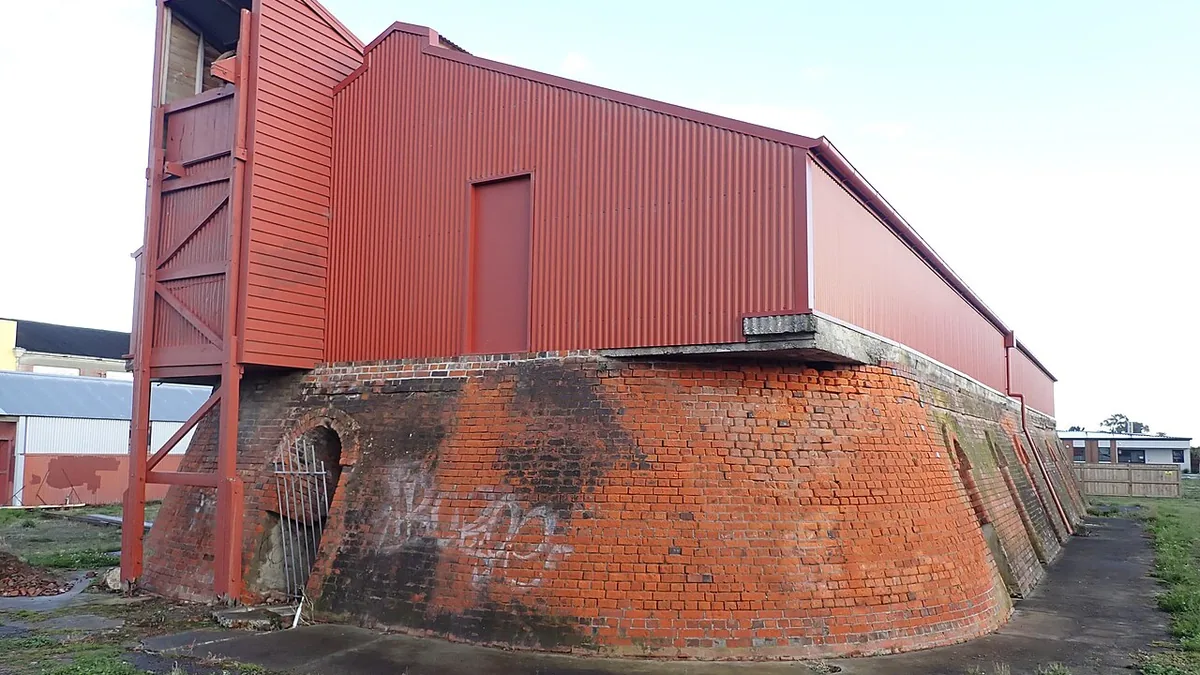
A Hoffman kiln installation startup builds a kiln that never stops. That is the whole idea, and it is what separates this trade from every other brick kiln business. A Hoffman kiln is a continuous brick kiln: a ring of chambers built in a circle or an oval, where the fire travels from chamber to chamber while the bricks stay put. One chamber is being loaded with green bricks, the next is drying, the next is firing, and the next is cooling and being unloaded, all at the same time. The fire moves on, chamber after chamber, for weeks without going out.
The client for this kind of kiln is a brickworks, a heritage brick maker, or a small manufacturer that needs a steady supply of fired bricks week after week and cannot afford the stop-start rhythm of a kiln that fires once, cools for days, and then starts again. A Hoffman kiln gives that client output every day, because there is always a chamber ready to be drawn and always a chamber ready to be lit.
That continuity is also what makes the job hard. A kiln that never cools cannot be fixed by waiting for it to go cold and starting again. The chambers have to be sealed and unsealed in the right order, the fuel has to be fed while the fire is live, and the bricks have to be loaded and drawn without disturbing the chambers beside them.
Key takeaways
- A Hoffman kiln is a continuous brick kiln: a ring of chambers where the fire travels from chamber to chamber while the bricks stay put.
- Unlike a batch kiln, a Hoffman kiln never cools down. Loading, firing and drawing happen at the same time in different chambers.
- The startup’s core skill is sequencing: knowing which chamber to load, which to seal, which to fire and which to draw on any given day.
- The nine tools below cover the whole cycle, from surveying the ring to pricing the build and keeping the chamber log.
- Buy the fire-travel planner first. If the fire cannot move around the ring on schedule, nothing else in the business works.
What makes a Hoffman kiln continuous?
The Hoffman kiln was designed in the nineteenth century to solve a simple problem: a brick kiln that fires once and then cools wastes most of its heat. Every firing starts with a cold kiln, burns a great deal of fuel to bring it up to temperature, and then throws that heat away as the kiln cools. The Hoffman design keeps the heat inside the ring.
The ring itself is the machine. It is usually a long oval or circle of brick chambers, each with its own door, its own flue connection and its own damper. A chamber that has just been fired is sealed off and left to cool while the fire moves on, and once it is cool enough its door is opened and the finished bricks are drawn out. The empty chamber is then loaded with green bricks, sealed again, and left to warm as the fire comes back around.
That is a very different business from building a kiln that fires in batches. A batch kiln is loaded, fired, cooled and emptied as one job, and the whole kiln is out of action while it cools. The Hoffman kiln is never out of action. The installer has to think in cycles rather than firings, in chambers rather than kilns, and in weeks rather than days. The tools that suit a batch kiln, which plan a single firing curve and a single cooling phase, do not fit a ring where three or four chambers are always at different stages at once.
How a Hoffman kiln differs from a batch brick kiln
The clearest way to see the difference is to watch a single brick. In a batch brick kiln, the brick is stacked, dried, fired and cooled in the same chamber, and the kiln does nothing else while that happens. The fire is lit, the temperature climbs for days, the kiln is sealed and left to cool for days more, and only then is the door opened.
That difference changes the building work too. A batch kiln needs one good chamber, one chimney and one firing curve. A Hoffman kiln needs a dozen or more chambers that all behave the same way, flues and dampers that can be opened and closed chamber by chamber, and a fuel feed that can be moved around the ring as the fire travels. The bricklaying is heavier, the flue work is more complicated, and the commissioning takes longer, because the kiln cannot be tested with a single firing.
The comparison matters because the two trades are often confused by clients who have only ever seen a batch kiln. A brick kiln installation startup that builds a batch kiln plans one chamber, one chimney and one firing at a time, and its tools are built around that single firing. A Hoffman kiln startup plans a ring, a cycle and a travelling fire, and it needs tools that can hold the state of every chamber at once. The client who buys a Hoffman kiln is buying daily output, not a single firing, and the startup has to be able to promise that output in writing.
How a Hoffman kiln differs from a clamp kiln and a pit kiln
The Hoffman kiln is also easy to confuse with the simplest brick kilns, and the confusion is worth clearing up early because it decides what the startup actually builds. A clamp kiln is a temporary stack of green bricks laid out in the open air, with layers of fuel between the courses and the whole stack sealed under clay or mud. It is lit once, burns for days, and is then broken open. There is no permanent chamber at all, no chimney and no second firing in the same place. A Hoffman kiln is the opposite: a permanent ring of chambers, built to fire again and again for years.
A pit kiln is further away still. It is a hole dug in the ground, filled with pots and sawdust and dung, covered over and left to smoulder. It fires pottery, not bricks, and it fires it once, in a pit that is dug fresh for the job. Nothing about a pit kiln carries over to a Hoffman kiln except the word kiln itself.
The outdoor kiln trade sits between these extremes, and it is worth knowing where it ends. An outdoor kiln installation startup that fits a controller kiln in a garden or studio works with a single chamber, a controller and a firing schedule that the owner starts and stops. That is a useful trade, and its tools are good at schedules and controllers, but they are built for a kiln that one person fires and then leaves to cool. A Hoffman kiln has no single schedule and no single cool-down. It has a ring of chambers at different stages, and the tools below are built to track all of them at once.
How a Hoffman kiln differs from an anagama kiln
The anagama kiln is the closest cousin to the Hoffman kiln in spirit, because both are fired by people who tend a fire for days, and both use the fire itself to finish the ware. But the two kilns are built for different products and different rhythms. An anagama kiln is a long, sloping chamber built into a hillside, fired with wood from a firebox at the low end, and the flame climbs through the chamber and settles ash on the pots as glaze. It fires pottery, in one long firing, and then it cools and is unloaded.
A Hoffman kiln fires bricks, not pots, and it fires them continuously. There is no slope and no ash glaze. The chambers are level, the fuel is usually coal or gas rather than cordwood, and the fire is moved from chamber to chamber by opening and closing dampers rather than by stoking a single firebox for days.
That is why the tools do not transfer. An anagama kiln installation startup that builds a wood-fired climbing kiln needs tools for stoking shifts, wood moisture and ash glaze, and those tools are excellent for that trade. A Hoffman startup needs tools for chamber sequencing, fuel feeding around a ring and drawing bricks while the kiln is still hot elsewhere. The two trades share a respect for a long firing, but they build different machines and they sell them to different clients.
The nine AI tools for a Hoffman kiln installation startup
The tools below are grouped by the part of the cycle they serve. The first three plan the ring and the travelling fire. The next three keep the fire moving and the chambers sealed. The last three draw the bricks, price the job and keep the record. Together they cover the whole business, from the first site survey to the hundredth chamber cycle. Each one is written up with what it does, who it suits, and where it earns its keep.
Tools that plan the ring
1. ChamberRing Survey AI: the best tool for laying out the ring of chambers
Every Hoffman kiln starts with the ring, and the ring starts with the ground. ChamberRing Survey AI takes a site survey, a soil report and the client’s target output, and works out how many chambers the ring needs, how large each one should be, and how the oval should sit on the plot. It checks the fall of the land, the access for lorries bringing green bricks in and fired bricks out, and the space needed for the fuel store and the drying floor. A ring that is too small cannot keep up with demand, and a ring that is too large costs more to build than it will ever earn back.
The tool also models the flue runs. In a Hoffman kiln the hot gases from the firing chamber are drawn through the chambers ahead of it, and the flues have to be sized so that the draught is even all the way around the ring. If one side of the ring draws harder than the other, the chambers on that side will fire fast and the chambers on the far side will lag, and the whole cycle will drift out of step. ChamberRing Survey AI flags uneven draught before a single brick is laid, which is far cheaper than rebuilding a flue after the kiln is built.
Buy it before the first foundation is dug. It stops the two most expensive mistakes in the trade: a ring that does not fit the plot, and a ring whose chambers do not fire evenly.
2. FireTravel Planner AI: the best tool for timing the fire around the ring
FireTravel Planner AI is the heart of the whole toolkit, and it is the tool this guide recommends buying first. It plans the movement of the fire from chamber to chamber: which chamber is firing today, which chamber the fire moves to tomorrow, and how long each chamber needs at full heat before the fire moves on. It takes the brick type, the fuel, the chamber size and the weather, and turns them into a day-by-day plan that the crew can follow without guessing.
The plan matters because the fire cannot wait. If a chamber is not ready when the fire arrives, the fire has nowhere to go, and the kiln loses a day. If a chamber is fired for too long, the bricks over-fire and the fuel bill climbs. FireTravel Planner AI watches the cycle and warns the crew a day ahead when a chamber is running behind, so the loading team can catch up before the fire arrives. It also keeps a record of how long each chamber actually took, so the next cycle is planned on real times rather than on hope.
For a new startup, this tool is the difference between a kiln that runs and a kiln that stumbles. A client who buys a continuous kiln is buying a promise of daily output, and the fire-travel plan is the document that backs that promise.
3. ColdChamber Load AI: the best tool for loading green bricks into a cold chamber
ColdChamber Load AI plans the loading of a chamber that has just been drawn and cooled. It works out how many green bricks the chamber will hold, how they should be stacked so the hot gases can pass between them, and how much space to leave at the door for the sealing work that follows. A badly loaded chamber fires unevenly, with cold spots where the gases could not reach and over-fired bricks where the draught ran too strong.
The tool is built for the particular rhythm of a Hoffman kiln, where loading happens while the kiln is running. The chamber being loaded is cold, but the chambers beside it are hot, and the crew is working next to a live kiln. ColdChamber Load AI times the loading so that it finishes before the fire comes back around, and it checks that the green bricks going in are dry enough to fire. Green bricks that are still wet will crack when the heat reaches them, and a chamber full of cracked bricks is a chamber wasted.
It turns loading from a job done by eye into a job done to a plan, and it gives the crew a checklist they can follow chamber after chamber. It earns its keep in chambers that fire evenly the first time, with no cold spots and no wasted loads.
Tools that keep the fire moving
4. FuelFeed Watch AI: the best tool for feeding fuel while the kiln runs
A Hoffman kiln is fed while it fires, and the feeding never stops for long. FuelFeed Watch AI plans the fuel feed for the chamber that is firing now, and for the chamber that will fire next. It works out how much fuel the firing chamber needs hour by hour, when the feed should be topped up, and how the feed should change as the fire moves on. It also tracks the fuel store, so the startup knows when to order more and never runs a live kiln short of fuel.
The tool reads the temperature of the firing chamber and the chambers ahead of it, and it warns the crew when the fire is running cool or hot. A fire that runs cool will leave the bricks under-fired and soft, and a fire that runs hot will waste fuel and risk over-firing the load. FuelFeed Watch AI gives the crew a simple reading, chamber by chamber, so they can adjust the feed before the bricks are damaged rather than after.
Fuel is the largest running cost of a Hoffman kiln, and a kiln that burns more than it needs will eat its own margin. FuelFeed Watch AI earns its keep in fuel saved, and in bricks that come out fired right the first time.
5. ChamberDoor Seal AI: the best tool for sealing and unsealing chamber doors
Every chamber in a Hoffman kiln has a door, and the door has to be sealed tight while the chamber fires and opened cleanly when the chamber is drawn. ChamberDoor Seal AI plans the sealing work: which doors to seal, which to open, and in what order, so that the draught always runs the right way around the ring. A door that leaks will pull cold air into the firing chamber and slow the fire, and a door that is opened at the wrong time will let the heat out of a chamber that still needs it.
The tool also tracks the condition of the doors themselves. The seals, the brickwork around the door, and the damper for each chamber all wear with use, and a door that has sealed well for twenty cycles may start to leak on the twenty-first. ChamberDoor Seal AI logs every sealing, notes which doors needed extra work, and flags the doors that should be rebuilt before they fail during a firing. That record is worth more than it looks, because a failed door in the middle of a cycle can cost the kiln a week.
It turns door work from a chore done from memory into a planned job with a record, and it gives the crew a clear order of work each day. It earns its keep in draught that stays even and doors that do not fail mid-cycle.
6. FirePass Curve AI: the best tool for the heat curve as the fire passes each chamber
FirePass Curve AI plans the heat curve for a chamber as the fire passes through it. Unlike a batch kiln, where the whole kiln follows one curve from cold to hot and back to cold, a Hoffman chamber is warmed by the chambers before it, fired when the fire arrives, and cooled by the air drawn through it after the fire has passed. The curve for one chamber is really three curves joined together: a slow warming, a sharp firing, and a long cooling.
The tool models all three parts. It works out how warm a chamber should be when the fire arrives, how hot it should get at the peak of the firing, and how quickly it should cool before its door is opened. It warns the crew when a chamber is warming too slowly, which usually means the flues ahead of it are not drawing well, and when a chamber is cooling too fast, which usually means a door is leaking. Those warnings come a day or more before the bricks are damaged, which is the whole point of the tool.
A Hoffman kiln that fires evenly, chamber after chamber, is a kiln that a brick buyer can trust, and the fire-pass curves are the evidence. FirePass Curve AI earns its keep in bricks that come out the same colour and the same strength, cycle after cycle.
Tools that draw the bricks, price the job and keep the record
7. HotDraw Planner AI: the best tool for drawing fired bricks while the kiln still runs
HotDraw Planner AI plans the drawing of a chamber that has cooled enough to open while the kiln is still firing elsewhere in the ring. It works out when a chamber is cool enough for the crew to work in, how the bricks should be drawn out and sorted, and how quickly the chamber needs to be emptied so it can be loaded again. The drawing has to be fast, because the fire is coming back around, but it also has to be careful, because hot bricks and a live kiln next door are a real hazard.
The tool sorts the drawn bricks as they come out. It records how many are first quality, how many are seconds, and how many are spoiled, and it ties that record to the chamber, the firing and the fuel used. Over a few cycles that record shows which chambers fire well and which ones do not, and that is the information the startup needs to fix the ring rather than guessing. A chamber that always produces seconds is a chamber with a draught problem, and the record proves it.
It turns drawing from a rush job into a planned job, with a sorting record that the client can see. It earns its keep in chambers that are emptied on time and bricks that are sorted correctly.
8. HoffmanBuild Estimator AI: the best tool for pricing a continuous kiln build
HoffmanBuild Estimator AI prices the whole job: the ring, the chambers, the flues, the fuel store, the drying floor and the commissioning. It takes the chamber count and the site conditions from the survey tool and turns them into a quote the client can understand, with the brickwork, the flue work and the commissioning shown as separate lines. A Hoffman kiln is a large build, and a client who cannot see what they are paying for will not sign.
The tool also prices the running of the kiln, not just the building of it. It estimates the fuel use per cycle, the crew time per chamber, and the output in bricks per week, so the client can see what the kiln will cost to run and what it will earn. That running-cost estimate is what sells a continuous kiln, because the client is buying daily output and needs to know the daily cost. A quote that only shows the build price tells the client half the story.
A quote that is too low will lose money on every chamber, and a quote that is too high will lose the job. HoffmanBuild Estimator AI earns its keep in quotes that win work and still leave a margin.
9. RingCycle Ledger AI: the best tool for the chamber-by-chamber firing log
RingCycle Ledger AI keeps the record of the ring. Every chamber, every firing, every load and every drawing goes into the ledger, with the fuel used, the bricks drawn, the seconds and spoils, and the time each stage took. It is the memory of the kiln, and it is what turns a startup that runs a kiln into a startup that understands its kiln. Without it, every cycle starts from scratch. With it, every cycle is better than the last.
The ledger also does the business paperwork. It raises the invoice for the bricks drawn, tracks the fuel bills against the output, and shows the client a simple report: how many bricks this week, how many firsts, how many seconds, and what it cost. A client who can see that report will trust the kiln, and a startup that can show it will win the next job more easily. The ledger is also the record that proves the kiln is running continuously, which is the promise the whole business is built on.
It is the least exciting tool in the list and the one the business will miss most if it is skipped. It earns its keep in records that are complete, invoices that go out on time, and a kiln that gets better with every cycle.

Comparing the nine tools
| Tool | What it does best | Buy it when |
|---|---|---|
| ChamberRing Survey AI | Lays out the ring, the chambers and the flues | Before the first foundation is dug |
| FireTravel Planner AI | Times the fire moving chamber to chamber | First, before any other tool |
| ColdChamber Load AI | Plans loading green bricks into a cold chamber | When loading has to keep up with the fire |
| FuelFeed Watch AI | Feeds fuel while the kiln runs | When fuel costs need controlling |
| ChamberDoor Seal AI | Seals and unseals chamber doors in order | When draught problems appear |
| FirePass Curve AI | Plans the heat curve as fire passes each chamber | When firing quality must be proven |
| HotDraw Planner AI | Draws fired bricks while the kiln still runs | When a chamber is drawn almost daily |
| HoffmanBuild Estimator AI | Prices the build and the running costs | When quoting the first Hoffman jobs |
| RingCycle Ledger AI | Logs every chamber, firing and drawing | From the first cycle onwards |
Startup checklist: your first Hoffman kiln
- Survey the site and fix the ring size, chamber count and flue runs before any brick is laid.
- Write the fire-travel plan for the first full cycle, chamber by chamber, and agree it with the crew.
- Load the first chambers with dry green bricks, stacked so the hot gases can pass between them.
- Seal the doors in order, check the dampers, and light the first chamber on schedule.
- Feed the fuel to the plan, watch the fire move, and draw the first chamber the day it cools.
- Log every chamber in the ledger, and use the record to plan the next cycle better than the first.
Frequently asked questions
What is a Hoffman kiln installation startup?
It is a startup that builds continuous brick kilns: a ring of chambers where the fire travels from chamber to chamber while the bricks stay put. The startup surveys the site, builds the ring and the flues, commissions the kiln, and hands the client a kiln that fires bricks every day rather than in single batches.
How is a Hoffman kiln different from a batch brick kiln?
A batch kiln is loaded, fired, cooled and emptied as one job, and the whole kiln is out of action while it cools. A Hoffman kiln never cools. While one chamber fires, another is being loaded, another is warming, and another is being drawn, so the kiln produces bricks every day.
How is a Hoffman kiln different from a clamp kiln?
A clamp kiln is a temporary stack of green bricks in the open air, sealed under clay or mud, lit once and then broken open. A Hoffman kiln is a permanent ring of brick chambers with doors, dampers and flues, built to fire again and again for years.
How long does a Hoffman kiln keep firing?
A well-run ring can keep firing for weeks or months without stopping. The fire moves from chamber to chamber on a rota, and as long as chambers are loaded ahead of the fire and drawn behind it, the cycle continues.
Which AI tool should a Hoffman kiln startup buy first?
FireTravel Planner AI. It times the fire moving around the ring, and if the fire cannot move on schedule, nothing else in the business works. Buy it first, learn its timings, and let the rest of the toolkit grow around it.
Can one person run a Hoffman kiln installation startup?
One person can plan it and quote it, but running a live ring needs a small crew. Loading, sealing, feeding and drawing happen at the same time in different chambers, and the work is too much for one pair of hands. A small team of three or four, working to the fire-travel plan, is a realistic start.
The bottom line
A Hoffman kiln installation startup sells something no batch kiln can offer: a kiln that never stops. The ring of chambers, the travelling fire, and the daily rhythm of loading, firing and drawing are the whole business, and they are what the client is paying for. Start with the fire-travel plan, build the ring to fit the site, and keep the record.

Keep what speaks to you.
Leave room for your own perspective.