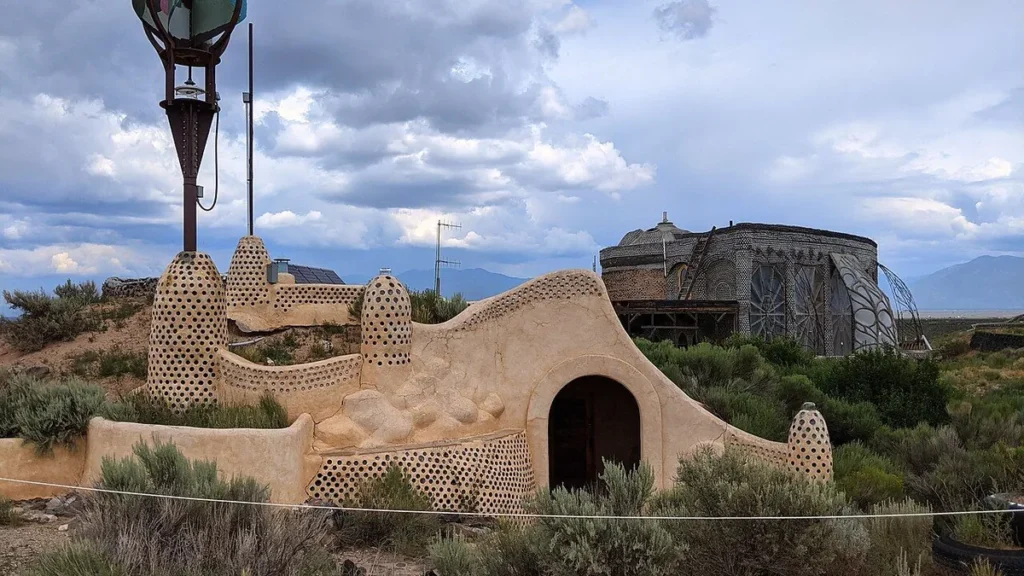
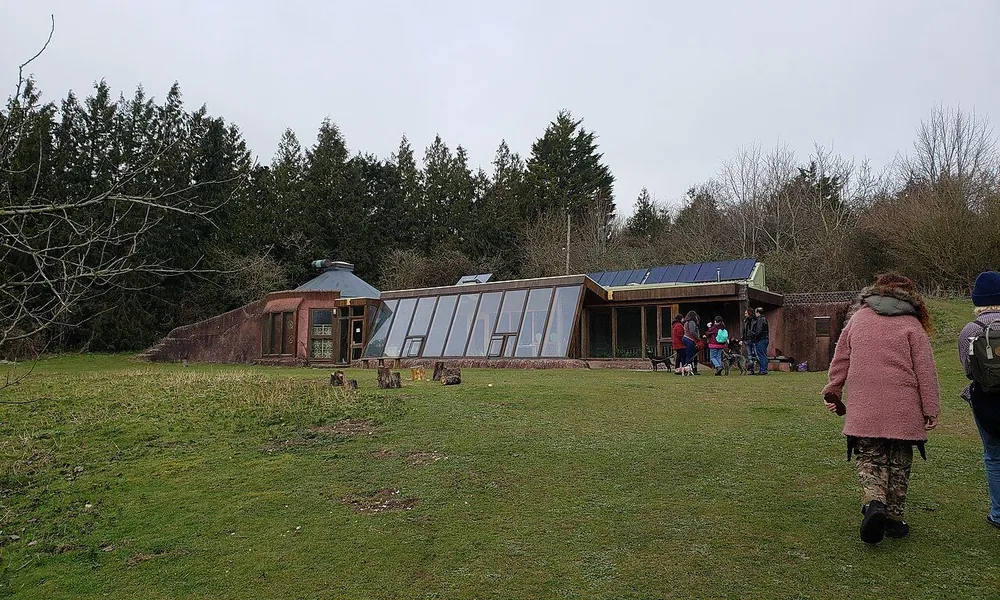
An earthship is not a house with solar panels bolted on. It is a house that heats itself, waters itself and holds itself up with the ground it stands on. The walls are old car tyres rammed full of earth, stacked like bricks and buried into a berm. The south face is a wall of glass that catches the winter sun and stores its warmth in that dense tyre mass. Rain lands on the roof, runs into cisterns, gets used four times over, and the whole building runs without a mains connection, a gas pipe or a water main.
That is a wonderful house to live in and a demanding one to build. A startup that installs earthships runs four trades at once: tyre-wall construction, passive-solar design, off-grid power, and rainwater plumbing. Get the orientation wrong and the house overheats in summer and freezes in winter. Size the solar array like a normal house and the batteries die on the third cloudy day.
The nine tools below are picked for that exact job, not for housebuilding in general. Each one handles a piece of the earthship build that a generic construction app ignores: shaping curved tyre walls, modelling sun across a glass facade, proving a rammed-earth wall will hold, sizing a solar and battery system that must never fail, and planning a water system that catches, stores, cleans and reuses every drop.
Key takeaways
- An earthship is a thermal battery first and a house second: tyre walls rammed with earth store the sun’s heat, so design tools must model sun, mass and airflow together.
- Off-grid power and water cannot be guessed. Solar, battery, cistern and greywater sizing all need real numbers before the first tyre is laid.
- Every tool in this list is new to this series: none of the nine appears in the tiny house, modular home or log cabin installation guides.
- Start with three tools only: a parametric modeller for the shape, a solar analysis tool for the glass wall, and an off-grid energy planner for the power system.
- Quote the tyre count, the cistern volume and the battery capacity in writing. Those three numbers decide whether the build makes money or loses it.

Best AI Tools for Earthship Installation Startups at a Glance
| Tool | Best for | Earthship job it solves | Starting point |
|---|---|---|---|
| Rhino 3D with Grasshopper | Parametric design | Curved tyre walls and bermed forms | Paid licence, free trial |
| Ladybug Tools | Sun and climate analysis | Glass-wall orientation and shading | Free, open source |
| cove.tool | Whole-building performance | Energy, water and carbon in one model | Free trial, paid plans |
| Aurora Solar | Solar design | Off-grid panel layout and shade modelling | Paid, demo available |
| HOMER Pro | Microgrid optimisation | Solar, battery and generator sizing | Paid licence, trial available |
| OpenFlows WaterGEMS | Water system modelling | Cisterns, pumps and greywater loops | Paid licence, trial available |
| Pix4D | Drone site mapping | Surveying remote, sloping plots | Paid, free trial |
| SimScale | Cloud simulation | Thermal and structural wall testing | Free community plan, paid plans |
| QuickBooks Online | Business finance | Quotes, invoices and crew costs | Paid, free trial |
What Makes an Earthship Installation Startup Different
A conventional builder starts with a flat slab and a rectangular plan. An earthship builder starts with a hillside, a pile of discarded tyres and a compass. The house is dug into the earth on its north side, so the berm itself becomes insulation and structure. The south side opens almost entirely to the sun through a sloped glass wall, and behind that glass sits a greenhouse corridor where food grows and grey water is filtered through planter beds. Nothing about that sequence appears in a standard housebuilding manual, and that is why the software has to change too.
The first difference is the wall. A tyre wall is built by packing each tyre with rammed earth until it rings solid, then stacking the tyres in a running bond and filling the gaps with cans, bottles and concrete. A single earthship can swallow eight hundred to a thousand tyres, and each one takes real labour. The crew needs to know the exact count, the volume of earth to move, and the order of the courses before the first sledgehammer swings. A tool that draws straight stud walls has nothing useful to say about any of that.
The second difference is the sun. The glass wall is the heating system, and the tyre mass behind it is the storage. In winter the low sun must reach deep into the rooms; in summer the high sun must be kept out by the roof overhang. That balance depends on latitude, orientation, glass angle and overhang depth, and it can only be settled with climate data and sun-path modelling.
The third difference is independence. There is no grid to fall back on and no mains water to top up the tanks. The solar array, the batteries, the inverter, the cisterns, the pumps and the treatment planters form one system, and a shortfall in any part shows up as a cold shower or a dark evening for the client. Sizing that system is engineering, and the numbers have to be right before the roof goes on, because adding panels or tanks afterwards costs three times as much.
Finally, the work happens in remote places. Earthship plots are usually rural and sloping, so deliveries and crew travel need planning around long drives and rough tracks. A tiny house installation startup can tow its product to the client; an earthship startup builds in place, in the weather. The tools below are chosen for that reality: design the mass, prove the sun, size the systems, survey the ground, and keep the money straight.
Design the Shape and the Sun
The design stage decides whether the earthship works. Once the tyre walls are up and the berm is backfilled, changing the shape or the glass angle is effectively impossible, so the modelling has to be honest before the ground is broken.
1. Rhino 3D with Grasshopper
Earthships are rarely rectangular. Tyre walls curve, berms slope, bottle walls follow the line of the land, and the glass facade tilts to catch the winter sun. Rhino 3D is a surface modeller built for exactly that kind of free-form geometry, and Grasshopper, its visual programming partner, turns the design into a set of rules instead of a fixed drawing. Change the wall radius or the glass angle and the whole model updates, including the tyre count and the wall lengths the crew will build from.
For an earthship startup, the practical win is the tyre schedule. Grasshopper can divide a curved wall into individual tyre courses, count them, and report the volume of rammed earth each course needs. That turns a vague estimate into a materials list: so many tyres, so many cubic metres of earth, so many days of ramming. It also lets the founder test variations quickly and price each option in an afternoon instead of arguing about it for a week.
The learning curve is real, and Rhino is not a tool to open the night before a client meeting. But for a startup whose product is a curved, hand-built, site-specific house, a parametric model is the difference between a design that survives contact with the hillside and one that has to be redrawn on a muddy plot. Start with one wall: model a single curved tyre course, count it, and build the rest of the house around that discipline.
2. Ladybug Tools
Ladybug Tools is a free, open-source set of climate analysis plugins that runs inside Rhino and Grasshopper, and it is the closest thing the earthship world has to a sun simulator. Feed it the site’s weather file and it will draw the sun path across the plot for any day of the year, map shadows hour by hour, and show how much direct sun hits the glass wall in January versus July. That is the single most important question in an earthship design, and Ladybug answers it with pictures a client can understand.
The tool also handles daylight, glare and thermal comfort, which matters because the glass wall that heats the house in winter can blind the people inside it in summer. Ladybug’s radiation studies show which parts of the floor will overheat, where the overhang needs to be deeper, and whether a shading device or a deciduous tree would do the job better. For the greenhouse corridor behind the glass, its temperature and humidity analysis helps decide what will actually grow there rather than what the brochure promises.
Because it is free, Ladybug is the cheapest way for a new startup to look professional. Bring a sun-path diagram and a shadow study to the first client meeting and the founder is no longer selling a dream, but showing the exact hours of sun the house will catch on the shortest day of the year. That evidence turns curious visitors into signed contracts.
3. cove.tool
cove.tool is a cloud platform that tests a building’s energy, water, daylight and carbon performance while it is still a sketch, using machine learning trained on thousands of simulations. For an earthship, its value is that it treats the house as one system instead of four separate trades. The tyre mass, the glass area, the insulation, the solar array and the rainwater system all feed the same model, so changing one number shows the effect on the others immediately.
That matters because earthship clients ask the hardest question in the business: will it really work? cove.tool produces energy, water-balance and carbon figures that can go into a quote or a planning application. If the model shows the house needs more south glass or a bigger cistern to survive a dry summer, the founder finds out in the office, not after the client has moved in and the tanks run dry.
The tool also keeps the startup honest about cost. Its cost-versus-performance analysis shows which upgrades actually pay back: thicker berm insulation might save more energy per pound than an extra row of panels, and a larger cistern might matter more than a fancier inverter. For a small business that lives or dies on its margins, that kind of ranking is worth more than any single feature. Use it to test the design before committing to the tyre count, and re-run it every time the client asks for a change.
Power and Water Off the Grid
An earthship that cannot power itself or water itself is a very expensive tent. The solar array, the battery bank, the cisterns and the greywater planters are the utilities, and they have to be sized for the worst week of the year, not the best.
4. Aurora Solar
Aurora Solar is a solar design platform that builds panel layouts from satellite imagery and shade modelling, and it is the fastest way to answer the question every earthship client asks first: how many panels, and where? The tool maps the roof and the surrounding ground, models shade from trees, hills and the berm itself, and calculates the expected output month by month. That last part is what matters, because an off-grid house lives or dies on its December output, not its June output.
For an earthship startup, Aurora’s shade modelling is the feature that earns its fee. Earthship plots are often wooded or hilly, and a panel that looks perfectly placed on a summer visit can sit in shadow all winter when the sun is low. Aurora shows that shadow before the panels are ordered, and its layout tools can test ground, roof and pergola arrays side by side to find the most winter energy for the least hardware.
The platform also produces the documents a startup needs to look established: professional proposals with production estimates, financial payback figures and clean layout drawings the client can sign off on. In a business where trust is everything, handing a client a proper solar proposal instead of a scribbled estimate is a quiet advantage. Pair Aurora with the battery sizing from the next tool, and the power system stops being a guess.
5. HOMER Pro
HOMER Pro is the standard tool for designing off-grid microgrids, and it is the one to use when the question stops being how many panels and becomes how the whole energy system behaves across a year. It simulates solar, batteries, wind, generators and loads hour by hour, then ranks thousands of system combinations by cost and reliability. For an earthship, that simulation is the difference between a house that runs quietly for years and one that needs the generator every cloudy week.
The practical use is sizing the battery bank. Batteries are the most expensive part of an off-grid system, and both mistakes are costly: too small and the house goes dark, too large and thousands sit unused. HOMER Pro tests the exact load profile of the house, including the water pumps and greenhouse fans most solar calculators forget, and finds the smallest battery that keeps the lights on through the worst winter weather on record.
It also settles the generator question honestly. Many off-grid houses keep a small generator as a backstop, and HOMER Pro shows how often it would actually run and how much fuel it would burn, which lets the founder quote running costs the client can believe. Run the model for the real site, with the real weather file and the real loads, and the energy system becomes a number the whole business can stand behind.
6. OpenFlows WaterGEMS
OpenFlows WaterGEMS is Bentley’s water distribution modelling software, and for an earthship startup it is the tool that turns a hopeful rainwater plan into a working plumbing system. Rain lands on the roof, collects in cisterns, gets pumped through filters, serves the house, drains to the greywater planters, gets cleaned by the plants, and flushes the toilets before finally watering the garden. That is four uses of every drop, and each step needs the right pipe size, pump pressure and tank volume.
WaterGEMS models the whole loop as a network, so the founder can test what happens when the cistern is half full, when two taps run at once, or when the pump has to lift water to the highest planter bed. It flags the weak points before they are buried in concrete: a pipe that is too narrow, a pump that cannot hold pressure, a cistern that empties two weeks before the rains return. In a house with no mains backup, those weak points are not inconveniences; they are the difference between a working home and a dry one.
The tool also helps with the numbers clients care about most: how many litres the roof will catch in a dry year, how long the stored water lasts, and how big the cisterns need to be to bridge the longest dry spell. Those figures belong in every quote, because water security is the promise the earthship makes.
Survey, Test and Run the Job
Design and systems are only half the business. The other half is getting a crew, a digger and a thousand tyres to a remote hillside, proving the walls will stand, and getting paid on time. These three tools cover the ground survey, the structural proof and the money.
7. Pix4D
Pix4D turns drone photographs into survey-grade maps, 3D models and contour plans, and for an earthship startup it replaces days of walking a rough plot with a tape measure. Fly the site once and the software builds a terrain model that shows exactly where the ground falls, where water will run in a storm, and where the house should sit so the berm drains away from the walls instead of into them.
The contour and volume tools are the practical win. An earthship needs a precise cut into the hillside and a known volume of earth to move, and Pix4D calculates cut and fill from the drone survey before the digger arrives. That lets the founder price the earthworks accurately instead of discovering halfway through that the hill is bigger than the quote allowed.
The orthomosaic maps also help with clients and planners. A clean aerial view of the plot, marked up with the house position, the glass orientation and the drainage lines, is worth more than a page of explanation. It shows the client exactly what will change on their land, and it shows the planning officer that the design respects the site. Fly the plot early, fly it again after the earthworks, and keep both surveys as a record of what was built.
8. SimScale
SimScale is a cloud simulation platform that runs structural and thermal analysis in a browser, and for an earthship startup it is the way to prove the tyre walls before they are built. A rammed-earth tyre wall is enormously strong in compression but unusual in every other respect, and a structural engineer will want numbers, not enthusiasm. SimScale can model the wall under the weight of the roof and the pressure of the berm behind it, and show where the stresses concentrate.
The thermal simulation is just as valuable. The earthship idea depends on the tyre mass absorbing heat by day and releasing it by night, and SimScale can model that heat flow through the wall across a full day and across the seasons. If the wall is too thin, the house swings between hot afternoons and cold mornings. Testing those thicknesses on screen costs nothing, while rebuilding a wall costs everything.
Because SimScale runs in the cloud, a small startup does not need a workstation or a simulation specialist to use it. The free community plan is enough to test a single wall section, and the results give the structural engineer a starting point instead of a blank page. Bring the simulation to the engineer, not just the sketch, and the professional sign-off the project needs becomes faster and cheaper.
9. QuickBooks Online
QuickBooks Online is the least glamorous tool on this list and the one most likely to save the business. An earthship startup juggles tyre suppliers, digger hire, concrete deliveries, solar installers and a crew paid by the day, and every one of those costs lands in a different week. QuickBooks tracks them all, and its AI-assisted categorisation and receipt matching mean the bookkeeping happens as the money moves, not in a panicked weekend before the tax deadline.
The quoting and invoicing features matter most. Earthship jobs are long, staged and expensive, so the founder needs staged invoices tied to milestones: deposit on signing, payment when the tyre walls are complete, payment when the glass goes in, final payment on handover. QuickBooks handles that structure, chases overdue invoices automatically, and shows the cash position at a glance.
It also keeps the pricing honest. By tagging every cost to a job, the founder can see after the first build exactly where the money went: how much the tyres really cost, how many days the ramming really took, and which stage overran. That record is what turns the second quote into a profitable one. The best design tools in the world will not save a business that does not know its own numbers, so run the money with the same discipline as the sun model.
How to Build Your Earthship Installation Stack
Do not buy all nine tools on day one. A startup needs a working stack, not a shelf of subscriptions, and the right order is design first, systems second, operations third. Start with the three tools that decide whether the house works: Rhino with Grasshopper for the shape, Ladybug Tools for the sun, and HOMER Pro for the energy system. Those three cover the design risk, and Ladybug costs nothing, so the first stack is one licence and one subscription.
Once the first design is signed, add Aurora Solar for the panel layout and WaterGEMS for the water loop, because those are the two systems the client will ask the hardest questions about. The solar proposal and the water balance figures go into the quote, and both tools pay for themselves on the first job by preventing a single sizing mistake. A modular home installation startup can standardise its designs and reuse them; an earthship startup designs for one hillside at a time, so the sizing tools earn their keep on every single project.
Then add the field and business tools: Pix4D for the site survey, SimScale for the wall proof, cove.tool for the whole-building check, and QuickBooks Online for the money. By that point the business has real projects, real costs and real deadlines, and each tool solves a problem the founder has already felt. The full stack costs less than a single week of crew time, and it prevents the mistakes that cost months.
One habit ties the stack together: keep a single project file per house, with the model, the sun study, the energy simulation, the water model, the survey and the costs in one place. When the client asks for a change, re-run the models and update the quote before agreeing to anything. Earthship clients love to add a bigger greenhouse or an extra bedroom, and each addition changes the sun, the heat, the water and the price.
Your First Earthship Installation Checklist
- Walk the plot with a compass and a level, confirm the south-facing slope, and note every tree, hill and building that could shade the glass wall in winter.
- Fly the drone survey, build the terrain model, and fix the house position, the berm line and the drainage before any design work starts.
- Model the tyre walls, count every tyre, and write the earth volume, the tyre count and the ramming days into the quote.
- Run the sun-path and shade studies, size the solar array for December output, and size the battery bank for the worst cloudy stretch on record.
- Model the water loop end to end: roof catchment, cistern volume, pump pressure, greywater planters and toilet flushing, with a dry-year safety margin.
- Set up staged invoicing tied to build milestones, and track every cost against the job so the second quote is better than the first.
Frequently Asked Questions
How much does it cost to start an earthship installation business?
The honest answer is that the tools are the cheap part: the stack in this guide costs a few hundred a month at most, and one tool is free. The real startup costs are a reliable vehicle, a tyre supply arrangement, equipment hire, insurance, and enough cash to carry a crew through a build that can take three to six months. Budget for the first house to take longer and cost more than the quote, and price the second house with the real numbers from the first.
Is an earthship the same as a tiny house?
No, and the difference decides everything about the build. A tiny house is a small home on a chassis or a trailer, built to be moved, with conventional walls and a normal heating system. An earthship is a permanent, site-specific house dug into a hillside, with tyre walls, a glass solar facade and no mains services at all. The two businesses share a love of small, sustainable living, but the skills, the tools and the risks are different, which is why the software in this guide is built around thermal mass, sun modelling and off-grid systems rather than towing and weight limits.
Do I need planning permission for an earthship?
Yes, in almost every case, and the permission is often the hardest part of the project. Earthships use unconventional materials and sit in rural locations, so planners may ask for structural calculations, drainage plans and visual impact studies before they agree. The tools in this guide help directly: the drone survey shows the site, the sun study shows the design logic, and the SimScale results support the structural case. Start the planning conversation before buying land or promising a client a date, and budget months, not weeks, for the decision.
How many tyres does an earthship need?
A typical three-bedroom earthship uses roughly eight hundred to a thousand car tyres, depending on the size of the house and the height of the walls. Each tyre is packed with rammed earth by hand, which is the slowest and most physical part of the build, so the count drives the labour budget directly. Model the walls first, count the tyres from the model, and never quote the ramming labour from a guess. A log cabin installation startup prices timber by the cubic metre; an earthship startup prices tyres by the hundred, and the count has to be right.
Can an earthship really run without mains water or electricity?
Yes, when it is designed and sized properly, which is the whole point of the tools in this guide. The roof catches rain, the cisterns store it, the planters clean the greywater, and the solar array and batteries cover the power. The catch is the word properly: a system sized for an average year will fail in a dry or cloudy one, so every part must be sized for the worst conditions on record for that site. That is why the energy simulation, the solar shade study and the water model all matter before the build starts, not after.
Should I offer earthship maintenance after the build?
Yes, and it is one of the best parts of the business. Off-grid houses need their filters changed, their batteries checked, their planters maintained and their panels cleaned, and the client who trusted you to build the house would rather pay you to look after it than find a stranger. A simple annual service visit keeps the systems working and brings in steady income between big builds.
The Bottom Line
An earthship installation startup is a design business, an energy business, a water business and a building business in one, and the tools have to match that range. Start with the shape and the sun, prove the power and the water with real numbers, survey the ground before you promise anything, and keep the money under control from the first quote. Build the first house carefully, learn from every number it produces, and the second one will be faster, cheaper and better.

Keep what speaks to you.
Leave room for your own perspective.


