
Barbara McClintock was one of the greatest geneticists who ever lived, yet for most of her career almost nobody believed her. In the 1940s, she discovered that genes could move around inside a chromosome — that they could jump from one place to another and switch other genes on and off. Her colleagues thought she was wrong, or worse, that she had lost her scientific judgement. It took more than thirty years for the world to catch up with her. In 1983, at the age of eighty-one, she won the Nobel Prize in Physiology or Medicine alone — the first woman ever to win that prize unshared.
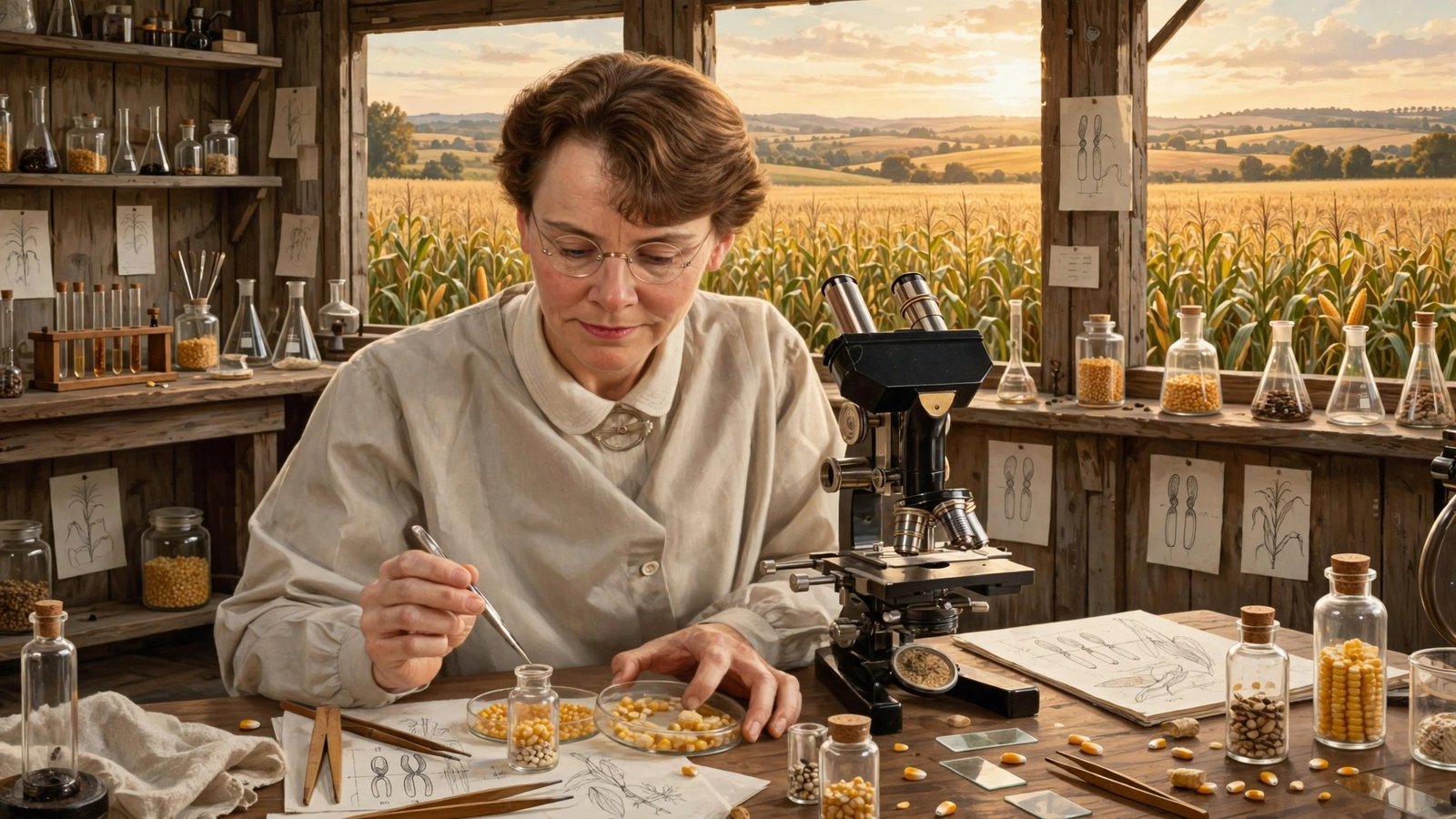
Her story is one of patience, independence and absolute trust in careful observation. McClintock spent her life looking at corn — ordinary maize — and seeing in its kernels patterns nobody else could see. She worked alone, in a small laboratory at Cold Spring Harbor, studying the colours and shapes of corn plants year after year. From that humble work came a revolution in biology: the discovery of transposable elements, the “jumping genes” that now help scientists understand everything from evolution to cancer.
This is the story of a woman who refused to be hurried, refused to be ignored, and refused to let the doubts of others change what her own eyes told her. On Face Zem, we celebrate the lives of people who changed the world by thinking differently. Barbara McClintock’s life is a powerful reminder that being right too early can look exactly like being wrong — and that the only answer is to keep going.
Key takeaways
- Barbara McClintock discovered transposable elements, or “jumping genes”, in maize in the 1940s — decades before the scientific world accepted her findings.
- She was the first woman to win the Nobel Prize in Physiology or Medicine alone, receiving it in 1983 at the age of eighty-one.
- Her breakthrough came from patient, hands-on observation of corn plants, reading the colour patterns of individual kernels.
- She chose to work alone and trusted her own evidence even when leading scientists dismissed her work.
- Her discovery now underpins modern genetics, helping scientists understand evolution, disease and the behaviour of the human genome.
Barbara McClintock at a Glance
| Fact | Detail |
|---|---|
| Full name | Barbara McClintock |
| Born | 16 June 1902, Hartford, Connecticut, United States |
| Died | 2 September 1992, Huntington, New York, aged 90 |
| Field | Genetics and cytogenetics |
| Greatest discovery | Transposable elements (“jumping genes”) |
| Nobel Prize | Physiology or Medicine, 1983 (unshared) |
| Main workplace | Cold Spring Harbor Laboratory, New York |
| Education | Cornell University (BS 1923, MS 1925, PhD 1927) |
| Other honours | National Medal of Science (1970), MacArthur Fellowship (1981) |
| Known for | Patience, independence, and seeing what others missed |
A Girl Who Preferred to Be Alone
Barbara McClintock was born in Hartford, Connecticut, in 1902, the third of four children. Her father was a doctor in the United States Army, and the family moved often. From an early age, Barbara was different from her siblings. She was quiet, intensely curious, and happiest on her own. Her mother, worried about her daughter’s independence, sent the young Barbara to live with relatives in Brooklyn for a time, hoping the change would make her more sociable. It did not.
At school in Brooklyn, Barbara discovered that she loved to learn. She was not interested in the usual things that occupied girls of her time. She did not care about parties or fashion. She cared about books, about science, about how things worked. When she finished high school, she wanted to go to college, but her mother opposed the idea. In 1919, it was still unusual for a woman to study at a university, and her mother feared it would make Barbara unmarriageable. Her father, however, supported her, and in the end she enrolled at Cornell University to study agriculture.
Cornell changed everything. Barbara began in agriculture, but she quickly found her way to botany and then to genetics. She joined a small group of students studying the new science of heredity — the study of how traits pass from parents to children. It was a field so new that the rules were still being written. Barbara McClintock would help to write them.
Cornell and the Corn
At Cornell, McClintock fell in love with maize — ordinary corn. Maize was the perfect plant for a geneticist. It grew fast, produced many seeds, and its kernels came in vivid colours: purple, red, yellow, white, spotted, striped. Each kernel on an ear of corn was a tiny experiment in heredity. By looking at the colours and patterns, a careful observer could work out exactly which genes a plant had inherited from its parents.
McClintock had a rare gift. She could look at a corn plant and see things that others could not. She studied the chromosomes of maize under the microscope — the tiny thread-like structures inside cells that carry the genes. In the 1920s, very few scientists could even see chromosomes clearly, let alone understand them. McClintock developed techniques to stain and examine them, and she became one of the first people in the world to link the physical structure of a chromosome to the traits it carried.
She earned her bachelor’s degree in 1923, her master’s in 1925, and her doctorate in 1927 — all from Cornell, all in botany and genetics. Her doctoral work was already remarkable. With a colleague, she proved that the ten chromosomes of maize could be identified individually, and that each one carried specific genes. It was painstaking, brilliant work, and it made her reputation among the small community of geneticists. But the best was yet to come.
The Breakthrough Nobody Wanted
After Cornell, McClintock worked at several universities — California, Missouri, and Cornell again — always studying maize. In the 1940s, at the University of Missouri, she began to notice something strange. Some corn kernels had patterns of colour that changed in unexpected ways. A kernel might be purple with yellow spots, or striped in a pattern that did not match anything its parents should have passed on. The patterns looked random, but McClintock suspected they were not.
She spent years studying these patterns, plant by plant, kernel by kernel. Slowly, she worked out what was happening. A gene — a piece of DNA — was moving. It was jumping from one place on a chromosome to another, and when it landed next to a gene that controlled colour, it switched that gene on or off. The moving genes were like switches, controlling the activity of other genes. She called them “controlling elements”. Today, scientists call them transposable elements, or “jumping genes”.
It was a revolutionary idea. At the time, most scientists believed that genes were fixed in place on the chromosome, like beads on a string, and that they stayed there. The idea that genes could move, and that they could control other genes, seemed impossible. McClintock presented her findings at a major scientific meeting in 1951. The audience listened politely. Then they ignored her. Some thought she had made a mistake. Others thought she was simply wrong. A few thought she had lost her way.
Thirty Years of Being Ignored
What happened next is one of the most remarkable parts of McClintock’s story. She did not argue. She did not write angry letters. She did not try to force the world to listen. She simply went back to her laboratory and kept working. “I knew I was right,” she said later. “I just had to wait.”
She moved to Cold Spring Harbor Laboratory on Long Island in 1942, and she stayed there for the rest of her life. It was a small, quiet place, and it suited her. She worked alone, growing her corn in the fields, studying the kernels in the autumn, and thinking through the long winter months. She published her results, but few people read them. The scientific world had moved on to other things — to bacteria, to viruses, to the new science of molecular biology. Maize seemed old-fashioned. McClintock seemed forgotten.
But she was not forgotten by everyone. Younger scientists who visited Cold Spring Harbor were amazed by her. She could walk through a cornfield and read the plants like a book, pointing to a kernel and explaining exactly what had happened in its genes. She had a deep, intuitive understanding of her subject that came from decades of looking. “She had a feeling for the organism,” one colleague said — a phrase that became famous. She did not just study corn. She understood it.
The World Catches Up
In the 1960s and 1970s, everything changed. Scientists studying bacteria discovered that genes could move in bacteria too. Then they found moving genes in fruit flies, in yeast, and eventually in humans. The “jumping genes” that McClintock had described in corn turned out to be everywhere — in almost every living thing. Suddenly, her old papers were being read again, and scientists realised that she had been right all along, decades ahead of her time.
The recognition came slowly at first, then all at once. In 1970, she received the National Medal of Science. In 1981, she was awarded a MacArthur Fellowship — the so-called “genius grant”. And in 1983, at the age of eighty-one, she received the Nobel Prize in Physiology or Medicine. She was the first woman to win that prize alone, and only the third woman ever to win an unshared Nobel Prize in science. She accepted the honour with characteristic modesty, saying that the prize was “such a surprise” and that she had never expected it.
By then, McClintock was in her eighties, but she was still working. She continued to go to her laboratory every day, still studying her corn, still asking questions. She died in 1992, at the age of ninety, at Cold Spring Harbor. She left behind a legacy that grows larger every year, as scientists discover more and more about the jumping genes she found.
Why Jumping Genes Matter
McClintock’s discovery was not just a curiosity. It changed the way scientists think about the genome — the complete set of genes in a living thing. Before her work, the genome was seen as a fixed, stable instruction book. After her work, scientists understood that the genome is dynamic, that it can change, rearrange and respond to its environment. Jumping genes can switch other genes on and off, create new combinations, and drive evolution itself.
Today, scientists know that nearly half of the human genome is made up of transposable elements — the descendants of jumping genes. They play a role in how our genes work, how we develop, and how diseases like cancer arise. When a jumping gene lands in the wrong place, it can cause illness. When it lands in the right place, it can create something new. McClintock’s discovery opened the door to all of this, and modern medicine, agriculture and evolutionary biology all rest on foundations she laid.
Her work also changed the way scientists think about plants. The colours and patterns of corn that she studied so carefully are now understood as the visible signs of genes switching on and off. Every time you see a variegated leaf, a striped flower, or a spotted fruit, you are looking at the same kind of process that McClintock discovered. She saw the beauty in it, and she saw the science in it, at the same time.
A Life of Independence
Barbara McClintock never married and never had children. She lived simply, in a small house near her laboratory, and she devoted her life entirely to her work. She was not lonely — she had many friends, and she loved music, especially opera, and she enjoyed the company of the young scientists who came to Cold Spring Harbor. But she valued her independence above all else, and she protected it fiercely.
She was also deeply modest. When the Nobel Prize was announced, she was out in the cornfield, as usual. A colleague had to go and find her to tell her the news. She did not seek fame, and she did not enjoy the attention that came with the prize. What mattered to her was the work itself — the joy of looking, of understanding, of finding out how nature really works.
Her independence was also her strength as a scientist. Because she worked alone, she was free to follow her own ideas, even when they were unpopular. She did not have to please a team, or a boss, or a funding committee. She could spend years on a problem that nobody else thought was important. That freedom is what allowed her to make a discovery that others, working in bigger and busier laboratories, had missed.
Lessons from Her Life
McClintock’s life offers lessons that go far beyond science. The first is patience. She waited more than thirty years for the world to accept her discovery. She did not give up, and she did not become bitter. She simply kept working, trusting that the truth would win in the end. In a world that demands instant results, her patience is a powerful example.
The second lesson is to trust your own eyes. McClintock believed what she saw, even when the experts told her she was wrong. She knew her corn better than anyone else in the world, and she trusted that knowledge. That is not arrogance — it is the confidence that comes from deep, careful, honest work. When you truly know your subject, you do not need other people to tell you what is true.
The third lesson is to follow your curiosity, not the crowd. McClintock studied maize when everyone else was studying bacteria. She worked alone when everyone else was working in teams. She asked questions that nobody else was asking. And it was precisely because she went her own way that she found something nobody else had found. The road less travelled is not always the easiest, but it is often the one that leads somewhere new.
What We Can Learn from Barbara McClintock
For anyone starting out in life, McClintock’s story is a guide. Choose a subject you truly love, and learn it deeply. Do not be afraid to work alone, or to be different from everyone around you. Be patient — real achievement takes time, and the most important work is often the slowest. And when you are sure of something, because you have looked carefully and thought honestly, do not let the doubts of others shake you.
For scientists, her legacy is a reminder that observation still matters. In an age of big data and automated experiments, McClintock’s method — looking, slowly and carefully, at a living thing — seems old-fashioned. But it was that method that led to one of the greatest discoveries in biology. Technology changes, but the habit of paying close attention never goes out of date.
And for all of us, her life is proof that it is never too late. She was eighty-one when she won the Nobel Prize, after a career that most people had written off. She kept working, kept learning, kept discovering, right up to the end of her life. Age did not slow her down. It made her wiser.
Checklist: Lessons from Barbara McClintock
- Trust what you observe, even when others disagree — careful observation is the foundation of all real knowledge.
- Be patient with your work: the most important discoveries often take years, or even decades, to be recognised.
- Follow your own curiosity instead of chasing the latest fashion in your field.
- Learn your subject deeply — true expertise comes from years of close, hands-on attention.
- Protect your independence: the freedom to think for yourself is worth more than approval.
- Never stop learning — McClintock was still working and discovering in her eighties.
Frequently Asked Questions
What did Barbara McClintock discover?
She discovered transposable elements, also known as “jumping genes” — pieces of DNA that can move from one place on a chromosome to another, switching other genes on and off. She made the discovery by studying the colour patterns of maize kernels in the 1940s.
Why did it take so long for scientists to accept her discovery?
At the time, most scientists believed that genes were fixed in place on the chromosome. The idea that genes could move seemed impossible. It was only in the 1960s and 1970s, when moving genes were found in bacteria and other organisms, that scientists realised McClintock had been right all along.
When did Barbara McClintock win the Nobel Prize?
She won the Nobel Prize in Physiology or Medicine in 1983, at the age of eighty-one. She was the first woman to win that prize unshared, and she won it more than thirty years after her original discovery.
Why did she study corn?
Maize was the ideal plant for genetic research. It grew quickly, produced many seeds, and its kernels came in vivid colours and patterns that revealed exactly which genes a plant had inherited. By reading those patterns, McClintock could work out what was happening inside the chromosomes.
What are jumping genes, and why do they matter today?
Jumping genes are pieces of DNA that can move around the genome. They make up nearly half of the human genome, and they play a role in evolution, development and disease. Understanding them helps scientists study cancer, genetic disorders and the history of life itself.
Did Barbara McClintock ever marry or have children?
No. She lived simply near her laboratory at Cold Spring Harbor and devoted her life entirely to her work. She valued her independence deeply and believed that it gave her the freedom to follow her own ideas, even when they were unpopular.
Bottom line
Barbara McClintock’s life is one of the great stories in science. She discovered that genes could jump, waited thirty years for the world to believe her, and won the Nobel Prize at eighty-one. She did it by looking carefully, thinking independently, and refusing to give up on what she knew to be true. Her story reminds us that the most important discoveries are often the ones that nobody believes at first — and that patience, curiosity and courage are the qualities that change the world.
On Face Zem, her success story stands alongside those of other great scientists, from Rosalind Franklin to Marie Curie and Charles Darwin — people who saw what others could not see, and changed how we understand the world.
Note: This article is a general historical account of Barbara McClintock’s life and work, written for readers of Face Zem. Dates, honours and scientific details are drawn from the public historical record, and the lessons drawn from her life reflect the values she lived by: patience, independence and trust in careful observation.

Keep what speaks to you.
Leave room for your own perspective.


