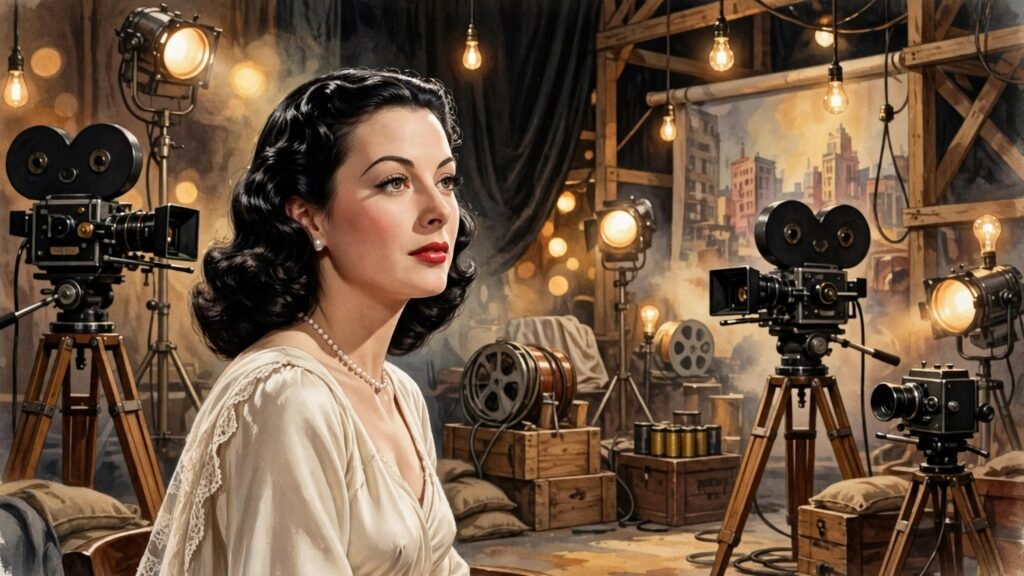
Alice Paul was a quiet Quaker schoolteacher who became one of the most feared and effective campaigners in American history. She did not raise her voice, she did not seek applause, and she did not stop. When she believed that women deserved the vote, she organised marches, picketed the White House in all weathers, went to prison, went on hunger strike, and was force-fed — and then she went back and did it again.
Her story is not only about winning the vote. After the Nineteenth Amendment became law in 1920, Alice Paul wrote the Equal Rights Amendment and spent the next fifty years fighting for it. She lived to see the world change, and she kept working until the very end. Face Zem tells her story here — a story of patience, courage, and a refusal to accept that some doors are closed forever.
What made Alice Paul different was her method. She believed that a cause needs a plan, a timetable, and pressure that never lets up. She studied how the British suffragettes won attention, she understood newspapers and parades, and she was willing to be unpopular if being unpopular moved the cause forward. This is her success story, and the lessons from it still matter for anyone who wants to change something that seems impossible.
Key takeaways
- Alice Paul helped win American women the right to vote through the Nineteenth Amendment in 1920.
- She founded the National Woman’s Party and led the first pickets of the White House in American history.
- She was arrested, imprisoned, and force-fed during a hunger strike — and refused to give up.
- In 1923, she wrote the Equal Rights Amendment and campaigned for it for the rest of her life.
- Her method was simple: a clear goal, a plan, constant pressure, and never accepting defeat.
Alice Paul at a Glance
| Fact | Detail |
|---|---|
| Full name | Alice Stokes Paul |
| Born | 11 January 1885, Mount Laurel, New Jersey |
| Died | 9 July 1977, Moorestown, New Jersey |
| Known for | Women’s suffrage, the National Woman’s Party, the Equal Rights Amendment |
| Key achievement | Helped secure the Nineteenth Amendment, 1920 |
| Organisation | National Woman’s Party (founder, 1916) |
| Education | Swarthmore College, University of Pennsylvania (PhD, 1912) |
| Major protest | The Silent Sentinels, White House pickets, 1917 |
| Prison | Occoquan Workhouse, 1917; hunger strike and force-feeding |
| Legacy | The Equal Rights Amendment, still debated today |
A Quiet Quaker Childhood
Alice Paul was born on 11 January 1885, on a farm at Paulsdale, near Mount Laurel in New Jersey. Her family were Quakers, and the Quaker way of life shaped everything about her. Quakers believed that men and women were equal before God, that war was wrong, and that a person should speak the truth plainly, even when it was unwelcome. Alice grew up attending Quaker meetings, where women spoke as freely as men, and where silence was respected as much as speech.
Her mother, Tacie Paul, was a strong influence. She had been educated, she ran the farm’s business affairs, and she took her daughter to suffrage meetings when Alice was still a girl. The idea that women should vote was not strange in the Paul household — it was common sense. What Alice learned early was something else: that believing in a cause was not enough. You had to act on it.
She was a serious, studious child, more interested in books than in games. She attended Moorestown Friends School and then Swarthmore College, where she studied biology and graduated in 1905. She was not a natural showman. Friends remembered her as shy, precise, and intensely determined. Nobody who knew the quiet young woman from New Jersey would have guessed that she would one day be carried, unconscious, out of a prison cell after a hunger strike — but that determination was already there.
Learning to Fight in Britain
After Swarthmore, Alice Paul went to England to study social work. It was there, almost by accident, that she found her calling. In London she met the Pankhursts — Emmeline, Christabel, and Sylvia — the leaders of the Women’s Social and Political Union, the militant suffragettes. They were doing something the American suffrage movement had never done: they were making trouble, on purpose, in public.
The suffragettes smashed windows, chained themselves to railings, interrupted politicians, and went to prison. They were mocked in the newspapers and beaten by police, but they could not be ignored. Alice Paul watched, and she learned. She joined a suffragette demonstration, was arrested, and went to prison in Britain. She went on hunger strike there too, and she was force-fed. It was a brutal education, but it taught her the central lesson of her life: polite requests are easy to ignore, and a movement that nobody notices is a movement that loses.
She returned to America in 1910 with a plan. The American suffrage movement, led by older, respectable organisations, had been asking politely for the vote for sixty years. Alice Paul believed it was time to stop asking and start demanding.
The Great Parade of 1913
Alice Paul’s first great act in America was the suffrage parade of 3 March 1913, the day before Woodrow Wilson’s inauguration as president. She organised a procession of some 8,000 women down Pennsylvania Avenue in Washington, D.C., with bands, floats, and women on horseback. It was meant to be a dignified, orderly demonstration. It became a riot.
The crowds were enormous and hostile. Men jeered, shoved, and spat at the marchers. The police stood by and did almost nothing. Hundreds of women were injured. But the violence backfired on the attackers: the newspapers were full of the story, Congress held hearings, and the whole country was suddenly talking about women’s suffrage. Alice Paul had learned the suffragette lesson well. A parade that nobody notices changes nothing. A parade that makes the front page changes everything.
The parade also made Alice Paul famous — and it made her enemies inside the suffrage movement. The older leaders thought her tactics were too bold, too confrontational, too embarrassing. She did not care. She had a goal, and she had a plan.
Breaking Away: The National Woman’s Party
In 1916, Alice Paul broke away from the National American Woman Suffrage Association and founded the National Woman’s Party. Her strategy was different from the older movement in one crucial way. The older suffragists worked state by state, trying to win the vote one state at a time. Alice Paul wanted a federal amendment to the Constitution — one law, for the whole country, all at once.
It was a bolder goal, and a harder one. An amendment to the Constitution needs two-thirds of Congress and three-quarters of the states. But Alice Paul argued that the state-by-state approach would take forever, and that women in the states that refused would be left behind. She wanted equality for all women, everywhere, and she wanted it written into the Constitution itself.
Her second strategic choice was equally bold: she would hold the party in power responsible. President Wilson and the Democrats controlled the government, and they had refused to support a suffrage amendment. Alice Paul decided to campaign against them in the 1916 election, urging women in the states where they could already vote to vote against Democratic candidates. It was ruthless politics, and it worked — it forced Wilson to pay attention.
The Silent Sentinels
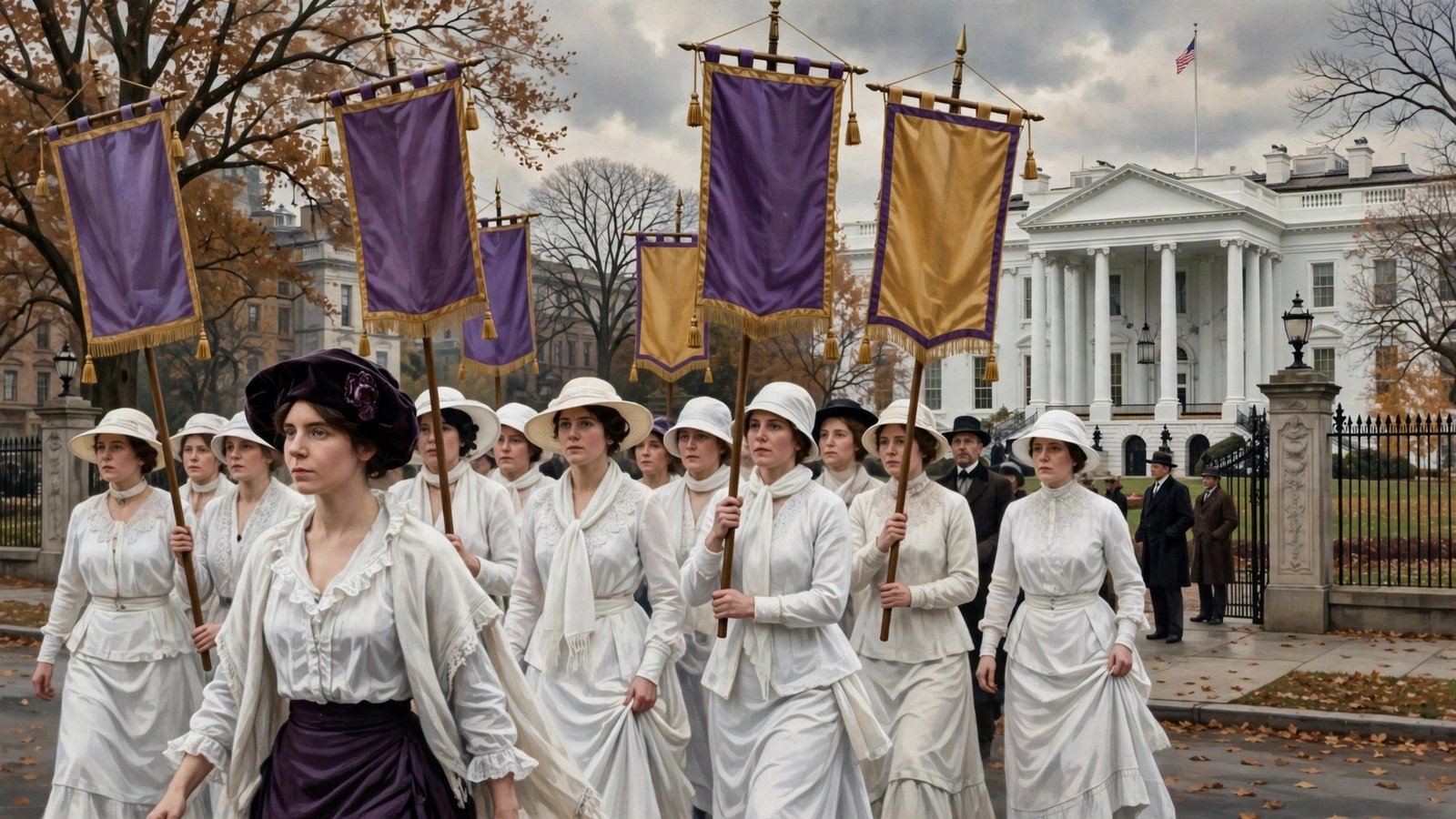
In January 1917, Alice Paul launched the protest that made her famous: the Silent Sentinels. Every day, women stood outside the White House gates, holding banners that asked the president why American women were not free. They stood in silence, in rain and snow and summer heat. They were the first people in American history to picket the White House.
At first, the pickets were treated as a curiosity. Then America entered the First World War, and the mood changed. Criticising the president during wartime was seen as disloyal, even treasonous. The pickets were attacked by crowds, their banners were torn down, and the police began arresting them — first for “obstructing traffic,” then on any charge that would stick.
Alice Paul was arrested in October 1917 and sentenced to seven months in the Occoquan Workhouse in Virginia. The conditions were dreadful. The food was rotten, the cells were filthy, and the women were treated with contempt. Alice Paul demanded to be treated as a political prisoner. When she was refused, she went on hunger strike.
Hunger Strike and Force-Feeding
The hunger strike was Alice Paul’s most dangerous weapon, and her most terrible ordeal. She refused all food, and the prison authorities responded by force-feeding her — pushing a tube down her throat and pouring raw eggs and milk into her stomach. It was a violent, painful procedure, and it was done three times a day.
She endured it for weeks. Her health collapsed. She became so weak that she could barely stand, and the prison doctors feared she would die. But she would not eat, and she would not give in. The story leaked out, and the public was horrified. Newspapers that had mocked the suffragists now demanded her release. Even President Wilson, who had ignored her for years, was forced to take notice.
After five weeks, Alice Paul was released. She was carried out of prison, thin and exhausted, but unbroken. The publicity had done its work. Within months, Wilson changed his position and supported a suffrage amendment. The hunger strike had nearly killed her — and it had won.
Winning the Vote: The Nineteenth Amendment
The Nineteenth Amendment was passed by Congress in June 1919, and ratified by the states in August 1920. It was a single sentence: “The right of citizens of the United States to vote shall not be denied or abridged by the United States or by any State on account of sex.”
Alice Paul had played a central part in winning it. Her parades, her pickets, her prison sentence, and her hunger strike had kept the issue in front of the country and forced the president to act. She was thirty-five years old, and she had already changed the Constitution of the United States.
But she did not celebrate for long. On the day the amendment was ratified, she was already thinking about the next fight. The vote was only the beginning. Women could vote, but they were still not equal under the law. They could be paid less, fired for getting married, barred from professions, and treated as second-class citizens. Alice Paul believed that the vote alone was not enough.
Writing the Equal Rights Amendment
In 1923, Alice Paul wrote the Equal Rights Amendment. It was just twenty-four words: “Equality of rights under the law shall not be denied or abridged by the United States or by any State on account of sex.” She believed that a single, clear statement in the Constitution would end legal discrimination against women, just as the Nineteenth Amendment had ended voting discrimination.
She introduced it to Congress in 1923, and then she waited. And waited. And waited. The amendment was introduced in every session of Congress for the next fifty years, and it never passed. Some women’s organisations opposed it, fearing it would end protective laws for women workers. Others thought it was unnecessary. Alice Paul disagreed, and she kept going.
It was the longest campaign of her life, and it was also the most frustrating. She had won the vote in seven years. The Equal Rights Amendment took half a century — and she did not live to see it passed. But she never stopped believing in it, and she never stopped working for it. In the 1970s, it finally passed Congress and went to the states for ratification. It fell three states short. The fight continues today, and the words are still hers.
The Later Years
Alice Paul spent the rest of her long life working for women’s equality, in America and around the world. She helped to found the World Woman’s Party, she worked with the United Nations on women’s rights, and she campaigned for the inclusion of sex discrimination in the Civil Rights Act of 1964 — a change that still protects millions of women today.
She lived simply, in a small house in Moorestown, New Jersey, surrounded by papers and books. She never married, never had children, and never stopped working. She was, by all accounts, a difficult person to know — private, stubborn, and utterly single-minded. But those who worked with her said the same thing: she was the most effective organiser they had ever met.
She died on 9 July 1977, at the age of ninety-two. She had spent more than sixty years fighting for equality, and she had changed the law of her country twice — once with the vote, and once with the Civil Rights Act. The Equal Rights Amendment, her life’s work, remained unfinished. It still does.
Why Alice Paul Still Matters
Alice Paul matters because she proved that a small group of determined people can change a constitution. She did not have money, she did not have power, and she did not have the support of the establishment. She had a plan, a timetable, and the willingness to pay the price.
Her methods are still studied today by campaigners of every kind. She understood that a cause needs a clear, simple demand — one sentence, not a hundred. She understood that pressure must be constant, not occasional. And she understood that the people in power will only move when the cost of standing still becomes higher than the cost of changing.
She also matters because she never accepted a partial victory. The vote was a great achievement, but she saw at once that it was not enough. She spent the next fifty years fighting for the rest. That is a rare kind of courage: the courage to win, and then to keep going.
Lessons from Alice Paul’s Life
The first lesson is to be specific. Alice Paul did not campaign for “women’s rights” in general — she campaigned for a single amendment, with a single sentence. A clear goal is easier to explain, easier to defend, and harder to ignore.
The second lesson is to plan. She kept detailed schedules, she organised parades down to the last detail, and she thought several moves ahead. Passion without a plan burns out. Passion with a plan wins.
The third lesson is to accept unpopularity. The Silent Sentinels were hated by many people, including other suffragists. Alice Paul did not let that stop her. If you only do what is popular, you will never change anything that matters.
The fourth lesson is to pay the price. She went to prison, she was force-fed, and she risked her health and her life. She did not ask others to do what she would not do herself. That is why people followed her.
The fifth lesson is to keep going after you win. The Nineteenth Amendment was a triumph, but Alice Paul did not retire. She saw the next fight, and she took it on. Success is not an ending — it is a beginning.
Checklist: What We Can Learn from Alice Paul
- Define one clear, simple goal — a single sentence if you can.
- Make a plan with dates, steps, and responsibilities.
- Keep the pressure on, every day, not just when it is convenient.
- Be willing to be unpopular if the cause is right.
- Lead by example — never ask others to take risks you will not take yourself.
- When you win, look for the next fight — and keep going.
Frequently Asked Questions
Who was Alice Paul?
Alice Paul (1885–1977) was an American suffragist and women’s rights campaigner. She founded the National Woman’s Party, led the White House pickets known as the Silent Sentinels, and helped win the Nineteenth Amendment, which gave American women the right to vote in 1920. She later wrote the Equal Rights Amendment.
What were the Silent Sentinels?
The Silent Sentinels were women who stood outside the White House gates every day from January 1917, holding banners asking President Wilson why women were not free. They were the first people in American history to picket the White House, and many were arrested and imprisoned.
Why did Alice Paul go on hunger strike?
She was imprisoned in the Occoquan Workhouse in 1917 and demanded to be treated as a political prisoner. When the authorities refused, she went on hunger strike. She was force-fed three times a day for weeks, and her ordeal turned public opinion in favour of women’s suffrage.
What is the Equal Rights Amendment?
The Equal Rights Amendment is a proposed amendment to the United States Constitution, written by Alice Paul in 1923. It states that equality of rights under the law shall not be denied on account of sex. It passed Congress in 1972 but was not ratified by enough states.
How did Alice Paul learn her tactics?
She learned them in Britain, where she joined the suffragettes led by Emmeline Pankhurst. She was arrested and force-fed there too, and she brought the suffragettes’ methods — marches, pickets, prison, and hunger strikes — back to America.
What did Alice Paul achieve in her later life?
She worked for women’s rights around the world, helped to found the World Woman’s Party, and campaigned for the inclusion of sex discrimination in the Civil Rights Act of 1964. She worked for the Equal Rights Amendment until her death in 1977.
Bottom line
Alice Paul was a quiet woman who changed a constitution. She did it with a plan, with patience, and with a willingness to suffer for what she believed. She won the vote for American women, she wrote the Equal Rights Amendment, and she spent sixty years fighting for equality. Her life is proof that one person, with a clear goal and an unbreakable will, can change the world — and that the work is never really finished.
Note: This article is a general historical account of Alice Paul’s life and work, written for readers of Face Zem. For more inspiring stories, read the Susan B. Anthony Success Story, the Rosa Parks Success Story, and the Harriet Tubman Success Story on Face Zem.

Keep what speaks to you.
Leave room for your own perspective.