
Key Takeaways
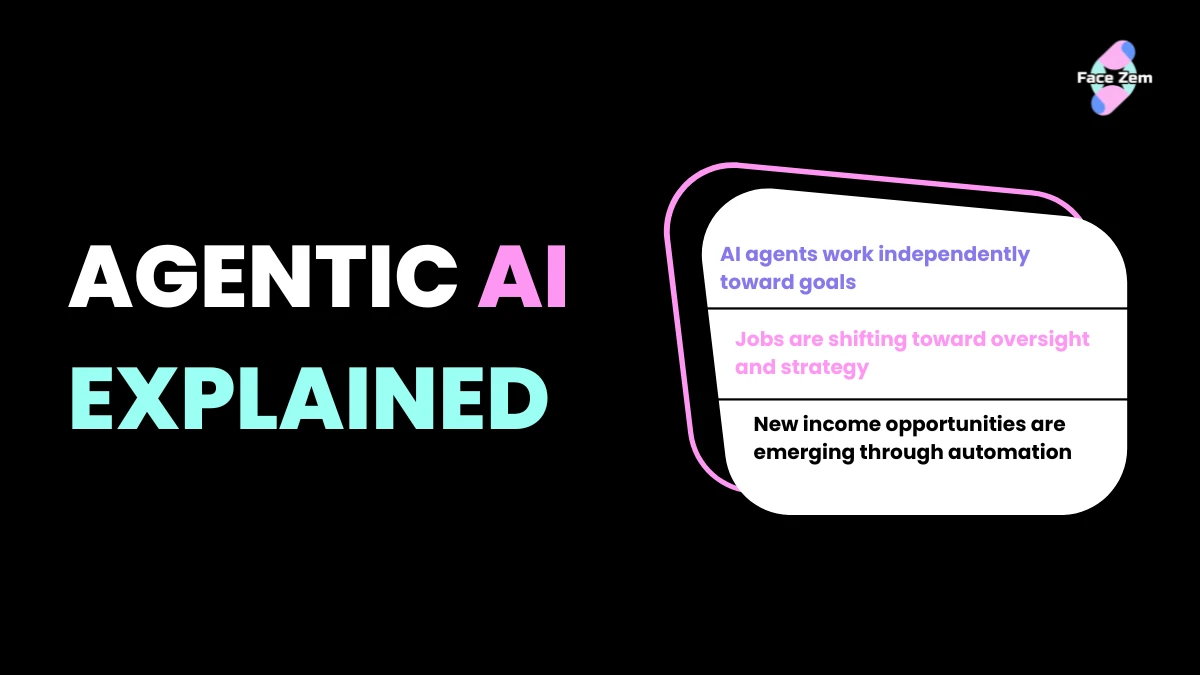
- AI is evolving from assistants to autonomous agents
- AI agents can plan, act, and self-correct
- Routine tasks are being automated rapidly
- Human value shifts to strategy and oversight
- New income opportunities emerge through AI automation
The world of artificial intelligence has changed rapidly over the last few years. We have moved far beyond the days of simple chatbots that merely answer questions or write basic emails when prompted.
In 2026, a massive shift is happening across industries, driven by a technology known as autonomous intelligence. If you want to understand this shift, you need agentic ai 2026 explained clearly so you can understand what it means for your job and your wallet in 2026.
Put simply, agentic ai 2026 refers to advanced artificial intelligence systems, known as AI agents, that do not just answer your questions; they actively execute multi-step tasks, make independent decisions, and accomplish complex goals without needing constant human prompts.
Unlike older AI models that sit passively waiting for instructions, these modern systems act as autonomous digital coworkers. This technological leap is changing the way businesses operate, reshaping career paths, and opening up brand-new ways to generate income.
AI Summary
Agentic AI in 2026 goes beyond traditional chatbots by acting as an autonomous digital coworker that can plan, make decisions, use tools, and complete complex tasks with minimal human input. It is transforming workplaces by automating routine work while increasing demand for strategic oversight. For individuals, it creates new opportunities to build businesses, boost productivity, and generate scalable income.
What Exactly is Agentic AI?
To truly grasp this concept, it helps to understand how we got here. Early AI systems were entirely reactive. You gave them a prompt, and they generated text, images, or code. While helpful, you still had to do all the heavy lifting, connecting the pieces and managing the project.

Systems utilizing agentic ai 2026 operate with a high degree of autonomy. When you give an AI agent a broad objective, it breaks that objective down into smaller, actionable steps.
It creates its own plan, uses external digital tools, reviews its own work, corrects its own mistakes, and works until the job is completed.
At Facezem, we track these digital shifts closely, and the data shows that this transition from passive assistants to active digital partners is the defining trend of the current economic landscape.
The Key Pillars of Agentic Autonomy
To understand how ai agents explained simply actually work in practice, it helps to look at the core capabilities that power them. These systems rely on four distinct pillars to function effectively without human hand-holding:
- Goal-Oriented Reasoning: Instead of following rigid, pre-written code, these systems analyze a complex goal and figure out the most logical path to achieve it.
- Dynamic Tool Usage: Modern agents can browse the web, interact with databases, call external APIs, and use software programs just like a human employee would.
- Persistent Memory: They retain context over long periods, meaning they remember what worked, what failed, and what the ultimate goal is across days or weeks of continuous work.
- Self-Reflection and Correction: If an agent encounters a broken link, an error code, or an unexpected hurdle, it evaluates the problem, adjusts its strategy, and tries a different approach.
How Agentic AI is Redefining the Workplace
The rise of autonomous workflows is fundamentally changing what it means to go to work. Many people worry that autonomous software will simply eliminate human employment.
However, current workplace data suggests a more complex reality: tasks are being automated, but entire human roles are being redesigned.

The real shift in agentic ai 2026 trends centers on the rise of multi-agent orchestration. Instead of a single AI trying to do everything, companies are deploying coordinated teams of specialized digital agents.
For example, in a modern marketing or customer service department, one agent might specialize in data analysis, another in content generation, and a third in compliance auditing.
They talk to one another using specialized communication protocols to complete massive projects with minimal human intervention.
Industries Experiencing the Fastest Adoption
While these systems are spreading everywhere, certain professional fields are feeling the impact much faster than others. The table below outlines how these autonomous digital systems are actively altering key corporate environments this year.
| Industry | Traditional Process | Agentic AI Workflow in 2026 |
| Customer Experience | Humans manually answering tickets, routing complex issues, and copying data between systems. | Autonomous agents handle end-to-end issues, process refunds, update accounts, and escalate only highly sensitive cases. |
| Software Engineering | Software developers writing every line of code, manually debugging, and managing deployments step by step. | AI coding agents plan, build, test, and deploy entire application features autonomously based on strategic business goals. |
| Finance & Banking | Loan officers manually reviewing credit scores, verifying income documents, and running fraud checks over days. | Multi-agent networks simultaneously run identity checks, calculate debt ratios, scan for fraud, and draft final approvals. |
| IT & Procurement | IT managers spending weeks writing RFPs, researching software vendors, and comparing technical specifications. | Specialized platforms analyze system requirements, draft compliant bids, and generate objective vendor comparisons in hours. |
What This Means for Your Job
If your daily responsibilities involve routine data entry, basic administrative coordination, or repetitive digital tasks, your role is facing significant disruption. Businesses are rapidly moving toward an “agent-first” workplace structure.
In this new setup, routine execution is handed over to software, while humans step into roles focused on strategic oversight, quality evaluation, and architecture.
This means you do not necessarily need to worry about being replaced by an algorithm. Instead, you need to learn how to manage and direct these systems.

When looking at ai agents explained through a career lens, professionals who learn to decompose complex business problems into clear instructions for AI networks are seeing their value skyrocket.
Your primary value is shifting away from doing the manual work and moving toward evaluating the final outcomes.
Furthermore, engineers and creators are becoming more “full-stack” in their capabilities. Because agentic ai 2026 infrastructure fills in deep technical knowledge gaps, a single marketer can now run complex data pipelines, and a lone designer can launch fully functioning web platforms.
The technical barriers to entry are falling, making strategic thinking the most valuable asset in the modern corporate world.
What This Means for Your Wallet and Financial Opportunities
The financial implications of autonomous software are massive, offering both distinct challenges and incredible opportunities for wealth creation. If you rely entirely on selling your manual digital labor by the hour, you may experience downward wage pressure.
However, if you learn to leverage autonomous systems, your ability to generate income can scale dramatically.

Because these software networks can operate continuously without breaks, the cost of running a highly efficient digital business has dropped significantly. This shift has unlocked several major avenues for personal financial growth:
1. Launching Micro-Enterprises with Minimal Capital
In the past, launching a digital brand or a specialized media site required a large team or immense personal effort. Now, an individual entrepreneur can use low-code agent builders to automate product research, content distribution, and inventory management.
By acting as the strategic director of your own digital agency, you can manage a portfolio of online platforms with almost zero overhead.
2. Building and Customizing Niche Agents
There is an exploding marketplace for domain-specific agents. Generic AI models often struggle with the unique vocabulary, strict regulations, and specific workflows of specialized industries.
If you possess deep expertise in a field like real estate law, medical billing, or localized supply chains, you can build and monetize custom agent workflows that solve specific business frustrations.
3. Participating in the Machine Economy
We are witnessing the early stages of agentic commerce. These digital entities are beginning to transact, pay for specific computing resources, and settle financial value autonomously using specialized digital payment rails.
As these machine-to-machine ecosystems grow, individuals who develop, host, or provide specialized data to these autonomous networks can build consistent streams of passive income.
How to Protect and Grow Your Wealth This Year
To make sure your wallet benefits from the growth of agentic ai 2026 platforms, you must change your approach to career development and personal finance. Standing still is no longer an option when software can execute long-running, multi-step digital projects independently.
First, you should audit your current professional skills. Identify the parts of your job that are repetitive or highly predictable, and actively look for automated tools that can handle those tasks.
By taking the initiative to introduce autonomous workflows into your current company, you position yourself as an indispensable manager of technology, rather than an employee displaced by it.

Second, dedicate time to understanding the foundational infrastructure of this new economy. You do not need a computer science degree, but you should understand how popular agentic frameworks function.
Knowing how systems maintain memory, use external digital tools, and communicate with other platforms will give you a massive competitive edge in any industry.
Conclusion
Understanding ai agents explained simply makes it clear that we are living through a fundamental shift in how digital work is performed.
The technology of agentic ai 2026 is actively moving away from passive assistant tools and toward autonomous digital partners that can think, plan, and execute over long periods.
For your career, this means shifting your focus away from manual execution and developing strong skills in strategy, system design, and technological oversight.
For your wallet, it means leveraging these incredibly low-cost, highly scalable tools to automate workflows, launch independent business ventures, and secure your place in an increasingly automated economy.
The future belongs to those who learn to orchestrate these autonomous systems effectively. By embracing this digital shift early, you can protect your career path, dramatically amplify your personal productivity, and build long-term wealth in a rapidly changing world.
Frequently Asked Questions
What is the main difference between generative AI and agentic AI?
Generative AI focuses strictly on creating content, such as text, images, or answers, based directly on an immediate human prompt. Agentic AI takes this a step further by operating autonomously over extended periods. It breaks down a broad goal, uses software tools, corrects its own errors, and works independently to complete complex, multi-step tasks.
Will agentic AI completely eliminate human jobs in 2026?
Based on current industry data, these systems are transforming roles rather than completely eliminating human workers. While routine, repetitive tasks are being highly automated, human oversight remains vital. Companies need professionals who can provide strategic direction, evaluate the quality of AI outputs, and manage complex system architectures.
How can a regular person make money with AI agents?
Individuals can build wealth by using autonomous workflows to run lean digital businesses, such as e-commerce brands or content networks, with very low operating costs. Additionally, there is a growing market for building, selling, or renting customized, domain-specific agents tailored to the unique regulatory needs of specialized industries.
Do I need to know how to code to use agentic AI tools?
No, deep coding skills are no longer required to build or deploy these systems. The current software landscape features numerous no-code and low-code visual builders. These platforms allow you to set up role-based agent teams, connect external tools, and establish operational boundaries using simple drag-and-drop interfaces and natural language.