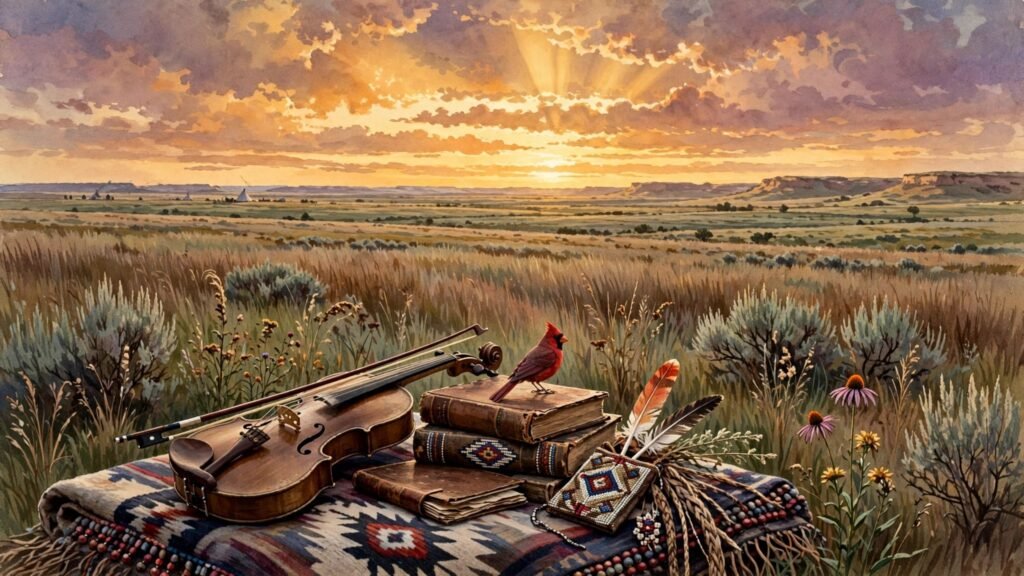
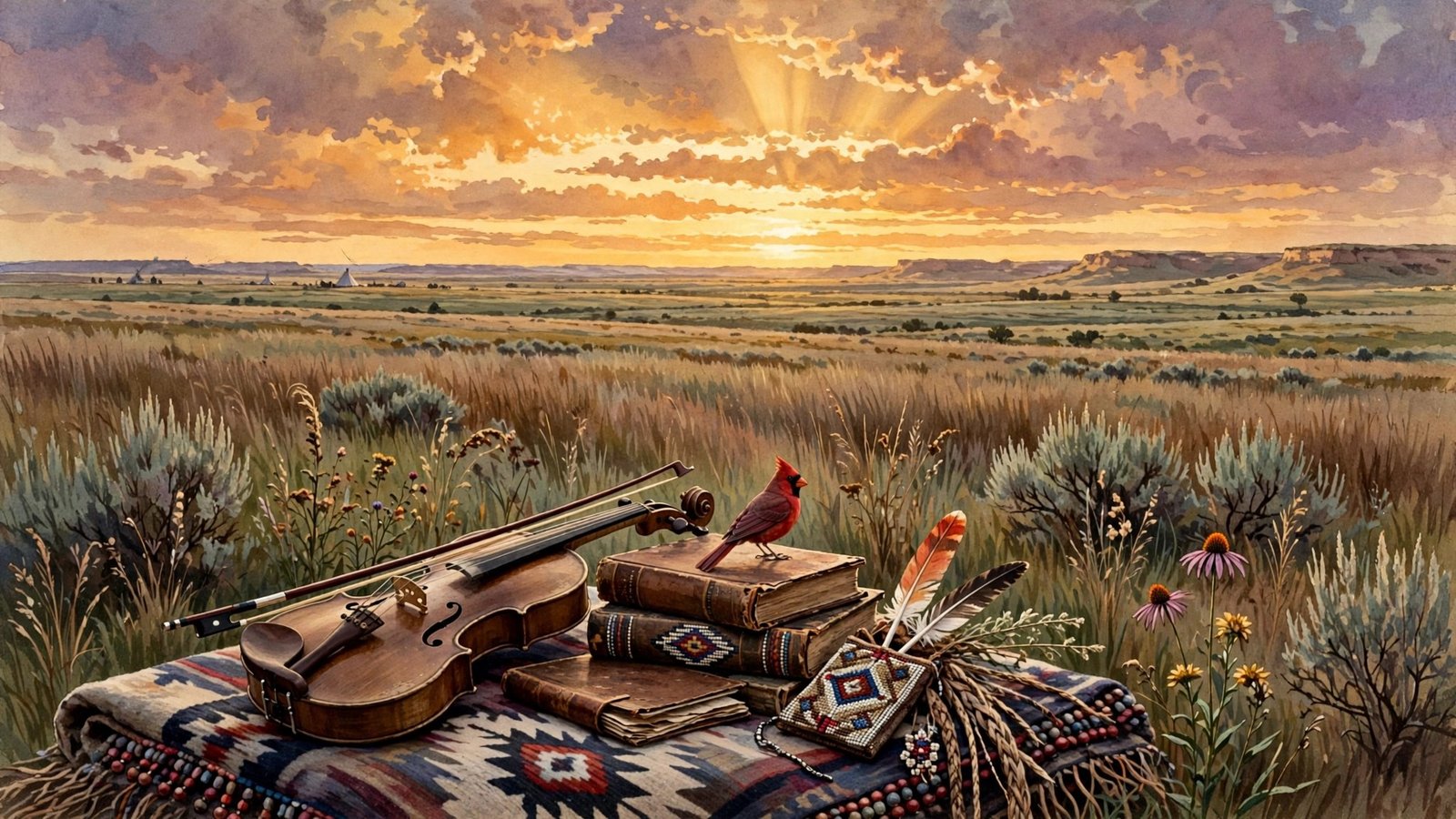
Zitkala-Sa was born on the Yankton Sioux Reservation in South Dakota in 1876, the daughter of a Yankton Sioux mother and a white father she never knew. Her Dakota name meant “Red Bird,” and she grew up in a world of prairie grass, river songs, and stories told around the fire. By the time she died in 1938, she had become one of the most important Native American voices in American history — a writer whose stories exposed the cruelty of the boarding school system, a musician who composed the first Native American opera, and an activist who helped win citizenship for her people.
Her life was a long fight against erasure. As a child, she was taken from her home and sent to a Quaker boarding school in Indiana, where her hair was cut, her language was forbidden, and her name was replaced with an English one. The school meant to make her forget who she was. Instead, it gave her the tools — the English language, the violin, the pen — to tell the world exactly what had been done to her people. She turned the instruments of assimilation into weapons of resistance.
This is the story of how a girl from the Dakota prairie became a teacher, an author, a composer, and a political leader who changed the law for Native Americans. Her journey holds lessons for anyone who has ever been told to be quiet, to fit in, or to forget where they came from. Zitkala-Sa refused all three — and the world is better for it.
Key takeaways
- Zitkala-Sa was taken from her family at eight years old and sent to a boarding school designed to erase her Native identity.
- Her autobiographical essays exposed the cruelty of the boarding school system to a national audience.
- She co-wrote The Sun Dance Opera, the first Native American opera, blending Sioux melodies with classical music.
- She helped found the National Council of American Indians and campaigned for Native citizenship.
- Her work helped lead to the Indian Citizenship Act of 1924, which granted citizenship to all Native Americans born in the United States.
Zitkala-Sa at a Glance
| Fact | Detail |
|---|---|
| Born | 22 February 1876, Yankton Sioux Reservation, South Dakota |
| Birth name | Gertrude Simmons |
| Dakota name | Zitkala-Sa, meaning “Red Bird” |
| Died | 26 January 1938, Washington, D.C. |
| Best known for | Autobiographical essays, The Sun Dance Opera, Native rights activism |
| Major works | American Indian Stories (1921), Old Indian Legends (1901), The Sun Dance Opera (1913) |
| Key achievement | Helped win Native American citizenship through the Indian Citizenship Act of 1924 |
| Organisation founded | National Council of American Indians (1926) |
| Education | White’s Indiana Manual Labor Institute, Earlham College, Boston Conservatory of Music |
| Legacy | Pioneer of Native American literature and the Native rights movement |
A Childhood on the Yankton Reservation
Zitkala-Sa was born Gertrude Simmons in 1876, on the Yankton Sioux Reservation in what is now South Dakota. Her mother, Tate Iyohinwin, was a full-blooded Yankton Sioux woman. Her father was a white man named Felker who left the family before his daughter was old enough to remember him. Her mother raised her alone, in a one-room log cabin on the prairie, teaching her the old ways.
Her childhood was, by her own account, a happy one. She learned to gather wild turnips, to listen for the stories in the wind, and to hear the legends her mother told by the fire. She played with the other children on the banks of the Missouri River and learned the songs and dances of her people. In her essays, she would later describe this time as one of freedom and belonging — a world where she knew exactly who she was and where she belonged.
But that world was already under threat. The United States government had spent decades pushing Native peoples onto reservations and trying to break their cultures apart. The boarding schools were the newest weapon in that campaign, and when Zitkala-Sa was eight years old, missionaries arrived at her home with promises of a wonderful place where she would ride on an iron horse and eat sweet apples. Her mother was suspicious and warned her not to go. The little girl begged to leave anyway, dazzled by the promises. It was a decision she would regret for the rest of her life.
The Boarding School That Tried to Erase Her
The school was White’s Indiana Manual Labor Institute in Wabash, Indiana, a Quaker-run boarding school hundreds of miles from her home. The moment she arrived, the erasure began. The teachers cut her long hair — a deep shame in Sioux culture, where hair was cut only in mourning. She fought back, hiding under a bed, but the teachers dragged her out and sheared her braids while she kicked and screamed. In her famous essay “The School Days of an Indian Girl,” she wrote that she had lost her spirit that day.
Everything about the school was designed to strip the children of their identity. They were forbidden to speak their own languages. Their Native names were replaced with English ones. Their clothes were taken and replaced with stiff uniforms. They were taught that their parents’ ways were savage and that civilisation meant becoming white. The children were punished for crying, punished for speaking Dakota, punished for remembering home.
And yet the school also gave her something she would use for the rest of her life: the English language, and with it, the ability to write. She was a gifted student and a talented violinist. She won an oratorical contest at the school, delivering a speech that moved the audience to tears — even as the white audience applauded her, a banner in the hall read “the Indian is the problem.” She stayed at the school for three years, went home for a time, and then returned, unable to settle back into reservation life after what she had seen and learned. The school had made her, in her own words, neither fully Indian nor fully white — and that painful in-between place became the source of her greatest work.
Finding Her Voice at Earlham and the Boston Conservatory
After leaving White’s Institute, Zitkala-Sa continued her education at Earlham College in Richmond, Indiana, a Quaker college. She was one of very few Native students there, and she excelled. In 1896, she won second place in a state oratorical contest, speaking on the subject of the progress of women. Her speech was so powerful that the local newspapers praised her, and a poem she wrote about her people was published. For a young Native woman in the 1890s, this was extraordinary.
But the praise came with a sting. When a student hung a banner mocking her during the contest, she understood that no amount of talent would make white America see her as an equal. She left Earlham without graduating and turned to music, her other great gift. She had taught herself the violin at the boarding school, and in 1899 she enrolled at the Boston Conservatory of Music, one of the finest music schools in the country.
At the conservatory, she studied violin and began to think seriously about what Native music could become. She believed that the melodies of her people — the songs she had heard as a child on the prairie — deserved a place in the concert hall. She began collecting and writing down Sioux songs, preserving music that the government was trying to stamp out. This work would lead, years later, to her most famous musical achievement.
The Teacher Who Spoke Out
In 1897, Zitkala-Sa took a job teaching at the Carlisle Indian Industrial School in Pennsylvania, the most famous of the government boarding schools. Carlisle was the model for the whole system — its founder, Captain Richard Henry Pratt, openly declared that the schools’ purpose was to “kill the Indian, save the man.” Zitkala-Sa had lived through that system as a child. Now she saw it from the inside as a teacher.
What she saw horrified her. The children were homesick, frightened, and punished for the smallest acts of remembering who they were. She clashed with the school’s administration, arguing that the children should be allowed to keep their languages and their cultures. She wrote letters to the school’s newspaper protesting its policies, and she began publishing essays in national magazines — the Atlantic Monthly among them — describing what the boarding schools really did to Native children.
Her essays caused a sensation. Here was a Native woman, writing in beautiful English, telling white readers that their “civilising” project was destroying children. She described the haircutting, the beatings, the loneliness, and the spiritual wound of being taught to be ashamed of your own mother. The essays were widely read and widely discussed. They also cost her the job at Carlisle. In 1901, the school dismissed her. She had chosen truth over security, and she would keep making that choice for the rest of her life.
Writing That Woke America
Zitkala-Sa’s first book, Old Indian Legends, was published in 1901. It was a collection of the stories her mother had told her as a child — tales of Iktomi the trickster spider, of the prairie animals, of the world before the white men came. The book was written for children, but its purpose was serious: to preserve the stories of her people in print, where they could not be erased. It was one of the first books of Native legends published by a Native author.
Her most important book, American Indian Stories, appeared in 1921. It collected her autobiographical essays — the boarding school years, the oratorical contest, the years of wandering between two worlds — alongside her fiction and her political writing. The book is now recognised as a founding text of Native American literature, and one of the earliest works of autobiography by a Native woman.
What made her writing so powerful was its honesty. She did not write about noble savages or romantic wilderness. She wrote about a real girl who lost her hair and her name, about a young woman who could not go home again because home had changed, about a people being crushed by a government that called its cruelty kindness. Like Emily Dickinson, she wrote from a private, interior place — but where Dickinson wrote about the soul, Zitkala-Sa wrote about survival. Her pen was her resistance, and it reached readers who would never have listened to a speech.
The Sun Dance Opera: Music as Resistance
In 1913, Zitkala-Sa achieved something no Native American had done before: she co-wrote an opera. The Sun Dance Opera, written with the composer William F. Hanson, was based on the sacred Sun Dance ceremony of the Sioux people — a ceremony the United States government had banned. She supplied the story and the melodies, drawing on the songs she had learned as a child and collected as an adult.
The opera told a love story set against the Sun Dance, and it brought Sioux music onto the stage in a form that white audiences could understand and admire. It premiered in Vernal, Utah, in 1913, and was performed again in New York in 1938, the year of her death. It was the first opera written by a Native American, and it was an act of cultural defiance: at a time when the government was trying to outlaw Native ceremonies, Zitkala-Sa put one on stage and made audiences applaud it.
Music was, for her, another language of resistance. She played the violin beautifully, and she understood that a melody could carry a people across a border that words could not cross. The opera’s success showed that Native culture was not a relic to be buried but a living art that could stand beside any tradition in the world. It remains one of her proudest achievements.
The Fight for Citizenship and the Vote
By the 1920s, Zitkala-Sa had turned most of her energy to politics. Native Americans were not citizens of the United States — the country that had taken their land did not even count them as its people. They could not vote, could not own property in the same way as white citizens, and had almost no legal rights. Zitkala-Sa believed this was the root of every other injustice, and she set out to change it.
In 1921, she joined the Society of American Indians, the first national Native rights organisation run by Native people themselves. She served as its secretary and edited its magazine, American Indian Magazine, using it to report on the abuses Native people suffered — stolen land, corrupt agents, children taken from their families, and starvation on the reservations. Her reporting was fearless, and it made her enemies in the Bureau of Indian Affairs.
Her campaign helped build the pressure that led to the Indian Citizenship Act of 1924, signed by President Calvin Coolidge, which granted United States citizenship to all Native Americans born in the country. It was a landmark victory, though an incomplete one: many states still found ways to keep Native people from voting for decades afterwards. Zitkala-Sa knew the fight was not over. She kept going, because for her, citizenship was not a favour to be granted — it was a right that had been stolen and had to be returned.
The National Council of American Indians
In 1926, Zitkala-Sa founded her own organisation, the National Council of American Indians, with her husband, Raymond Bonnin. The Council was dedicated to uniting Native peoples across tribal lines and lobbying the federal government for their rights. She served as its president until her death, travelling across the country to speak, to organise, and to gather evidence of the government’s failures.
Under her leadership, the Council investigated conditions on the reservations and published its findings. She testified before Congress, wrote to presidents, and built alliances with other reformers. She understood something that few activists of her time grasped: that the fight for Native rights had to be fought in Washington, in the newspapers, and in the courts — not only on the reservations.
The Council’s work laid the groundwork for the Native rights movement that would follow. Decades later, the activists of the 1960s and 1970s — the people who occupied Alcatraz and Wounded Knee — were walking a road that Zitkala-Sa had helped to build. She did not live to see those victories, but she made them possible. Her organising, like her writing, was a seed planted in hard ground.
Her Marriage and Family Life
In 1902, Zitkala-Sa married Raymond Bonnin, a Yankton Sioux man she had known since childhood. It was a partnership of equals and of shared purpose. Raymond worked for the Bureau of Indian Affairs, and together they raised a son, Ohiya Bonnin, born in 1903. The family lived for many years on the Uintah and Ouray Reservation in Utah, where Raymond was employed, and where Zitkala-Sa continued her writing and her activism.
Family life gave her an anchor. She taught her son the stories and songs of their people, determined that he would not lose what the schools had tried to take from her. Her home was filled with music — she played the violin, and she and Raymond sang the old songs together. Even as she travelled and campaigned, she returned to a family that shared her values and her cause.
Her marriage also showed a different side of her: not the public fighter or the celebrated author, but a wife and mother who built a home in a world that had tried to destroy hers. That balance — between the public struggle and the private life — was one of her quietest achievements, and one of the hardest to hold onto in a life of constant battle.
What Made Her Great
Zitkala-Sa was great because she refused to be erased — and then refused to let her people be erased either. The boarding school tried to cut the Indian out of her; she used the school’s own tools to cut the truth into the American conscience instead. She was a writer who told the truth when the truth was unwelcome, a musician who carried her people’s songs into the concert hall, and an organiser who turned grief into law.
She was also great because she worked in more than one field at once. Most reformers choose one weapon. She chose them all: the pen, the violin, the lecture hall, the courtroom, and the halls of Congress. Each one strengthened the others. Her essays gave her activism a voice; her activism gave her essays a purpose; her music gave both of them a soul. That range — writer, composer, teacher, organiser — is rare in any life, and extraordinary in a life lived against such odds.
Like Ida B. Wells, she was a woman who investigated injustice and reported it to the world, even when the world did not want to hear it. And like Helen Keller, she turned a life shaped by hardship into a public voice for those who had none. But Zitkala-Sa’s fight was her own: she spoke for a people whose very existence was being denied, and she made America listen.
Lessons From Her Life
The first lesson of Zitkala-Sa’s life is that your voice is your power, even when others try to take it. The school took her language, her hair, and her name — but it could not take her ability to tell the truth. She learned the language of her oppressors and used it to expose them. When you are told to be silent, speaking is the most powerful thing you can do.
The second lesson is that culture is not a luxury — it is survival. Zitkala-Sa spent her life preserving the stories, songs, and ceremonies of her people because she understood that a people who lose their culture lose themselves. The boarding schools knew this too, which is why they attacked culture first. Protecting your heritage is not nostalgia; it is resistance.
The third lesson is that one person can change the law. Zitkala-Sa was a single woman from a small reservation, with no wealth and no political office. Yet her writing, her organising, and her testimony helped bring about the Indian Citizenship Act of 1924 — a change that affected hundreds of thousands of lives. Change does not always start with the powerful. Often it starts with one person who refuses to accept the way things are.
The final lesson is that grief can become fuel. Zitkala-Sa carried the wounds of her childhood for her whole life — the haircut, the loneliness, the feeling of belonging nowhere. She could have let those wounds make her bitter or silent. Instead, she turned them into essays, operas, organisations, and laws. Pain, honestly faced and honestly told, can become the most useful thing a person owns.
Checklist: Lessons You Can Use From Zitkala-Sa’s Life
- Speak the truth even when it costs you — she lost her teaching job for telling it, and the truth outlived the job.
- Protect your culture and your stories; they are the foundation of who you are.
- Learn the tools of the world you live in, then use them for your own cause.
- Build organisations, not just arguments — lasting change needs structure behind it.
- Stand up for people who cannot stand up for themselves.
- Turn your hardest experiences into work that helps others.
Frequently Asked Questions
Who was Zitkala-Sa?
Zitkala-Sa, born Gertrude Simmons in 1876, was a Yankton Sioux writer, musician, teacher, and activist. She is considered one of the founders of Native American literature and a pioneer of the Native rights movement in the United States.
What does the name Zitkala-Sa mean?
Zitkala-Sa is a Dakota name meaning “Red Bird.” She adopted it as her pen name and public name as an adult, reclaiming the identity the boarding school had tried to take from her.
What is The Sun Dance Opera?
The Sun Dance Opera, co-written with William F. Hanson in 1913, was the first opera written by a Native American. It was based on the Sioux Sun Dance ceremony and blended Native melodies with classical music.
How did Zitkala-Sa help win Native American citizenship?
Through her writing, her work with the Society of American Indians, and her lobbying in Washington, she helped build the public and political pressure that led to the Indian Citizenship Act of 1924, which granted citizenship to all Native Americans born in the United States.
What was the National Council of American Indians?
It was an organisation Zitkala-Sa founded in 1926 with her husband, Raymond Bonnin, to unite Native peoples and campaign for their rights. She served as its president until her death in 1938.
Why is Zitkala-Sa important today?
Her essays exposed the boarding school system, her music preserved Native culture, and her activism helped change the law. She is now recognised as one of the most important Native American voices in American history, and her work is studied in schools and universities across the country.
Bottom line
Zitkala-Sa was taken from her home as a child and sent to a school that tried to erase everything she was. Instead of being erased, she became a writer, a composer, a teacher, and a political leader who changed the law for her people. Her life proves that no system, however powerful, can take away a person’s voice — and that a voice, honestly used, can change a nation. Face Zem tells her story because it is a story about refusing to disappear, and about turning pain into power.
Note: This article is a general historical account of Zitkala-Sa’s life and achievements, based on her published writings and the historical record.

Keep what speaks to you.
Leave room for your own perspective.


