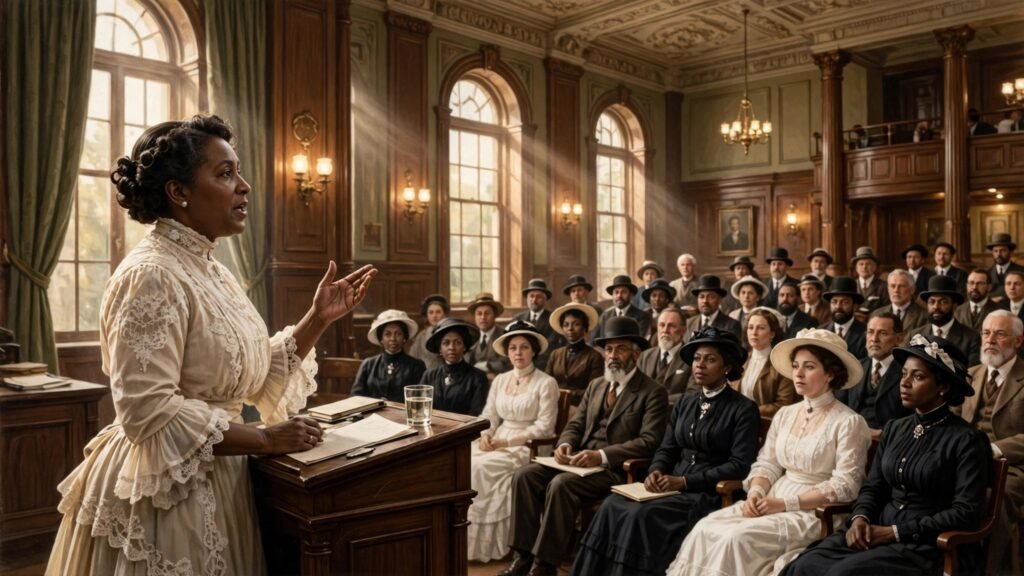
Mary Church Terrell was born into freedom in 1863, the year of the Emancipation Proclamation, and she spent the next ninety years turning that freedom into a weapon against segregation. She was the daughter of two of the wealthiest Black people in the American South, a college graduate when few women of any race held a degree, and a woman who could have lived a comfortable, quiet life. Instead she chose the hardest road available to her: a public, relentless, seven-decade fight for the rights of Black Americans and of women.
Her life is one of the great American stories of endurance. Terrell did not win her battles in a single dramatic moment. She won them slowly, meeting by meeting, court case by court case, speech by speech, from the 1890s until the 1950s. She outlived her enemies, outlasted the institutions that excluded her, and lived long enough to see the Supreme Court strike down the very segregation she had been arrested for protesting. When she died in 1954, the year of the Brown v. Board of Education decision, the cause she had served for seventy years was finally beginning to prevail.
What makes Mary Church Terrell’s story so powerful is that it is not a story of privilege wasted or privilege enjoyed. It is a story of privilege used as a tool. She had education, money, connections and a platform, and she spent them all on people who had none of those things. This is the story of how she did it, and what her remarkable life can teach anyone who wants to make a difference that lasts.
Key takeaways
- Mary Church Terrell fought segregation and sexism for more than seventy years, from the 1890s until her death in 1954.
- She was one of the first Black women in America to earn a college degree, graduating from Oberlin College in 1884.
- She co-founded the National Association of Colored Women in 1896 and served as its first president.
- She helped found the National Association for the Advancement of Colored People (NAACP) in 1909.
- At the age of 86, she led the campaign that desegregated Washington, D.C. restaurants, winning a Supreme Court victory in 1953.
Mary Church Terrell at a Glance
| Fact | Detail |
|---|---|
| Full name | Mary Eliza Church Terrell |
| Born | 23 September 1863, Memphis, Tennessee |
| Died | 24 July 1954, Highland Beach, Maryland |
| Education | Oberlin College, B.A. 1884, M.A. 1888 |
| Known for | Civil rights leader, suffragist, educator, writer |
| Key organisations | NACW, NAACP, National Council of Negro Women |
| Major victory | District of Columbia v. John R. Thompson Co. (1953) |
| Husband | Robert Heberton Terrell, judge |
| Autobiography | A Colored Woman in a White World (1940) |
| Legacy | Seven decades of activism for Black and women’s rights |
A Childhood of Privilege and Pain
Mary Eliza Church was born in Memphis, Tennessee, on 23 September 1863, into a family that had already achieved the extraordinary. Her father, Robert Reed Church, had been born enslaved and had become one of the wealthiest Black men in the South, a saloon owner and real estate investor who was the first Black millionaire in Memphis. Her mother, Louisa Ayers Church, owned a hair salon and was herself a successful businesswoman. Mary grew up in a large, comfortable house, with books, music lessons and every advantage money could buy.
But the advantages of wealth could not protect her from the realities of being Black in the post-Civil War South. When Mary was a small child, her mother was turned away from a first-class railway carriage because of her race. Her father built his fortune in a city where Black people were lynched, where the Ku Klux Klan operated openly, and where the Memphis massacre of 1866 had killed dozens of Black citizens. Mary learned early that money could buy comfort but not dignity, and that lesson shaped everything that followed.
When Mary was six, her parents sent her north to school, first to Ohio and then to Oberlin College, one of the first colleges in America to admit Black students and women on equal terms. The separation from her family was painful, but the education was transformative. At Oberlin she studied the classical “gentleman’s course” of Greek, Latin, mathematics and literature, refusing the easier “ladies’ course” that most women were steered toward. She was determined to be educated as well as any man, and she was.
Oberlin and the Making of a Mind
Mary Church graduated from Oberlin College in 1884, one of the first Black women in the United States to earn a bachelor’s degree. Four years later she returned to earn a master’s degree. Her Oberlin years gave her more than a diploma. They gave her a network of friends and mentors, a command of languages and literature, and a confidence in her own intellect that no amount of prejudice could shake.
After graduation she taught briefly at Wilberforce University in Ohio, then took a position teaching Latin at the M Street High School in Washington, D.C., the finest Black high school in the country. It was there, in the capital of the nation, that she met Robert Heberton Terrell, a young lawyer who would become the first Black municipal court judge in Washington. They married in 1891 and became one of the most prominent couples in Black Washington, a city where the Black middle class was building churches, schools, clubs and newspapers.
But the Terrells’ comfortable life was shattered by an event that changed Mary’s direction forever. In 1892 her friend Thomas Moss, a Black grocer in Memphis, was lynched by a white mob, along with two of his friends, for the crime of running a successful business that competed with a white store. The lynching horrified Mary and her friend Ida B. Wells, and it turned both women into activists. Mary would later write that the murder of Thomas Moss was the moment she understood that no Black person, however successful, was safe in America.
The National Association of Colored Women
In 1896 Mary Church Terrell helped found the National Association of Colored Women (NACW), the first national organisation of Black women in the United States, and she was elected its first president. The organisation’s motto, “Lifting as We Climb,” captured Terrell’s philosophy exactly: those who had risen had a duty to lift those still below.
Under her leadership the NACW built kindergartens, nurseries, homes for working women, and training schools across the country. The organisation fought lynching, campaigned for women’s suffrage, and raised money for Black schools and hospitals. It gave Black women a national voice at a time when white women’s organisations often refused to admit them and Black men’s organisations often ignored them.
Terrell served as president of the NACW for five years, and she remained one of its most active leaders for the rest of her life. The organisation she helped build became one of the most durable institutions in Black America, and it trained a generation of Black women leaders. Her work with the NACW proved that she was not only a speaker and a writer but an organiser, a builder of institutions that outlived her.
Speaking to the World
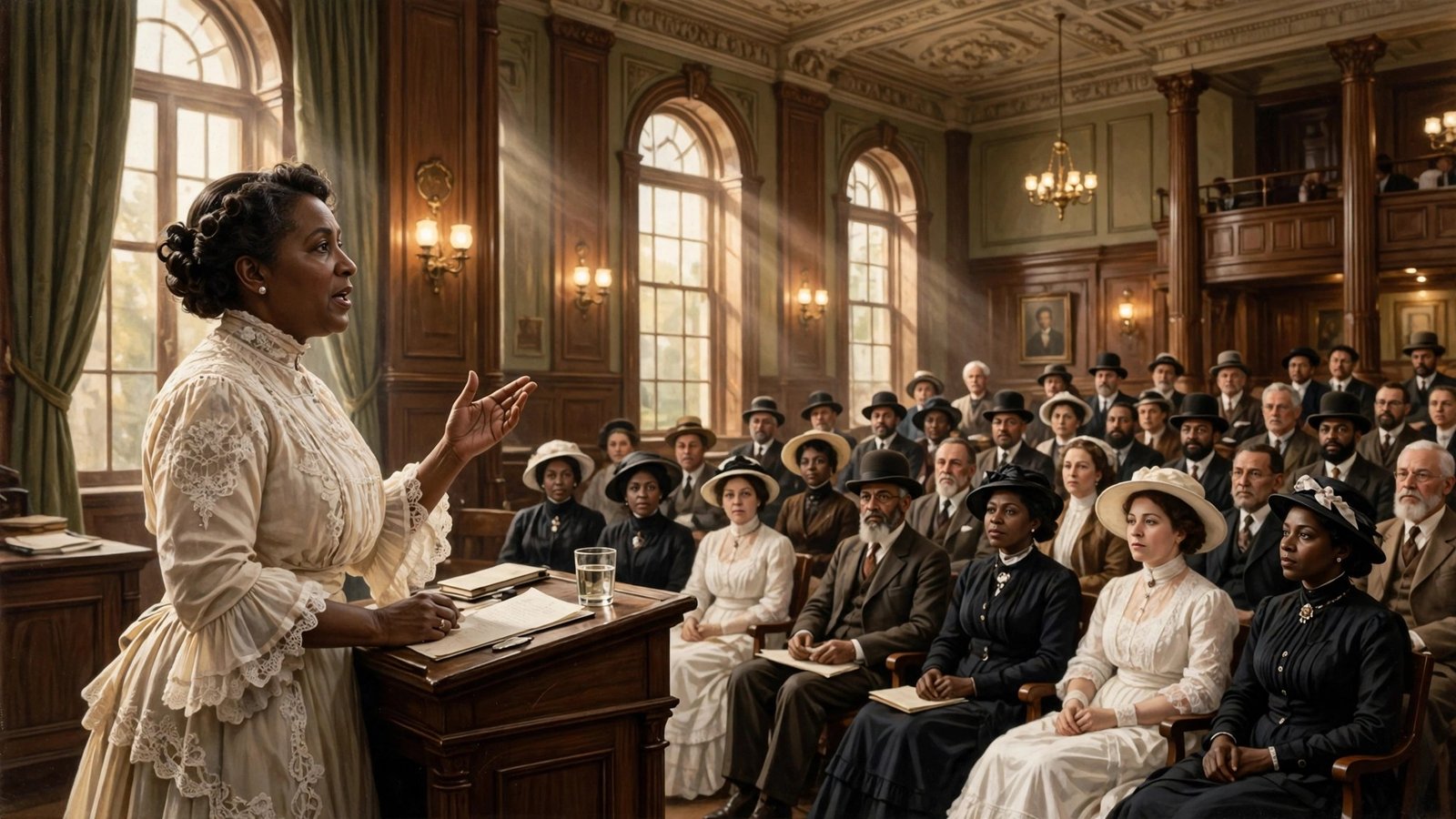
Mary Church Terrell was one of the most gifted public speakers of her generation, and she used that gift relentlessly. She addressed audiences in the United States and in Europe, speaking in English, French and German. She spoke to white audiences about lynching, to Black audiences about self-help and education, and to women’s groups about suffrage.
Her most famous speech, “What It Means to Be Colored in the Capital of the United States,” delivered in 1906, was a devastating account of the humiliations Black people endured even in the nation’s capital. She described being refused service in restaurants, turned away from theatres, and denied a seat on a train. The speech was printed and widely circulated, and it made her one of the best-known Black women in America.
She also wrote for newspapers and magazines, and in 1940 she published her autobiography, A Colored Woman in a White World. The book is a remarkable document, a first-hand account of seventy years of American history seen through the eyes of a Black woman who refused to accept the world as it was. It remains one of the most important memoirs of the civil rights era.
The Fight for Women’s Suffrage
Terrell was a lifelong suffragist, and she fought for women’s right to vote at a time when the suffrage movement was often divided by race. White suffrage organisations frequently excluded Black women or asked them to march at the back of parades, and Terrell refused to accept second-class status in a movement for equality.
In 1913 she marched in the great suffrage parade in Washington, D.C., alongside the women of the Delta Sigma Theta sorority, insisting that Black women march as equals. She served as a leader in the National American Woman Suffrage Association and in the National Woman’s Party, and she worked to build bridges between the Black and white women’s movements.
When the Nineteenth Amendment was ratified in 1920, giving women the vote, Terrell celebrated the victory but did not stop. She knew that in the South, Black women were still kept from the polls by poll taxes, literacy tests and violence, and she continued to fight for voting rights for the rest of her life. Her suffrage work showed the same quality as all her activism: she never confused a partial victory with a finished job.
Founding the NAACP
In 1909 Mary Church Terrell was one of the founders of the National Association for the Advancement of Colored People (NAACP), the organisation that would become the legal engine of the civil rights movement. She was the only Black woman among the founders, and she served on its executive committee for decades.
The NAACP’s strategy was to fight segregation through the courts, and Terrell was one of its most effective public voices. She testified before Congress, she spoke at NAACP conventions, and she used her social standing in Washington to open doors that were closed to other Black leaders. She understood that the fight for civil rights needed lawyers, but it also needed public opinion, and she was a master at shaping it.
Her long association with the NAACP connected her to a new generation of activists, including the young lawyers who would argue Brown v. Board of Education. When that case was decided in 1954, the year of her death, Terrell was one of the few people alive who had been fighting for school desegregation since the nineteenth century.
The Long Middle Years
The decades between the First World War and the Second World War were the hardest part of Terrell’s career. The early promise of the civil rights movement faded, lynching continued, segregation hardened, and many of her fellow activists grew discouraged. Terrell did not. She kept speaking, kept writing, kept organising, even as the audiences grew smaller and the victories rarer.
She served as president of the National Association of College Women, she worked with the National Council of Negro Women, and she travelled the country speaking to Black women’s clubs. She also became an international figure, representing the United States at conferences in Europe and speaking out against colonialism and racism around the world.
Her personal life during these years was marked by loss. Her husband Robert died in 1925, and her daughter Phyllis died young. Terrell bore these losses with the same stoicism she brought to her public work, and she continued to fight. She understood that activism is not a sprint but a marathon, and that the people who change the world are usually the ones who simply refuse to stop.
The Washington Restaurant Campaign
Mary Church Terrell’s greatest victory came at the very end of her life, when she was in her late eighties. In 1950 she and three friends were refused service at Thompson’s Restaurant in Washington, D.C., a segregated lunch counter in the nation’s capital. Terrell decided to fight back, and she took the case to court.
The legal battle lasted three years. Terrell picketed the restaurant herself, carrying a sign at the age of 86, and she organised a boycott that drew national attention. In 1953 the Supreme Court ruled in District of Columbia v. John R. Thompson Co. that segregated restaurants in the District of Columbia were unconstitutional, and the decision desegregated the capital’s restaurants, theatres and hotels.
It was a fitting final victory. Terrell had been fighting segregation since the 1890s, and she lived to see the Supreme Court strike it down in the city where she had lived for sixty years. A year later, the Court decided Brown v. Board of Education, desegregating the nation’s schools. Terrell died on 24 July 1954, weeks after that decision, having lived long enough to see the cause of her life begin to triumph.
What Made Her Great
Several qualities made Mary Church Terrell extraordinary. The first was her endurance. She fought for seventy years, through periods when the cause seemed hopeless, and she never quit. The second was her versatility. She was an educator, an organiser, a speaker, a writer and a litigant, and she used every one of those skills in the service of her cause.
The third was her independence. Terrell refused to be told where she belonged. She insisted on the classical curriculum at Oberlin when women were expected to take the ladies’ course. She insisted on marching with the suffragists as an equal. She insisted on being served in a segregated restaurant at the age of 86. She never accepted a subordinate place, and she never asked permission to lead.
The fourth was her generosity. She used her wealth, her education and her social standing for others, and she did it for a lifetime. She could have lived comfortably and quietly. Instead she spent her life, her money and her reputation on people she would never meet. That is the definition of a great life.
Lessons from Her Life
Mary Church Terrell’s life offers lessons that apply far beyond the civil rights movement. The first is that change takes longer than anyone expects, and that the people who make it happen are the ones who keep going when others give up. Terrell fought for seventy years before she saw her greatest victories. Most people would have quit after seven.
The second lesson is that privilege is a tool, not a reward. Terrell had every advantage, and she used them all in the service of others. The question is not what you have been given, but what you do with it.
The third lesson is that you can fight on many fronts at once. Terrell fought racism and sexism, she built organisations and wrote books, she spoke to audiences in three languages and picketed a restaurant at the age of 86. She did not choose between causes. She fought them all, and she fought them for a lifetime.
Checklist: Lessons from Mary Church Terrell
- Commit for the long term — real change takes decades, not months.
- Use whatever advantages you have in the service of others.
- Build institutions that outlast you, not just moments that pass.
- Refuse to accept a second-class place in any movement for equality.
- Speak clearly and publicly about injustice, even when it is unpopular.
- Never confuse a partial victory with a finished job.
Frequently Asked Questions
Who was Mary Church Terrell?
Mary Church Terrell (1863–1954) was an American educator, writer and civil rights leader who fought segregation and sexism for more than seventy years. She co-founded the National Association of Colored Women, helped found the NAACP, and led the campaign that desegregated Washington, D.C. restaurants.
What was Mary Church Terrell’s greatest achievement?
Her greatest victory was the 1953 Supreme Court decision in District of Columbia v. John R. Thompson Co., which desegregated restaurants in Washington, D.C. She was 86 years old when she led the campaign, picketing the restaurant herself.
What did Mary Church Terrell do for women’s suffrage?
Terrell was a lifelong suffragist who fought for women’s right to vote and insisted that Black women be treated as equals in the suffrage movement. She marched in the 1913 suffrage parade in Washington and worked in the National American Woman Suffrage Association and the National Woman’s Party.
What is A Colored Woman in a White World?
A Colored Woman in a White World is Terrell’s autobiography, published in 1940. It is a first-hand account of seventy years of American history, covering her childhood in Memphis, her education at Oberlin, and her long career as a civil rights leader.
How did Mary Church Terrell help found the NAACP?
Terrell was one of the founders of the NAACP in 1909, the only Black woman among the founders, and she served on its executive committee for decades, using her voice and her social standing to advance the organisation’s legal campaign against segregation.
What did Mary Church Terrell have in common with Mary McLeod Bethune?
Both women were pioneering Black educators and organisers who built national institutions for Black women. Terrell founded the National Association of Colored Women, while Mary McLeod Bethune founded the National Council of Negro Women, and the two women worked together for decades in the fight for civil rights and women’s rights.
Bottom line
Mary Church Terrell lived for ninety years and fought for seventy of them, and she won her greatest victory at the age of 86. She was born into freedom in the year of the Emancipation Proclamation, and she spent her life making that freedom real for millions of people who did not share her advantages. She built organisations, she wrote books, she spoke to the world, and she picketed a segregated restaurant when most people her age had long since retired. Her life proves that one person, armed with education, courage and an unwillingness to quit, can change the world — if they are willing to keep fighting for a lifetime. Like Sojourner Truth before her, she showed that a Black woman’s voice, raised in truth and persistence, could move a nation.
Note: This article is a general historical account of Mary Church Terrell’s life and legacy, written for readers of Face Zem. Dates, organisations and events are drawn from the public historical record.

Keep what speaks to you.
Leave room for your own perspective.


