Charlotte Perkins Gilman was told that the cure for her suffering was to stop thinking, stop writing and stop working. She refused — and in refusing, she wrote one of the most famous short stories in American literature and became one of the most influential feminist thinkers of her generation. Her life is a story of a woman who turned personal pain into a public argument, and that argument changed how the world thought about women, work and independence.
Born in Hartford, Connecticut, in 1860, Gilman grew up in difficult circumstances, married young, and fell into a deep depression after the birth of her daughter. The treatment prescribed by the leading doctor of the day nearly destroyed her. Instead of surrendering, she left the treatment behind, left her marriage, and rebuilt her life as a writer, lecturer and reformer. Her book Women and Economics was translated around the world, and her utopian novel Herland still inspires readers more than a century later.
This is the success story of Charlotte Perkins Gilman — a woman who was told to be quiet and chose instead to speak, write and think her way to freedom, and whose ideas about women’s economic independence remain strikingly relevant on Face Zem today.
Key takeaways
- Charlotte Perkins Gilman turned a harmful medical treatment, the “rest cure,” into the inspiration for her most famous work, The Yellow Wallpaper.
- She argued that women’s economic dependence on men was the root of their inequality — a radical idea in the 1890s.
- She supported herself for decades as a writer, lecturer and editor, living the independence she preached.
- Her magazine, The Forerunner, was written almost entirely by her alone for seven years.
- Her lessons still apply: trust your own mind, turn hardship into work, and never let anyone else define your limits.
Charlotte Perkins Gilman at a Glance
| Fact | Detail |
|---|---|
| Born | 3 July 1860, Hartford, Connecticut, USA |
| Died | 17 August 1935, Pasadena, California, USA |
| Best known for | The Yellow Wallpaper (1892) and Women and Economics (1898) |
| Occupation | Writer, lecturer, editor, sociologist and reformer |
| First marriage | Charles Walter Stetson, 1884–1894 |
| Daughter | Katharine Beecher Stetson (1885–1979) |
| Second marriage | George Houghton Gilman, 1900–1934 |
| Major works | The Yellow Wallpaper, Women and Economics, Herland, The Home |
| Magazine | The Forerunner (1909–1916), written largely by Gilman herself |
| Legacy | Pioneer of feminist economics and a founder of modern feminist thought |
A Difficult Childhood in Hartford
Charlotte Anna Perkins was born into a family that had once been distinguished and was now struggling. Her father, Frederic Beecher Perkins, was a librarian and writer, and her great-aunts included the famous Beecher sisters — Harriet Beecher Stowe, author of Uncle Tom’s Cabin, and Catharine Beecher, a leading educator. But her father left the family when Charlotte was a small child, and her mother, Mary, raised Charlotte and her brother Thomas in near-poverty, moving from one relative’s house to another.
The constant moving made Charlotte’s childhood lonely, but it also made her fiercely self-reliant. She read widely, taught herself, and developed a habit of thinking for herself that never left her. She attended the Rhode Island School of Design for a time, hoping to support herself as an artist, and worked as a commercial artist and a teacher. She was, from an early age, determined never to depend on anyone else for her living — a determination that would shape everything she did.
Her upbringing also gave her a sharp eye for the unfairness of women’s lives. She watched her mother struggle, saw how marriage could trap a woman without money of her own, and noticed how the world expected women to be decorative and dependent. These observations became the foundation of her life’s work.
The Rest Cure That Nearly Destroyed Her
In 1884, Charlotte married the artist Charles Walter Stetson. A year later, their daughter Katharine was born, and Charlotte fell into a severe depression — what we would now recognise as postnatal depression. She sought help from Dr. Silas Weir Mitchell, the most famous nerve specialist in America. His prescription was the “rest cure”: complete bed rest, no reading, no writing, no work, no intellectual stimulation of any kind, and a rich diet. She was told to live a life of enforced idleness and to “never touch pen, brush or pencil again.”
The treatment made her worse. She later wrote that she came “so near the borderline of utter mental ruin that I could see over the brink.” The enforced idleness, the isolation and the command to stop thinking were, for a mind like hers, a kind of torture. She was intelligent, energetic and ambitious — and she was being told that her cure was to become a passive, unthinking invalid.
In the end, she saved herself by disobeying the doctor. She returned to work, to writing and to thinking, and her health improved. She left her husband — an almost unheard-of step for a respectable woman in the 1880s — and moved to California with her daughter. It was one of the bravest decisions of her life, and it made her career possible.
The Yellow Wallpaper: Turning Pain into Protest
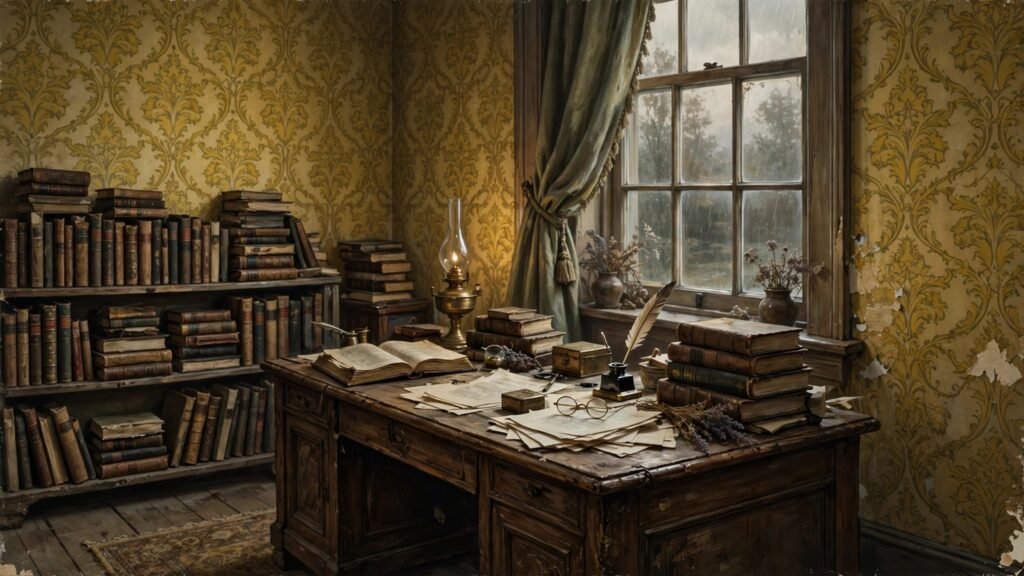
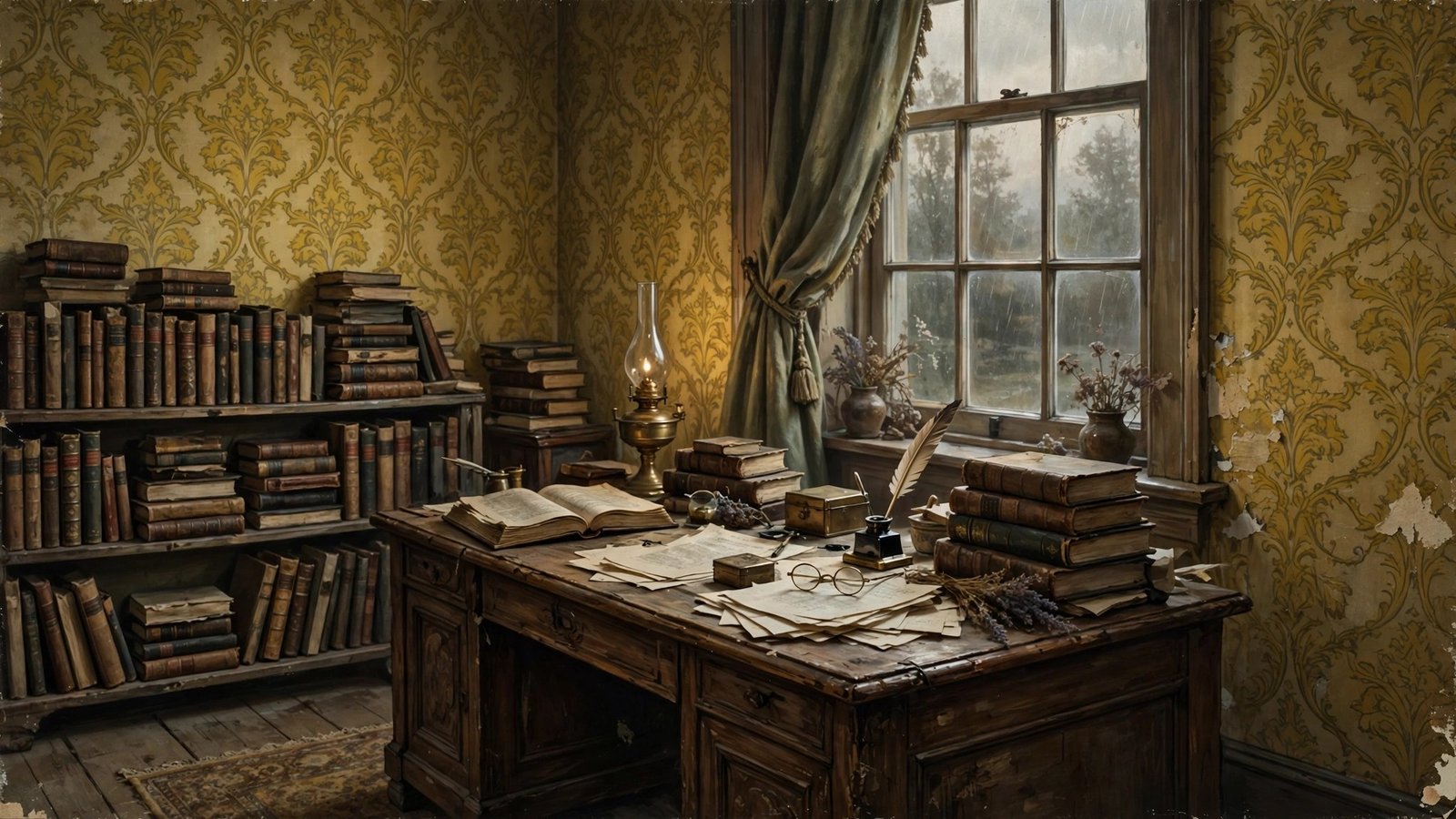
In 1890, Gilman wrote the story that would make her famous. The Yellow Wallpaper is a short, chilling tale of a young mother confined to an upstairs nursery by a well-meaning husband who insists she rest and do nothing. Forbidden to work or write, she becomes obsessed with the yellow wallpaper in her room, and her mind slowly unravels. The story is fiction, but it is barely disguised autobiography — Gilman herself had lived through the same treatment.
Published in 1892, the story was an immediate sensation. Some readers found it horrifying; others recognised it as a powerful attack on the way women’s minds were dismissed and controlled. Gilman later said that the story was not intended as literature but as a warning: she sent a copy to Dr. Weir Mitchell himself, and he reportedly changed his treatment afterwards. It remains one of the most widely read and taught short stories in American literature.
The lesson of The Yellow Wallpaper goes beyond medicine. It is a story about what happens when a person is denied meaningful work and told to be passive. Gilman believed that work — real, purposeful, paid work — was essential to human health and dignity, for women as much as for men. Like Emily Dickinson, who also wrote her greatest work in difficult circumstances, Gilman turned private suffering into art that spoke to the world.
A New Life in California
California gave Gilman a fresh start. She lived in Pasadena and later in Oakland, supported herself by writing and lecturing, and became part of the reform circles of the West Coast. She wrote poems, articles and stories, and she began to develop the social and economic ideas that would make her famous. She also sent her daughter Katharine to live with her former husband and his new wife — a decision that scandalised respectable opinion, but one she believed was best for the child.
The 1890s were her breakthrough decade. She travelled widely, lecturing on women’s rights and social reform, and she built a reputation as one of the most original thinkers in America. She was not a conventional suffragist: while many campaigners focused on the vote, Gilman argued that the vote alone was not enough. Women needed economic independence, professional work and a complete rethinking of the home and the family.
Her second marriage, in 1900, to her cousin George Houghton Gilman, a lawyer, was a happy one. Unlike her first marriage, it was a partnership between equals, and it gave her the stability to do her most productive work. She wrote, edited and lectured for the rest of her life.
Women and Economics: Her Radical Argument
In 1898, Gilman published Women and Economics, the book that made her an international figure. Its argument was simple and devastating: women were economically dependent on men, and that dependence distorted everything — marriage, motherhood, work, art and even women’s health. Women were, she argued, the only creatures in nature that depended on the opposite sex for food. This dependence made them, in her phrase, “over-sexed” — valued for their sex rather than for their abilities.
Her solution was equally bold. Women should work, earn their own money and be economically independent. Housework should be professionalised and socialised — cooked food, laundry and childcare could be done more efficiently by trained workers and shared services than by every woman alone in her own kitchen. Children would be better cared for by professionals than by exhausted, isolated mothers. It was a vision of a world in which women were full human beings, not dependents.
The book was translated into seven languages and praised by thinkers across Europe and America. It made Gilman one of the most famous women in the world. Her ideas were radical, but they were argued with logic, humour and a mass of evidence, and they could not be ignored.
The Forerunner: Her Own Magazine
In 1909, Gilman launched her own magazine, The Forerunner, and for seven years she wrote almost all of it herself — essays, stories, poems, editorials and serialised novels, month after month. It was an extraordinary feat of productivity and discipline. She used the magazine to develop her ideas about women, work, the home and the future of society, and to publish her fiction, including the utopian novel Herland.
The Forerunner gave her complete independence as a writer. She answered to no editor and no publisher, and she could say exactly what she thought. It also proved her point about women’s capacity for sustained, professional work: she was, in effect, a one-woman publishing house. The magazine closed in 1916, when her eyesight began to fail and the workload became too much, but it remains a remarkable achievement.
Her productivity was her argument in action. She did not merely write about women’s independence — she lived it, earning her own living by her own pen for more than forty years.
Herland and the Vision of a Better World
Herland, serialised in The Forerunner in 1915, is Gilman’s most famous novel and one of the great utopias of modern literature. It tells the story of three American men who discover an isolated country inhabited entirely by women — a peaceful, efficient, educated society in which motherhood is honoured, work is shared, and there is no war, no poverty and no crime. The men arrive expecting to conquer and are instead gently educated out of their assumptions.
The novel is both a fantasy and a serious argument. Gilman used it to show what a society might look like if women’s values — care, cooperation, education, peace — were allowed to shape the world. It was a radical challenge to the idea that competition, conflict and domination were natural or inevitable. Herland was largely forgotten for decades and rediscovered in the 1970s, when it became a classic of feminist literature.
Like Jane Austen, whose novels also exposed the economic traps of women’s lives, Gilman used fiction to say what argument alone could not. Her stories made her ideas vivid, memorable and impossible to dismiss.
Marriage, Motherhood and Independence
Gilman’s views on marriage and motherhood were controversial in her lifetime and remain thought-provoking today. She believed that marriage should be a partnership of equals, not an economic arrangement in which a woman traded her independence for support. She argued that motherhood was a social duty, not a private sacrifice, and that society should support mothers rather than leaving them isolated and exhausted.
Her own life illustrated both the cost and the value of her principles. Leaving her first marriage cost her respectability and, for a time, her daughter’s daily company. But it also gave her the freedom to work, to think and to become herself. Her second marriage showed that a different kind of marriage was possible — one based on mutual respect and shared purpose.
She never softened her message to make it more acceptable. She believed that honesty mattered more than popularity, and that the truth about women’s lives needed to be told plainly, even when it made people uncomfortable.
Later Years and Lasting Influence
In her later years, Gilman continued to write and lecture, though her health declined and her eyesight failed. She wrote her autobiography, The Living of Charlotte Perkins Gilman, published in 1935, the year of her death. In 1932, she was diagnosed with breast cancer. When the disease became incurable, she made her own choice about how to end her life, dying in Pasadena in August 1935 at the age of seventy-five.
Her influence has only grown since her death. Women and Economics is recognised as a founding text of feminist economics. The Yellow Wallpaper is one of the most widely taught stories in the English language. Herland is a classic of utopian fiction. Her ideas about childcare, professional housework and women’s economic independence anticipated debates that are still live today.
She is remembered not only as a writer but as a thinker who saw further than almost anyone of her generation — a woman who understood that women’s freedom depended on economic freedom, and who had the courage to say so.
What Made Her Great
Several qualities set Charlotte Perkins Gilman apart. The first was intellectual courage: she was willing to think the unthinkable and to say it in public, even when it cost her reputation and comfort. The second was independence of mind: she trusted her own judgement over the authority of doctors, husbands and social convention. The third was the ability to turn suffering into insight — her worst experience became her most famous work.
She also had extraordinary discipline. Writing a magazine almost single-handed for seven years, lecturing across the country, producing books, essays and stories for decades — none of this was possible without relentless, daily work. And she had clarity: she could take a complex social problem and explain it in plain language that anyone could understand.
Like Susan B. Anthony, who spent a lifetime campaigning for a cause she would not live to see won, Gilman worked for a future she knew she might not see. She planted ideas and trusted that they would grow.
Lessons from Her Life
Gilman’s life offers lessons that reach far beyond her own time. Trust your own mind: when the experts told her to stop thinking, she knew they were wrong, and she was right. Turn hardship into work: her depression became a story, her story became a career, and her career changed the world. Earn your own independence: she believed that economic independence was the foundation of all other freedom, and she lived by that belief.
She also teaches the value of persistence. She was mocked, dismissed and scandalised, but she kept writing, kept lecturing and kept arguing for forty years. And she teaches the importance of seeing the system, not just the symptom: she understood that women’s unhappiness was not a personal failing but the result of an economic arrangement, and that changing the arrangement was the real work.
Finally, she teaches that one person with a clear idea and the courage to express it can change the conversation of a whole society. She started with a story about wallpaper — and ended by reshaping how the world thought about women.
Checklist: Lessons from Charlotte Perkins Gilman
- Trust your own mind, even when the experts disagree with you.
- Turn your hardest experiences into work that helps others.
- Build economic independence — it is the foundation of real freedom.
- Do meaningful work every day, and protect your time for it.
- Say the uncomfortable truth plainly, even when it costs you.
- Keep going for decades — lasting change takes a lifetime of effort.
Frequently Asked Questions
What is Charlotte Perkins Gilman best known for?
She is best known for her short story The Yellow Wallpaper (1892) and her book Women and Economics (1898), which argued that women’s economic dependence on men was the root of their inequality.
What was the “rest cure”?
The rest cure was a treatment prescribed by Dr. Silas Weir Mitchell for nervous disorders: complete bed rest, no reading, no writing and no intellectual work. Gilman found it made her depression far worse, and she based The Yellow Wallpaper on the experience.
Why did Gilman leave her first husband?
After her breakdown and the failure of the rest cure, she believed that returning to her old life would destroy her health. She left the marriage, moved to California and rebuilt her life as an independent writer and lecturer — a very unusual step for a woman in the 1880s.
What is Herland about?
Herland (1915) is a utopian novel about an isolated country inhabited entirely by women — a peaceful, educated, cooperative society. It imagines what the world might look like if women’s values shaped it.
Was Gilman a suffragist?
She supported votes for women, but she argued that the vote alone was not enough. Women also needed economic independence, professional work and a rethinking of housework and childcare.
Why is Gilman still read today?
Her ideas about women’s economic independence, the value of meaningful work, and the dangers of enforced passivity remain strikingly relevant — and The Yellow Wallpaper is one of the most widely taught short stories in the English language.
Bottom line
Charlotte Perkins Gilman was told to stop thinking, stop writing and stop working — and she refused. She turned a harmful treatment into a masterpiece, built a career on her own terms, and wrote ideas that reshaped how the world understood women and work. Her life proves that trusting your own mind, doing meaningful work and refusing to accept the limits others set for you can change not only your own life, but the conversation of a whole society.
Note: This article is a general historical account of Charlotte Perkins Gilman’s life and work, written for Face Zem. Dates and facts are drawn from the public historical record.

Keep what speaks to you.
Leave room for your own perspective.


