Starting a podcast in 2026 has never been easier, and it has never been more rewarding. The tools are cheaper, the audience is bigger, and the path from your first recording to a show people genuinely look forward to is clearer than it has ever been. You do not need a studio, a broadcast background, or a large following to begin. You need a clear idea, a voice people enjoy hearing, and a simple plan you can repeat every week. That is the whole secret, and everything in this guide is built around helping you put it into practice.
A podcast is one of the few formats where depth still wins. Short videos fight for seconds of attention, but podcast listeners give you thirty minutes, an hour, or more while they drive, walk, cook, or work out. That attention is rare and valuable, and it builds a kind of trust that no other medium matches. When someone listens to your voice every week, they start to feel as though they know you, and that connection is what turns casual listeners into loyal fans, customers, and community members.
This guide walks you through the entire process, step by step, from choosing a topic you can talk about for a hundred episodes to recording, editing, publishing, growing, and eventually earning money from your show. Every recommendation is practical, budget-conscious, and tested by independent creators who started with nothing more than a phone and an idea. By the end, you will know exactly what to do first, what to buy, what to skip, and how to launch a podcast in 2026 that sounds professional from episode one.
Key takeaways
- Pick a narrow niche you can talk about for at least 100 episodes, and define exactly who the show is for before you buy any equipment.
- You can start with a good USB microphone, free editing software, and a quiet room — a professional sound costs far less than most beginners expect.
- Record, edit, and publish a short trailer first, then launch with three episodes so new listeners have something to binge.
- Consistency beats perfection: a weekly show released on the same day builds an audience faster than an occasional flawless episode.
- Growth comes from guest appearances, short clips, and listener word of mouth — and monetisation follows once you have a loyal, defined audience.
Why Start a Podcast in 2026?
Podcasting in 2026 is a mature medium with room still left for new voices. Millions of people listen every day, and the audience keeps growing as cars, smart speakers, and phones make audio easier to access than ever before. Unlike social media feeds, where your content disappears within hours, podcast episodes keep working for you for years. An episode you record today can still find new listeners next year, because podcast apps recommend older episodes to people discovering your show for the first time.
The other reason 2026 is a good year to start is that the technology has become almost invisible. Recording software is free, hosting costs a few dollars a month, and distribution to every major app happens automatically once you publish. Artificial intelligence tools can now clean up background noise, remove filler words, and draft show notes in minutes, which means a solo creator can produce a polished show in a fraction of the time it used to take. The barrier is no longer technical skill. It is having something worth saying and the discipline to say it regularly.
There is also a real business case. A podcast builds authority faster than almost any other content format, because listeners spend so much time with you. Coaches, consultants, authors, and small business owners use podcasts to attract clients who already trust them before the first conversation. Creators use shows to sell courses, books, and memberships. And even if you never earn a cent directly, the relationships and opportunities a podcast creates — invitations, collaborations, and friendships — are often worth far more than the download numbers suggest.
Pick a Niche You Can Sustain
The most common mistake new podcasters make is choosing a topic that is too broad. A show about everything is a show about nothing, and listeners cannot tell whether it is for them. A show about a specific thing, for a specific person, is easy to recommend. Instead of a podcast about business, make a podcast about starting a side business while working a full-time job. Instead of a show about health, make a show about strength training for busy parents over forty. The narrower the focus, the faster you become the obvious show for that audience.
Before you commit, test your idea against three questions. First, can you list at least fifty episode topics without struggling? If you run out of ideas after ten, the niche is too narrow or you do not care about it enough. Second, is there an audience already looking for this? Search podcast apps and social media for your topic. Competition is a good sign — it proves demand exists. Third, would you still enjoy talking about this in a year? A podcast is a long game, and enthusiasm is the fuel that keeps it going when downloads are slow.
Once you have a topic, write a single sentence that describes your show: who it is for, what problem it solves, and what makes it different. For example, a show might be for new managers who want practical leadership advice they can use the same day, delivered in twenty-minute episodes without corporate jargon. That sentence becomes your compass. Every episode idea, guest choice, and title should pass through it. If an idea does not fit the sentence, save it for another project.
Choose Your Format and Episode Length
Format is the shape of your show, and it should match both your topic and your lifestyle. A solo show is the simplest to produce: you talk directly to the listener, no scheduling required. An interview show brings in new voices and new audiences, but it needs booking, preparation, and editing. A co-hosted show feels like a conversation between friends and is wonderful for chemistry, but it needs two people with matching schedules. A narrative or storytelling show is the most polished and the most time-consuming. Many successful podcasters start solo, then add interviews once they have a rhythm.
Episode length should follow the content, not a rule. Twenty to thirty minutes works well for focused advice shows, because listeners can finish an episode on a commute. Forty to sixty minutes suits interviews and deep conversations. Some of the most popular shows run for two hours or more, but those hosts earned that attention over years. For your first season, aim for episodes of twenty-five to forty minutes. That length is long enough to deliver real value and short enough to edit without exhausting yourself.
Decide your release schedule before you launch, and be honest about what you can sustain. Weekly is the standard and the best choice for most new shows, because it keeps you visible in podcast apps and builds a habit for listeners. Fortnightly works if your episodes are long or heavily researched. Daily shows grow fast but burn creators out quickly. Whatever you choose, pick a release day and stick to it. Listeners plan around reliable shows, and podcast apps reward consistency.
Name, Brand, and Cover Art
Your show name is doing three jobs at once: it tells listeners what the show is about, it helps them find you in search, and it sticks in their memory. The best names are short, easy to spell, and easy to say out loud. A descriptive name that includes a keyword, such as a topic or audience, helps with discovery in podcast apps. A clever or abstract name can work, but only if you already have an audience that knows you. Before you fall in love with a name, search for it in podcast apps and check whether the domain and social media handles are available.
Cover art is your first impression, and it matters more than most beginners realise. In a list of search results, your square artwork is the only thing a potential listener sees. Good cover art is bold, readable at thumbnail size, and uses no more than a few words in large type. Avoid cluttered photos, tiny text, and dark images that disappear on a phone screen. You can design cover art yourself with a free design tool, or hire a designer for a modest fee. Either way, test it by shrinking it to the size of a postage stamp: if you can still read the title and understand the topic, it works.
Podcast Equipment: What You Actually Need
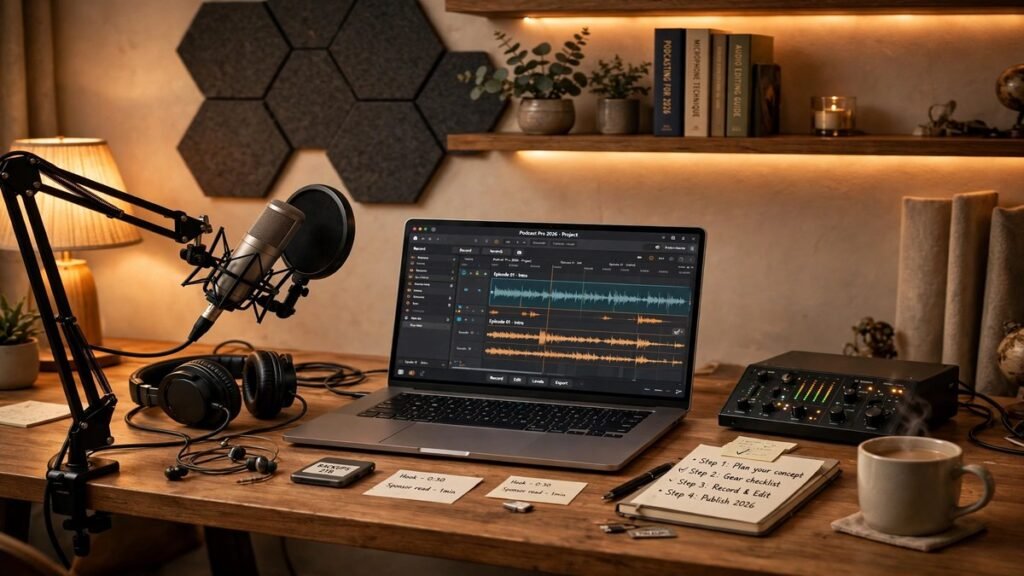
You do not need expensive equipment to sound good. What matters most is a quiet room, a decent microphone, and headphones. A USB microphone that plugs straight into your computer is the right starting point for almost everyone, because it is simple, affordable, and sounds excellent in a treated room. An XLR microphone with an audio interface sounds slightly better and gives you more control, but it costs more and adds complexity. If you are recording on the move, a portable recorder or a quality lavalier microphone is worth considering.
The room you record in matters more than the microphone you buy. Hard, empty rooms create echo that no microphone can fix. Record in a small room with soft furnishings — a bedroom with curtains, carpet, and a wardrobe full of clothes is ideal. Close the windows, turn off fans and appliances, and place a cushion or blanket behind the microphone to absorb reflections. These free fixes improve your sound more than upgrading your microphone ever will.
Headphones are essential, even cheap ones, because they let you hear problems while you record. Without them, you will not notice a buzzing light, a clicking keyboard, or a microphone that is too far from your mouth. A pop filter or foam windscreen, which costs very little, removes the harsh bursts of air from words that start with p and b. A microphone arm or stand keeps the microphone at the right distance and stops you from knocking it during recording. These small accessories make a noticeable difference to the final sound.
| Setup level | Microphone | Typical cost | Best for |
|---|---|---|---|
| Starter | Good USB microphone | Under $100 | Solo shows, first season, tight budgets |
| Serious hobbyist | Dynamic XLR microphone + audio interface | $200–$400 | Interviews, two hosts, better sound control |
| Professional | Broadcast dynamic microphone + interface + treated room | $500+ | Daily shows, client work, studio-quality sound |
| On the move | Portable recorder or lavalier microphone | $100–$250 | Field interviews, travel, outdoor recording |
The table above shows how little you need to spend to sound professional. Most listeners cannot tell the difference between a starter setup and a professional one when the recording environment is quiet and the microphone technique is good. Spend your first money on a microphone and headphones, then invest in acoustic treatment for your room before you buy anything else. Upgrade your equipment only when your current setup is genuinely limiting you, not because a new gadget looks appealing.
Recording Software and Remote Interviews
Recording software falls into two groups: software you install on your computer, and browser-based tools designed for remote interviews. Free desktop editors let you record and edit with full control, and they are the best choice for solo shows and in-person recordings. Browser-based recording tools record each guest on a separate audio track, which makes editing much easier when someone talks over someone else or a connection glitches. Many of these tools offer free tiers that are generous enough for a new show.
For remote interviews, always record a backup. Ask your guest to record themselves on their phone as a safety net, and record your own side locally as well. Internet connections fail, and a backup recording has saved countless episodes. Before the interview, send your guest a short guide: use headphones, find a quiet room, close other applications, and keep their phone nearby in case you need to reconnect. A five-minute technical check before you start recording prevents most disasters.
Microphone technique is simple once you know the rules. Keep the microphone about a fist’s width from your mouth, slightly off to one side so your breath does not hit it directly. Speak at a consistent volume, and do not move towards and away from the microphone while you talk. Smile when you speak — listeners can genuinely hear the difference in your voice. Keep water nearby, and pause between sections so editing is easier. If you make a mistake, stop, clap once to mark the spot, and repeat the sentence. That clap creates a visible spike in the audio that makes the mistake easy to find later.
| Tool type | Examples of use | Cost | Best for |
|---|---|---|---|
| Free desktop editor | Record and edit on your computer | Free | Solo shows, full editing control |
| Browser recorder | Remote interviews, separate tracks | Free tier available | Guest interviews, co-hosts in different places |
| All-in-one studio | Record, edit, and publish in one place | Subscription | Beginners who want simplicity |
| AI cleanup tool | Remove noise, filler words, level volume | Free tier available | Speeding up editing, polishing audio |
Recording Your First Episode
Do not try to record your first episode perfectly. Record it, listen back, and learn from it. Start with an outline rather than a word-for-word script: a hook for the opening, three or four main points, and a clear ending. An outline keeps you natural and conversational, while a full script often sounds stiff when read aloud. If you are nervous, write out your first minute word for word so you can start confidently, then switch to bullet points for the rest.
Open every episode with a hook that tells the listener why this episode matters to them. State the promise of the episode in the first thirty seconds, then deliver on it. A strong opening might be a surprising fact, a relatable problem, or a short story that leads into the topic. Avoid long introductions about yourself at the start of the episode; listeners want value first, and they will learn who you are as they keep listening.
Record in a single session when you can, and accept that the first few episodes will feel awkward. Every podcaster sounds strange to themselves at first, and every show improves quickly with practice. Record three or four practice episodes before you publish anything, and listen to them critically: is the pace right, is the sound clean, and would a stranger find this interesting? Use what you learn to improve, then publish. Waiting until you feel ready is a trap, because readiness comes from publishing, not from preparing.
Editing Without Spending Hours
Editing is where a good recording becomes a good episode, but it does not need to take hours. A simple edit — removing long pauses, mistakes, filler words, and background noise — is enough for most shows. Listen through once, cut what does not serve the listener, and keep everything else. Aim to remove about ten percent of the recording. If you cut much more than that, you are probably over-editing and losing the natural feel of the conversation.
Modern editing tools can do much of the tedious work for you. Noise removal cleans up hums and hisses, levelling evens out volume differences between speakers, and filler-word removal takes out the ums and uhs. Use these tools, but listen to the result before you publish, because automated editing can occasionally cut a word or create an odd pause. A final listen at normal speed, from start to finish, is the best quality check there is. If you find yourself bored during the listen, your audience will be too, and that section probably needs cutting.
Hosting, Distribution, and Your RSS Feed
A podcast host is the service that stores your audio files and creates the RSS feed that podcast apps use to deliver your show. You upload an episode once to your host, and it appears automatically in every app where your show is listed. Choose a host with clear pricing, reliable analytics, and easy distribution to the major apps. Most hosts charge a small monthly fee based on storage or downloads, and many offer free tiers for new shows. Avoid hosting audio files on your own website, because a popular episode can use up your bandwidth and slow your site down.
When you set up your show, you will fill in your title, description, cover art, category, and author name. Choose the category that best matches your topic, because listeners browse by category, and add a second category if your host allows it. Write your episode titles carefully: they should be clear, specific, and interesting enough to earn a tap. Number your episodes so listeners can follow the order, and write a short description for each one that explains what the listener will learn and includes a few relevant keywords.
Distribution is mostly automatic. Your host will submit your feed to the major directories, and within a few days your show will appear in search results. You can also submit your feed manually to any directory your host does not cover. Once your show is live, test it: subscribe in a podcast app, download an episode, and check that the artwork, description, and audio all look right. Fix any problems before you promote the launch, because first impressions matter.
Launching With Three Episodes and a Trailer
A strong launch gives new listeners something to binge and gives podcast apps a reason to notice you. Record a short trailer first — two minutes explaining who the show is for, what it covers, and when it launches — and publish it a week or two before your first full episode. A trailer lets you claim your show name, test your publishing workflow, and start collecting subscribers before launch day.
On launch day, publish three full episodes at once. Three episodes show that you are serious, give listeners a real taste of the show, and make it easy for someone to spend an hour with you. Announce the launch everywhere you already have an audience: your email list, your social media accounts, and any communities you belong to. Ask friends and early listeners to subscribe and leave an honest review in the first week, because early activity helps your show appear in recommendations and charts.
If you also create video content, a podcast and a video channel reinforce each other beautifully. Recording your podcast on camera gives you clips for short-form video, and your video audience becomes a ready-made source of podcast listeners. If you want to see how creators build an audience on video, our guide on How to Start a YouTube Channel 2026 covers the same launch principles for video, from channel setup to your first uploads.
Growing Your Audience in 2026
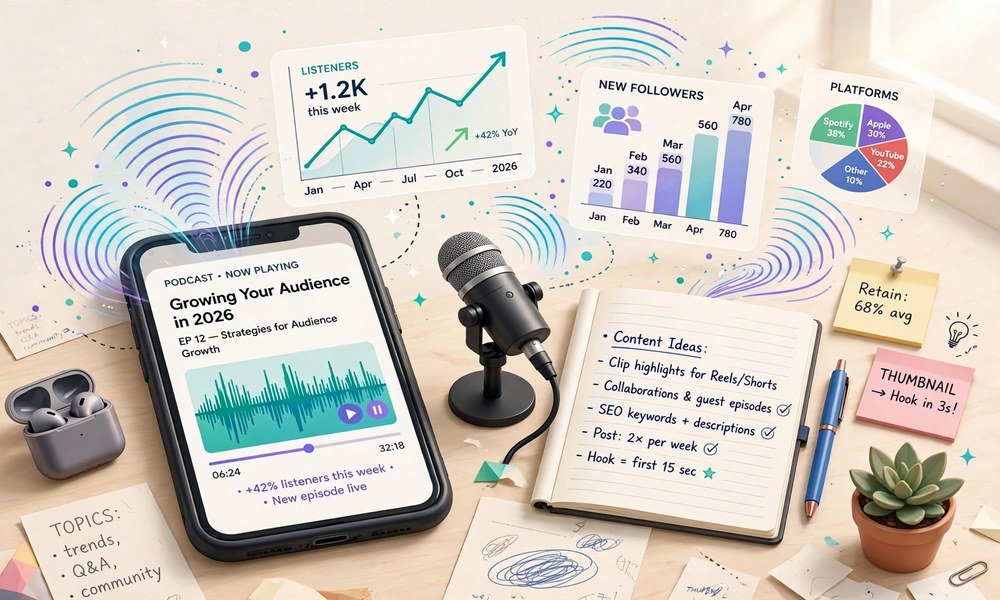
Growth in podcasting is slow at first and then compounds. The first hundred listeners are the hardest to earn, and they usually come from people you already know and communities you already belong to. Share each episode with a personal note about why it matters, not just a link. Post in groups and forums where your topic is discussed, but contribute genuinely rather than dropping links. Answer questions, help people, and mention your show only when it is truly relevant.
Guest appearances are the fastest way to reach new listeners. Appear on other podcasts in your niche, and invite their hosts onto your show in return. Each appearance puts you in front of an audience that already likes your topic, and a good conversation converts far better than any advertisement. When you are a guest, prepare two or three stories or insights the host has not heard before, and make it easy for their listeners to find your show afterwards.
Short clips are the discovery engine of podcasting in 2026. Cut the best thirty to ninety seconds from each episode — a surprising idea, a funny moment, or a practical tip — and share it as a short video with captions. Clips travel much further than full episodes, and a single clip can bring in hundreds of new listeners. You do not need to post everywhere; choose one or two platforms where your audience already spends time, and post consistently. Your personal brand grows alongside your show, and a clear personal brand makes every episode easier to promote, which is why our guide on How to Build a Personal Brand 2026 pairs so well with this one.
Making Money From Your Podcast
Monetisation follows audience, not the other way around. Most shows earn nothing for the first few months, and that is normal. The first income usually comes from your own products and services: coaching, consulting, courses, books, or memberships that your listeners already trust you to deliver. A podcast is an unusually effective sales tool for these, because listeners arrive pre-sold on your expertise.
Sponsorships and advertising become realistic once you have a consistent audience, typically a few thousand downloads per episode. Advertisers pay for access to a defined, engaged audience, and podcast listeners are famously loyal to the brands their favourite hosts recommend. You can join an advertising network, or approach brands directly with a simple pitch: who your listeners are, how many downloads you get, and what a sponsorship costs. Start with products you genuinely use and like, because your recommendation is your reputation.
Affiliate income, listener support, and premium content are useful additions. Affiliate links let you earn a small commission when listeners buy something you recommend, and listener support platforms let your biggest fans contribute directly. Some podcasters offer bonus episodes or an ad-free feed for paying subscribers. The key is to diversify slowly and to be transparent with your audience about how you earn money. Listeners accept monetisation gladly when the show stays valuable and honest. If you are exploring income ideas beyond your show, our guide on the Best Ways to Make Money Online 2026 covers the options that pair best with a content-based business.
Common Mistakes to Avoid
The most common mistake is inconsistency. A show that publishes weekly for a month and then disappears for six weeks trains its audience to stop checking. It is better to publish fortnightly for a year than weekly for a month. If life gets busy, record shorter episodes or repeat a popular format rather than going silent. A short episode still keeps the habit alive for you and your listeners.
The third mistake is copying another show instead of finding your own voice. It is useful to study successful podcasters, but your audience follows you for your perspective, your stories, and your way of explaining things. Speak the way you speak in real life, share your own experiences, and do not be afraid to have an opinion. The shows that last are the ones that sound like a real person talking to a friend, not a presenter reading a script.
Your Podcast Launch Checklist
- Define your niche, audience, and one-sentence show description before buying any equipment.
- Choose a name, design cover art that reads clearly at thumbnail size, and write a compelling show description.
- Set up your recording space, microphone, and headphones, and record three practice episodes.
- Choose a podcast host, submit your show to the major directories, and test the feed in a real app.
- Record a two-minute trailer, then launch with three full episodes published on the same day.
- Promote every episode consistently, appear as a guest on other shows, and share one short clip per episode.
Frequently Asked Questions
How much does it cost to start a podcast in 2026?
You can start for under $100 with a good USB microphone and free editing software, plus a few dollars a month for hosting. Many successful shows began with exactly that setup. You can upgrade your equipment later, once your show is earning money or you know you will stick with it.
Do I need a website for my podcast?
A website helps, but it is not required to launch. Your podcast host provides a basic page for your show, and that is enough to start. A simple website becomes valuable later, when you want a home for show notes, an email list, and products or services.
How long should my episodes be?
For most new shows, twenty-five to forty minutes is a good target. It is long enough to deliver real value and short enough to edit without exhaustion. Let the content decide: a focused advice episode can be twenty minutes, while an in-depth interview can run for an hour.
How do I get my podcast on all the major apps?
Your podcast host creates an RSS feed, and you submit that feed once to each directory. Most hosts submit to the major apps automatically. Once approved, every new episode you publish appears in all of those apps without any extra work from you.
How long does it take to grow a podcast audience?
Most shows take six to twelve months of consistent weekly publishing to reach a few hundred regular listeners. Growth is slow at first and then compounds as reviews, recommendations, and guest appearances accumulate. Consistency and quality matter far more than any single promotion tactic.
Can I really make money from podcasting?
Yes, but it takes time and a defined audience. Most podcasters earn first from their own products and services, then from sponsorships once they have a few thousand downloads per episode. A loyal audience of a thousand true fans can support a real income, even if the show never reaches the charts.
Bottom Line
Starting a podcast in 2026 is a simple project with a long payoff. Pick a niche you care about, buy a decent microphone, record in a quiet room, and publish consistently. Launch with a trailer and three episodes, promote each one, and keep improving a little with every recording. You do not need permission, a studio, or a big budget. You need a clear idea and the willingness to press record, and then to do it again next week.
Your first episode will not be perfect, and that is fine. Nobody’s first episode is. What matters is that it exists, that it helps someone, and that it is followed by a second episode, a tenth, and a fiftieth. That is how shows grow, how audiences form, and how a simple idea becomes something people look forward to every week. The best time to start was a year ago. The second-best time is today.
Note: This guide reflects the podcasting tools, platforms, and best practices available in 2026. Prices, features, and app policies change over time, so check the current details on any service before you buy. Face Zem publishes practical guides to help you start and grow with confidence, and the steps above are a starting point — adapt them to your topic, your audience, and your voice.

Keep what speaks to you.
Leave room for your own perspective.