
Walt Disney is one of the most famous names in the history of entertainment, but the empire that bears his name was not built in a day. Long before theme parks, animated classics, and a media company worth hundreds of billions of dollars, Walt Disney was a young artist in Kansas City who could not pay his rent, lost the rights to his first popular character, and was told more than once that his ideas would never work. His story is not a fairy tale of overnight success. It is a story of failure, stubbornness, and an imagination that refused to quit.
What makes Walt Disney’s success story so powerful is how many times it nearly ended before it began. His first animation studio went bankrupt. His most successful early character was taken from him by a distributor. His plan to make the first full-length animated film was mocked by Hollywood as “Disney’s Folly.” His dream of building a theme park was dismissed by bankers who could not see why anyone would pay to walk around a clean, family-friendly park. At every turn, the sensible move would have been to stop. Disney kept going anyway.
Today, the company he founded is one of the largest entertainment businesses on the planet, with beloved characters, blockbuster films, streaming platforms, and theme parks that welcome millions of visitors every year. This is the full story of how a farm boy from Missouri with a pencil and an impossible dream built an empire from a mouse — and the lessons any dreamer can take from his journey.
Key takeaways
- Walt Disney failed early and publicly — his first studio, Laugh-O-Gram, went bankrupt in 1923 — but he treated failure as tuition, not as a verdict.
- Losing Oswald the Lucky Rabbit to a distributor in 1928 forced Disney to create Mickey Mouse, the character who changed everything.
- Snow White and the Seven Dwarfs (1937) was mocked as “Disney’s Folly,” yet it became a massive hit and proved feature animation could work.
- Disneyland opened in 1955 after years of rejection from bankers, and it redefined what a theme park could be.
- Disney’s real genius was not drawing alone — it was storytelling, quality control, and building a team that shared his standards.
From a Farm in Missouri to a Drawing Table in Kansas City
Walter Elias Disney was born on December 5, 1901, in Chicago, Illinois, and grew up mostly in Marceline, Missouri, a small railroad town where his family ran a farm. Life on the farm was hard work — Walt and his brother Roy delivered newspapers in the cold before school, milked cows, and did chores — but Marceline gave Walt something priceless: a love of animals, open spaces, and storytelling. He later said that the small-town warmth of Marceline shaped the idealized American town at the entrance of Disneyland, Main Street, U.S.A. The boy who sketched animals in the margins of his schoolbooks was already practicing the skill that would make him famous.
As a teenager, Walt moved with his family back to Chicago and then to Kansas City. He took art classes, worked as a commercial artist, and became fascinated by the new medium of animation. In Kansas City he met Ub Iwerks, a gifted animator who would become his most important creative partner for decades. The two young men were ambitious but broke, working out of a small studio and taking whatever commercial jobs they could find — advertisements, slide shows, and short animated clips for local theaters.
In 1922, Walt founded Laugh-O-Gram Studio, his first animation company. The idea was to make short animated fairy tales that would play before movies in Kansas City theaters. The cartoons were charming and clever, but the business side was a disaster. Walt was an artist, not an accountant, and he spent money he did not have. Within a year, Laugh-O-Gram was bankrupt. Walt lost his studio, his equipment, and his savings. He was twenty-one years old, and by every ordinary measure, he had failed.
The Laugh-O-Gram Failure That Nearly Ended Everything
Bankruptcy in 1923 could have been the end of Walt Disney’s career before it started. Many talented people would have taken a steady job and moved on. Walt did something different: he packed a single suitcase, bought a train ticket to Hollywood with about forty dollars in his pocket, and arrived in California with little more than a sample reel of his cartoons and a letter of introduction. He had no job, no studio, and no guarantee that anyone in Hollywood would care about a young animator from Kansas City.
What saved him was a combination of luck, family, and persistence. His brother Roy, who was recovering from tuberculosis in California, believed in Walt’s talent and helped him raise a small amount of money. Together, the brothers founded the Disney Brothers Studio in a tiny office in Los Angeles in 1923. Their first break came when a distributor agreed to buy a series of short films called the Alice Comedies, which mixed live action with animation. It was not glamorous work, but it paid the bills and kept the studio alive.
The lesson of this period is one Disney would repeat for the rest of his life: a setback is only permanent if you stop. The bankruptcy taught him that creativity alone is not enough — a business needs discipline, budgets, and people who understand money. Roy became the financial brain of the company while Walt became its creative heart, a partnership that lasted for decades. The studio that started in a cramped Los Angeles office with a handful of employees would eventually become one of the most famous companies in the world.
Losing Oswald and Finding Mickey
By 1927, Walt Disney had created a character who was becoming genuinely popular: Oswald the Lucky Rabbit, a cheerful animated rabbit with long ears and a mischievous streak. Oswald cartoons were selling well, and Walt felt, for the first time, that he had a real hit on his hands. He traveled to New York to renegotiate his contract with his distributor, expecting a raise. Instead, he received a shock that changed entertainment history.
The distributor told Walt that he was cutting the budget, and worse, that he owned the rights to Oswald — not Walt. Most of Walt’s animators had already been hired away behind his back. Walt could accept the distributor’s terms and keep working on a character he did not own, or he could walk away with almost nothing. He walked away. On the train ride back to California, legend says, he sketched a new character with his wife Lillian: a cheerful little mouse with round ears, white gloves, and a big personality. They named him Mickey Mouse.
Mickey’s debut came in 1928 with Steamboat Willie, one of the first cartoons with fully synchronized sound. Audiences had never heard a cartoon character whistle, laugh, and make music in time with the action, and they went wild for it. Mickey Mouse became a sensation almost overnight, and this time Walt Disney owned his character outright. The loss of Oswald, which felt like a disaster at the time, forced Disney to create something better — and to learn the most important business lesson of his life: never build your future on something you do not control.
The Snow White Gamble
Success with Mickey Mouse made the Disney studio famous, but Walt was not satisfied with short cartoons. He had a far bigger ambition: to make the first full-length animated feature film, a fairy tale called Snow White and the Seven Dwarfs. Hollywood thought he had lost his mind. Critics and rival studios called the project “Disney’s Folly” and predicted that audiences would never sit through an hour of animation. Animators themselves worried that a cartoon character could not hold a viewer’s emotions for a whole movie.
The production was brutal. Snow White took four years to complete and cost around one and a half million dollars — a fortune in the 1930s. Walt mortgaged his house, borrowed heavily, and pushed his artists to a level of quality no one had attempted before. He brought in live actors to model the movements of the characters, hired art instructors to train his staff, and insisted on backgrounds and colors that looked like paintings come to life. When the money ran out, he showed a rough cut to bankers to convince them to lend more.
When Snow White premiered in December 1937, the audience response was extraordinary. People wept, cheered, and gave the film a standing ovation. The movie became the highest-grossing film of its time and earned Walt a special Academy Award — one full-size Oscar and seven miniature ones, presented by Shirley Temple. Snow White proved that animation was not just a novelty for children; it was a serious art form that could tell powerful stories. The gamble that everyone called folly had transformed the Disney studio from a cartoon shop into a movie studio.
Building Disneyland — “The Happiest Place on Earth”
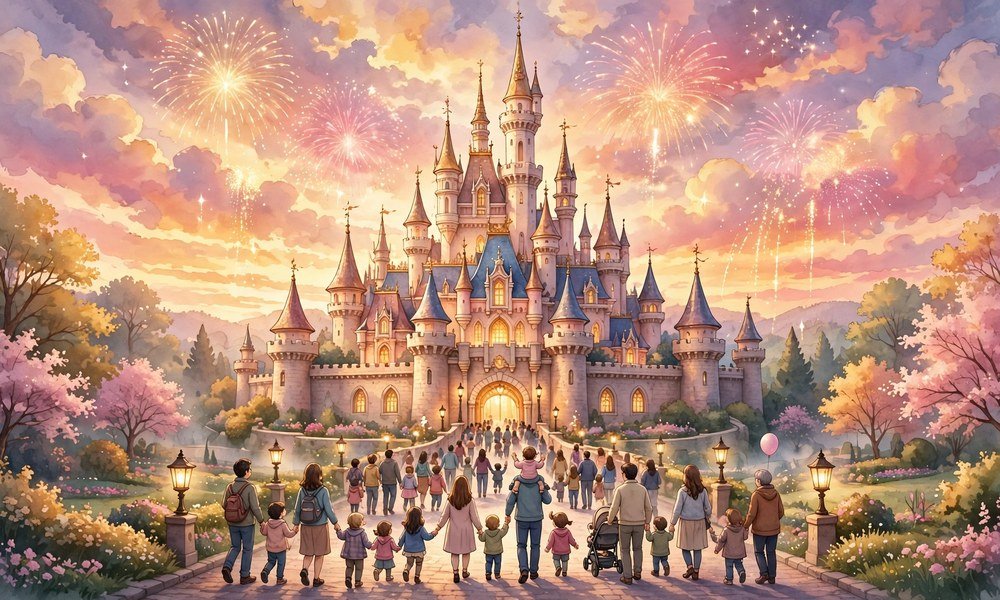
By the 1950s, Walt Disney was one of the most successful filmmakers in America, but he had a new dream that seemed even stranger than Snow White. He wanted to build a theme park — not a dirty carnival with barkers and broken rides, but a clean, beautiful place where parents and children could have fun together. He imagined a park built around his stories, with a castle at its center, lands based on adventure, fantasy, and the future, and a train circling the whole thing. Bankers laughed. Amusement park owners said it would never work. Even his own brother Roy worried about the cost.
Disney refused to give up. He spent years developing the idea, buying orange groves in Anaheim, California, and searching for financing. He used his weekly television show, Disneyland, to build excitement for the park before it even opened, and he convinced a television network to invest in exchange for the broadcast rights. The park was built in just one year, an almost impossible schedule, and when it opened on July 17, 1955, the day was a mess: the asphalt was still soft, rides broke down, food ran out, and the crowds were far larger than expected. Critics called it a disaster. Walt called it a beginning.
Within weeks, Disneyland was a hit. Families came from all over the world to walk down Main Street, ride through Fantasyland, and meet Mickey Mouse in person. Disney had invented the modern theme park, and he had done it by applying the same principle he used in his films: control every detail, tell a story with everything, and never settle for good enough. Disneyland became the template for theme parks everywhere, and its success gave Disney the confidence to plan an even bigger project in Florida — Walt Disney World — though he would not live to see it open.
The Disney Empire Today
When Walt Disney died on December 15, 1966, at the age of sixty-five, he left behind a company that was already a giant — and a plan for an even bigger one. His brother Roy carried on the work, opening Walt Disney World in Florida in 1971 and naming it in Walt’s honor. In the decades that followed, the company grew far beyond animation, acquiring the film studio Pixar, the Marvel superhero universe, the Star Wars saga from Lucasfilm, and the 20th Century Fox studio. Today, the Walt Disney Company is one of the largest media and entertainment companies in the world, with streaming services, television networks, cruise ships, and theme parks on three continents.
What is remarkable is how much of the modern company still follows Walt’s original playbook. Every new film, park attraction, and streaming show is judged by the same standard he set in the 1930s: does it tell a great story, and is the quality high enough to make people feel something? The characters he created — Mickey, Minnie, Donald, Goofy, and the princesses — are still the most recognizable figures in popular culture nearly a century after they first appeared. Very few founders build something that outlives them by generations. Walt Disney did.
The numbers tell part of the story, but the real measure of his success is cultural. Disney’s stories are told in dozens of languages, his parks welcome tens of millions of visitors a year, and his name has become shorthand for imagination itself. A boy who once drew animals on a Missouri farm built a company that shapes how the world dreams. That is why his story still matters — not because he never failed, but because he never let failure have the last word.
Walt Disney’s Life and Career at a Glance
| Year | Milestone | Why it mattered |
|---|---|---|
| 1901 | Born in Chicago, raised in Marceline, Missouri | Small-town childhood inspired Main Street, U.S.A. |
| 1922 | Founds Laugh-O-Gram Studio in Kansas City | First studio; went bankrupt within a year |
| 1923 | Moves to Hollywood; founds Disney Brothers Studio with Roy | The true start of the Disney company |
| 1928 | Loses Oswald the Lucky Rabbit; creates Mickey Mouse | Steamboat Willie makes Mickey a star |
| 1937 | Snow White and the Seven Dwarfs premieres | First full-length animated feature; huge success |
| 1955 | Disneyland opens in Anaheim, California | Invented the modern theme park |
| 1966 | Walt Disney dies at age 65 | Roy completes Walt Disney World in his honor |
| Today | Disney spans film, streaming, parks, and cruises | One of the world’s biggest entertainment companies |
Lessons From Walt Disney’s Success Story
Disney’s journey offers lessons that apply far beyond animation. His approach to creativity, risk, and leadership has been studied by business schools and admired by entrepreneurs for decades. Like George Lucas, who turned a space adventure into a global entertainment empire, Disney understood that a great story can become a great business when it is protected and nurtured. And like Steven Spielberg, who built his career on unforgettable stories told with total commitment, Disney believed that audiences always reward quality. Perhaps the most practical lesson comes from Howard Schultz, who turned a small coffee chain into a worldwide brand by obsessing over the customer experience — exactly what Disney did with every film and every park.
First, Disney dreamed bigger than his resources. Snow White and Disneyland both looked impossible on paper, and both required him to bet everything he had. Second, he protected his creations. After losing Oswald, he never again built a business on a character he did not own. Third, he invested in people. He built an animation school inside his studio, paid for training, and hired artists who were better than he was at specific skills. Fourth, he controlled quality obsessively. He famously walked through Disneyland himself, looking for peeling paint or a burned-out light bulb, because he knew that small details add up to a big experience. Finally, he never confused a setback with a defeat. Bankruptcy, the loss of Oswald, and the mockery of Snow White were all moments when quitting would have been reasonable. He kept going, and that persistence is the thread that runs through his entire life.
Your Walt Disney-Inspired Success Checklist
- Start before you feel ready: Walt launched Laugh-O-Gram with almost no money. Begin with what you have and learn as you go.
- Own your best ideas: Make sure the work you care most about belongs to you, not to a distributor or a platform.
- Treat failure as information: Ask what a setback teaches you, then use it to build something better — just as losing Oswald led to Mickey Mouse.
- Bet on quality: Audiences notice the difference between good enough and great. Put the extra effort into the details.
- Build a team that shares your standards: Find people who are excellent at what you are not, and invest in their growth.
- Keep dreaming bigger: When one goal is reached, set a new one. Walt went from cartoons to films to theme parks — and was planning a whole new city when he died.
Frequently Asked Questions
How did Walt Disney become successful?
Walt Disney became successful through a mix of artistic talent, relentless persistence, and smart business decisions. After early failures, including the bankruptcy of his first studio, he created Mickey Mouse, pioneered feature-length animation with Snow White, and later built Disneyland. He combined great storytelling with strict quality control and a team that shared his vision.
What was Walt Disney’s first failure?
His first major failure was Laugh-O-Gram Studio in Kansas City, which went bankrupt in 1923 when Walt was twenty-one. He lost the studio and his savings, then moved to Hollywood with very little money and started over with his brother Roy.
Why did Walt Disney lose Oswald the Lucky Rabbit?
Disney lost Oswald because his distributor owned the rights to the character, not Disney. When Walt traveled to New York to renegotiate his contract in 1928, the distributor cut his budget and revealed that most of his animators had already been hired away. Walt walked away and created Mickey Mouse instead.
Was Snow White really called “Disney’s Folly”?
Yes. Hollywood critics and rival studios called Snow White and the Seven Dwarfs “Disney’s Folly” because they believed audiences would never sit through a full-length animated film. The film proved them wrong, becoming a massive hit and earning Walt a special Academy Award.
When did Disneyland open?
Disneyland opened on July 17, 1955, in Anaheim, California. The opening day had many problems, including broken rides and crowds far larger than expected, but the park quickly became a huge success and invented the modern theme park.
What is Walt Disney’s most important lesson for entrepreneurs?
His most important lesson is to keep going after failure and to protect what you create. Disney went bankrupt, lost his most popular character, and was mocked for his biggest ideas — yet he treated each setback as a step forward. He also believed that quality and storytelling matter more than shortcuts, a principle that still guides the company today.
The Bottom Line
Walt Disney’s success story is not a story of luck. It is a story of a young man who failed in public, lost what he had built, and kept creating anyway. From a bankrupt studio in Kansas City to a mouse that conquered the world, from a film everyone called folly to a theme park everyone said would fail, Disney proved that imagination backed by persistence can build an empire. His life shows that the difference between dreamers and builders is not talent alone — it is the willingness to keep going when the sensible thing is to stop, to protect the work you love, and to care about quality when no one is watching. Nearly sixty years after his death, millions of people still visit his parks, watch his films, and tell his stories. That is the truest measure of success: work that outlives you and keeps making people happy.
Note: This article celebrates Walt Disney’s creative and business journey as an inspirational success story. Figures and dates are based on widely reported historical accounts of his life and career.

Keep what speaks to you.
Leave room for your own perspective.


