
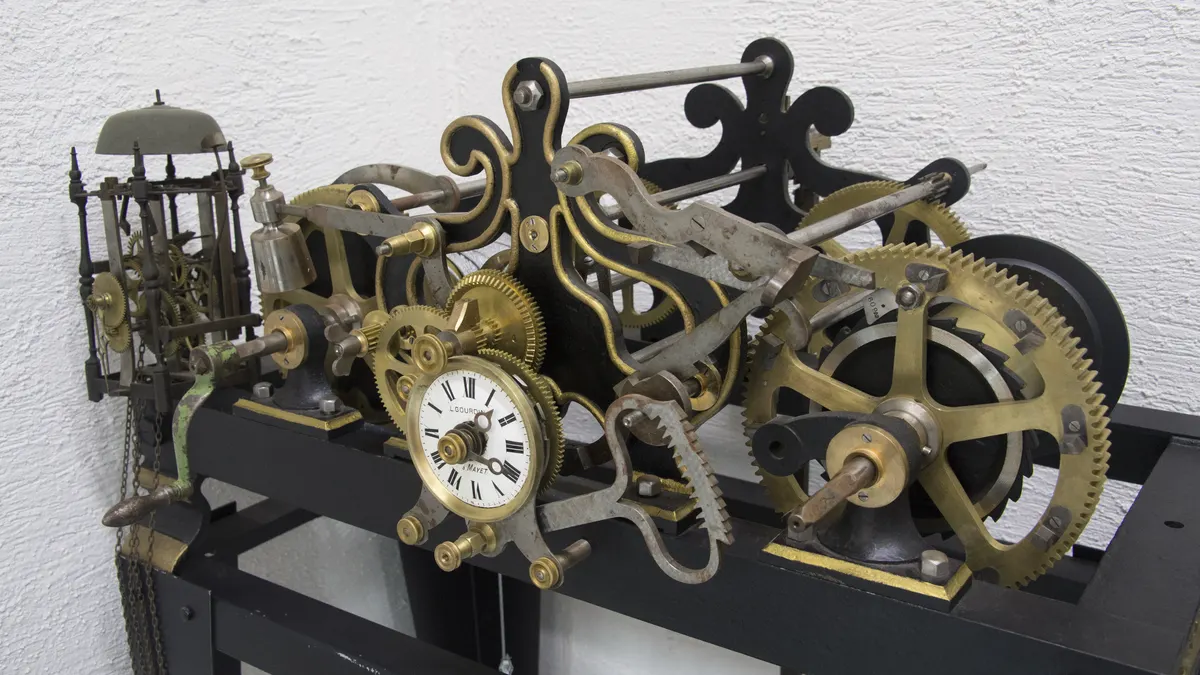
A clock making workshop installation startup is a small manufacturing business that designs, builds and assembles clocks from their component parts. The workshop takes a movement, a case, a dial, hands and chimes, and turns them into a finished clock that keeps accurate time and looks right in the room it was made for. Some workshops build traditional weight-driven longcase clocks and mantel clocks with mechanical movements, while others build modern quartz wall clocks, skeleton clocks with exposed gear trains, and bespoke commissions where the customer chooses the wood, the dial and the chime. In every case the product is a clock the workshop itself has made, not a clock it has bought in and resold.
The work of such a startup falls into four clear stages, and each one needs different skills and different tools. First comes design, where the case, the dial and the gear train are drawn and checked before any material is cut. Then comes the movement, which is either bought in as a finished unit or built up from plates, wheels, pinions and escapements on the bench. Third comes the case and the dial, where woodwork, finishing and dial printing decide how the clock looks. Finally comes assembly, regulation and testing, where the movement is fitted, the hands are set, the beat is adjusted and the clock is run for days to prove it keeps time before it leaves the workshop.
This guide compares nine tools that cover every one of those stages, from the first sketch of a case to the final timegrapher reading that proves a new clock is ready for its owner. Each tool was chosen because it solves a real problem in a clock making workshop: a gear train that must mesh cleanly, a case that must fit its movement to the millimetre, a dial that must be legible at a glance, or a customer who needs a firm price before the work begins. Together they form a practical stack for a founder who wants to launch a clock making workshop in 2026 and build clocks that last.
Key takeaways
- Start with one design tool, one movement supplier and one bench tool set. Those three carry most of the launch work for a new clock making workshop.
- Design the gear train and the case together, because a movement that does not fit its case is the most expensive mistake a new workshop can make.
- Buy proven movements for your first clocks and build your own gear trains only once the workshop has paying customers.
- Regulate and test every clock for several days before delivery, and keep the timegrapher readings with the job record.
- Price every clock around the movement, the case materials and the bench hours, because customers accept a price they understand and dispute one they do not.
How the nine tools compare
| Tool | What it does | Best for | Starting point |
|---|---|---|---|
| Onshape | Cloud CAD for cases, dials and movement plates | Designing a clock before cutting material | Free plan for makers |
| Gearotic Motion | Gear train design and clock wheel calculation | Cutting wheels and pinions that mesh cleanly | One-time licence |
| Hermle | Mechanical clock movements | Weight-driven and spring-driven clocks | Trade movement prices |
| Seiko | Quartz clock movements | Reliable battery clocks at volume | Low unit cost |
| Bergeon | Precision bench tools and movement holders | Assembly, oiling and hand fitting | Buy the core set first |
| Sherline | Precision bench lathe and milling accessories | Turning wheels, pinions and arbors | Starter lathe packages |
| Klockit | Clock kits, dials, hands and chimes | Finished clocks and first commissions | Kit and parts pricing |
| Timesavers | Clock parts, bushings and mainsprings | Keeping a wide range of parts on hand | Parts catalogue orders |
| Weishi Timegrapher 1000 | Rate, beat error and amplitude testing | Proving a clock keeps time before delivery | One-time purchase |
Designing the clock before you cut anything
Onshape: the best tool for designing cases, dials and movement plates
Onshape is a cloud-based computer-aided design tool that runs in a web browser, which makes it a natural fit for a small clock making workshop that cannot afford a dedicated design workstation. The founder can draw a case, a dial and a movement plate in the same model, check that the parts fit together, and share the design with a customer or a supplier through a link rather than by sending files back and forth. Because the design lives in the cloud, the workshop can open it on the bench laptop, on a tablet in the showroom, or at home in the evening without worrying about which machine holds the latest version.
The strength of Onshape for clock making is its parametric modelling, which means a change to one measurement updates everything that depends on it. If a customer asks for a case two inches taller, the dial, the glass, the seat board and the pendulum length can all be checked against the new dimension in minutes rather than redrawn from scratch. That matters for clocks more than for most woodwork, because a clock case is built around a movement with fixed dimensions, and every part of the case must respect them. A dial that is drawn a fraction too small will not cover the movement, and a pendulum that is too long for its case will never swing freely.
Onshape also helps a new workshop keep its designs organised from the first commission onwards. Each clock can live as its own project with its own versions, so the workshop can return to a popular design a year later, change the wood or the dial, and build a second one without starting again. The free plan is generous enough for a maker starting out, and the paid plans add the private projects and version control that matter once the workshop has a catalogue of designs it wants to protect. For a founder who needs one design tool that covers cases, dials and plates, Onshape is the strongest place to start, and it pairs well with the broader planning in any general workshop installation guide for setting up the floor itself.
Gearotic Motion: the best tool for designing gear trains that mesh cleanly
Gearotic Motion is specialist software for designing gears, and for a clock maker it is the tool that turns a sketch of a gear train into wheels and pinions that actually mesh. Clock gears are not like ordinary gears: the teeth must be cut to a profile that rolls smoothly at very low speeds, the ratios must give the right number of turns per hour, and the escape wheel must work with the pallet fork to release the train one tooth at a time. Gearotic Motion calculates those ratios, draws the tooth profiles, and exports the shapes as files a small CNC mill or a laser cutter can follow, which removes the guesswork from the most technical part of clock making.
A new workshop benefits most from Gearotic Motion when it starts cutting its own wheels rather than buying them in. The software lets the maker try a train on screen first, checking that the centre wheel, third wheel and escape wheel all fit between the plates with room for the arbors and the collets. If a wheel is too large for the plates, the maker sees the clash before cutting brass. The software also handles the pendulum calculation, working out the length a pendulum needs to beat at the right rate for a given train, which is the kind of arithmetic that is easy to get wrong by hand and expensive to correct after the case is built.
Movements: the heart of every clock you make
Hermle: the best tool for mechanical movements in weight-driven and spring-driven clocks
Hermle is a German maker of mechanical clock movements, and its movements power a large share of the mantel, wall and longcase clocks built by small workshops around the world. A Hermle movement arrives as a complete, tested unit with a known beat rate, a known pendulum length and a known set of winding and setting instructions, which means the workshop can design the case and the dial around dimensions it can trust. For a founder launching a clock making workshop, that certainty is worth a great deal: the first clocks a workshop sells must work, and a proven movement removes the biggest source of risk from the build.
The range is wide enough to cover most of the clocks a new workshop will be asked to make. There are spring-driven movements for mantel clocks that chime the hour, weight-driven movements for longcase clocks with a seconds pendulum, and triple-chime movements that play Westminster, Whittington or St Michael chimes for customers who want a clock that fills a room with sound. Each movement comes with mounting dimensions, hand sizes and dial requirements, so the workshop can order the matching dial and hands with confidence and avoid the common mistake of fitting a dial that hides the winding arbors.
Seiko: the best tool for quartz movements in reliable battery clocks
Seiko quartz movements are the workhorse of the modern clock trade, and they give a new clock making workshop a way to sell reliable, affordable clocks while its mechanical work builds a reputation. A quartz movement runs on a single battery, keeps time to within seconds a month, and needs no winding, oiling or regulation, which means the workshop can concentrate its skill on the case, the dial and the finish, the parts the customer actually sees. For wall clocks, desk clocks, school clocks and simple commissions, a quartz movement is often exactly what the customer wants, and the workshop that refuses to offer one turns away good business.
The practical advantage of Seiko movements is their consistency. The mounting dimensions, hand sizes and shaft lengths are standardised, so a workshop can design a dial and a case once and fit the same movement to a dozen different designs. Hands, dials and bezels are available to match, and the movements themselves are inexpensive enough that the workshop can keep a range in stock without tying up much money. That matters for cash flow in the first year, when every pound spent on stock is a pound that cannot be spent on timber, tools or marketing.
The bench: tools that shape wheels, pinions and cases

Bergeon: the best tool for precision bench work, assembly and hand fitting
Bergeon is a Swiss maker of precision tools for watchmakers and clockmakers, and its bench tools are the standard against which other makers are judged. A Bergeon movement holder grips a clock movement firmly without marking the plates, a Bergeon screwdriver fits the slot of a tiny screw without slipping, and Bergeon tweezers pick up a pinion without bending it. None of these tools does anything dramatic on its own, but together they let a maker work on a movement for hours without damaging it, and that is the difference between a workshop that produces clean, reliable clocks and one that produces clocks with scratched plates and burred screws.
The range is wide, and a new workshop should buy the core set first rather than trying to own everything at once. A movement holder, a set of screwdrivers, a pair of tweezers, an oiler and a hand-setting tool cover most of the assembly and servicing work a workshop does in its first year. The tools are expensive compared with general-purpose equivalents, but they last for decades when they are cared for, and they hold their value if the workshop ever needs to sell them. More importantly, they are made to the sizes clock movements actually use, so the maker is not improvising with tools that are almost the right size and damaging parts in the process.
Sherline: the best tool for turning wheels, pinions and arbors on a precision lathe
Sherline makes small precision lathes and milling machines that fit on a workbench, and for a clock making workshop they are the machine tools that turn raw brass rod into wheels, pinions and arbors. A clock wheel must be round, flat and centred on its arbor to within a few thousandths of an inch, or it will wobble, bind and stop the clock. A Sherline lathe, with its fine feeds and its range of collets and chucks, lets a maker turn those parts to the accuracy a clock demands without needing a full-size industrial lathe or a factory floor. The machines are small enough for a workshop in a converted room and precise enough for the finest wheel work.
The strength of the Sherline system is that it grows with the workshop. The basic lathe handles turning and facing, and the milling attachment, the indexing head and the gear-cutting accessories turn the same machine into a wheel-cutting setup. A maker can start by turning arbors and collets, then add the accessories to cut wheels, and later still add a computer-controlled stepper system for cutting complex trains. Each step builds on the skills learned in the last one, and the workshop never has to replace its first machine to take the next step.
Sherline machines also suit the way a small clock workshop actually works, which is one part at a time rather than in batches of hundreds. The setup is quick, the machine is easy to keep clean, and the maker can switch from turning a wheel to milling a plate in minutes. That flexibility matters when a workshop is building one bespoke clock at a time, because every clock is different and the bench must adapt to each one. For a founder who wants to cut their own wheels and pinions, a Sherline lathe is the most practical machine tool to start with, and it complements the design thinking in any woodworking shop guide for the case-making side of the trade.
Dials, hands and kits: finishing what the customer sees
Klockit: the best tool for clock kits, dials, hands and chimes
Klockit is a supplier of clock kits, dials, hands, movements and chime units, and it is the first port of call for a new workshop that needs to build a finished clock without sourcing every part from a different supplier. A kit from Klockit includes the movement, the dial, the hands and the fixings matched to one another, which removes the most common beginner mistake in clock making: ordering parts that do not fit together. A dial with the wrong hand size, a movement with a shaft too short for the dial thickness, or a chime unit that will not fit the case are all problems a matched kit avoids entirely.
The catalogue is broad enough to let a workshop offer real choice to its customers. There are traditional Roman numeral dials for mantel clocks, modern Arabic dials for wall clocks, skeleton dials that show the movement behind them, and chime units that play Westminster quarters for customers who want a clock they can hear as well as see. The workshop can build a clock around a kit, add its own case and finishing, and sell a finished piece that looks and sounds like a much more expensive clock than the cost of its parts suggests.
Timesavers: the best tool for clock parts, bushings and mainsprings
Timesavers is a clock parts supplier with a catalogue that runs to thousands of items, from bushings and mainsprings to hands, dials, glass, weights and chime rods. For a clock making workshop, a parts supplier of this depth is not a luxury but a necessity, because no workshop can afford to keep every part it might ever need in stock, and no customer wants to wait weeks while a single bushing is ordered from overseas. Timesavers lets the workshop order the exact part it needs, in the exact size, and have it on the bench within days.
The value of a deep parts catalogue shows itself most clearly in the small jobs that fill the gaps between commissions. A customer brings in a clock with a worn pivot hole, and the workshop needs a bushing of the right size. Another customer needs a replacement hand for a clock whose hands were lost years ago. A third needs a new mainspring for a mantel clock that will not run a full week. Each of these jobs is small, but each one is a paying customer, and each one depends on having the right part available quickly. A workshop that can say yes to these jobs builds a reputation and a customer list that feeds its commission work.
Testing and regulation: proving the clock keeps time
Weishi Timegrapher 1000: the best tool for testing rate, beat error and amplitude
The Weishi Timegrapher 1000 is a timing machine that listens to the tick of a clock and displays its rate, its beat error and its amplitude on a screen. The maker places the movement or the whole clock on the machine, and within seconds the display shows whether the clock is gaining or losing, whether the tick and the tock are evenly spaced, and whether the pendulum or balance is swinging with enough strength. Those three numbers tell the maker exactly what to adjust, and they turn regulation from a matter of feel into a matter of measurement.
The practical benefit for a new workshop is speed. Without a timegrapher, regulating a clock means adjusting it, waiting a day, checking it against a reference, adjusting it again, and waiting another day, which can take a week for a single clock. With a timegrapher, the maker can see the effect of an adjustment immediately and get the clock close to correct in a single bench session, leaving the multi-day test as a confirmation rather than as the regulation itself. That saves days on every clock the workshop makes, and it lets the workshop promise delivery dates it can actually meet.
How to build your clock making workshop AI workflow
A clock making workshop does not need a complicated software stack, and the best workflow is a simple one that the whole workshop actually uses. Start with design, where Onshape holds the case and dial drawings and Gearotic Motion holds the gear train calculations for each clock. Keep the two together under the job number, so that anyone picking up the job can see the design, the movement ordered, and the parts list in one place. That single habit prevents more mistakes than any single tool, because most workshop errors come from working from an old drawing or a superseded parts list.
Next, build the ordering workflow around the movement and the parts. When a commission is agreed, order the movement first, because it has the longest lead time and its dimensions fix the case. Then order the dial, hands and chime unit to match the movement, and only then cut the timber for the case. Workshops that cut the case first and order the movement afterwards are the ones that end up with cases that do not fit, and cases that do not fit are expensive to remake. A simple checklist for each job, with the movement, dial, hands and parts ticked off as they arrive, keeps the workshop honest about what is ready and what is still on order.
Common mistakes new clock making workshops make
The most common mistake is designing the case before choosing the movement. A beautiful case that will not hold its movement is not a clock, it is a box, and the workshop that discovers this after the timber is cut has wasted both material and time. Always choose the movement first, design the case around its dimensions, and check the dial, the hands and the pendulum against the case before cutting anything. The design tools in this guide make that check easy, but only if the workshop uses them in the right order.
The second mistake is under-pricing the work. A clock takes hours of bench time, and those hours are the workshop’s real product. Founders who price a clock at the cost of its parts plus a small margin soon discover that they are working for less than the minimum wage, and a workshop that cannot pay its founder cannot survive. Price every clock around the movement, the materials and the bench hours, and be honest with the customer about what the work costs. Customers who want a handmade clock understand that it costs more than a factory clock, and they respect a workshop that prices its skill fairly.
Installation checklist
- Choose the movement first and design the case, dial and pendulum around its dimensions.
- Order the movement, dial, hands and chime unit as a matched set before cutting any timber.
- Set up the bench with a movement holder, proper screwdrivers and oilers before the first assembly.
- Cut and test the gear train on the bench before fitting it into the case.
- Regulate the clock with a timegrapher and record the rate, beat error and amplitude on the job card.
- Run every finished clock on the test bench for several days and check its rate daily before delivery.
Frequently asked questions
What is a clock making workshop installation startup?
A clock making workshop installation startup is a small business that designs, builds and assembles clocks, fitting out a workshop with the bench, machine tools and testing equipment needed to make movements, cases, dials and assemblies. It makes clocks rather than selling clocks bought in from elsewhere, and it takes commissions from customers who want a clock built for a particular room, occasion or family.
How much space does a clock making workshop need?
A clock making workshop can start in a single room with a bench, a small lathe and a test area, because clock parts are small and the work is done sitting down. The workshop needs good light, a level bench for regulation, a dust-free area for dial work, and enough storage for timber, brass and movements. A garage or a spare room is enough to start, and the workshop can grow into a larger space as commissions increase.
Should a new workshop buy movements in or build its own first?
A new workshop should buy proven movements in for its first clocks and build its own gear trains only once it has paying customers. Bought movements remove the biggest technical risk from the first builds, let the workshop learn fitting and regulation on a sound movement, and give the founder saleable clocks while the workshop builds its skills and its reputation.
What is the difference between a clock making workshop and a watch repair business?
A clock making workshop makes clocks, designing and building movements, cases and dials and assembling them into finished clocks. A watch repair business services and repairs watches that already exist, and its work is diagnosis, cleaning and part replacement rather than making. The two trades share bench skills, but a clock making workshop is a manufacturing business and a watch repair business is a service business, as the wood carving workshop guide shows for another bench craft that builds rather than repairs.
How long does it take to build a clock?
A simple quartz wall clock can be built in a day once the case is made, while a mechanical mantel clock typically takes several days of bench work plus several days of testing. A longcase clock with a weight-driven movement and a hand-finished case can take several weeks from commission to delivery. The testing period should never be shortened, because a clock that has not been run for days has not been proven.
Can AI tools really help a clock making workshop?
AI tools help a clock making workshop most in design, calculation and organisation, where computer-aided design, gear train calculation and job tracking save hours and prevent expensive mistakes. They do not replace the bench skills of fitting, oiling and regulating a movement, and they do not replace the judgement of a maker who can hear when a clock is beating unevenly. The best workshops use the tools for what they are good at and keep the craft on the bench.
The bottom line
A clock making workshop installation startup succeeds when it treats the clock as a whole: a movement that fits its case, a dial that suits its hands, and a finished clock that has been tested until its rate is steady. The nine tools in this guide cover that whole journey, from Onshape and Gearotic Motion at the drawing board, through Hermle and Seiko movements, Bergeon bench tools and a Sherline lathe, to Klockit kits, Timesavers parts and a Weishi timegrapher proving the result. Start with one tool from each stage, build your first clocks around proven movements, and let the workshop grow one tested, delivered clock at a time.

Keep what speaks to you.
Leave room for your own perspective.


